Why a Thorough Preparation Matters
A detailed preparation directly influences workers’‑comp benefits by ensuring the medical evaluator sees a complete, accurate picture of the injury. Qualified Medical Evaluators (QMEs) and Independent Medical Examiners (IMEs) rely on comprehensive records, symptom logs, and clear timelines to form opinions that carry significant legal weight. When an employee organizes medical histories, incident reports, photographs, and witness statements before the appointment, the evaluator can focus on clinical findings rather than chasing missing information, which speeds report issuance and reduces the chance of disputes. Early organization also limits delays caused by supplemental requests or challenges, helping the claim progress smoothly and preserving the claimant’s right to timely benefits.
Pre‑Appointment Preparation
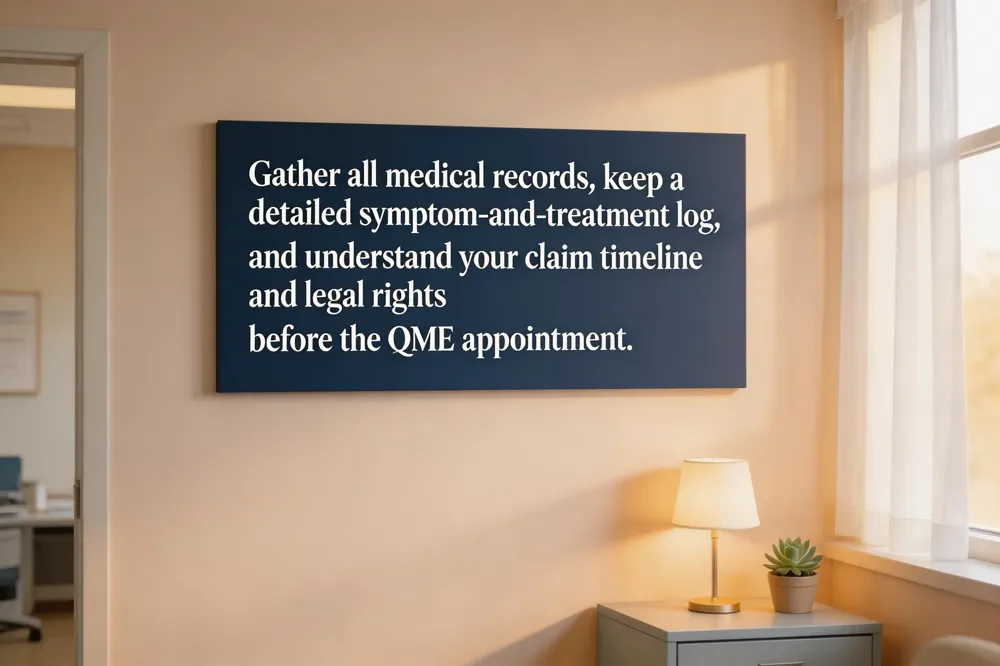 Effective preparation for a Qualified Medical Evaluator (QME) appointment in California hinges on three core actions: gathering all medical records, creating a detailed symptom‑and‑treatment log, and understanding the claim timeline and legal rights.
Gathering all medical records – Bring every doctor’s note, diagnostic imaging (X‑rays, MRIs, audiograms), lab results, and prior independent medical examination (IME) reports. Include the workers’ compensation claim number, the employer’s incident report, and any employer‑provided documents such as the First Report of Injury. A complete file enables the QME to assess the injury history without delays.
Creating a symptom and treatment log – Draft a chronological journal that lists each symptom, its intensity on a 1‑10 pain scale, functional limitations, and secondary effects like anxiety or sleep disturbances. Record every treatment, medication (with dosage and last taken time), therapy session, and any work‑restriction updates. This log serves as objective evidence and helps the QME produce a precise report.
Understanding your claim timeline and legal rights – Know that QME reports are typically issued within 30 days, but challenges can extend this period. In California, the QME’s opinion often carries more legal weight than the primary treating physician’s. Review your rights under state workers’ compensation law, including the ability to select a QME from the state‑provided panel or negotiate an Agreed Medical Evaluator (AME) with counsel.
What to bring to QME appointment
- All relevant medical records (notes, imaging, test results)
- Written symptom list with pain ratings and secondary effects
- Detailed timeline of injury, treatment, and work status changes
- Current medication list with dosages and timing
- Support person or friend for emotional support and witness purposes
What to Expect During the Assessment
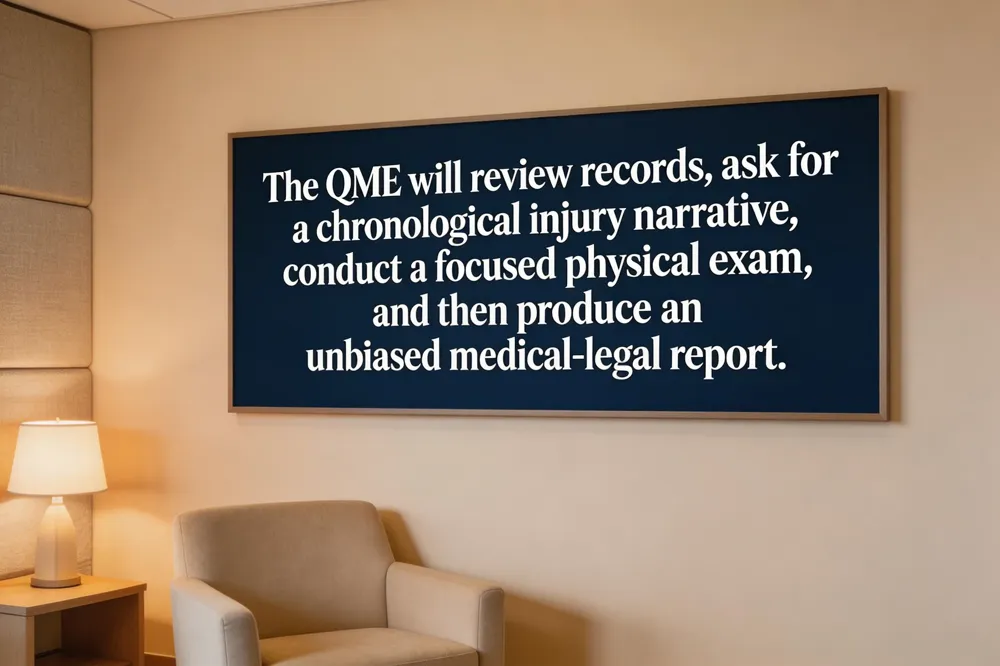 A QME or IME appointment follows a predictable sequence. First, the evaluator reviews the worker’s medical records, the employer’s incident report, and any insurer‑provided summary. Next, the worker is asked to give a concise, chronological account of the injury, including date, time, location, and the activities being performed. The examiner then conducts a focused physical examination of the affected body parts, noting range of motion, strength, pain response, and functional limitations. Throughout the exam the evaluator records observations, asks clarifying questions, and documents any discrepancies between the worker’s narrative and the medical history. After the examination the QME prepares a detailed, unbiased medical‑legal report that includes a disability rating, treatment recommendations, and a causation opinion that will be used in workers’ compensation proceedings.
Key questions typically include:
- Basic identifying information (name, DOB, handedness).
- Exact date and mechanism of injury.
- Description of immediate symptoms and any prior related conditions.
- Pain characteristics (location, quality, aggravating/relieving factors, 0‑10 rating).
- Current functional limitations and which job duties are now difficult.
- Employment details at the time of injury.
Professional demeanor matters. Arrive early, dress appropriately, and remain calm, polite, and honest. Bring a complete symptom journal, all medical records, and a list of medications. Take time‑stamped notes during the session and, if possible, have a trusted witness for documentation. This disciplined approach supports accurate reporting and protects the worker’s claim.
Post‑Assessment: Reports, Timelines and Follow‑Up
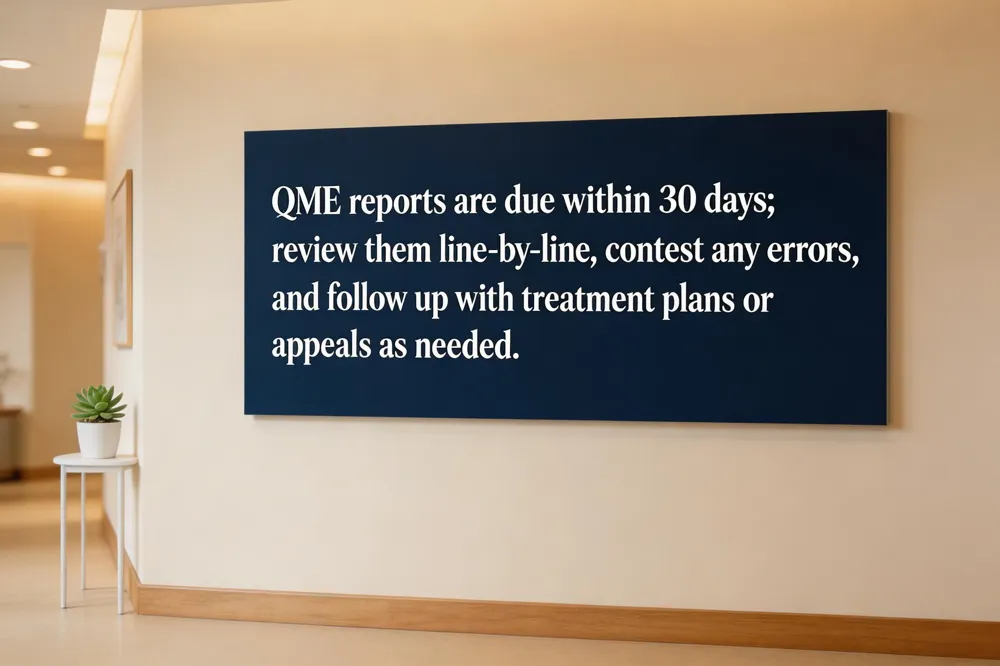 After a California Qualified Medical Evaluation (QME), the physician has 30 days to complete and submit a detailed medical‑legal QME report. That report is mailed to the injured worker, the employer’s insurance carrier, and any attorneys involved in the claim. The findings—including the disability rating and recommended treatment—are not binding; they can be challenged if they contain errors, omissions, or conflicts of interest.
Time frame for QME report issuance – The QME appointment itself typically lasts one to two hours, after which the doctor has up to 30 calendar days to finalize the written report. Delays are common when either party requests supplemental information, a second opinion, or a deposition, but the statutory deadline remains 30 days from the examination date.
How to review and contest a QME or IME report – Upon receipt, read the document line‑by‑line, checking for missing injuries, inconsistent timelines, or inaccurate functional‑capacity statements. If discrepancies exist, you may request a supplemental report, negotiate a settlement, or file an appeal with the Workers’ Compensation Appeals Board. An experienced workers‑comp attorney can help identify legal bases for contesting the opinion and ensure all filing deadlines are met.
Next steps after receiving the report – The report’s disability rating and treatment recommendations guide the next phase of the claim. If you agree, the employer’s insurer will typically approve benefits. If you disagree, you can pursue an Independent Medical Review (IMR) or appeal to the Board. Throughout, maintain a symptom log, keep all medical records current, and stay in communication with your attorney to protect your benefits.
Legal, Safety and Documentation Essentials
 Key OSHA Forms (300, 301, 300A) and Their Role in Claims
OSHA Form 300 logs each recordable injury or illness, while Form 301 provides a detailed incident report for each case. The annual Summary (Form 300A) aggregates these totals and must be posted between February 1‑15. Failure to post can trigger citations and weaken workers’ compensation claims because the summary demonstrates an employer’s transparency about workplace hazards.
Key OSHA Forms (300, 301, 300A) and Their Role in Claims
OSHA Form 300 logs each recordable injury or illness, while Form 301 provides a detailed incident report for each case. The annual Summary (Form 300A) aggregates these totals and must be posted between February 1‑15. Failure to post can trigger citations and weaken workers’ compensation claims because the summary demonstrates an employer’s transparency about workplace hazards.
Hazard Identification Checklists for Auditory Loss A HIRA PDF guides evaluators through noise‑exposure risks, equipment‑related sound levels, and ergonomic factors that contribute to hearing loss. Documenting exposure levels, duration, and protective equipment helps NorCal Medical Consulting substantiate causal links in legal and insurance proceedings.
What Not to Say to an IME or During a Claim
- Never lie about prior injuries, pre‑existing conditions, or downplay the accident.
- Do not exaggerate pain, limitations, or claim abilities.
- Avoid discussing settlement amounts, legal strategy, or advice from counsel.
- Do not refuse legitimate questions or attempt to influence the examiner’s opinion.
- Refrain from seeking treatment advice from the IME; the role is purely evaluative.
Adhering to these guidelines protects credibility, ensures compliance with OSHA reporting, and strengthens the evidentiary foundation of workers’ compensation claims.
Returning to Work and Ongoing Health Management
 After a QME evaluation, the next step is a functional capacity evaluation (FCE) that quantifies what the employee can safely do on the job. The FCE results guide the employer in creating a modified‑duty plan that matches the worker’s current abilities while protecting recovery, especially for injuries such as auditory loss that affect communication and safety. Throughout the return‑to‑work period, the employee should keep a detailed symptom log, track treatment progress, and retain all medical and employer documentation to support any needed adjustments. When meeting the QME, ask the doctor to explain how the injury, including hearing loss, relates to work duties, what functional limitations are expected, the treatment plan and timeline, the criteria for any disability rating, and that the report will capture all symptoms such as tinnitus, balance issues, or anxiety. Consistent monitoring and record‑keeping ensure that accommodations remain appropriate and that any changes in condition are promptly reflected in the workers’ compensation claim.
Final Checklist Before Your Assessment
Before you walk into the evaluation, gather every piece of paperwork the insurer may request: workers’ comp claim number, employer incident report, medical records, imaging studies, medication lists, and any prior audiograms for hearing loss. Double‑check contact information for your employer, claims adjuster, and treating physician so you can provide it instantly. Rehearse a brief story of the incident and practice answering questions with truthful language—avoid exaggeration or speculation. Bring a friend or family member as a witness, and keep a printed copy of the appointment notice and written instructions.