Why a Structured Post‑Injury Checklist Matters
A well‑designed post‑injury checklist ensures strict compliance with workers’ compensation statutes, such as Texas Labor Code §§408.004/408.0041, by prompting timely reporting, proper documentation, and filing of claim forms within statutory windows. It protects employee health and legal rights by requiring medical clearance, HIPAA‑authorized information exchange, and continuous updates on functional limitations, allowing the worker to receive appropriate modified‑duty assignments and avoid premature return that could exacerbate injuries. The checklist also curtails claim expenses; early engagement, documented light‑duty work, and systematic mileage reimbursement reduce indemnity payouts and prevent costly re‑injuries. Finally, it creates a clear communication loop among the employee, employer, treating physician, and claims adjuster, fostering coordinated decisions, transparent expectations, and a smoother, safer transition back to work.
Medical Clearance and Documentation
 A return‑to‑work (RTW) form is a collaborative document that captures the injured employee’s medical restrictions, the treating physician’s fitness‑for‑duty certification, and the employer’s proposed modified duties. By detailing the injury date, job‑task analysis, and allowable activities, the RTW form creates a structured plan that protects the employee’s earning power, satisfies Texas Workers’ Compensation requirements (Labor Code §§408.004, 408.0041; TAC §134.110), and provides the insurer with a clear record for benefit eligibility. The form must be completed promptly after medical clearance and updated as the employee’s condition evolves.
When communicating with workers’ compensation, honesty is paramount. Employees should never lie about prior injuries, exaggerate pain, or claim full recovery before a physician’s clearance. Misrepresentations—such as stating they can return to work early, denying treatment, or providing false medical information—can jeopardize benefits and expose the employee to legal liability. Consistent, truthful updates to the employer, claims adjuster, and treating doctor ensure compliance with legal obligations and support a safe, timely RTW.
Understanding State‑Specific Programs
 How long does it take to get the RTWSP check?
The eligibility decision for the Return‑to‑Work Supplement Program (RTWSP) can take up to 60 days after the Division of Workers’ Compensation receives a complete application. Once approved, the agency typically issues the check within 25 days, so workers may wait as long as 85 days from filing. Most applicants are notified and paid sooner when paperwork is accurate. Status updates are available by email (RTWSP@dir.ca.gov) or phone (510) 286‑0787.
How long does it take to get the RTWSP check?
The eligibility decision for the Return‑to‑Work Supplement Program (RTWSP) can take up to 60 days after the Division of Workers’ Compensation receives a complete application. Once approved, the agency typically issues the check within 25 days, so workers may wait as long as 85 days from filing. Most applicants are notified and paid sooner when paperwork is accurate. Status updates are available by email (RTWSP@dir.ca.gov) or phone (510) 286‑0787.
State of Texas return to work Employers must provide a safe environment, coordinate with treating physicians about restrictions, and may use the RTW Reimbursement Program for workplace modifications. A well‑implemented plan benefits both the employee’s health and the employer’s productivity while supporting related legal and insurance claims.
What if an employer cannot accommodate work restrictions Texas? If a reasonable accommodation would cause undue hardship under Labor Code §21.128, the employer may decline modified duty, but must document the effort and why it is infeasible. The employee then remains eligible for workers’ compensation benefits without a RTW requirement and may pursue ADA accommodations or consult a workers’‑comp attorney to protect rights and explore disability benefits.
Employer Responsibilities and Policies
 A well‑designed workers’‑compensation return‑to‑work (RTW) program is an employer‑driven process that matches an injured employee’s medically‑restricted abilities with suitable light‑duty tasks. By establishing clear eligibility criteria, transitional job descriptions, and a dedicated RTW team—including HR, supervisors, occupational health, and claims adjusters—the program reduces absenteeism, lowers claim costs, and promotes quicker recovery while preserving income and morale.
Key elements of a written RTW policy include: (1) a purpose and scope that apply to all employees returning from workers’‑compensation leave; (2) notification timelines (e.g., five business days before return); (3) required medical clearance and a functional work‑status report (e.g., DWC Form‑073); (4) a process for identifying modified duties through a job‑task analysis; (5) designation of a RTW coordinator or case manager; (6) documentation procedures and confidentiality safeguards; and (7) compliance references to the ADA, FMLA, and state statutes.
Using a policy template ensures consistency across locations and incidents. The template should outline the steps for obtaining physician restrictions, creating a bona‑fide offer of modified work, monitoring progress weekly, and updating the plan as restrictions change. Regular training and annual review keep the policy current and effective, supporting smoother claim resolution and better outcomes for both employees and employers.
Employee Rights and Communication
 Can my employer refuse to let me return to work after injury? Yes—an employer may deny reinstatement when safety or business reasons exist. If a doctor’s clearance lists restrictions that cannot be accommodated or no suitable light‑duty position exists, the refusal must be documented. California requires the employer to first engage in an interactive process for accommodations; an unlawful denial can be challenged via a workers’ comp grievance or attorney.
Can you return to work soon after injury? Yes. Returning before the body is ready can delay healing and raise re‑injury. A physician’s clearance should state when duties may resume and whether a phased return is needed. Begin with light tasks, monitor fatigue, and inform employer.
Do you have to be fully recovered to return? No. A modified‑duty role that fits doctor‑approved restrictions permits return. Coordinate with physician, claims adjuster, and employer to define safe tasks and adjust duties as healing progresses.
Safety and Practical Checklists
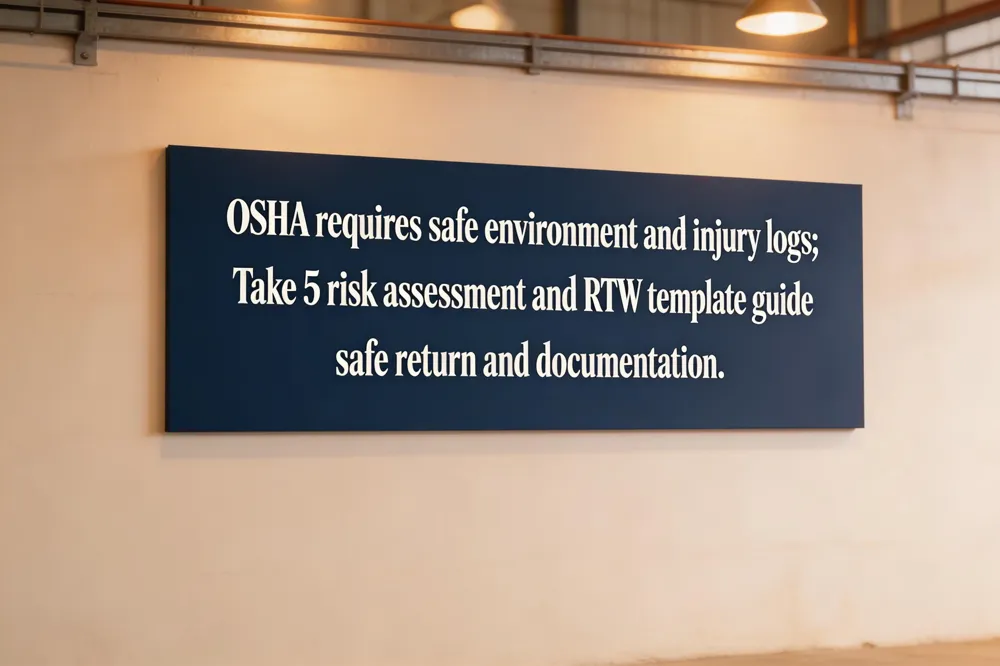 OSHA Record‑Keeping and Safety Requirements OSHA does not set a fixed return‑to‑work timeline; it mandates a safe work environment and accurate injury logs (29 CFR 1904.7). Before regular duties resume, a qualified health professional must clear the employee, and any restrictions must be recorded on the OSHA 300 Log. State workers’ compensation statutes add specific medical‑clearance and accommodation rules. Failure to document or provide safe modified duties can trigger citations.
Take 5 Personal Risk Assessment The Take 5 checklist is a quick pre‑task safety review: (1) stop and observe the work area, (2) walk the task to confirm resources and training, (3) identify hazards, (4) apply hierarchy‑of‑controls measures, and (5) safely complete the task while re‑evaluating risks. It is especially useful for jobs with auditory or other injury risks.
Practical Return‑to‑Work Template A standard template captures employee details, injury description, physician release (medical restrictions, accommodations, earliest safe return date), approved modified duties or phased schedule, and signature blocks for manager, HR, and treating doctor. It also outlines reassessment intervals to adjust restrictions as recovery progresses.
Putting It All Together
A comprehensive return‑to‑work checklist should serve as the master roadmap, capturing every action from immediate injury reporting and medical documentation to the final “Bona Fide” offer of modified duties. Keep all communications— with the, physicians, insurers, and adjusters—transparent, timely, and documented in writing to avoid disputes and protect rights. Engage specialist consultants such as NorCal Medical Consulting to translate physician restrictions into practical job‑task analyses and phased RTW plans that meet both medical and operational needs. Finally, verify that every step complies with Texas Workers’ Compensation statutes, the ADA, FMLA, and OSHA requirements, safeguarding employee health while minimizing legal exposure.