Why Workplace Injury Prevention Matters
Workplace injuries degrade employee health, increase absenteeism, and trigger costly workers’ compensation claims that can erode profit margins and morale. OSHA data show that every seven seconds an injury occurs, translating into billions of dollars in direct medical expenses, indirect productivity losses, and higher insurance premiums. A proactive safety program—rooted in hazard identification, engineering controls, and regular training—reduces these financial and human costs while supporting corporate social‑responsibility goals.
When an injury does occur, expert medical assessments are essential for accurate documentation, causation analysis, and credible testimony in legal and insurance proceedings. Specialists such as NorCal Medical Consulting provide independent, court‑admissible evaluations of conditions like occupational hearing loss, musculoskeletal disorders, and traumatic injuries. Their detailed reports help claimants substantiate damages, assist insurers in claim triage, and guide employers in targeted corrective actions, ultimately fostering a safer, more compliant workplace.
Core OSHA Practices and Monthly Safety Themes
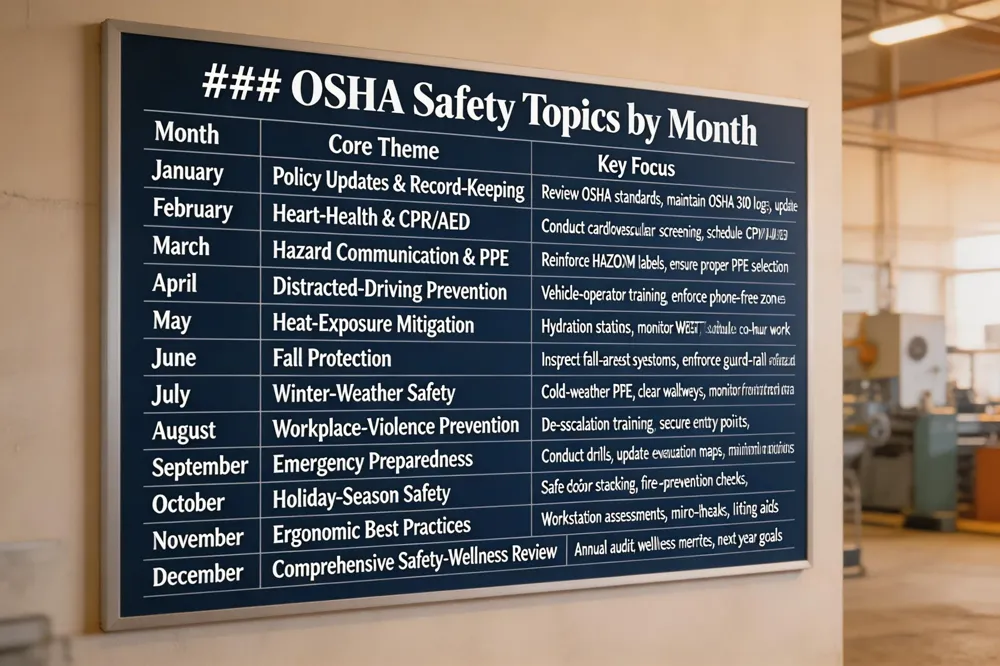
OSHA Safety Topics by Month
| Month | Core Theme | Key Focus |
|---|---|---|
| January | Policy Updates & Record‑Keeping | Review OSHA standards, maintain accurate OSHA 300 logs, update safety policies |
| February | Heart‑Health & CPR/AED | Conduct cardiovascular screening, schedule CPR/AED refresher training |
| March | Hazard Communication & PPE | Reinforce hazard‑communication (HAZCOM) labels, ensure proper PPE selection |
| April | Distracted‑Driving Prevention | Vehicle‑operator training, enforce phone‑free zones, vehicle inspections |
| May | Heat‑Exposure Mitigation | Hydration stations, monitor WBGT, schedule work during cooler hours |
| June | Fall Protection | Inspect fall‑arrest systems, enforce guard‑rail use, conduct fall‑hazard assessments |
| July | Winter‑Weather Safety | Provide cold‑weather PPE, clear walkways, monitor for frostbite/ hypothermia |
| August | Workplace‑Violence Prevention | De‑escalation training, secure entry points, incident reporting protocol |
| September | Emergency Preparedness | Conduct drills, update evacuation maps, maintain emergency kits |
| October | Holiday‑Season Safety | Safe stacking of décor, fire‑prevention checks, increased staffing for fatigue monitoring |
| November | Ergonomic Best Practices | workstation workstation assessments, promote micro‑breaks, provide lifting aids |
| December | Comprehensive Safety‑and‑Wellness Review | Annual program audit, integrate wellness metrics, set goals for next year |
 OSHA’s Recommended Practices for Safety and Health Programs rest on seven core elements—management leadership, worker participation, hazard identification and assessment, hazard prevention and control, education and training, program evaluation, and program improvement. These elements create a proactive safety system that lowers workers’ compensation costs, reduces injury rates, and generates documentation essential for legal and insurance claims.
OSHA safety topics by month – Employers are encouraged to rotate a core safety theme each month. January focuses on OSHA policy updates and accurate record‑keeping; February highlights heart‑health awareness and CPR/AED training; March spotlights hazard communication and PPE use; April targets distracted‑driving prevention for vehicle operators; May addresses heat‑exposure mitigation; June emphasizes fall protection; July covers winter‑weather safety; August tackles workplace‑violence prevention; September reinforces emergency preparedness; October promotes holiday‑season safety; November reviews ergonomic best practices; December concludes with a comprehensive safety‑and‑wellness plan review.
The three C’s of workplace health and safety are Compliance (adhering to regulations), Competence (providing employee training and skills), and Commitment (leadership‑driven safety culture).
The five E’s of accident prevention are Education, Engineering, Enforcement, Encouragement, and Evaluation.
Ten ways to prevent workplace injuries include: implementing a comprehensive safety plan; conducting pre‑placement physicals and ergonomic training; supplying and enforcing proper PPE; maintaining adequate staffing and housekeeping; and continuously monitoring, rewarding, and reinforcing safety performance through regular training and audits.
Quick Safety Briefings: 5‑Minute, 1‑Minute and Short Topics
Sample Toolbox Talk Topics
5‑Minute Talks
| Topic | Core Elements |
|---|---|
| Hearing Conservation | Proper ear‑plug fitting, noise‑level monitoring, early symptom reporting |
| Ergonomic Lifting | Demonstrate safe lift technique, load limits, use of mechanical aids |
| Slip‑Trip‑Fall Prevention | Housekeeping checks, floor signage, proper footwear |
| Heat‑Stress Hydration | Water‑break schedule, recognize heat‑related illness, cooling stations |
| Fatigue Management | Shift rotation, rest breaks, alertness self‑assessment |
1‑Minute Moments
| Hazard | Quick Message |
|---|---|
| Noise Zone | "Wear hearing protection in areas >85 dB(A)" |
| Walkway Obstruction | "Keep aisles clear – report spills immediately" |
| Workstation Height | "Adjust chair and monitor to neutral posture" |
| Fire‑Escape Cue | "Locate nearest exit, keep path clear" |
Short Topics (Bullet‑Point Lists)
- Noise‑monitoring program with signage
- Fit‑tested earplugs/earmuffs training
- Interactive ergonomics toolbox talks
- Written emergency‑response plan with clear evacuation routes
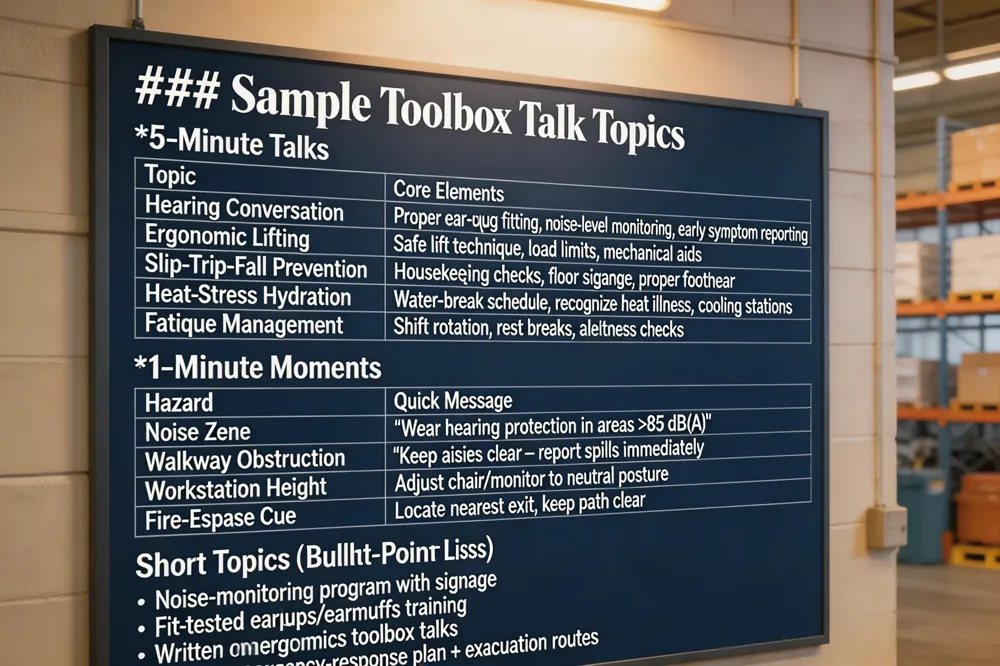 Effective short toolbox talks are a cornerstone of a proactive safety culture and provide the documentation essential for legal and insurance claims. A 5‑minute safety topic should combine hearing‑conservation (properly fitted earplugs, noise‑level monitoring, early reporting of auditory symptoms) with brief ergonomic reminders on safe lifting, slip‑trip‑fall prevention, and workplace hygiene. A 1‑minute safety moment can focus on a single hazard—such as mandating hearing protection in noisy zones, keeping walkways clear to prevent falls, adjusting workstation height, or a fire‑escape cue—while stressing immediate reporting of any injury, no matter how minor.
Short safety topics for work can be delivered as concise 5‑minute talks on noise‑induced hearing loss, ergonomic stretching, heat‑stress hydration, and fatigue management. Five practical ways to prevent hazards and risk include regular hazard assessments, comprehensive training, provision and proper use of PPE, clear safety protocols with a reporting culture, and technology‑driven inspections. Safety suggestions examples encompass a noise‑monitoring program with signage, fit‑tested hearing protectors, periodic audiometric testing, interactive toolbox talks covering ergonomics and fatigue, and a written emergency‑response plan. By integrating these brief, evidence‑based briefings, employers protect worker health, lower injury rates, and generate the objective records needed for expert witness testimony and successful workers’ compensation or personal‑injury claims.
Risk Assessment Foundations, Templates and Practical Examples
Risk‑Assessment Workflow (Template Overview)
| Step | Description | Example Output |
|---|---|---|
| 1️⃣ Identify Hazard | List sources (e.g., noisy machinery >85 dB(A)) | "Press‑machine #3" |
| 2️⃣ Determine Exposure | Who is exposed, duration, frequency | "Operators, 8 hrs/day" |
| 3️⃣ Evaluate Existing Controls | PPE, engineering controls, administrative measures | "Earplugs, quarterly fit‑test" |
| 4️⃣ Rate Risk | Use Probability‑Severity matrix (1‑5) | "Probability 3, Severity 4 → Risk 12 (High)" |
| 5️⃣ Recommend Actions | Hierarchy of controls: Eliminate → Engineer → Admin → PPE | "Install acoustic enclosure, rotate staff, upgrade to earmuffs" |
| 6️⃣ Assign Responsibility & Timeline | Owner, target date | "Safety Manager – 6 months" |
Sample Risk‑Rating Matrix
| Likelihood (1‑5) | Severity (1‑5) | Risk Score (L×S) | Action Level |
|---|---|---|---|
| 1 (Rare) | 1 (Insignificant) | 1 | Accept |
| 2 (Unlikely) | 3 (Minor) | 6 | Monitor |
| 3 (Possible) | 4 (Major) | 12 | Mitigate |
| 4 (Likely) | 5 (Catastrophic) | 20 | Immediate action |
| 5 (Almost Certain) | 5 (Catastrophic) | 25 | Immediate action |
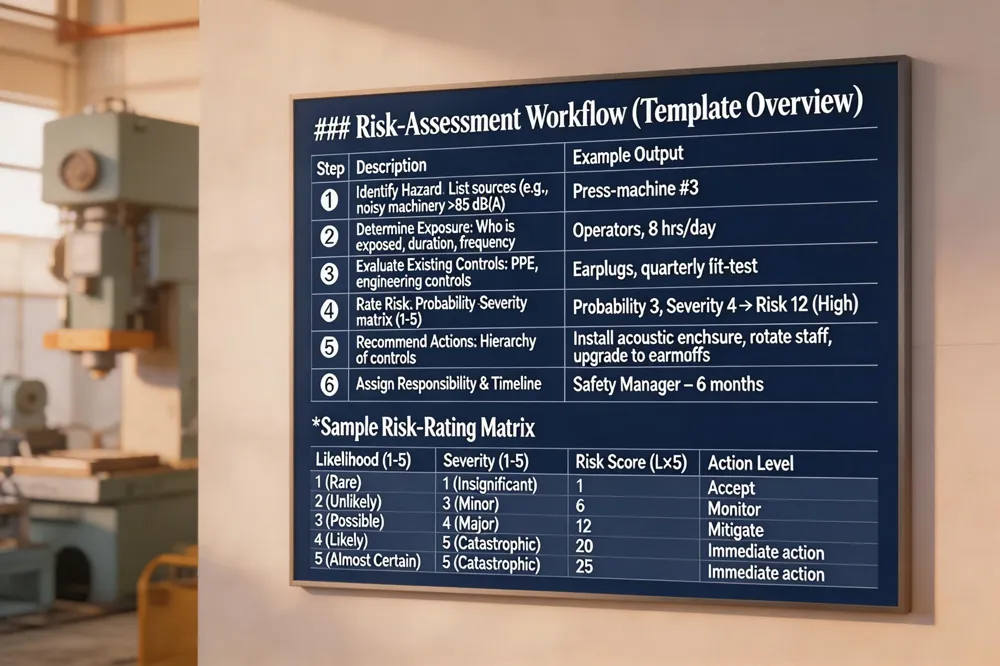 Risk assessment is a systematic process of identifying, evaluating, and prioritizing workplace hazards that could cause injury or illness. It answers three core questions—what could happen, how likely it is, and what the consequences would be—by examining exposure levels such as noise, chemicals, or ergonomic stressors. The findings guide employers in selecting controls from elimination through personal protective equipment, and they provide essential evidence for legal and insurance claims.
A typical auditory‑loss risk‑assessment begins by identifying the noise hazard on a manufacturing floor where machinery exceeds 85 dB(A). Workers who may be exposed are listed, existing controls such as earplugs and noise‑monitoring are recorded, and a risk‑rating matrix evaluates adequacy. Recommended actions often include upgrading to higher‑attenuation protectors, implementing quarterly fit‑testing, and conducting engineering studies to reduce source noise. Responsibility is assigned to the safety manager with a six‑month target date.
Documentation tools that meet OSHA standards include the OSHA risk‑assessment template, a structured worksheet with sections for job description, step‑by‑step tasks, hazard identification, hierarchy of controls, and a risk‑rating matrix. The “Hazard Identification and Risk‑Assessment” PDF provides a repeatable format for recording findings, legal references, and corrective actions. NorCal Medical Consulting uses these templates to create defensible reports that support workers‑compensation and personal‑injury litigation. These practices ensure continuous improvement and compliance across industries.
Safety Rules, Five S System and Everyday Practices
Ten Essential Safety Rules
| # | Rule |
|---|---|
| 1 | Treat safety as a shared responsibility |
| 2 | Wear and inspect PPE before each use |
| 3 | Keep work areas clean, organized, and free of spills or obstructions |
| 4 | Follow established procedures – no shortcuts |
| 5 | Report unsafe conditions immediately |
| 6 | Know emergency protocols and evacuation routes |
| 7 | Use proper lifting, bending, and stretching techniques |
| 8 | Remain sober; avoid impairing substances on the job |
| 9 | Take regular breaks to prevent fatigue |
| 10 | Stay current on policy updates and ask questions when unclear |
The 5 S System (OSHA‑Aligned)
| 5 S | Description |
|---|---|
| Sort (Seiri) | Remove unnecessary items; keep only tools/documents needed |
| Set in Order (Seiton) | Arrange essential items for easy access, label storage |
| Shine (Seiso) | Clean and inspect work areas daily; maintain equipment |
| Standardize (Seiketsu) | Create visual standards (checklists, signage) for the first three steps |
| Sustain (Shitsuke) | Embed the routine into daily habits; conduct regular audits |
Daily Workplace Safety Habits
- Conduct a quick visual inspection each shift
- Wear fitted PPE (include hearing protectors when noise >85 dB)
- Practice ergonomics and micro‑breaks every 60 min
- Stay hydrated and monitor ambient temperature
- Report hazards or near‑misses promptly via the reporting system
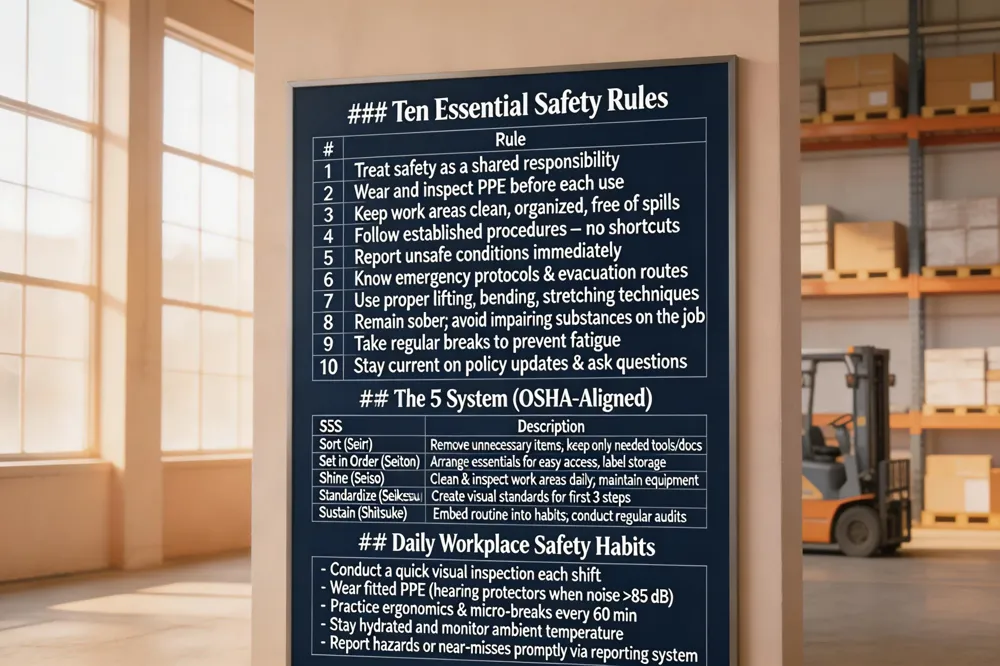 OSHA’s core elements stress that a proactive safety culture—driven by clear rules, worker participation, and regular hazard identification—reduces injuries and lowers compensation costs.
Ten essential safety rules in industry 1) Treat safety as a shared responsibility; 2) Wear and inspect PPE before each use; 3) Keep work areas clean, organized, and free of spills or obstructed exits; 4) Follow established procedures—no shortcuts or untrained equipment use; 5) Report unsafe conditions immediately; 6) Know emergency protocols and evacuation routes; 7) Use proper lifting, bending, and stretching techniques; 8) Remain sober and avoid impairing substances; 9) Take regular breaks to prevent fatigue; 10) Stay current on policy updates and ask questions when unclear.
The 5 S system (OSHA‑aligned) - Sort (Seiri) – remove unnecessary items, keeping only tools and documents needed for the job. - Set in order (Seiton) – arrange essential items for easy access, reducing search time and hazards. - Shine (Seiso) – clean and inspect work areas regularly to prevent accidents and maintain equipment. - Standardize (Seiketsu) – establish consistent procedures and visual cues for the first three steps. - Sustain (Shitsuke) – embed the routine into daily habits, reinforcing a culture of safety.
Daily workplace safety habits Conduct a quick visual inspection each shift; wear fitted PPE (including hearing protectors when noise >85 dB); practice ergonomics and micro‑breaks; stay hydrated and monitor temperature; report hazards or near‑misses promptly. These practices, supported by OSHA‑recommended programs and expert medical assessments, create a safer environment, aid legal and insurance documentation, and improve overall productivity.
OSHA’s core elements stress that a proactive safety culture—driven by clear rules, worker participation, and regular hazard identification—reduces injuries and lowers compensation costs.
Ten essential safety rules in industry 1) Treat safety as a shared responsibility; 2) Wear and inspect PPE before each use; 3) Keep work areas clean, organized, and free of spills or obstructed exits; 4) Follow established procedures—no shortcuts or untrained equipment use; 5) Report unsafe conditions immediately; 6) Know emergency protocols and evacuation routes; 7) Use proper lifting, bending, and stretching techniques; 8) Remain sober and avoid impairing substances; 9) Take regular breaks to prevent fatigue; 10) Stay current on policy updates and ask questions when unclear.
The 5 S system (OSHA‑aligned) - Sort (Seiri) – remove unnecessary items, keeping only tools and documents needed for the job. - Set in order (Seiton) – arrange essential items for easy access, reducing search time and hazards. - Shine (Seiso) – clean and inspect work areas regularly to prevent accidents and maintain equipment. - Standardize (Seiketsu) – establish consistent procedures and visual cues for the first three steps. - Sustain (Shitsuke) – embed the routine into daily habits, reinforcing a culture of safety.
Daily workplace safety habits Conduct a quick visual inspection each shift; wear fitted PPE (including hearing protectors when noise >85 dB); practice ergonomics and micro‑breaks; stay hydrated and monitor temperature; report hazards or near‑misses promptly. These practices, supported by OSHA‑recommended programs and expert medical assessments, create a safer environment, aid legal and insurance documentation, and improve overall productivity.
Comprehensive Prevention Strategies and Continuous Improvement
Hierarchy of Controls & Prevention Strategies
| Control Level | Example Measures |
|---|---|
| Elimination | Remove noisy equipment, redesign work process |
| Substitution | Replace high‑noise tools with quieter models |
| Engineering Controls | Acoustic enclosures, vibration dampening, local exhaust ventilation |
| Administrative Controls | Job rotation, exposure‑time limits, scheduled breaks, training programs |
| Personal Protective Equipment (PPE) | Certified earplugs/earmuffs, anti‑fatigue footwear |
Continuous‑Improvement Cycle
- Plan – Set safety objectives (e.g., reduce hearing‑loss incidents by 20 %)
- Do – Implement controls, conduct training, perform inspections
- Check – Collect data (audit results, injury logs, audiometric trends)
- Act – Adjust program based on findings, update procedures, reward compliance
Key Performance Indicators (KPIs)
- Number of OSHA 300 recordable incidents per quarter
- Percentage of employees completing annual hearing‑conservation training
- Average time to close corrective actions after inspection
- Employee safety‑engagement survey score
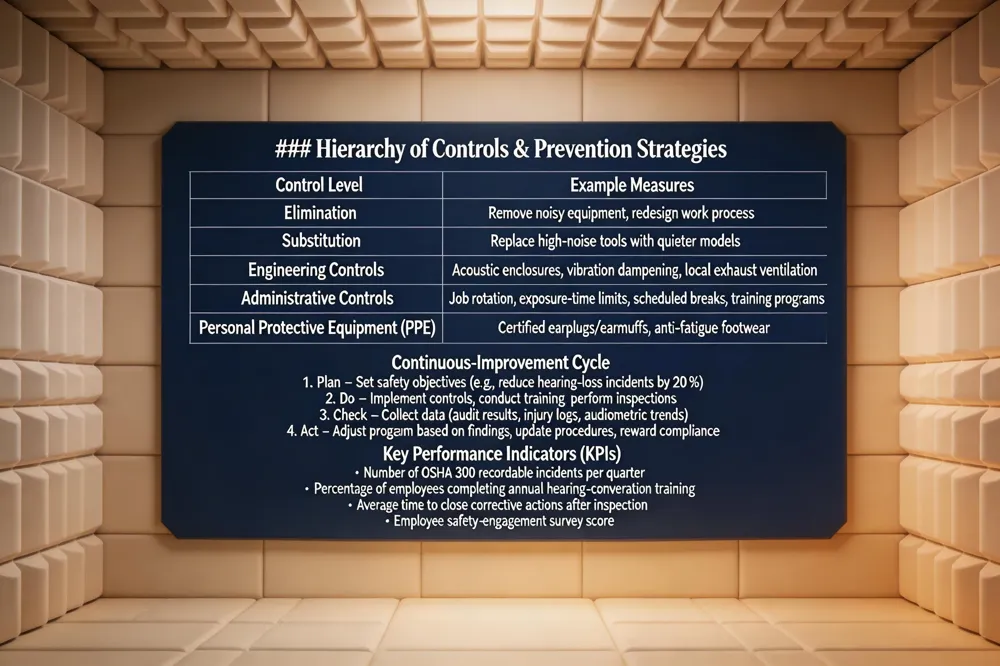 What are injury‑prevention strategies?
Injury‑prevention strategies begin with a systematic safety program that integrates hazard identification, risk assessment, and control measures. Proactive approaches—such as regular workplace inspections, job‑safety analyses, and early audiometric monitoring—detect risks before they cause harm. Engineering controls (e.g., noise‑reducing enclosures), administrative controls (e.g., job rotation, exposure‑time limits), and personal protective equipment (PPE) form the hierarchy of controls recommended by OSHA and NIOSH. Ongoing education, competency‑based training, and reinforcement of safe work practices ensure that workers understand both the “what” and the “why” of each control. Continuous monitoring of performance metrics and periodic audits enable data‑driven adjustments, while documentation of training, inspections, and medical surveillance supports workers’‑compensation and legal claim integrity.
What is the best way to prevent workplace injuries?
The most effective method is a comprehensive safety‑and‑health management system that aligns with OSHA’s seven core elements: leadership commitment, worker participation, hazard identification, prevention and control, education, program evaluation, and continuous improvement. By conducting thorough risk assessments, matching tasks to employee capabilities through pre‑placement physicals, and supplying appropriate PPE, employers address both the source and the exposure. A strong safety culture—reinforced through transparent communication, incentive programs, and leadership modeling—further reduces injury rates and improves morale.
How will you ensure safety in the workplace?
Our approach follows OSHA’s recommended practices, emphasizing auditory health and overall injury prevention. We perform regular site assessments, implement engineering controls (e.g., sound‑absorbing barriers), and deliver targeted training on hearing‑conservation, ergonomics, and emergency response. A confidential reporting system, routine equipment inspections, and periodic program reviews ensure that controls remain effective and that documentation is ready for any legal or insurance claim.
Workplace safety improvement suggestions
Cultivate a safety‑first culture by involving employees in hazard‑identification committees, providing position‑specific training, and rewarding safe behaviors. Conduct scheduled inspections, maintain clean work areas, and partner with occupational health experts—such as NorCal Medical Consulting—to perform expert auditory assessments and support workers’‑compensation litigation.
Hazard prevention and control example
Excessive noise in manufacturing is mitigated first by eliminating or substituting the source. If not feasible, engineering controls (acoustic enclosures, barriers) reduce exposure, followed by administrative controls (rotations, exposure‑time limits). Finally, PPE—earplugs or earmuffs—provides the last line of defense.
Safe working‑environment examples
Implement acoustic enclosures, enforce a hearing‑conservation program with regular audiometric testing, post clear signage of exposure limits, and maintain a reporting system that promptly addresses hazards. These measures not only protect health but also generate robust documentation for workers’‑compensation and court admissibility.
Supporting Documentation, Claims and Continuous Evaluation
Core Documentation Types & Their Uses
| Document | Primary Purpose | Typical Audience |
|---|---|---|
| OSHA 300 Log | Recordable injury/illness tracking | Regulators, insurers, legal counsel |
| Safety‑Management Plan (PDF) | Outline program structure, responsibilities, procedures | Management, auditors, claim attorneys |
| Risk‑Assessment Worksheet | Identify hazards, rate risk, assign actions | Safety officers, supervisors |
| Training Attendance Records | Verify employee competency | HR, auditors, courts |
| Incident Investigation Reports | Root‑cause analysis, corrective actions | Management, insurers, legal teams |
| Medical Surveillance Reports (Audiograms, etc.) | Track health outcomes, support workers‑compensation claims | Occupational health providers, attorneys |
Documentation Workflow for a Claim
- Incident Occurs – Immediate verbal report → complete incident form
- Initial Investigation – Gather witness statements, photos, equipment logs
- Medical Evaluation – Perform exam, obtain audiogram if noise‑related
- Root‑Cause Analysis – Use risk‑assessment worksheet to identify gaps
- Corrective Action Plan – Assign responsibilities, set deadlines
- Record Keeping – Upload all forms, reports, and communications to a centralized system
- Claim Submission – Provide compiled documentation to insurer/legal counsel
- Follow‑Up Review – Audit effectiveness of corrective actions, update SOPs
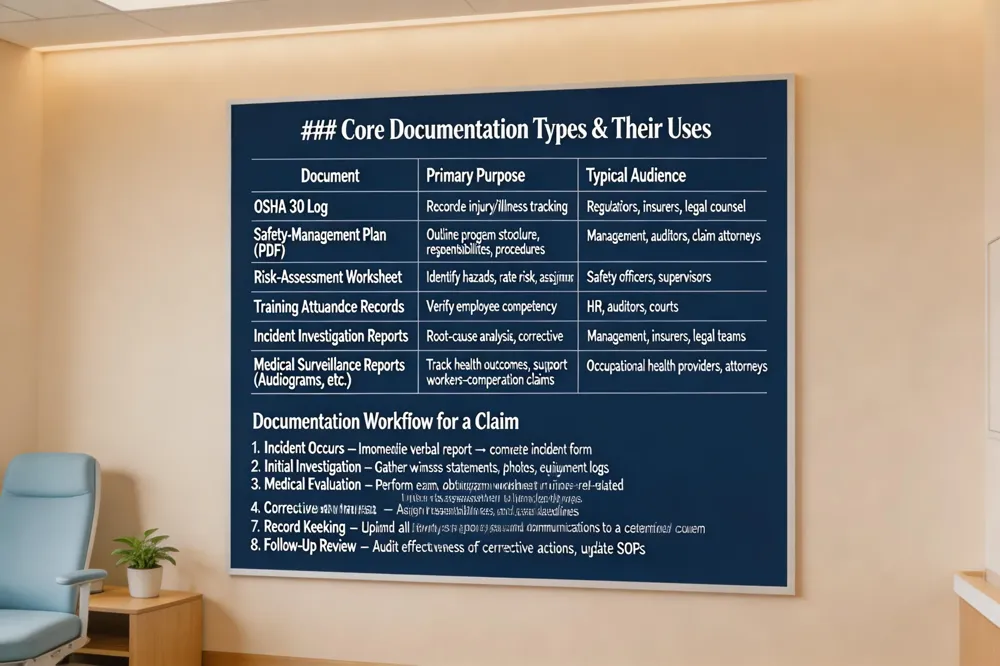 Accident prevention in the workplace (PDF)
The "Accident Prevention in the Workplace" PDF is a comprehensive safety‑management guide that outlines a systematic approach to identifying, assessing, and controlling hazards—from slips and trips to ergonomic and auditory risks. It defines the scope of a prevention plan, assigns clear responsibilities, mandates training and safety meetings, and prescribes incident‑reporting procedures such as the OSHA 300 log. By analyzing log data, hazard‑inspection trends, and worker suggestions, employers can pinpoint recurring injury patterns and implement corrective actions before injuries occur, thereby meeting regulatory requirements, reducing workers’ compensation claims and supporting legal documentation for litigation.
Accident prevention in the workplace (PDF)
The "Accident Prevention in the Workplace" PDF is a comprehensive safety‑management guide that outlines a systematic approach to identifying, assessing, and controlling hazards—from slips and trips to ergonomic and auditory risks. It defines the scope of a prevention plan, assigns clear responsibilities, mandates training and safety meetings, and prescribes incident‑reporting procedures such as the OSHA 300 log. By analyzing log data, hazard‑inspection trends, and worker suggestions, employers can pinpoint recurring injury patterns and implement corrective actions before injuries occur, thereby meeting regulatory requirements, reducing workers’ compensation claims and supporting legal documentation for litigation.
Safety suggestions examples
- Implement regular noise‑level monitoring and post signage in high‑decibel zones.
- Provide fit‑tested earplugs/earmuffs and train staff on proper use.
- Schedule periodic audiometric testing to detect early hearing loss.
- Conduct brief interactive toolbox talks on ergonomics, fatigue management, and equipment safety.
- Develop a written emergency‑response plan with clear evacuation routes and reporting mechanisms.
What are the five E’s of accident prevention? The five E’s – Education, Engineering, Enforcement, Encouragement, Evaluation – are tools to reduce accident risk.
What are the three C’s of workplace health and safety? Compliance, Competence, and Commitment form the pillars of a robust safety culture that protects workers and supports claim documentation.
Risk assessment in occupational health and safety (PDF) A systematic process that identifies, evaluates, and controls hazards—including auditory loss—documented in a PDF guide to ensure regulatory compliance and provide evidence for legal and insurance claims.
Hazard identification and risk‑assessment PDF A structured worksheet that rates hazards using a probability‑severity matrix, records control measures, and creates an actionable safety plan; NorCal Medical Consulting can interpret results to strengthen injury‑assessment and claim‑support processes.
Moving Forward with a Safer Workplace
Implementing a proactive safety program begins with a clear commitment from leadership, followed by systematic hazard identification, risk assessment, and the hierarchy of controls (elimination, substitution, engineering, administrative, PPE). Workers should be actively engaged in safety committees, reporting near‑misses, and receiving regular, role‑specific training on hazard recognition, proper equipment use, and emergency procedures. Continuous monitoring—through inspections, audits, and performance metrics—allows data‑driven adjustments and ongoing improvement.
NorCal Medical Consulting supports these efforts by providing expert medical assessments of occupational injuries, especially auditory loss, that serve as objective, court‑admissible evidence for workers’ compensation and personal injury claims. Their detailed audiograms, injury documentation, and independent opinions streamline claim filing, bolster legal defenses, and help insurers verify causation, ultimately reducing claim costs and accelerating employee return‑to‑work.