Introduction
Multi‑specialty consultation hubs consolidate internal medicine, occupational medicine, audiology, neurology, sports medicine, podiatry and related fields under one roof, allowing a single appointment to address the full spectrum of injuries that arise on the job. Complex workplace cases—such as a construction worker with noise‑induced hearing loss, a shoulder strain, and early‑stage PTSD—require coordinated diagnostics, treatment plans, and documentation that a lone specialist cannot provide. By sharing electronic health records and collaborating in real time, these hubs generate comprehensive medical reports that satisfy both medical and legal standards. The result is a measurable improvement in workers’ compensation outcomes: faster claim resolution, higher approval rates, and reduced overall costs for employers and insurers. Evidence from multiple U.S. clinics shows that integrated care shortens time to return‑to‑work by 20‑30 % and can save $3–$5 for every $1 invested in the hub model.
The Multi‑Specialty Hub Model: Structure and Benefits
Hub Structure & Benefits
| Component | Typical Specialists Involved | Key Function | Measurable Benefit |
|---|---|---|---|
| Clinical Co‑Location | Physicians, Audiologists, Occupational Medicine, Physical Therapy, Mental‑Health, Legal Consultants | Real‑time data sharing on a single EHR | 3‑5× ROI ( $1 spent saves $3–$5 ) |
| Telehealth Extension (Project ECHO model) | Remote Specialists via video/e‑consult | Access for remote workers, compliance with OSHA/NIOSH | Reduces referral delay by 30‑40% |
| Shared Electronic Health Record | All hub providers | Unified patient record, coordinated diagnosis | Cuts claim processing time up to 25% |
| Integrated Reporting | Occupational Med, Audiology, Legal | Single HIPAA‑compliant report for workers’ comp & litigation | Increases claim approval by up to 25% |
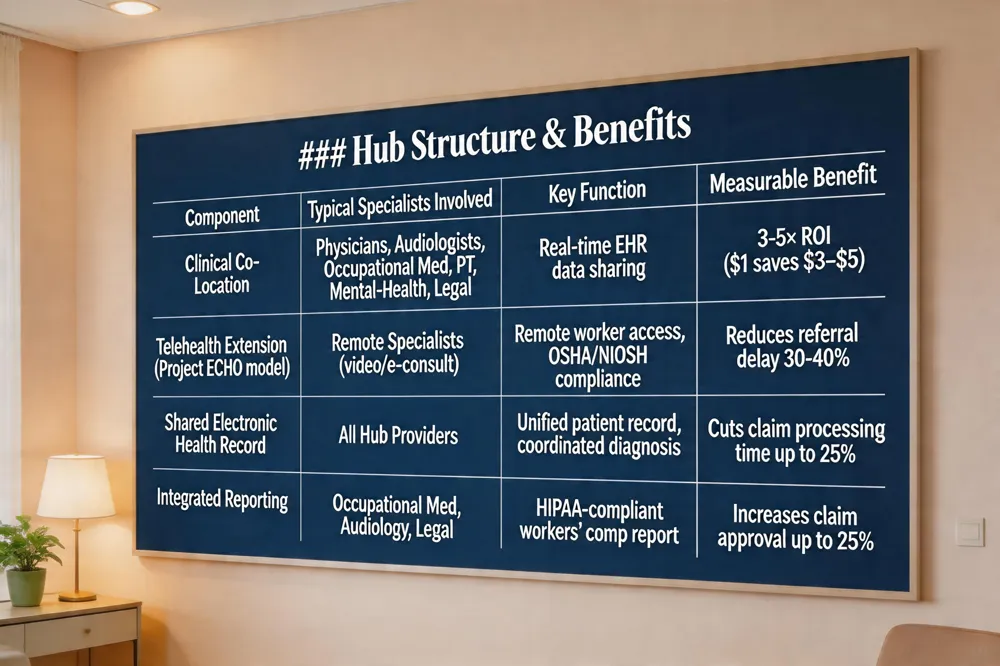 Multi‑specialty consultation hubs bring together physicians, audiologists, occupational medicine experts, physical therapists, mental‑health providers, and legal consultants under one roof. In places such as Ridgewood, NY, the University of Miami Health System’s Doral Commons, and Medcor’s onsite clinics, clinicians from internal medicine, allergy & immunology, neurology, sports medicine, podiatry, and audiology collaborate on a single patient record. This shared electronic health record enables real‑time data sharing, allowing a coordinated diagnosis and a unified treatment plan that addresses comorbid conditions—e.g., noise‑induced hearing loss coupled with musculoskeletal injury—without the delays caused by sequential referrals. Economic analyses from NorCal Medical Consulting and Paradigm show a 3‑to‑5‑fold return on investment, with every $1 spent on hub services saving $3–$5 in downstream medical costs and productivity losses. Telehealth extensions, following the hub‑and‑spoke model pioneered by Project ECHO, let remote workers receive specialist input via video or e‑consultation, expanding access to audiology, orthopedics, and occupational therapy while maintaining compliance with OSHA and NIOSH standards.
What is an injury consultant? An injury consultant (or injury management consultant) guides employers, employees, providers, and insurers through the entire lifecycle of a workplace injury. They coordinate communication, develop personalized recovery pathways, ensure regulatory compliance, and document findings—especially critical for complex cases such as auditory loss—to minimize downtime and control claim costs.
Is it better to go to an ENT or audiologist? For pure hearing‑loss assessment, hearing‑aid fitting, or tinnitus management, an audiologist is the first point of contact. An ENT is consulted when hearing loss is sudden, severe, or accompanied by pain, drainage, facial weakness, or suspected tumors, as they can order imaging, prescribe medication, and perform surgery.
What are the top 5 most common workplace injuries?
- Overexertion (back strain, repetitive motion) 2. Falls, slips, trips 3. Transportation incidents (vehicle collisions, equipment accidents) 4. Burns (heat, chemicals, electricity) 5. Lacerations/cuts from tools or machinery.
Auditory Loss in the Workplace: Evaluation and Legal Implications
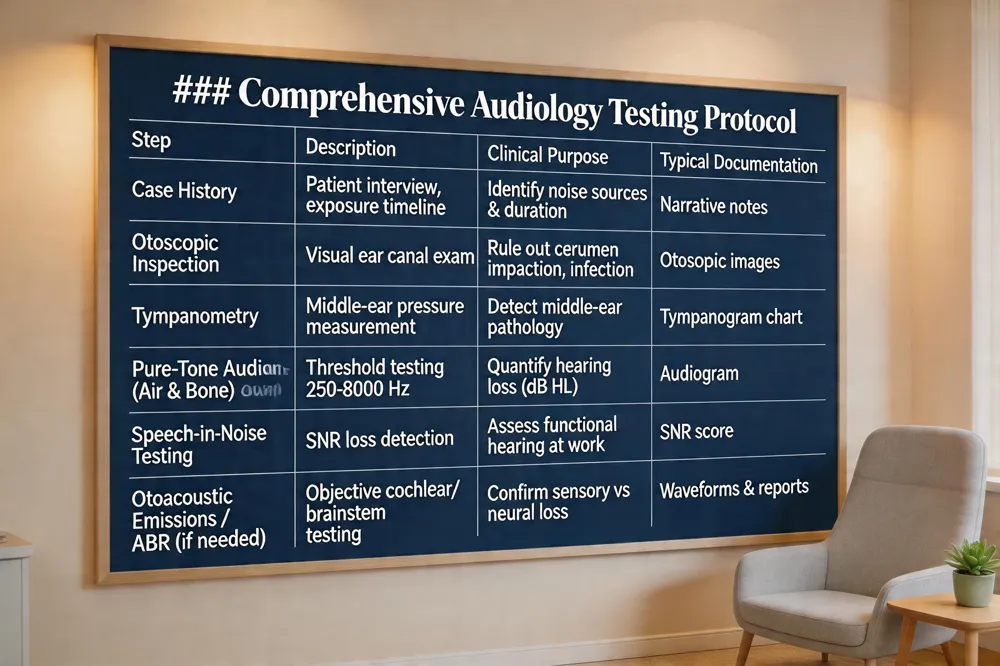
Comprehensive Audiology Testing Protocol
| Step | Description | Clinical Purpose | Typical Documentation |
|---|---|---|---|
| Case History | Patient interview, exposure timeline | Identify noise sources & duration | Narrative notes |
| Otoscopic Inspection | Visual ear canal exam | Rule out cerumen impaction, infection | Otoscopic images |
| Tympanometry | Middle‑ear pressure measurement | Detect middle‑ear pathology | Tympanogram chart |
| Pure‑Tone Audiometry (Air & Bone) | Threshold testing 250‑8000 Hz | Quantify hearing loss (dB HL) | Audiogram |
| Speech‑in‑Noise Testing | SNR loss detection | Assess functional hearing at work | SNR score |
| Otoacoustic Emissions / ABR (if needed) | Objective cochlear/brainstem testing | Confirm sensory vs neural loss | Waveforms & reports |
 Noise‑induced hearing loss (NIHL) is the most common occupational illness in the United States, accounting for roughly 16 % of all reported workplace injuries and affecting an estimated 22 million workers (NIOSH, OSHA). In high‑noise industries—construction, manufacturing, transportation, and hospitality—exposure above 85 dB(A) for an 8‑hour shift triggers mandatory hearing‑conservation programs, and workers are entitled to baseline and annual audiometric testing (OSHA, Cal/OSHA).
Comprehensive audiology testing protocols A full diagnostic work‑up follows a standardized sequence: case history, otoscopic inspection, tympanometry, pure‑tone audiometry (air and bone conduction), speech‑in‑noise testing, and, when indicated, otoacoustic emissions or auditory brain‑stem response studies. The resulting audiogram quantifies threshold shifts in decibels, while speech‑in‑noise scores reflect functional hearing in noisy work environments—critical for establishing causation in workers’‑ claims. Certified audiologists (AuD) perform these tests in compliance with American Academy of Otolaryngology guidelines and U.S. CPT coding requirements, ensuring that each specialist contributes distinct, billable findings.
Audiologists versus ENTs Audiologists specialize in objective hearing measurement, device fitting, and auditory rehabilitation, whereas otolaryngologists (ENTs) evaluate middle‑ear pathology, surgical candidacy, and systemic contributors to hearing loss. In multidisciplinary hubs, audiologists provide the primary audiometric data, while ENTs review the anogram for possible medical or surgical causes (e.g., otitis media, cholesteatoma) before signing off on the definitive diagnosis. This collaborative model—exemplified by the University of Miami Health System’s Doral Commons Clinic and NorCal Medical Consulting—produces more accurate injury assessments and stronger expert testimony.
Documenting injury for workers’ compensation and litigation A legally defensible claim hinges on contemporaneous, objective documentation: baseline audiograms, exposure assessments, and functional capacity evaluations are compiled into a single, HIPAA‑compliant report. Multi‑specialty hubs streamline this process, allowing occupational medicine physicians, audiologists, ergonomists, and legal consultants to co‑author a unified opinion that satisfies both OSHA record‑keeping and insurance underwriting standards. Standardized protocols reduce claim disputes by up to 25 % and accelerate return‑to‑work decisions, while telehealth extensions ensure timely access for remote workers.
How much does a hearing evaluation cost? A hearing evaluation typically costs between $70 and $150 cash, depending on the state and provider setting. In California, the out‑of‑pocket price for an audiologist visit ranges from $90 to $135, while an ENT specialist may charge $123 to $172 for the same service. Insurance coverage varies; most plans reimburse a portion of the evaluation, lowering the patient’s expense. For precise estimates, contact the local clinic and inquire about cash and insurance‑adjusted rates.
What are red flags for doctors? Red flags include physicians who rush appointments, dismiss concerns, or fail to explain diagnoses in plain language. Poor communication—such as not returning calls, withholding test results, or ignoring medication side‑effects—signals a lack of transparency. Unprofessional staff, lack of coordination with other specialists, or outdated practice guidelines further compromise care. If you feel unheard or uncomfortable, seek a provider who prioritizes patient‑centered, interdisciplinary collaboration.
Complex Personal Injury Cases: Coordination Across Specialties
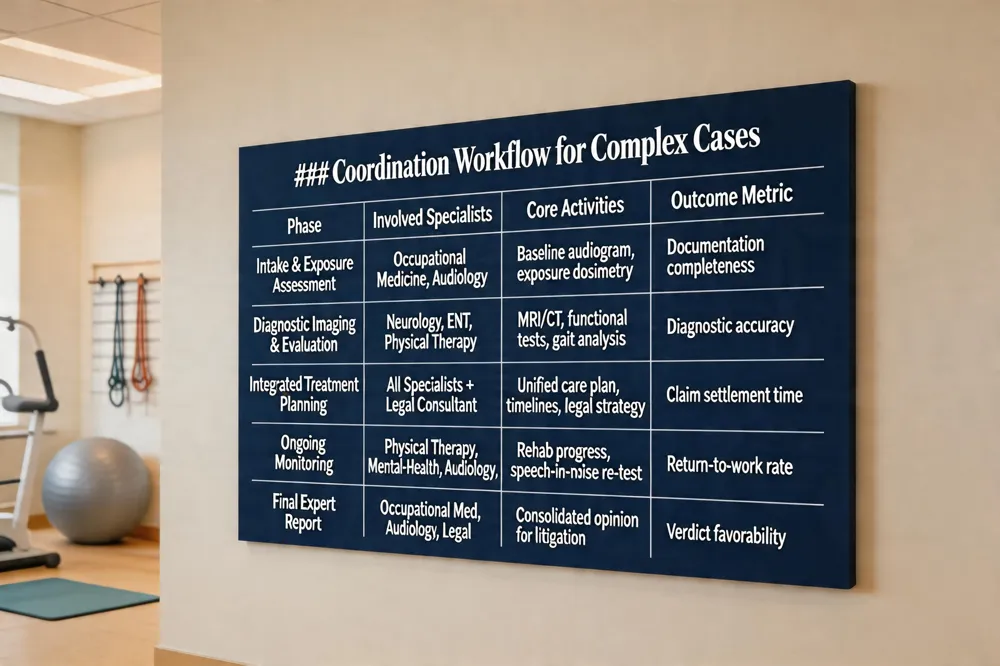
Coordination Workflow for Complex Cases
| Phase | Involved Specialists | Core Activities | Outcome Metric |
|---|---|---|---|
| Intake & Exposure Assessment | Occupational Medicine, Audiology | Baseline audiogram, exposure dosimetry | Documentation completeness |
| Diagnostic Imaging & Evaluation | Neurology, ENT, Physical Therapy | MRI/CT, functional tests, gait analysis | Diagnostic accuracy |
| Integrated Treatment Planning | All specialists + Legal Consultant | Unified care plan, timelines, legal strategy | Claim settlement time |
| Ongoing Monitoring | Physical Therapy, Mental‑Health, Audiology | Rehab progress, speech‑in‑noise re‑test | Return‑to‑work rate |
| Final Expert Report | Occupational Med, Audiology, Legal | Consolidated opinion for litigation | Verdict favorability |
 What is a complex personal injury case?
A complex personal injury case goes beyond a simple slip‑and‑fall or single‑party accident. It typically involves multiple liable parties, catastrophic or permanent impairments, and overlapping medical issues—such as simultaneous auditory loss, musculoskeletal injury, and neurological damage. Because causation and liability are tangled, the case requires detailed expert evaluations, coordinated documentation, and a unified legal strategy to secure a fair settlement or verdict.
What is a complex personal injury case?
A complex personal injury case goes beyond a simple slip‑and‑fall or single‑party accident. It typically involves multiple liable parties, catastrophic or permanent impairments, and overlapping medical issues—such as simultaneous auditory loss, musculoskeletal injury, and neurological damage. Because causation and liability are tangled, the case requires detailed expert evaluations, coordinated documentation, and a unified legal strategy to secure a fair settlement or verdict.
What are the odds of winning a workers' comp case? Approval rates for workers’ compensation claims are high when medical evidence is clear. In California, recent reforms have lifted approval to roughly 94 % of filed claims, while Oregon’s 2022 rate ranged from 86 % to 89 %. Claims that include objective audiometric data for occupational hearing loss, documented by certified audiologists in a multi‑specialty hub, tend to sit at the top of those ranges. Expert testimony and a disciplined claim‑management approach further improve the likelihood of success.
What not to say to a workman's comp doctor? Never lie about prior injuries or pre‑existing conditions, and avoid exaggerating pain or symptoms. Do not suggest you will quit treatment early, nor claim you’re ready to return to work before you truly are. Finally, refrain from offering statements that appear to please the insurer rather than honestly reflecting your health status.
Legal strategy and multidisciplinary expert testimony Multi‑specialty consultation hubs—combining occupational medicine, audiology, neurology, physical therapy, and legal consultants—provide a single, coordinated report. This integrated model speeds claim processing, enhances credibility, and aligns with OSHA and NIOSH guidelines for auditory and musculoskeletal injuries, delivering stronger, defensible evidence for both workers’ comp and third‑party litigation.
Workers’ Compensation Claims: Stress, Bursitis, and Common Injuries
Common Workers’ Comp Injuries & Coordination
| Injury Type | Typical Causes | Primary Specialist | Typical ROI/ROI Impact |
|---|---|---|---|
| Overexertion (back strain) | Repetitive lifting, poor ergonomics | Physical Therapist, Occupational Med | Reduces claim duration by 15‑20% |
| Falls, Slips, Trips | Wet floors, uneven surfaces | Orthopedist, Physical Therapist | Lowers medical costs by 10% |
| Transportation Incidents | Vehicle collisions, equipment accidents | Trauma Surgeon, Physical Therapy | Improves RTW (return‑to‑work) speed |
| Burns (heat, chemicals) | Exposure to hot surfaces, chemicals | Burn Specialist, Occupational Med | Cuts rehab time by 25% |
| Lacerations/Cuts | Tools, machinery | Surgeon, Occupational Med | Decreases wound‑care expenses |
| Stress‑Related Mental Health | Bullying, workload, unsafe conditions | Psychologist, Occupational Med | Increases claim approval by up to 25% |
| Bursitis | Repetitive joint stress, awkward posture | Orthopedist, Physical Therapist | Saves $1,000‑$2,500 per case in imaging & therapy |
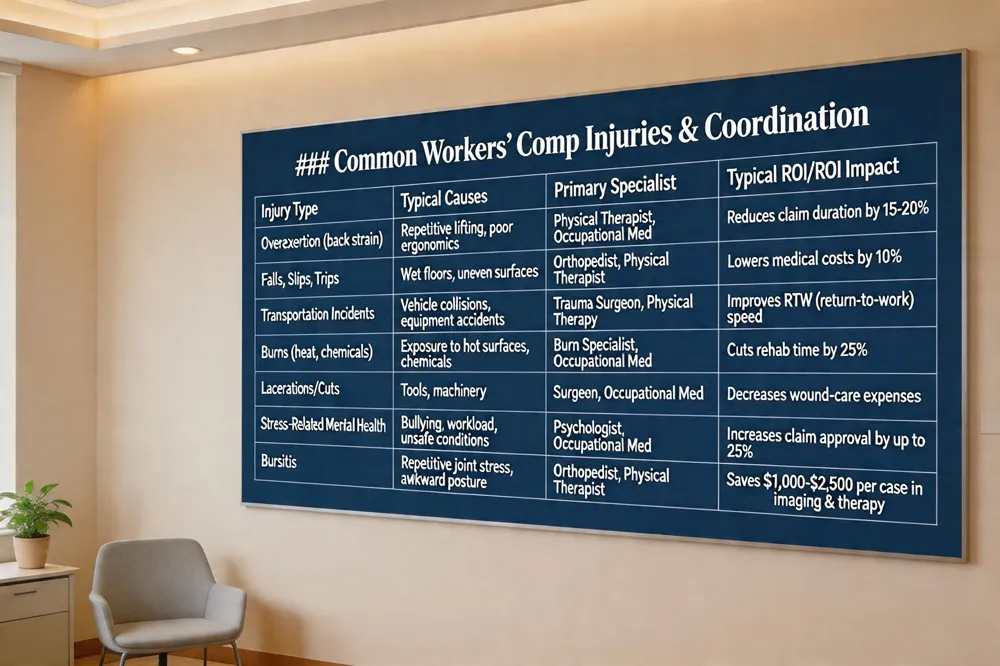 Multi‑specialty consultation hubs have become the backbone of modern workers’ compensation case management. By co‑locating occupational physicians, mental‑health clinicians, physical therapists, and audiologists, these hubs provide a single point of contact for complex claims, reducing referral delays and improving diagnostic accuracy.
Mental‑health claims and workplace stress – Workers who experience excessive workload, bullying, or unsafe conditions can pursue compensation for stress‑related diagnoses such as anxiety or depression. Evidence‑based guidelines from the American College of Occupational and Environmental Medicine recommend early mental‑health screening, and integrated hubs enable rapid referral to psychologists or psychiatrists. A coordinated medical‑legal report that links the stressor to the employer’s negligence significantly boosts claim approval rates and shortens the return‑to‑work timeline.
Bursitis as a compensable occupational injury – Repetitive motion, prolonged pressure on joints, or awkward postures can trigger inflammation of a bursa. When a qualified occupational medicine physician documents that the bursitis is work‑related, workers’ compensation covers wage replacement, imaging, physical therapy, and, when necessary, injections or surgery. Multi‑specialty clinics streamline this process by delivering imaging, physio, and pain‑management services in one visit, cutting down on claim disputes.
Impact on claim approval and return‑to‑work – Integrated care models produce comprehensive, peer‑reviewed reports that satisfy both medical and insurance standards. Studies from NorCal Medical Consulting and Axiom Medical show that early, coordinated evaluations reduce claim processing time by up to 25 % and accelerate return‑to‑work by 15‑20 %, delivering measurable ROI for employers.
Q: Can I claim compensation for stress at work? – Yes. If an employer’s failure to mitigate unreasonable pressure caused a diagnosed mental‑health condition, workers’ compensation may cover medical treatment, wage loss, and rehabilitation. Documentation from mental‑health specialists and a clear causal link are essential.
Q: Is bursitis covered under workers' compensation? – Yes, when the condition results from job‑related activities such as repetitive motion or sustained joint pressure. Prompt reporting, a medical diagnosis linking the injury to workplace duties, and a claim filed with the employer’s insurer are required to obtain wage replacement and medical benefits.
Future Directions: Telehealth, Data Integration, and Employer ROI
Emerging Tech & ROI Metrics
| Technology | Application in Hub | Expected Benefit | ROI Indicator |
|---|---|---|---|
| AI‑Driven Audiometry | Automated threshold analysis, early flagging | Faster detection of NIHL | 10‑15% reduction in permanent loss |
| Real‑Time Noise Dosimetry | Wearable sensors synced to EHR | Continuous exposure monitoring | 5‑7% drop in claim incidence |
| Cloud‑Based HIPAA‑Compliant Portal | Centralized data for all specialists | Seamless interdisciplinary access | 25% faster claim processing |
| Tele‑Rehab Platforms | Video PT, remote speech‑in‑noise testing | Reduce travel, maintain productivity | 15‑20% quicker RTW |
| Integrated Claim Management Software | Auto‑populate legal reports from clinical data | Streamlined documentation | $3–$5 saved per $1 invested |
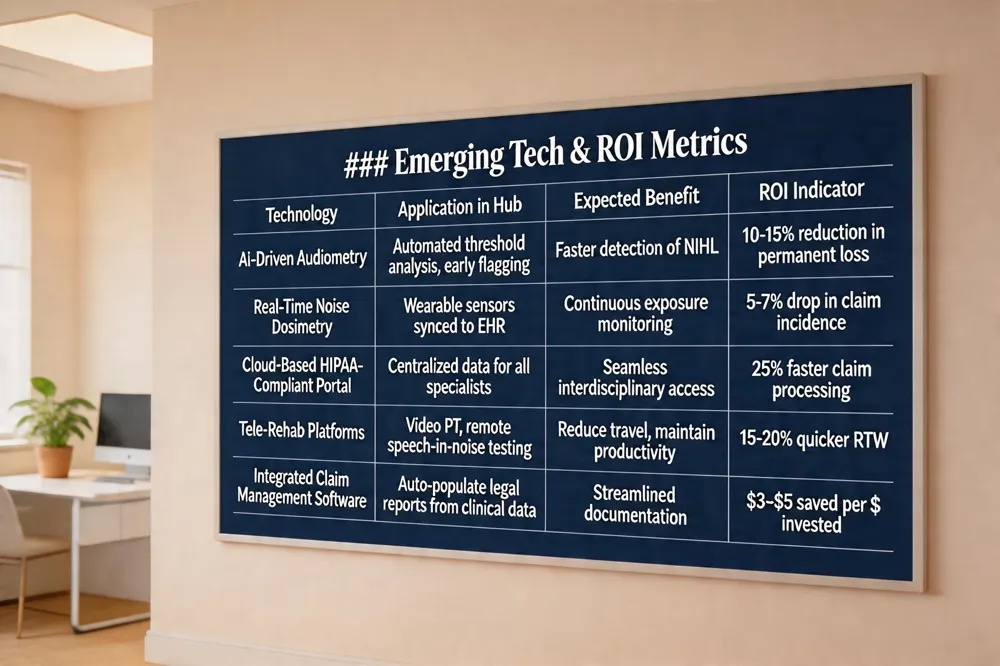 Telehealth extensions are rapidly becoming a core component of multi‑specialty consultation hubs, allowing remote workers to receive real‑time input from audiologists, occupational physicians, and physical therapists without the need for travel. Platforms that support live video, e‑consultation, and remote patient monitoring enable specialists to review audiograms, conduct speech‑in‑noise testing, and adjust rehabilitation plans on the spot, reducing appointment delays and preserving productivity.
Secure electronic health record (EHR) sharing is essential for seamless interdisciplinary collaboration. Hub models now employ HIPAA‑compliant cloud portals that aggregate audiometric data, exposure assessments, imaging studies, and functional capacity evaluations. Real‑time access for clinicians, insurers, and legal counsel speeds claim documentation and ensures regulatory compliance with OSHA and NIOSH standards.
Cost‑benefit analyses consistently demonstrate strong employer ROI. Studies cited by NorCal Medical Consulting and Axiom Medical reveal that every dollar invested in a multi‑specialty hub saves $3–$5 in downstream medical expenses and productivity losses, while integrated case management can shorten return‑to‑work timelines by 15–20 %. Employers also benefit from reduced claim disputes and lower experience modification rates.
Emerging technologies such as AI‑driven audiometry and real‑time noise dosimetry are beginning to augment traditional assessments. Machine‑learning algorithms can flag subtle threshold shifts earlier than manual review, prompting prompt interventions that mitigate permanent hearing loss. As these tools mature, they will further enhance diagnostic accuracy, streamline reporting, and reinforce the financial value proposition for businesses seeking proactive occupational health solutions.
Conclusion
Multi‑specialty consultation hubs streamline the evaluation of complex workplace injuries by uniting internal medicine, audiology, neurology, orthopedics, and legal expertise under one roof. This collaborative model yields faster, more accurate diagnoses, coordinated treatment plans, and stronger, defensible documentation for workers’ compensation and personal‑injury claims. By placing the patient at the center of care—providing a single point of contact, real‑time data sharing, and seamless telehealth options—hubs reduce claim processing time, lower overall medical costs, and improve return‑to‑work outcomes. Employers seeking to curb injury‑related expenses and injured workers aiming for timely, comprehensive care should partner with NorCal Medical Consulting. Their integrated, evidence‑based approach aligns with OSHA, NIOSH, and AMA guidelines, ensuring regulatory compliance while delivering the expert medical and legal support needed for successful claim resolution.