Why Accurate Auditory Evaluation Is Critical for Workers
Occupational hearing loss is rising sharply—NIOSH estimates that 30 million U.S. workers are exposed to hazardous noise, and CDC data show that roughly 24 % of all hearing loss in the country originates at work. This growing prevalence directly influences workers’ compensation and litigation outcomes because insurers and courts rely on objective audiometric evidence to determine causation, impairment rating, and eligible benefits. When assessments are inconsistent or based on outdated decibel cut‑offs, claims can be delayed, denied, or result in inequitable settlements. A standardized, technology‑driven evaluation framework—leveraging AI‑powered audiogram analysis, cloud‑connected portable audiometers, and real‑time dosimetry—produces reproducible thresholds, links exposure data to functional outcomes, and aligns with OSHA and NIOSH documentation requirements. Such precision not only streamlines medicolegal documentation and supports consistent disability ratings but also strengthens the credibility of expert witness testimony, ultimately improving claim resolution for workers with noise‑induced hearing injuries.
AI‑Driven Audiogram Platforms and Boothless Testing
Key Features of AI‑Driven Audiogram Platforms
| Feature | Description | Benefit |
|---|---|---|
| Real‑time cloud‑based threshold testing | Portable AI‑driven audiometers (NIOSH‑approved) transmit data instantly | Immediate results, no lab needed |
| Automatic noise‑floor correction | AI algorithms adjust for ambient noise levels | Accurate thresholds in noisy environments |
| Standardized HL7‑FHIR audiology profiles | Uniform data exchange format | Seamless sharing with providers, insurers, and employers |
| AI flagging of subtle shifts | Machine‑learning models detect small threshold changes | Faster claim documentation, reduced human error |
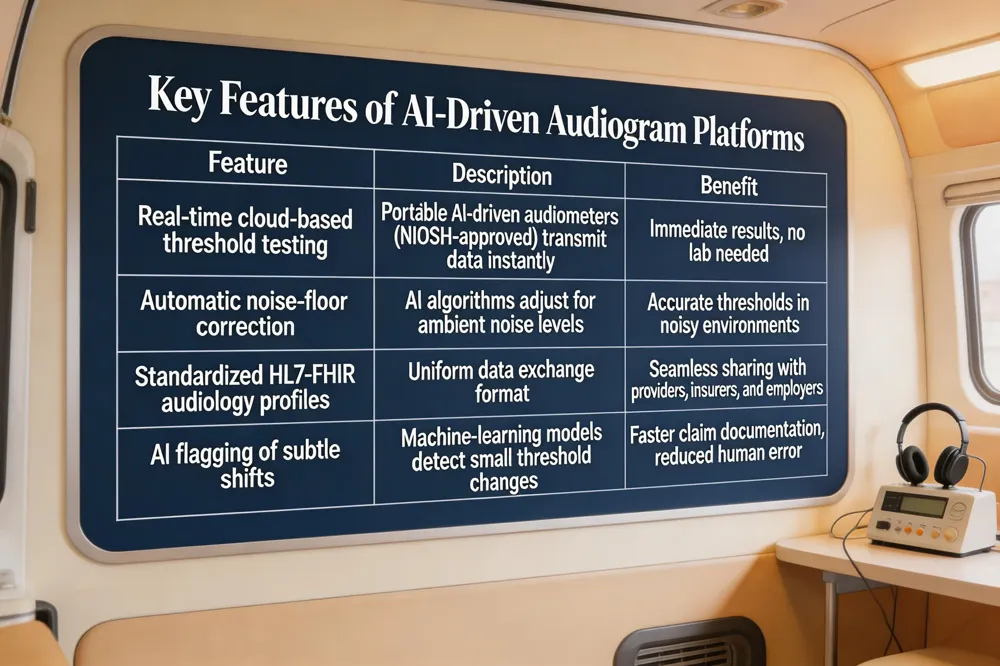 Portable, AI‑driven audiometers (e.g., NIOSH‑approved devices) now provide real‑time, cloud‑based threshold testing with automatic noise‑floor correction, allowing employers to conduct on‑site baseline and follow‑up assessments without a full laboratory setup.
AI‑driven audiogram analysis platforms now automatically flag subtle threshold shifts, reducing human error and speeding up claim documentation.
Standardized digital audiogram formats (e.g., HL7‑FHIR audiology profiles) streamline the exchange of hearing data between employers, healthcare providers, and insurers, improving claim efficiency.
What evidence is needed for a hearing loss claim?
To support a hearing‑loss claim you need solid medical documentation, such as audiometric test results that show the degree of loss, baseline and follow‑up comparisons, and a qualified doctor or audiologist’s diagnosis linking the impairment to workplace noise exposure. You also need workplace records that prove you were exposed to hazardous sound levels, including noise‑level reports or OSHA inspections, job‑duty descriptions of noisy tasks, and any safety‑equipment policies showing whether ear protection was provided or used. Statements from coworkers or supervisors who can confirm the noisy conditions further strengthen the case. Finally, any training logs, safety‑meeting minutes, or incident reports that demonstrate the employer’s failure to mitigate the risk serve as crucial supporting evidence. Together, these medical and occupational documents create a clear, credible link between the job environment and your hearing loss.
Patient‑Centric Staging System for Sensorineural Loss
Hearing Health Collaborative Staging Overview
| Stage | PTA (dB HL) | Word‑Recognition (%) | Sentence Comprehension (%) | Functional Impact |
|---|---|---|---|---|
| 0 (Normal) | ≤ 15 | ≥ 80 (quiet) | ≥ 80 (quiet) | No impact |
| 1 (Mild) | 16‑25 | ≥ 80 | ≥ 80 (quiet) | Early occupational productivity dip, risk of depression |
| 2 (Moderate) | 26‑40 | 60‑79 | 60‑79 (noise) | Cognitive‑decline markers, fall risk, measurable work impairment |
| 3 (Mod‑Severe) | 41‑55 | 40‑59 | 40‑59 (noise) | Depressive disorder risk, social isolation, specialist referral |
| 4 (Profound) | ≥ 56 | < 40 | < 40 (noise) | Severe disability, high fall risk, major occupational limitation |
Note: A 15 dB shift sits at the upper edge of normal hearing (Stage 0) but may be critical for early‑stage claim documentation.
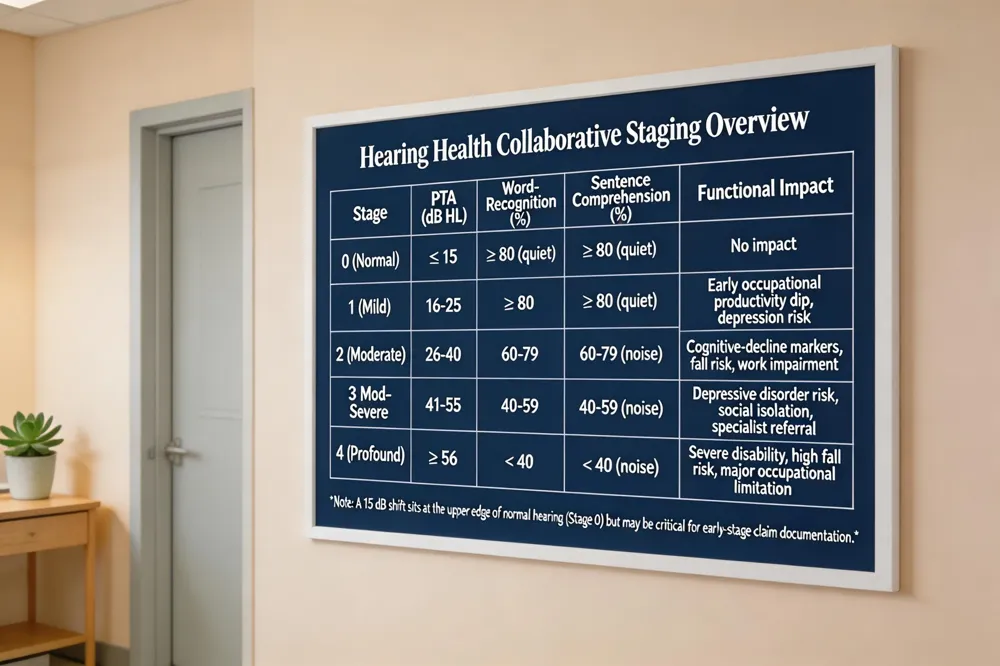 The Hearing Health Collaborative’s (HHC) patient‑centric staging framework anchors each of four numeric stages (0‑4) to concrete audiometric and functional thresholds. Primary diagnostic variables are a four‑frequency pure‑tone average (PTA), word‑recognition scores, and sentence‑in‑quiet/noise comprehension. Stage 0 represents normal hearing (PTA ≤ 15 dB HL) with no functional impact. Stage 1 (mild) is defined by PTA 16‑25 dB HL, word‑recognition ≥ 80 % and sentence comprehension ≥ 80 % in quiet; early risk of depression and reduced occupational productivity begins to emerge. Stage 2 (moderate) ( PTA 26‑40 dB HL, word‑recognition 60‑79 % and sentence comprehension 60‑79 % in noise, correlating with measurable cognitive‑decline markers, increased fall risk, and measurable work‑performance impairment. Stage 3 (moderately severe‑severe) ( PTA 41‑55 dB HL, word‑recognition 40‑59 % and sentence comprehension 40‑59 % in noise) signals high probability of depressive disorder, social isolation, and substantial occupational limitation, prompting specialist referral and aggressive rehabilitation. Stage 4 (profound) ( PTA ≥ 56 dB HL, word‑recognition < 40 %, sentence comprehension < 40 % in noise) reflects severe functional loss, high fall risk, and major occupational disability, requiring comprehensive multidisciplinary management and potential workers‑compensation claim support.
15 dB hearing loss – A 15 dB shift sits at the upper edge of the normal hearing range (–10 to 15 dB HL). It is typically imperceptible in daily life, affecting only the quietest sounds (e.g., a soft whisper). While not classified as slight (16‑25 dB) or mild (26‑40 dB) loss, documenting a 15 dB change can be critical in occupational injury claims to establish early‑stage auditory damage and trigger preventive interventions.
AI‑Powered Hearing Aids and Integrated Health Monitoring
Starkey Omega AI – Core Capabilities
| Capability | Technical Detail | Occupational Relevance |
|---|---|---|
| Speech clarity boost | Up to 28 % clearer speech via G3 Gen AI Neuro Processor | Improves communication in noisy sites |
| DNN 360 acoustic scene analysis | 360‑degree real‑time processing, spatial cue preservation | Reduces background noise for workers |
| BLE Audio & Auracast™ broadcasting | Low‑power multi‑device streaming | Enables remote clinician adjustments via TeleHear AI |
| Integrated sensors | Balance‑builder, respiratory‑rate tracking | Monitors fall risk and cardiovascular health linked to hearing loss |
| Market penetration | ~23 million U.S. adults (≈ 12 % of adult population) wear hearing aids | Highlights need for data‑driven occupational assessments |
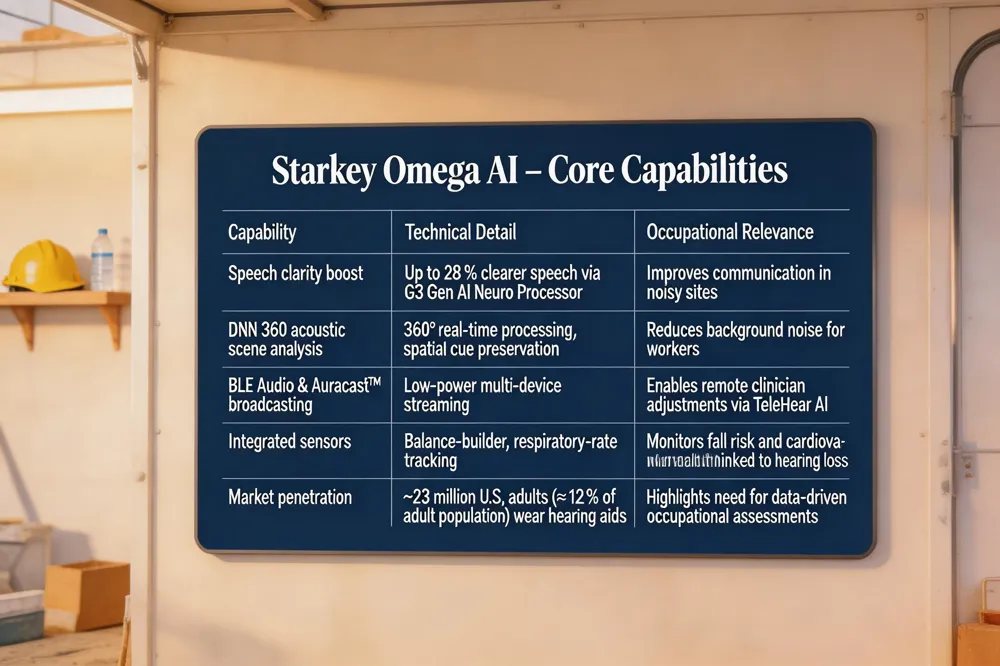 The Hearing Health Collaborative's new staging framework for occupational hearing loss dovetails with advances in AI‑enabled hearing aids that are reshaping workers’ compensation evaluations. Starkey’s Omega AI incorporates a G3 Gen AI Neuro Processor that delivers up to 28 % clearer speech and processes sound four times faster than prior models. Its DNN 360 engine analyzes the full 360‑degree acoustic scene in real time, preserving spatial cues while suppressing background noise—crucial for workers in noisy industrial settings. Bluetooth® Low Energy Audio and Auracast™ broadcasting enable low‑power, multi‑device streaming to smartphones, TVs, and public venues, allowing clinicians to conduct remote, generative‑AI‑driven adjustments via TeleHear AI without in‑office visits. Integrated balance‑builder sensors and respiratory‑rate tracking add health‑monitoring dimensions that directly address fall‑risk and cardiovascular concerns linked to untreated hearing loss. Approximately 23 million U.S. adults—about 12 % of the adult population—currently wear hearing aids, underscoring the need for expert, data‑driven assessments when occupational auditory injury claims arise.
Occupational Noise Surveillance, Standards, and Age‑Related Trends
Noise Exposure & Age‑Adjusted Thresholds
| Parameter | Value/Formula | Application |
|---|---|---|
| OSHA Action Level | 85 dBA TWA (8 hr) | Triggers hearing‑conservation program |
| NIOSH Recommended Exposure Limit | 85 dBA for 8 hr (5 dBA exchange) | More protective than OSHA |
| Cumulative‑fraction dose (D) | D = Σ (Cᵢ / Tᵢ) | Calculates mixed‑level noise dose |
| Age‑related PTA norms | 18‑30 yr: 0‑20 dB; 40‑49 yr: 20‑30 dB; 60‑yr: 30‑40 dB; >70 yr: >40 dB | Adjusts interpretation of occupational audiograms |
| Standard Threshold Shift (STS) | ≥ 10 dB change at 2, 3, or 4 kHz in either ear | Documented for claim evidence |
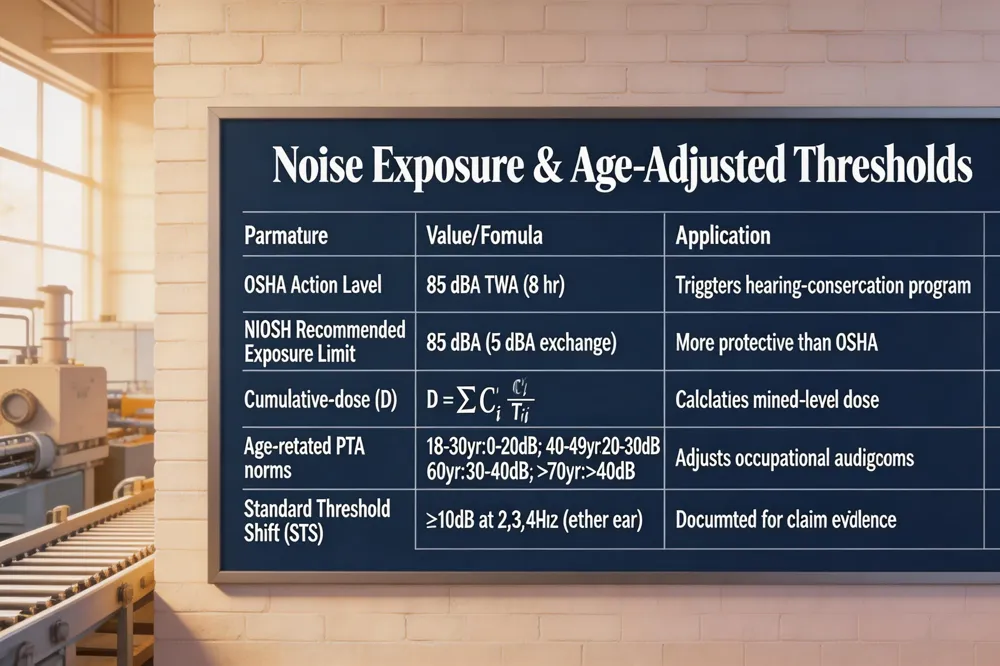 NIOSH’s Occupational Hearing Loss Surveillance Program aggregates millions of de‑identified audiograms and uses the NAICS coding system to pinpoint high‑risk sectors such as construction, manufacturing, mining, and agriculture. The program’s real‑time, cloud‑connected audiometers and AI‑driven threshold‑shift detection enable faster identification of standard threshold shifts (STS) and support medicolegal documentation. OSHA requires a hearing‑conservation program when an 8‑hour time‑weighted average (TWA) exposure meets or exceeds 85 dBA (the "action level") or a cumulative‑fraction dose of 50 percent (29 CFR 1910.95). The cumulative‑fraction formula, [D = \frac{C_1}{T_1} + \frac{C_2}{T_2} + \dots], where C is the measured level and T the permissible exposure time, is used to evaluate mixed‑level noise exposures and to calculate dose for both OSHA (3 dBA exchange) and the more protective NIOSH (5 dBA exchange) limits. Age‑related threshold shifts follow a predictable pattern: young adults (18‑30 yr) typically record 0‑20 dB, mid‑40s rise to 20‑30 dB, 60‑year‑olds reach 30‑40 dB, and those over 70 commonly exceed 40 dB, reflecting mild to severe loss. These age‑adjusted norms are essential when interpreting occupational audiograms and determining the causality of hearing impairment in workers’‑ claims.
Legal Framework, Compensation, and Claim Strategy
Claims Process & Compensation Highlights
| Step | Requirement | Typical Outcome |
|---|---|---|
| Medical Diagnosis | Audiometric evidence linking loss to workplace noise | Basis for claim eligibility |
| Documentation | Baseline & follow‑up audiograms, OSHA noise logs, PPE records | Supports causation and damages |
| Filing Deadline | Usually 3 years from diagnosis/discovery (state‑specific) | Timely filing preserves rights |
| Compensation Types | Medical costs, hearing‑aid devices, tinnitus treatment, disability benefits | Varies by degree of permanent threshold shift |
| Settlement Range (U.S.) | $20‑40 k (moderate loss) up to $100 k+ (severe bilateral) | Guides negotiation expectations |
| Expert Testimony | Quantitative staging, AI‑driven analysis, exposure modeling | Critical for both workers’ comp and civil suits |
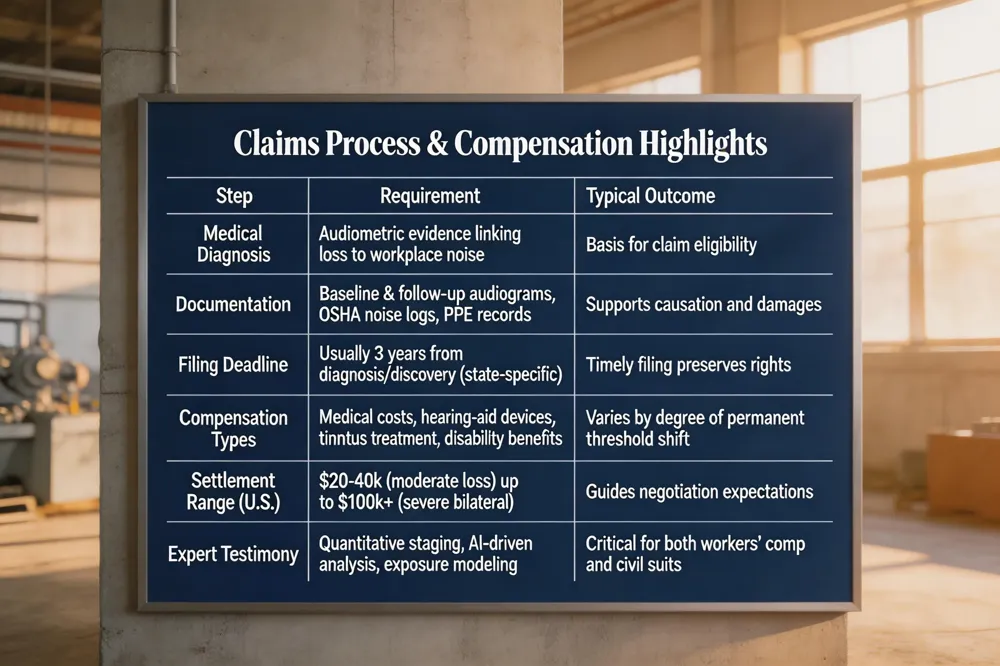 In the United States, workers’ compensation provides a statutory vehicle for employees who develop occupational hearing loss. To be eligible, a claimant must first obtain a medical diagnosis that links the loss to workplace noise exposure, then file a claim within the state‑specific deadline—typically three years from the date of diagnosis or discovery. Documentation such as baseline audiograms, OSHA‑mandated noise‑monitoring records, and employer‑provided hearing‑protection logs is essential. When the claim is accepted, benefits may cover medical expenses, hearing‑aid devices, batteries, servicing, and, in many jurisdictions, tinnitus treatment. Economic compensation is calculated on the degree of permanent threshold shift, age, and occupational impact, while non‑economic damages address pain, suffering, and reduced quality of life.
If workers’ compensation does not fully address the injury, a civil lawsuit can be pursued. A hearing‑loss lawsuit is a civil claim in which the plaintiff must prove that the employer’s failure to maintain a safe acoustic environment caused permanent auditory impairment. The elements of such a claim include (1) duty of care, (2) breach of that duty (e.g., inadequate hearing‑protection programs, non‑compliance with OSHA 29 CFR 1910.95), (3) causation demonstrated by audiometric trends, exposure‑dose data, and expert testimony, and (4) damages. Settlements often combine medical cost reimbursement with lost‑wage calculations and, where negligence is egregious, punitive damages.
Expert testimony is a linchpin in both workers’ compensation and civil actions. Firms like NorCal Medical Consulting provide quantitative assessments—using four‑frequency PTA, word‑recognition scores, and speech‑in‑noise testing—to assign a numeric stage to the loss, mirroring chronic‑disease staging models. These expert reports can be cross‑referenced with NIOSH surveillance data, AI‑driven audiogram analysis, and exposure‑prediction models (e.g., multimodal risk models with AUC > 0.80) to substantiate causation and forecast future impairment.
Settlement calculations typically reference state compensation tables; for example, California’s Schedule of Benefits assigns a dollar value per decibel of permanent loss and translates it into a Whole‑Person Impairment percentage that determines weekly disability benefits. National averages for workplace hearing‑loss claims range from $20,000 to $40,000 for moderate loss, while severe bilateral loss can exceed $100,000. Accurate, expert‑driven documentation is therefore critical to achieving a fair settlement and ensuring that workers receive the full spectrum of entitled benefits.
Clinical Evaluation of Unilateral Hearing Loss
Diagnostic Workflow for Unilateral Loss
| Test | Purpose | Typical Findings |
|---|---|---|
| Pure‑tone Audiometry | Baseline thresholds per ear | Identify sensorineural pattern in affected ear |
| Speech‑in‑Noise Testing | Functional hearing in realistic settings | May reveal disproportionate difficulty on affected side |
| Tympanometry & OAE | Assess middle‑ear status | Rule out conductive contributions |
| Imaging (MRI/CT) | Detect retrocochlear pathology (e.g., acoustic neuroma) | Critical for sudden, unilateral loss |
| AI‑dr Documentation Baseline Recording | Timestamped, cloud‑stored audiograms | Strengthens causation evidence for claims |
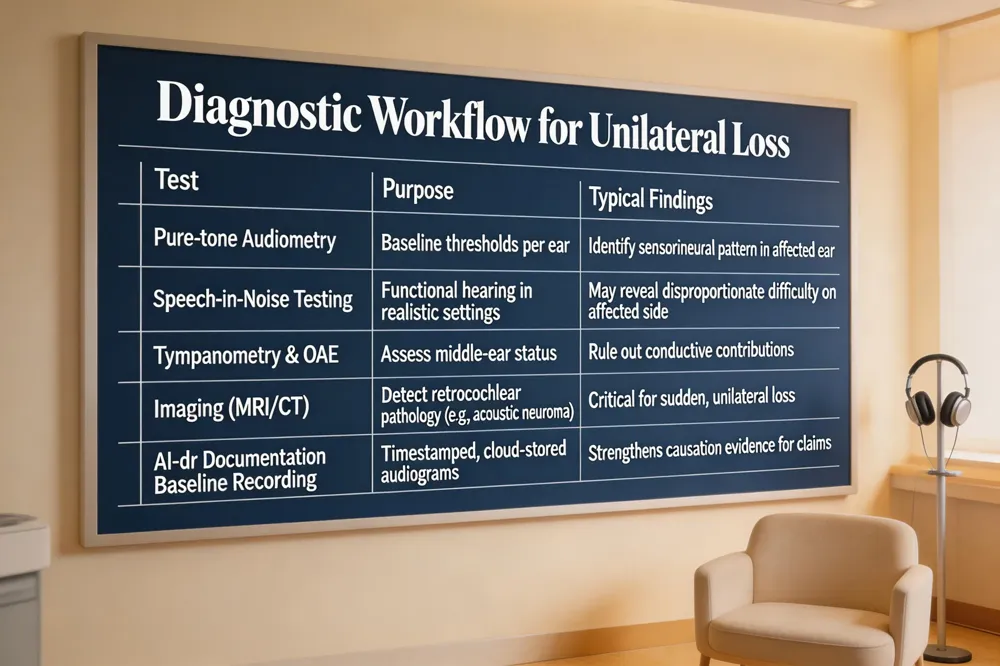 Unilateral hearing loss—loss of hearing in one ear—commonly stems from acoustic trauma (e.g., a sudden loud explosion), sudden sensorineural hearing loss, middle‑ear pathology, acoustic neuroma, or neural injury. In occupational settings, high‑intensity noise or head trauma are frequent precipitants. A comprehensive work‑up begins with pure‑tone audiometry and speech‑in‑noise testing , followed by tympanometry and otoacoustic emissions to rule out middle‑ear dysfunction. When audiograms reveal a sensorineural pattern, high‑resolution imaging (MRI/CT) assesses retrocochlear lesions. Early, AI documentation of baseline thresholds, exposure logs, and contemporaneous medical notes is vital for workers’ compensation and litigation, as it establishes causation and severity. NorCal Medical Consulting can coordinate these evaluations and produce expert reports that meet legal standards for claim substantiation.
Emerging Molecular and Cellular Therapies
Regenerative Approaches in Hearing Loss
| Modality | Mechanism | Current Clinical Status |
|---|---|---|
| Gene Therapy (AAV vectors) | Deliver functional copies of defective cochlear genes | Early‑phase trials show restored mechanotransduction |
| Stem‑Cell Progenitor Injection | Differentiate into hair‑cell‑like or neuronal cells | Pre‑clinical to Phase I studies ongoing |
| CRISPR‑Based Editing with Nanocarriers | Precise correction of pathogenic mutations | Demonstrated safety in animal models, moving toward human trials |
| Combination Therapies (e.g., gene + pharmacologic) | Synergistic restoration of hair‑cell function | Investigational, promising for disease‑modifying outcomes |
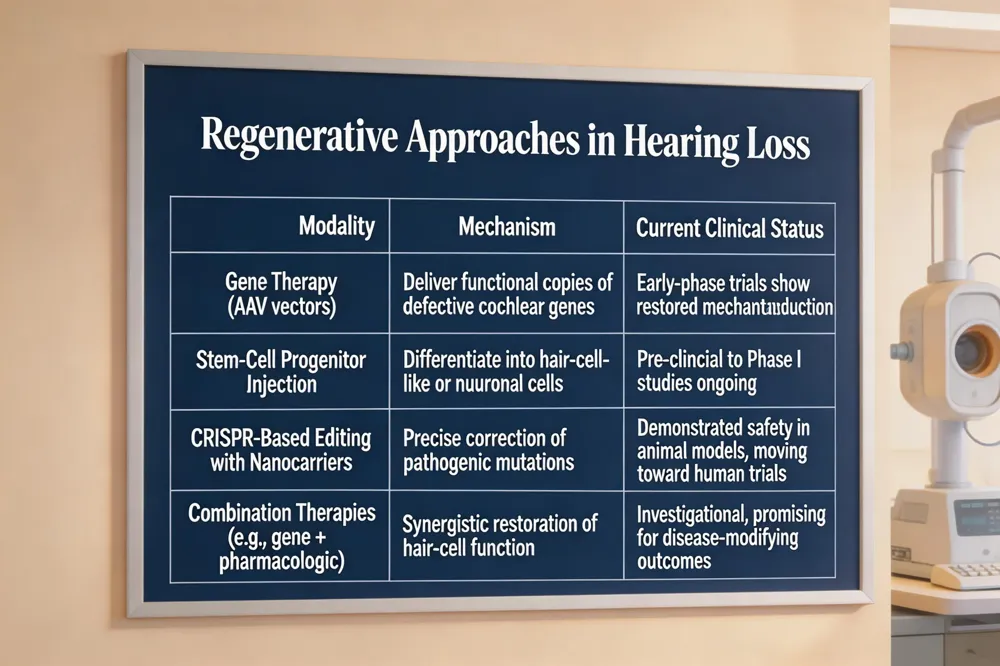 Recent advances in hearing‑loss treatment shift focus from amplification to regeneration of inner‑ear structures. Gene‑therapy vectors, such as adeno‑associated viruses, deliver functional copies of defective genes directly to cochlear hair cells, restoring mechanotransduction and improving speech perception. Stem‑cell progenitor injections introduce donor‑derived auditory progenitor cells into the scala tympani, where they differentiate into hair‑cell‑like or neuronal phenotypes, offering a biological replacement for damaged tissue. CRISPR‑based editing, paired with nanocarrier delivery systems, enables precise correction of pathogenic mutations while minimizing immunogenicity, and can be administered via minimally invasive intracochlear injections. Together, these modalities promise disease‑modifying outcomes for sensorineural hearing loss, supporting more robust medical evaluations and strengthening expert testimony in occupational injury and compensation cases.
Global Perspective and Future Directions
Future Trends in Occupational Hearing Health
| Trend | Description | Implication for Compensation |
|---|---|---|
| WHO 2050 Projection | 2.5 billion people with hearing loss; $1 trillion economic impact | Heightened public‑health focus, potential policy changes |
| Predictive Modeling (AUC > 0.80) | Integrates audiograms, age, exposure, genetics | Early risk identification, proactive interventions |
| WHO HearWHO & “WHOears” Mobile Tools | Smartphone‑based screening and monitoring | Scalable occupational screening, data collection for claims |
| Standardized 0‑4 Staging System | Numeric framework for severity | Uniform disability ratings across jurisdictions |
| Tele‑Audiology & Remote AI Adjustments | Cloud‑based hearing‑aid tuning via TeleHear AI | Reduces need for in‑person visits, supports claim documentation |
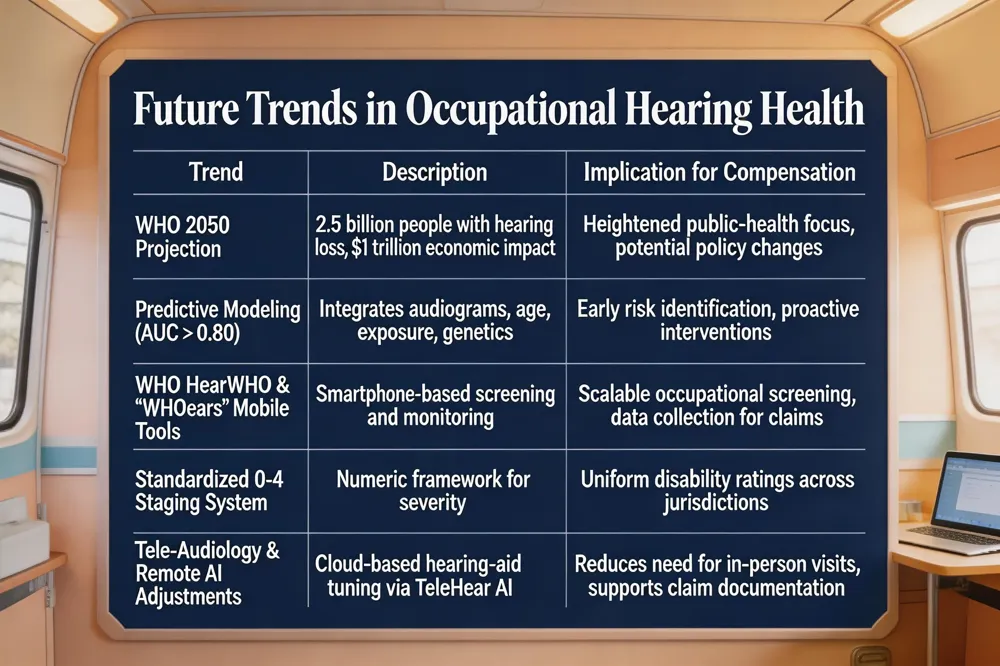 Worldwide, hearing loss remains a massive public‑health challenge. The WHO projects that by 2050 nearly 2.5 billion people will have some degree of hearing loss and that unaddressed loss will cost the global economy almost US$ 1 trillion annually. In the United States, roughly 13 % of individuals aged 12 or older have bilateral loss, translating to about 37 million adults with clinically significant impairment. The 2026 World Hearing Day campaign, themed “From communities to classrooms: hearing care for all children,” emphasizes school‑based screening, safe‑listening education, and the rollout of tools such as the WHO HearWHO app and the upcoming “WHOears tone‑based mobile assessment. Parallel to these public‑health efforts, predictive modeling of occupational risk is advancing. Multimodal prediction models for speech‑frequency hearing loss integrating audiometric thresholds (especially 3 kHz and 6 kHz), age, quantified noise exposure, and genetic variants now achieve AUC values above 0.80, enabling insurers and employers to identify workers at highest risk for speech‑frequency loss. Such data‑driven approaches, combined with standardized staging systems like the Hearing Health Collaborative’s numeric 0‑4 model, promise earlier intervention, more consistent disability ratings, and improved outcomes for workers’ compensation claims.
Putting Technology and Standards Together for Better Claim Outcomes
Modern occupational‑hearing claims benefit from a seamless blend of AI‑driven audiogram analysis, clinically‑validated staging, and continuous wearable dosimetry. AI platforms now flag subtle threshold shifts and age‑correct results in real time, while high‑resolution otacoustic‑emission and extended‑frequency audiometry provide early evidence of cochlear damage. The Hearing Health Collaborative’s proposed numeric staging system (0‑4) anchors stage definitions to outcomes such as depression, cognitive decline and and falls, using four‑frequency PTA, word‑recognition and sentence‑in‑quiet scores as thresholds. Wearable dosimeters with machine‑learning exposure models log individual noise dose, enabling precise correlation between documented exposure and stage progression.
Expert testimony leverages these standardized data streams and the nationally‑recognized compensation tables from the HHC and OSHA‑compliant grading systems. Law.com’s expert‑witness directory supplies qualified audiologists, occupational‑health physicians, and industrial hygienists who can interpret AI‑derived metrics and testify to causation under the “more probable than not” standard.
Looking ahead, the next decade will see broader integration of blockchain‑secured audiometric records, tele‑audiology follow‑up, and AI‑enabled hearing‑aid analytics. These advances will streamline claim documentation, improve disability ratings, and support proactive hearing‑health programs that reduce future liability for employers and insurers alike.