Why Objective Auditory Testing Matters in Compensation Claims
The compensation landscape for hearing loss hinges on reliable, reproducible audiometric evidence. Courts and insurers demand objective data that cannot be influenced by patient effort, malingering, or examiner bias. Objective electrophysiological tests—particularly the Auditory Steady‑State Response (ASSR)—provide statistically validated thresholds across the standard frequencies (500 Hz, 1 kHz, 2 kHz, 4 kHz) without requiring behavioral responses. ASSR’s ability to test multiple frequencies simultaneously shortens examination time to 20‑25 minutes, yields a conventional audiogram, and can be performed during natural sleep or safe sedation, making it ideal for infants, cognitively impaired workers, or individuals who cannot cooperate with pure‑tone audiometry. For claimants, ASSR delivers a credible, court‑admissible record of hearing impairment; for attorneys, it supplies expert‑witness testimony that quantifies loss, distinguishes sensorineural from conductive components, and supports causation arguments tied to occupational noise exposure. This objective evidence strengthens the likelihood of claim approval and expedites compensation.
ASSR Basics, Normal Ranges, and Diagnostic Scope
The Auditory Steady‑State Response (ASSR) is an objective electrophysiological test that estimates pure‑tone thresholds by presenting rapid, amplitude‑ or frequency‑modulated tones and analyzing the brain’s steady‑state response in the frequency domain. Normative data vary by study: Luts et al. reported mean thresholds of 37 ± 10 dB nHL (500 Hz), 35 ± 10 dB nHL (1 kHz), 32 ± 10 dB nHL (2 kHz) and 36 ± 9 dB nHL (4 kHz); Van Maanen and Stapells later defined practical normal limits of approximately 50 dB HL (500 Hz), 45 dB HL (1 kHz), 40 dB HL (2 kHz) and 40 dB HL (4 kHz). Compared with Auditory Brainstem Response (ABR), ASSR offers simultaneous multi‑frequency testing, higher stimulus levels (up to 100 dB HL), and faster sessions (≈6 min per ear versus ≈17 min for ABR). ABR remains the gold standard for precise low‑frequency thresholds and auditory neuropathy diagnosis, while ASSR excels at documenting mild to profound sensorineural loss, ototoxicity monitoring, and hearing status in infants or uncooperative adults—critical for workers’‑compensation and legal claims. ASSR can reliably detect loss across the spectrum, especially severe versus profound deficits (e.g., 75 dB vs 95 dB), but it does not primarily reveal low‑frequency occupational loss; noise‑induced injury typically first appears in the high‑frequency range (3–6 kHz) and may later spread to lower frequencies.
Technical Details of ASSR Testing
EEG Electrode Placement and Recording
The ASSR is recorded with a standard EEG montage. Active electrodes are placed at the vertex (Cz) and over each mastoid (or earlobe), with a ground electrode on the cheek. Impedances must be ≤ 3 kΩ to ensure low noise. The scalp electrodes capture the brain’s synchronized electrical activity to rapid, amplitude‑modulated tones (typically 40 Hz), providing an objective, frequency‑specific measure of auditory pathway function.
Step‑by‑Step Test Procedure
- Prepare a quiet, sound‑attenuated booth; clean skin and attach electrodes.
- Verify impedances and calibrate insert earphones.
- Present simultaneous stimuli at 0.5, 1, 2, and 4 kHz (air‑ and/or bone‑conducted) using amplitude and/or frequency modulation.
- Record responses while the patient relaxes, sleeps, or is lightly sedated.
- The software applies a statistical detection algorithm (F‑test or Bayesian) to determine response presence at each intensity, converting nHL to estimated hearing level (eHL).
Statistical Detection and Correction Factors
ASSR thresholds are derived from objective amplitude‑phase consistency across harmonics. Raw nHL values are adjusted by manufacturer‑specific correction tables that account for age, middle‑ear status, stimulus type, and modulation rate, yielding eHL values that align with behavioral audiometry (often 0‑20 dB difference).
Equipment Manufacturers and Pricing
Interacoustics (Eclipse, Titan) leads the market, offering CE‑Chirp® stimuli, automated threshold estimation, and binaural testing of up to eight frequencies simultaneously. Test costs in the U.S. range from $200–$500 per ear, varying by clinic, provider, and whether the assessment is bundled with a comprehensive audiologic exam. Insurance may cover part of the fee when medically justified.
Interpreting ASSR Reports for Legal Use
A well‑structured ASSR report begins with patient demographics, test conditions (state, sedation, electrode impedance, and the stimulus parameters used (carrier frequencies, modulation rates, intensity levels). The core of the report is an estimated audiogram that lists threshold values for the standard octaves—500 Hz, 1 kHz, 2 kHz, and 4 kHz—in each ear, accompanied by the statistical confidence level (often an F‑test or Bayesian probability) and the signal‑to‑noise ratio (SNR) for each frequency. Reliability indices such as the number of repeatable runs, artifact‑rejection percentages, and any corrective factors applied by the manufacturer are documented to substantiate reproducibility.
Cross‑checking these electrophysiologic thresholds with any available behavioral audiometry—or with bone‑conduction ASSR when a conductive component is suspected—helps confirm the accuracy of the estimated loss and identifies discrepancies that may require further testing.
Question: ASSR report
Answer: An ASSR (Auditory Steady‑State Response report provides an objective estimate of a patient’s hearing thresholds across multiple frequencies, typically presented as an estimated audiogram with numeric threshold values for 500 Hz, 1 kHz, 2 kHz, and 4 kHz. The report also includes statistical confidence limits, signal‑to‑noise ratios, and comments on test reliability or any factors that may have affected the recording (e.g., patient state or electrode impedance. Because ASSR uses frequency‑domain analysis and automated detection algorithms, the results are reproducible and can be compared directly to behavioral audiometry or ABR findings. In a workplace‑injury context, the report serves as a quantitative, medically‑validated documentation of auditory loss that can support legal and insurance claims. Finally, the report often contains a brief clinical interpretation outlining the degree of loss (mild‑moderate‑severe‑profound) and recommendations for further evaluation or hearing‑conservation measures.
When presenting findings in a compensation claim, the expert witness should highlight the objective nature of the ASSR, reference the statistical confidence (e.g., a 95 % probability of response), compare the thresholds to baseline or age‑adjusted norms, and explain any correction factors applied. A clear, concise summary linking the documented threshold shift to the worker’s noise exposure strengthens the causation argument and satisfies evidentiary standards for workers’ compensation and insurance adjudication.
Occupational Hearing Loss: Definition, Statistics, and Regulatory Framework
 Occupational hearing loss refers to a permanent reduction in hearing ability caused by workplace exposure to hazardous noise (≥85 dBA) and/or ototoxic chemicals. It may be sensorineural, conductive, or mixed and is a leading work‑related illness in the United States, often accompanied by tinnitus, communication difficulties, and increased health risks.
Occupational hearing loss statistics – NIOSH and CDC estimate that about 27 million U.S. workers are exposed to dangerous noise levels each year, with roughly 22 million at risk for noise‑induced loss. Approximately 11 % of workers report hearing difficulty and 8 % experience tinnitus; around 10 % of noise‑exposed employees will develop permanent loss over a career.
OSHA hearing‑conservation program fact sheet – OSHA requires a written program when employees are exposed to an 8‑hour TWA of 85 dBA. The program must include noise monitoring, baseline audiograms within six months of first exposure, annual audiometric testing, provision of properly fitted hearing‑protectors at no cost, and annual training on noise effects, protection use, and testing procedures. Records of exposure, audiograms, and training must be retained for at least two years.
Training and program templates – A typical template starts with an objective statement, assigns responsibilities (program administrator, supervisors, employees), outlines procedures for monitoring, protection‑device selection, audiometric testing, and training, and includes appendices for exposure logs, equipment inventories, and training records. Periodic review ensures the program remains effective and compliant.
Compensation Calculations, Tables, and Payouts
Workers’ compensation settlement ranges – In Virginia a claim is compensable when the average loss across 500‑Hz, 1‑kHz, 2‑kHz and 3‑kHz exceeds 27 dB. A 50‑dB loss is 38.3 % compensable, yielding roughly 19 weeks of wage benefits; a loss of ≥ 90 dB is deemed total and can provide up to 50 weeks of benefits. Nationally, settlements for hearing loss typically fall between $50,000 and $250,000, with higher awards for severe, permanent loss that precludes return to the claimant’s occupation (e.g., construction, mining, firefighting).
State and federal hearing‑loss compensation tables – Workers’‑compensation statutes convert average decibel loss at 500, 1,000, 2,000 and 3,000 Hz into a compensable percentage (e.g., 30 dB ≈ 5 % rating, 60 dB ≈ 55 %). The percentage is applied to the statutory benefit rate. Federal veterans use a separate schedule that assigns disability percentages in 10 % increments, with monthly payments up to $3,938 for 100 % loss (2026 rates).
Tinnitus awards and calculators – Tinnitus can be added to a hearing‑loss claim, often increasing the award by converting a unilateral loss to a bilateral rating. Online tinnitus compensation calculators estimate damages by factoring severity, associated hearing loss, lost wages and medical costs.
Impact of severity and occupation on payouts – Objective ASSR testing provides statistically validated thresholds that align within 0‑20 dB of pure‑tone audiometry, strengthening expert testimony. Workers in high‑noise professions (construction, manufacturing, mining) may qualify for larger settlements because the occupational exposure is well documented and the 4‑kHz “notch” pattern is readily identified by ASSR. Applying manufacturer‑specific correction factors and cross‑checking with bone‑conduction results ensures the audiogram meets legal evidentiary standards.
Putting It All Together: Next Steps for Claimants
Identifying the correct occupational hearing test is the first step in a successful claim. Audiometric testing—whether conventional pure‑tone audiometry or an objective Auditory Steady‑State Response (ASSR)—provides the decibel thresholds needed to quantify loss. ASSR is especially valuable when the worker cannot cooperate with behavioral testing, as it yields a statistically‑validated audiogram in 20‑25 minutes and can differentiate conductive from sensorineural loss.
Choosing an expert ASSR evaluation service requires a licensed audiologist, calibrated equipment that follows IEC/ANSI standards, and a documented protocol that includes stimulus frequencies (500 Hz‑4 kHz), modulation rates (40 Hz for awake adults, 80‑90 Hz for infants), and manufacturer‑specific correction tables. High‑quality labs also perform bone‑conduction ASSR to confirm the type of loss.
Documenting exposure and linking it to ASSR findings strengthens causation. Gather noise‑dosimetry records, NIOSH or OSHA exposure levels, and any pre‑injury baseline audiograms. Compare the ASSR‑derived thresholds to the expected standard threshold shift (≥10 dB at 2, 3, and 4 kHz) and apply age‑correction and equipment correction factors as required for legal admissibility.
Legal and consulting resources are essential. Workers’ compensation attorneys can present ASSR data as expert evidence, while professional consultants (e.g., NorCal Medical Consulting) prepare detailed reports that meet Daubert standards. Engaging these experts early ensures that the occupational hearing test data are properly contextualized for compensation calculations and settlement negotiations.
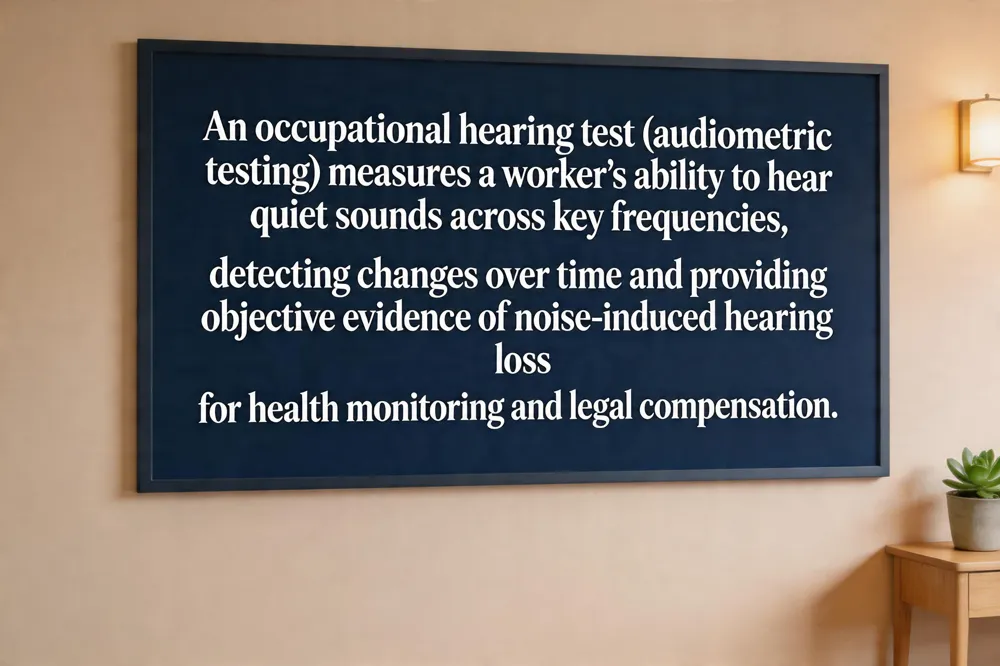
What is an occupational hearing test?
Audiometric testing is a type of hearing test that can measure a worker's ability to hear quiet sounds and, when done regularly, can detect changes in their hearing over time.
Secure Your Claim with Objective ASSR Evidence
ASSR provides objective thresholds, reduces patient bias, and fits legal standards. Expert audiologists ensure accurate calibration, statistical analysis, and reporting. NorCal Medical Consulting delivers certified testing, expert testimony, and claim support.