Understanding the Immediate Reporting Landscape
OSHA requires employers to notify the agency within eight hours for a fatality and within twenty‑four hours for severe injuries such as amputations, loss of an eye, or inpatient hospitalization; most states impose similar deadlines for workers’ compensation notices, often within 24‑48 hours. Delaying a report can inflate claim costs, trigger higher insurance premiums, and expose the employer to fines, potential civil liability, and loss of benefits for the employee. The reporting chain begins with the injured worker, who must alert a supervisor or designated safety officer. The supervisor then contacts human resources, the company’s workers’ compensation carrier, and, when required, OSHA or state agency. A claims owner or risk‑manager ensures documentation, medical referral, and follow‑up are completed on schedule.
The True Cost of Immediate Accident Reporting
| Question | Key Point |
|---|---|
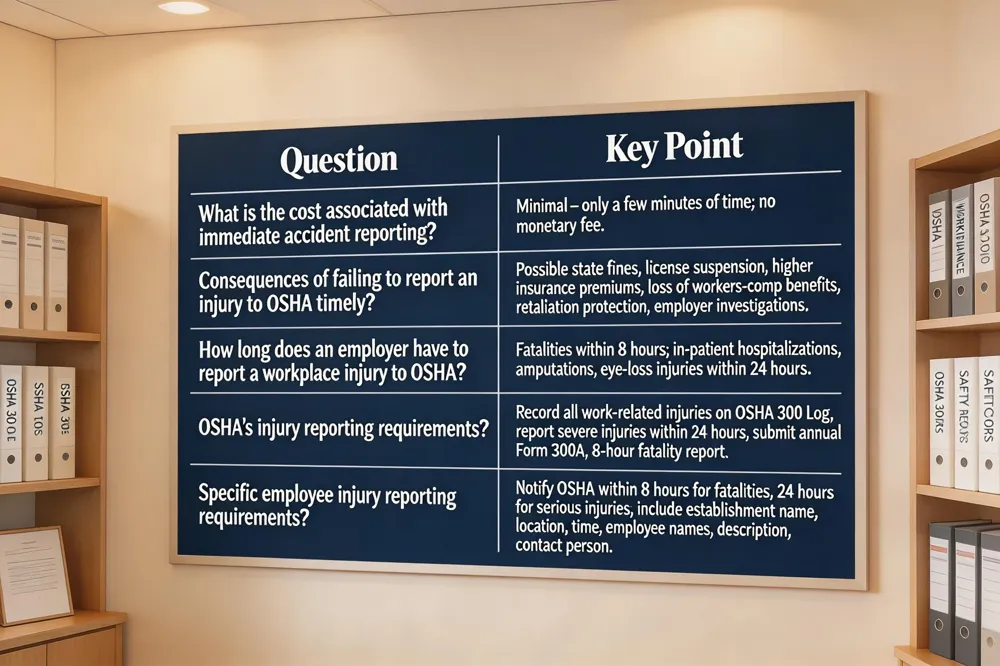
| What is the cost associated with immediate accident reporting? | Minimal – only a few minutes of time; no monetary fee. |
| Consequences of failing to report an injury to OSHA timely? | Possible state fines, license suspension, higher insurance premiums, loss of workers‑comp benefits, retaliation protection, employer investigations. |
| How long does an employer have to report a workplace injury to OSHA? | Fatalities within 8 hours; in‑patient hospitalizations, amputations, eye‑loss injuries within 24 hours. |
| OSHA’s injury reporting requirements? | Record all work‑related injuries on OSHA 300 Log, report severe injuries within 24 hours, submit annual Form 300A, 8‑hour fatality report. |
| Specific employee injury reporting requirements? | Notify OSHA within 8 hours for fatalities, 24 hours for serious injuries; include establishment name, location, time, employee names, description, contact person. |
 What is the cost associated with immediate accident reporting?
Immediate reporting carries virtually no monetary fee; the primary expense is a few minutes spent gathering details, taking photos, and completing the required form. Failing to report can trigger state fines, license suspension, and higher insurance premiums that far outweigh this minimal effort.
What are the consequences if an employee fails to report an injury to OSHA in a timely manner?
Untimely reporting may prevent the injury from appearing on the OSHA 300 Log, jeopardizing workers’‑ compensation benefits and the employee’s retaliation protection. The employer could face investigations and fines, which can indirectly affect job security and claim outcomes. Delayed medical care may also be used to argue the injury was not work‑related.
How long does an employer have to report a workplace injury to OSHA?
OSHA requires employers to notify the agency of any work‑related fatality within 8 hours and of in‑patient hospitalizations, amputations, and eye‑loss injuries within 24 hours.
What are OSHA's injury reporting requirements?
Employers must record all work‑related injuries and illnesses on the OSHA 300 Log, report severe injuries within 24 hours, and submit an annual summary (Form 300A). The agency also requires an 8‑hour fatality report.
What specific employee injury reporting requirements does OSHA mandate?
OSHA requires employers to notify the agency of any work‑related fatality within 8 hours and of in‑patient hospitalizations, amputations, and eye‑loss injuries within 24 hours. Reports can be made via the 24‑hour toll‑free line (1‑800‑321‑6742), online, or by phone and must include the establishment name, location, time, employee names, a brief description, and a contact person. Failure to meet these timelines can result in penalties and enforcement actions.
Immediate Actions: From the Scene to the Phone
| Step | Action |
|---|---|
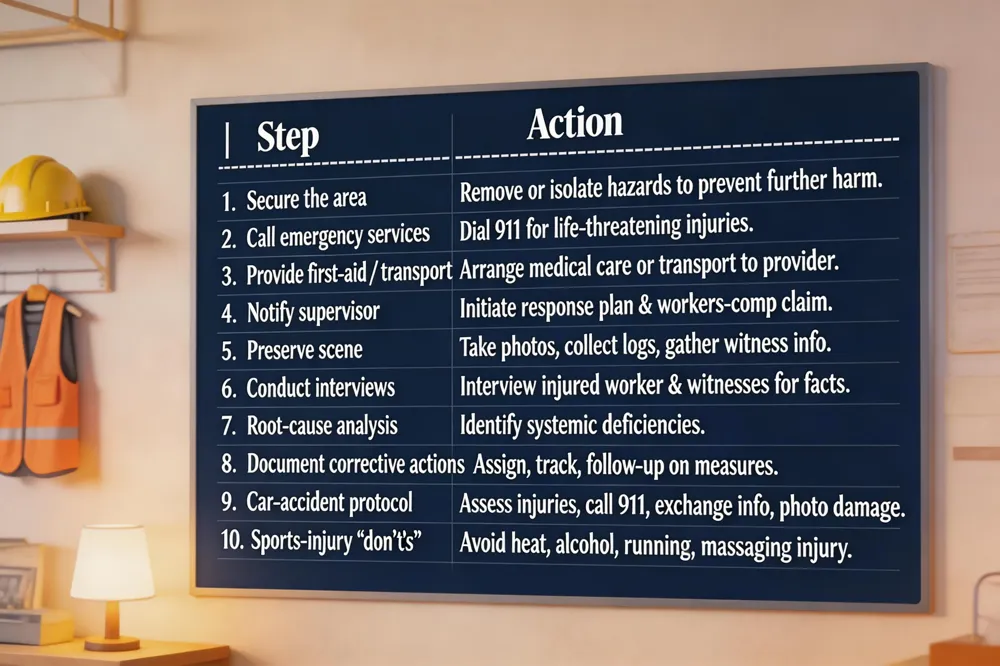
| 1. Secure the area | Remove or isolate hazards to prevent further harm. |
| 2. Call emergency services | Dial 911 for life‑threatening injuries. |
| 3. Provide first‑aid / transport | Arrange medical care or transport to a qualified provider. |
| 4. Notify supervisor or safety officer | Initiates documented response plan and engages workers‑comp claim owner. |
| 5. Preserve scene | Take photographs, collect equipment logs, gather witness contact info. |
| 6. Conduct interviews | Interview injured worker and witnesses for factual narrative. |
| 7. Root‑cause analysis | Identify systemic deficiencies beyond immediate actions. |
| 8. Document corrective actions | Assign, track, and follow‑up on corrective measures. |
| 9. Car‑accident protocol | Assess injuries, call 911 if needed, move vehicles safely, exchange info, photograph damage, seek medical evaluation. |
| 10. Sports‑injury “don’ts” | Avoid heat, alcohol, vigorous running, and massaging the injured area. |
 When an incident occurs, the first priority is to secure the area and prevent further harm. Remove or isolate hazards, call 911 for life‑threatening injuries and provide first‑aid or arrange transport to a qualified medical provider. Once the injured employee is safe, notify the direct supervisor or designated safety officer immediately; this triggers the employer’s documented response plan and ensures the workers’ compensation claim owner is engaged.
Standard accident‑investigation steps begin with scene preservation, followed by collection of photographs, equipment logs, and witness contact information. Investigators then interview the injured worker and any witnesses to capture a factual narrative. A root‑cause analysis identifies systemic deficiencies, after which corrective actions are documented, assigned, and tracked.
Car‑accident protocol mirrors workplace response: assess injuries, call 911 if needed, move vehicles to a safe location, and contact law‑enforcement. Exchange driver’s licence, insurance, and contact details, and photograph damage and the surrounding environment. Seek prompt medical evaluation, even for minor symptoms, to document potential delayed injuries.
Four actions to avoid after a sports injury are applying heat, consuming alcohol, engaging in running or other vigorous exercise, and massaging the injured area. Each can increase bleeding, swelling, or tissue damage, delaying recovery.
Adhering to these steps protects employee health, preserves evidence for workers’ compensation, and reduces legal and financial exposure for the employer.
Reporting Timelines, Forms, and Where to Find Them
| Item | Details |
|---|---|
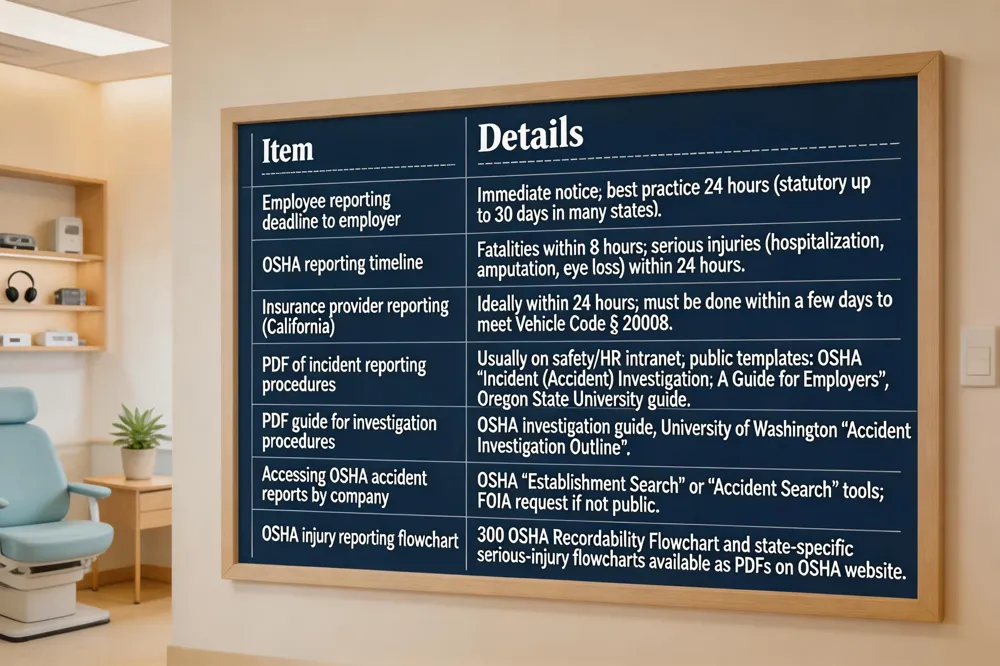
| Employee reporting deadline to employer | Immediate notice; best practice 24 hours (statutory up to 30 days in many states). |
| OSHA reporting timeline | Fatalities within 8 hours; serious injuries (hospitalization, amputation, eye loss) within 24 hours. |
| Insurance provider reporting (California) | Ideally within 24 hours; must be done within a few days to meet Vehicle Code § 20008. |
| PDF of incident reporting procedures | Usually on safety/HR intranet; public templates: OSHA “Incident (Accident) Investigation: A Guide for Employers”, Oregon State University guide. |
| PDF guide for investigation procedures | OSHA investigation guide, University of Washington “Accident Investigation Outline”. |
| Accessing OSHA accident reports by company | OSHA “Establishment Search” or “Accident Search” tools; FOIA request if not public. |
| OSHA injury reporting flowchart | 300 OSHA Recordability Flowchart and state‑specific serious‑injury flowcharts available as PDFs on OSHA website. |
 How long does an employee have to report an injury to their employer? Most jurisdictions require immediate notice, and OSHA expects verbal or written reporting within minutes of the event. Many states set a statutory deadline of 30 days from the date of injury or when symptoms become reasonably discoverable, but a 24‑hour window is the industry best practice for accurate documentation and timely medical care. Missing the deadline can jeopardize workers‑compensation benefits.
(OSHA requires immediate reporting of workplace fatalities and severe injuries within 24 hours.)
How soon should an accident be reported to an insurance provider in California? California policies demand prompt notification—ideally within 24 hours and certainly within a few days. Early reporting preserves evidence, speeds claim adjudication, and satisfies both policy language and Vehicle Code § 20008 requirements. Delays may give the insurer grounds to deny or reduce the claim.
(California policies demand prompt notification—ideally within 24 hours.)
Where can I find a PDF of incident reporting and investigation procedures? Most employers post the PDF on the safety or HR intranet under “Policies & Procedures.” Public agencies also provide templates: OSHA’s “Incident (Accident) Investigation: A Guide for Employers” and university safety manuals (e.g., Oregon State University’s accident‑recording guide) are freely downloadable.
(OSHA’s “Incident (Accident) Investigation: A Guide for Employers”)
Is there a PDF guide for incident investigation procedures? Yes. OSHA’s investigation guide and the University of Washington’s “Accident Investigation Outline” are available as PDFs and include checklists, forms, and step‑by‑step instructions.
(OSHA’s investigation guide
How can I access OSHA accident reports by company? Use OSHA’s online “Establishment Search” or “Accident Search” tools, entering the employer’s name or OSHA number. If records are not public, a FOIA request to OSHA or the regional office can be filed.
(OSHA’s online “Establishment Search”)
Is there an OSHA injury reporting flowchart available? OSHA provides a “300 OSHA Recordability Flowchart” and state‑specific serious‑injury flowcharts as PDFs on its website, helping employers determine reporting timelines for fatalities, amputations, eye loss, and hospitalizations.
(300 OSHA Recordability Flowchart)
Investigation Essentials: From Scene to Root‑Cause
| Phase | Key Activities |
|---|---|
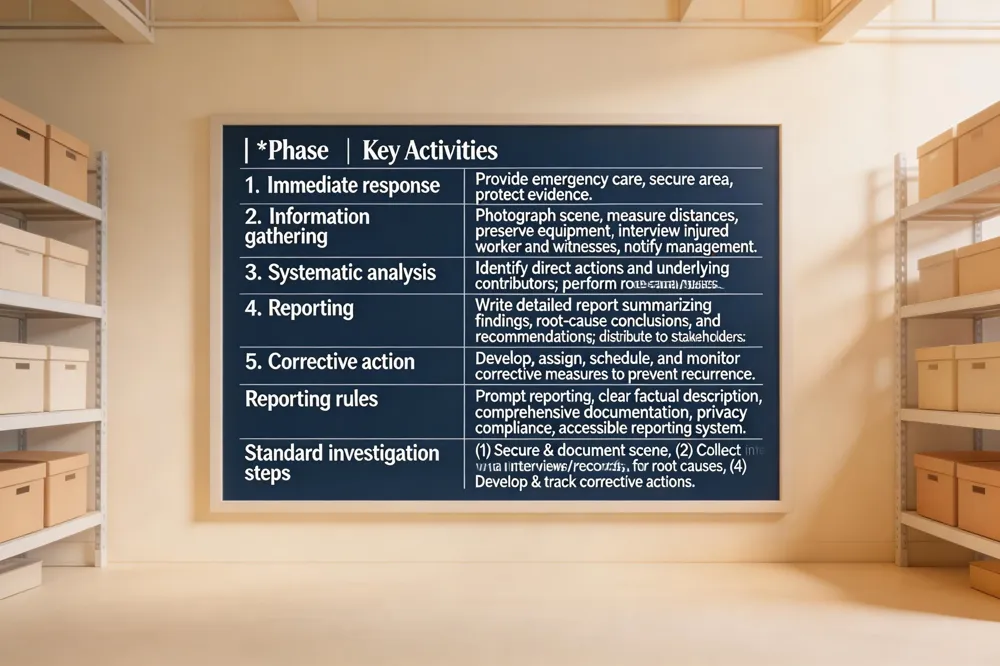
| 1. Immediate response | Provide emergency care, secure area, protect evidence. |
| 2. Information gathering | Photograph scene, measure distances, preserve equipment, interview injured worker and witnesses, notify management. |
| 3. Systematic analysis | Identify direct actions and underlying contributors; perform root‑cause analysis. |
| 4. Reporting | Write detailed report summarizing findings, root‑cause conclusions, and recommendations; distribute to stakeholders. |
| 5. Corrective action | Develop, assign, schedule, and monitor corrective measures to prevent recurrence. |
| Reporting rules | Prompt reporting, clear factual description, comprehensive documentation, privacy compliance, accessible reporting system. |
| Standard investigation steps | (1) Secure & document scene, (2) Collect info via interviews/records, (3) Analyze data for root causes, (4) Develop & track corrective actions. |
 A thorough accident investigation begins with immediate response: provide emergency medical care, secure the area, and protect evidence. Next, gather information by photographing the scene, measuring distances, preserving equipment, and interviewing the injured worker and witnesses while notifying management. The third step is a systematic analysis of the collected data to identify both direct actions and underlying contributors. A detailed written report then summarizes findings, root‑cause conclusions, and actionable recommendations, which is distributed to all stakeholders, including safety committees, insurers, and regulatory agencies. Finally, implement corrective actions and monitor their effectiveness to prevent recurrence.
Effective incident reporting follows five key rules. First, report the event promptly, ideally within minutes of occurrence. Second, keep the description clear, factual, and objective—avoid speculation or blame. Third, document all relevant details, such as photographs, witness statements, and environmental conditions. Fourth, protect personal health information to comply with privacy regulations. Fifth, ensure the reporting system is accessible and tailored to the organization so anyone can file a complete report quickly and consistently.
The standard workplace incident‑investigation procedure can be condensed into four steps: (1) secure and document the scene; (2) collect information through interviews and record reviews; (3) analyze the data to pinpoint root causes beyond immediate actions; and (4) develop, assign, and schedule corrective actions while communicating the findings in a written report. This structured, systems‑based approach ensures that underlying hazards are addressed, reducing future injury risk.
Forms, Templates, and the OSHA Incident Report
| Component | Description |
|---|---|
| Injury‑Reporting Policy Templates | Outline purpose, scope, definitions, timelines, investigation steps, medical protocol, workers‑comp procedures, role responsibilities. |
| OSHA record‑keeping forms | Form 301 (injury record) completed within 8 hours (fatality) or 24 hours (serious injury); Form 300A annual summary. |
| Accessing investigation reports | Retain internally; request from employer, state agency, OSHA (FOIA), or consulting firms for de‑identified samples. |
| Sample Q&A | What is the OSHA Incident Report Form? – Form 301 used for detailed injury record, supports OSHA tracking and legal/insurance claims. |
| Template creation | Combine OSHA standard forms with custom policy template defining timelines, responsibilities, and medical‑care steps. |
| Finding PDF of workplace accident investigation report | Request from safety/HR department, state agency, OSHA, or via FOIA; consulting firms may provide sample PDFs. |
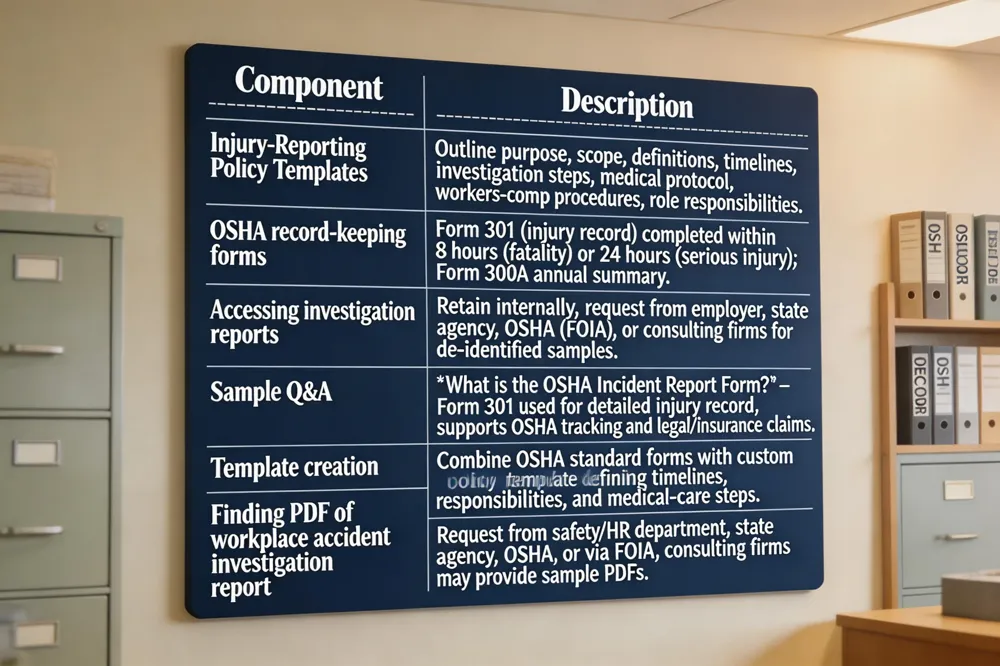 Injury‑Reporting Policy Templates – OSHA provides standard record‑keeping forms, but a comprehensive policy should also outline purpose, scope, definitions of reportable incidents, reporting timelines, investigation steps, medical‑care protocol, workers’‑compensation procedures, and role responsibilities. Ready‑made templates are available from safety‑policy kits and can be customized to match company structure, communication channels, and legal obligations (e.g., auditory‑loss reporting for NorCal Medical Consulting).
Accessing Accident Investigation Reports – Employers must retain investigation documentation and make it available to injured workers and their representatives. If not supplied internally, a request can be made to the state occupational‑safety agency or OSHA, often via a FOIA or public‑records request. Consulting firms such as NorCal Medical Consulting also provide de‑identified sample PDFs for reference.
Key Q&A
- What is the OSHA Incident Report Form and how is it used? Form 301 is the detailed injury record completed within 8 hours (fatality) or 24 hours (serious injury) and supports OSHA tracking and legal/insurance claims.
- Is there a template for creating an injury‑reporting procedure? Yes – combine OSHA’s standard forms with a policy template that defines reporting timelines, responsibilities, and medical‑care steps.
- Where can I find a PDF of a workplace accident investigation report? Request it from the employer’s safety/HR department, the state agency, OSHA, or obtain it through a FOIA request; consulting firms may also supply sample reports.
Your Bottom Line: Report Fast, Document Thoroughly, Protect Rights
OSHA mandates that any fatality be reported within eight hours and severe injuries—hospitalizations, amputations, loss of an eye—within twenty‑four hours. Most states require a workers’‑compensation notice within 24‑48 hours, and the employer’s internal incident form should be completed while details are fresh. Prompt medical care reduces complications and speeds recovery, while early claim filing preserves benefits, limits payout costs, and protects the employee’s right to treatment. Using a standardized incident‑report template guarantees that date, time, location, witness statements and photographs are captured, and assigning a claims owner ensures follow‑up. Professional guidance from safety consultants, attorneys, or medical experts helps navigate OSHA, state regulations and insurance requirements, minimizing legal exposure and supporting a swift return‑to‑work plan effectively.