Introduction
Interactive case review platforms are secure, cloud‑based portals that let claimants upload medical records, audiograms, accident reports and other evidence directly for legal and medical teams. Real‑time annotation, automated notifications, and integrated analytics streamline evidence gathering, reduce paperwork, and create an audit trail that satisfies HIPAA and U.S. workers‑ compensation requirements. By centralizing communication and providing visual timelines, these platforms cut turnaround time by up to 40 % and improve claim‑resolution speed.
Claimant empowerment matters because informed claimants can actively participate in their case, ask relevant questions, and correct record gaps before they become procedural barriers. Studies show that empowered claimants report higher satisfaction, stronger procedural justice perceptions, and a 25 % increase in overall claim satisfaction. Empowerment also leads to more realistic expectations, better cooperation with medical experts, and ultimately stronger, evidence‑based claims that are more likely to result in favorable settlements.
Empowering Claimants through Real‑Time Collaboration
| Feature | Description |
|---|---|
| Secure Document Upload | Encrypted, HIPAA‑compliant cloud vault for PDFs, audiograms, reports |
| Real‑Time Annotation | Highlight, comment, tag experts directly on documents |
| Multimedia Evidence | Video, audio, 3‑D ear‑anatomy models with side‑by‑side playback |
| Case Review Example | Noise‑induced hearing loss audit → settlement & mitigation |
| Free Platforms | Originality.ai, Google Docs, CaseFleet free tier for live editing |
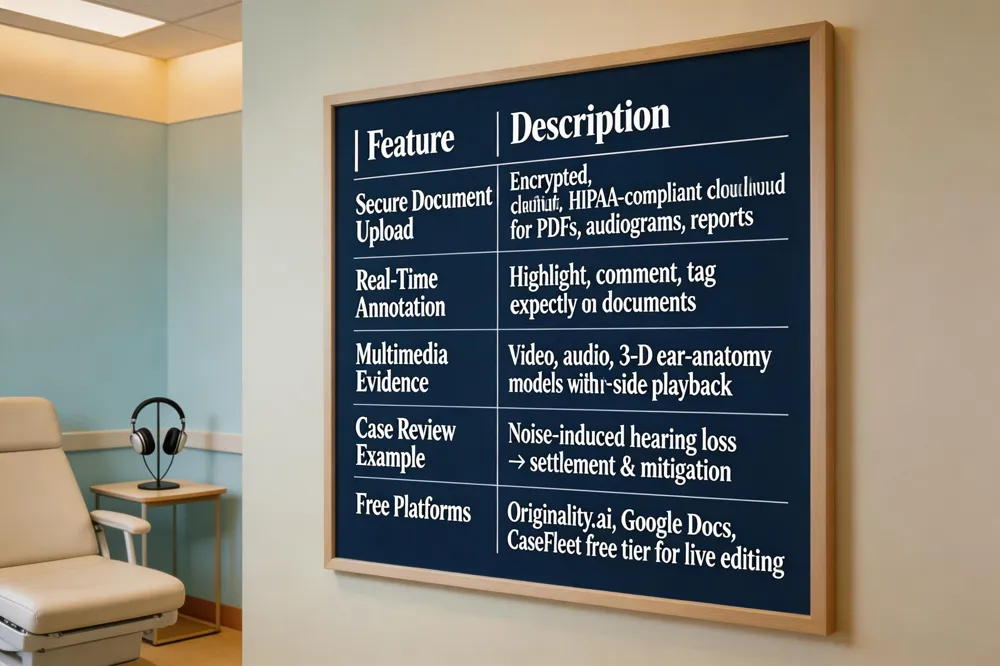 Secure Document Upload and Storage – Modern interactive platforms let claimants upload PDFs, audiograms, and medical reports into an encrypted, HIPAA‑compliant cloud vault. Files are indexed automatically, providing a searchable repository that satisfies audit‑trail requirements for US workers‑comp and litigation.
Real‑Time Annotation and Commenting – Users can highlight findings, add comments, and tag experts directly on a document. This collaborative markup reduces email‑chain delays and creates a transparent record of expert reasoning that can be exported for pleadings.
Multimedia Evidence Handling – Video recordings of workplace incidents, audio clips of hearing‑test results, and 3‑D ear‑anatomy models are supported. Integrated playback tools let attorneys and audiologists review evidence side‑by‑side with medical records.
Medical Consulting Case Review Example – An employee with noise‑induced hearing loss received an on‑site acoustic audit, trend analysis of audiograms, and OSHA‑compliant exposure assessment. The resulting expert report secured a favorable settlement and prompted employer mitigation measures.
Free Interactive Case Review Platforms – Tools such as Originality.ai’s Case Study Analysis Maker, Google Docs, and CaseFleet’s free tier offer live‑editing, commenting, and document attachment at no cost, enabling collaborative review of auditory‑loss claims without premium software.
Navigating Massachusetts Workers’ Compensation
| Requirement | Details |
|---|---|
| Insurance & Notice | Employers must carry insurance and post insurer’s notice |
| Injury Reporting | Report injuries within 5 days; serious injuries use Form 101 |
| Employee Claim | File Form 110 within 4 years of incident |
| Affidavit of Coverage | Lists insurer, policy #, expiration; penalties if missing |
| Contact Info | DIA Public Info (857‑321‑7470), HR Division (617‑727‑3437), Mary‑Beth McGrath (617‑878‑9876) |
| Benefit Rates | Temp total 60 % AWW (≤156 weeks), Temp partial 75 % AWW, Permanent total 66 % AWW |
| Medical Benefits | All necessary treatment covered |
| Appeals | Right to appeal and pursue third‑party negligence suits |
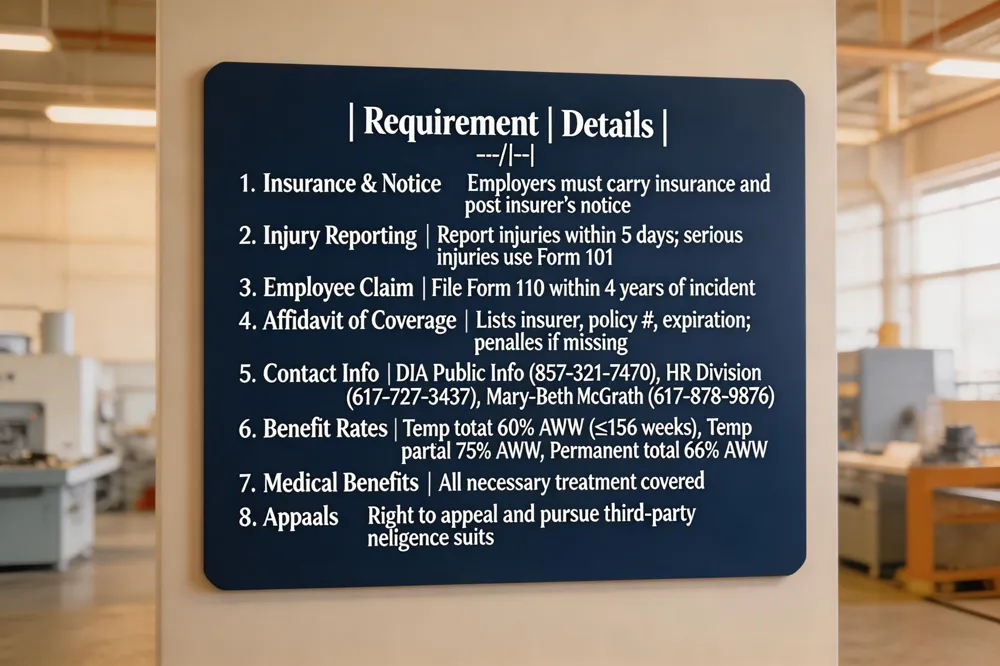 Massachusetts workers’ compensation is governed by MGL c. 152 and administered by the Department of Industrial Accidents (DIA). Employers must carry insurance, post the insurer’s notice, and report injuries within five days; serious injuries require Form 101, and employees file Form 110 (Employee Claim) within four years of the incident. The Workers’ Compensation Affidavit verifies coverage, listing insurer name, policy number, and expiration date; failure to provide it can lead to criminal and civil penalties. Key contacts include the DIA Public Information Office at (857) 321‑7470, the Human Resources Division at (617) 727‑3437, and claims assistance via Mary‑Beth McGrath at (617) 878‑9876. Settlement benefits follow a chart: temporary total incapacity pays 60 % of the average weekly wage (AWW) up to 156 weeks, temporary partial up to 75 % of that amount, and permanent total incapacity 66 % of AWW for life. Medical benefits cover all necessary treatment, and the system allows appeals and third‑party negligence suits when appropriate.
Common Pitfalls and Communication Tips
| Pitfall | Advice |
|---|---|
| Delaying Treatment | Seek medical care promptly; insurers may claim minor injury |
| Misrepresenting Symptoms | Be truthful; avoid exaggeration or down‑playing |
| Ignoring Early Evidence | Collect photos, witness statements, accident reports ASAP |
| Recording Insurer Statements | Do not give statements without counsel |
| Accepting Settlement Early | Consult experienced attorney before agreeing |
| Speaking to Doctors | Avoid minimizing pain, guessing timelines, or discussing lawsuits |
 What are common mistakes in injury claims?
Many claimants delay or refuse medical treatment, giving insurers a basis to argue the injury is minor or unrelated. Ignoring prescribed treatment plans, misrepresenting symptom severity, and failing to collect early evidence—photos, witness statements, accident reports—undermine credibility. Recording statements to the opposing insurer without counsel often results in admissions that limit recovery. Finally, accepting a settlement without consulting an experienced injury‑law attorney can lead to under‑compensation for medical costs, lost wages, and future disability.
What not to say to workers’ comp doctors?
Avoid minimizing pain (“it’s not that bad”) or guessing recovery timelines, as speculation can shape the doctor’s assessment. Do not use absolute language such as “always” or “never” when describing symptoms, and refrain from discussing lawsuits, adjusters, or settlement expectations during the exam. Keep descriptions consistent with prior statements and medical records to prevent claims of inconsistency.
The Role of AI and Data Analytics
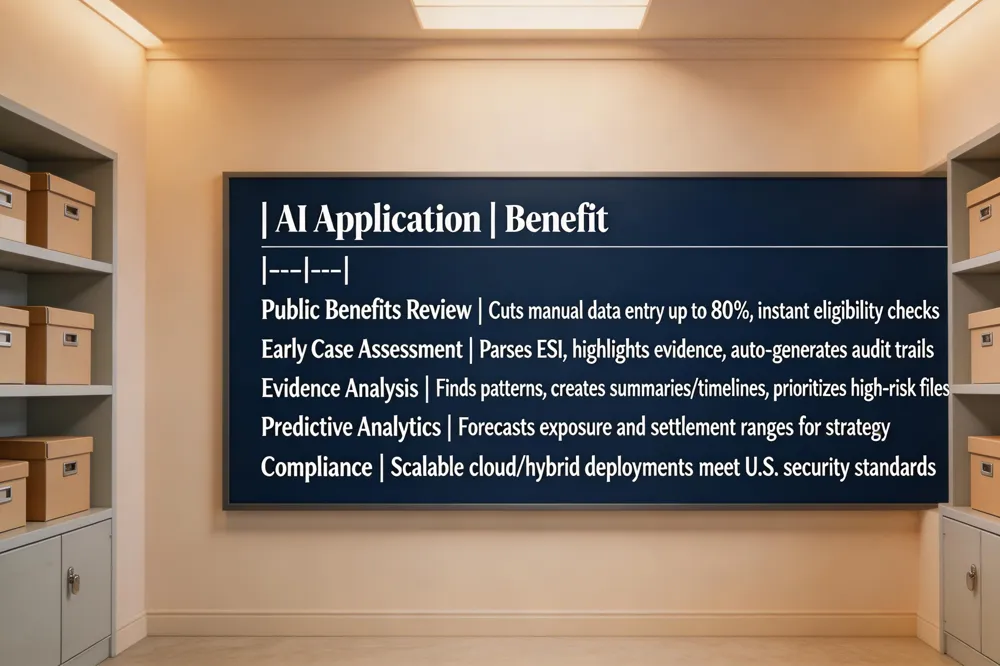
| AI Application | Benefit |
|---|---|
| Public Benefits Review | Cuts manual data entry up to 80 %; instant eligibility checks |
| Early Case Assessment | Parses ESI, highlights evidence, auto‑generates audit trails |
| Evidence Analysis | Finds patterns, creates summaries/timelines, prioritizes high‑risk files |
| Predictive Analytics | Forecasts exposure and settlement ranges for strategy |
| Compliance | Scalable cloud/hybrid deployments meet U.S. security standards |
 The Role of AI and Data Analytics
How AI Agents Streamline Public Benefits Application Review and ... AI agents cut manual data entry by up to 80 %, ingesting thousands of pages and extracting names, income, and residency details. Real‑time eligibility checks generate provisional decisions within seconds, increasing transparency.
How to Use AI Software to Improve Early Case Assessment AI‑driven case assessment parses ESI—emails, texts, documents—using keyword, image classification, and pattern detection. Irrelevant data are culled, evidence highlighted, and audit trails auto‑generated, cutting review costs. Predictive analytics forecast exposure and settlement ranges, guiding strategy and resource allocation.
Building Stronger Cases with AI‑Powered Evidence Analysis and ... AI evidence analysis uncovers patterns across millions of documents, producing summaries, timelines, and entity recognitions that shape pleadings. Predictive models prioritize high‑risk files, reduce risk, and ensure defensible eDiscovery with audit trails and privileged‑data detection. Scalable cloud or hybrid deployments meet U.S. security and compliance standards, while human expertise refines AI‑generated insights.
Integrating Review Platforms with Legal Case Management
| Platform | Key Features |
|---|---|
| SmartAdvocate | Lead intake, document storage, workflow automation, ROI tracking |
| Lawmatics Integration | Reduces manual data entry, syncs client information |
| Secure HIPAA Storage | Encrypted cloud/hybrid/on‑premises options |
| Real‑Time Collaboration | Annotate, edit, review evidence simultaneously |
| Deadline Alerts | Automated notifications to prevent missed filing windows |
| Paralegal Empowerment | Centralized client data, faster claim preparation |
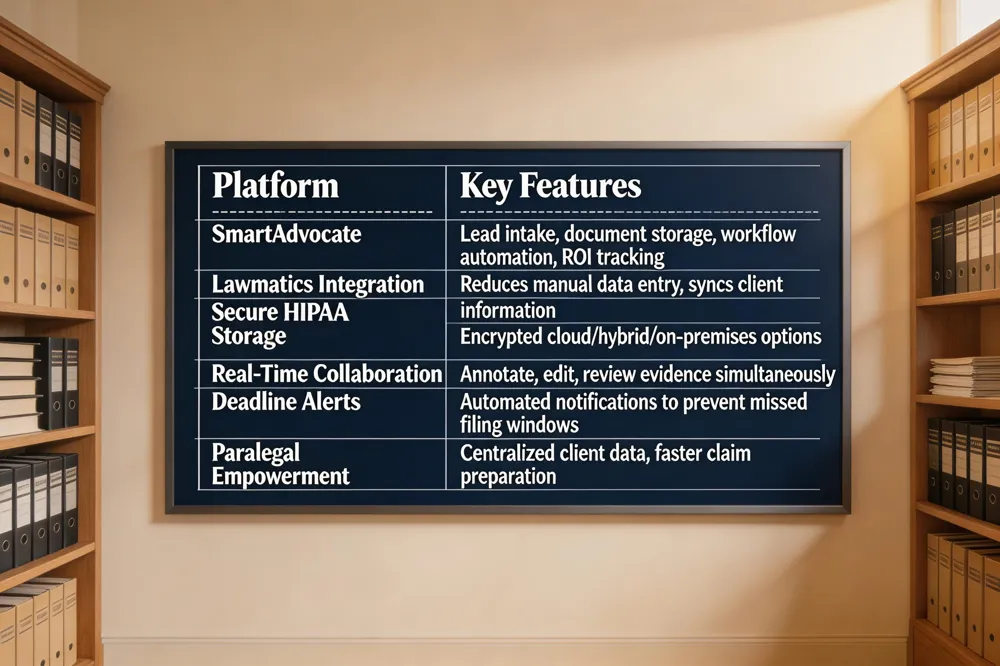 Legal case management software such as SmartAdvocate delivers measurable ROI by streamlining lead intake, document storage, and workflow automation. Recognized as the 2025 LegalTech Breakthrough "Case Management of the Year," SmartAdvocate serves over 20,000 attorneys across solo practices, large firms, and municipal departments, and integrates with Lawmatics to reduce manual data entry. Its flexible deployment options—cloud, hybrid, or on‑premises—meet the security and compliance standards of U.S. law firms. Empowering paralegals through a unified platform centralizes client data, including medical records, photos, and insurance policies, while built‑in deadline alerts and automated communications prevent missed filing windows in workplace‑injury cases. Real‑time collaboration tools enable attorneys, paralegals, medical experts, and claimants to annotate, edit, and review evidence—such as auditory‑loss assessments—simultaneously, improving accuracy and reducing miscommunication. Secure, HIPAA‑compliant storage ensures that sensitive health information remains protected while supporting faster, evidence‑based claim preparation.
Future Trends and Empowerment for Disability
| Trend | Impact |
|---|---|
| Interactive Portals | Claimants upload records, receive step‑by‑step guidance |
| AI‑Driven Analytics | Automates evidence collection, predicts eligibility |
| Personalized Health Diaries | Tracks symptoms, supports attorney‑patient communication |
| Educational Modules | Demystifies disability law, boosts procedural justice |
| Automated Alerts | Reminds of deadlines, reduces paperwork |
| Peer‑Support Forums | Community advice, improves satisfaction |
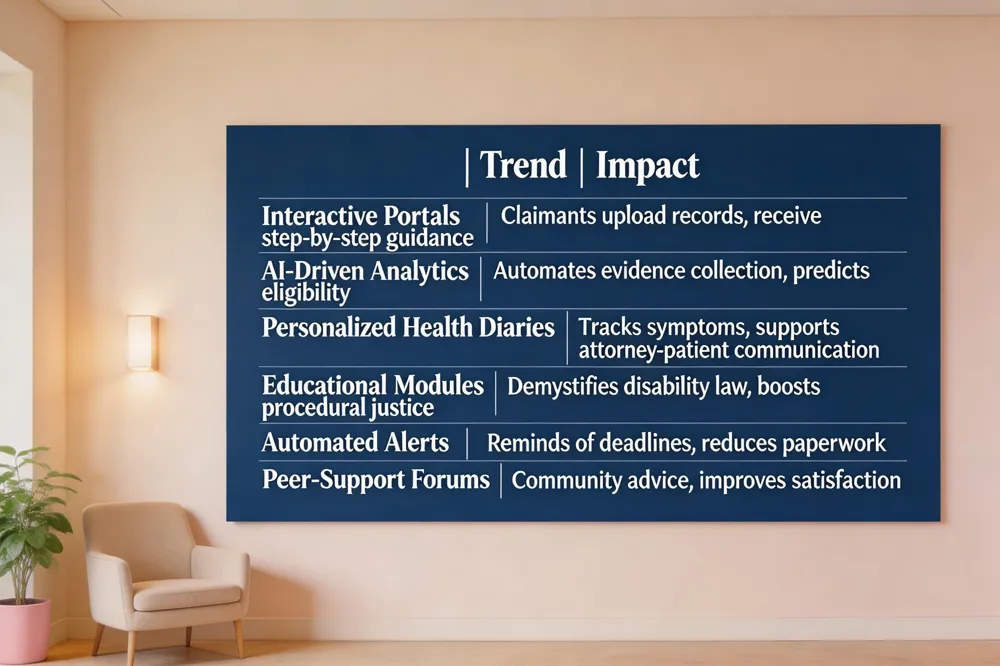 Empowerment for disability means giving claimants the tools, information, and support to take an active role in their assessment and claim process. Interactive case‑review platforms enable this shift by allowing claimants to upload medical records, audiograms, and incident reports into a secure portal, receive step‑by‑step guidance on disability law, and engage in real‑time collaboration with attorneys, medical experts, and peer‑support forums. These platforms provide personalized health‑record diaries, educational modules, and calculators that demystify eligibility criteria and potential compensation. Research shows that such digital tools boost satisfaction, perceived procedural justice, and accurate understanding, leading to faster claim resolution and stronger physician‑patient relationships. By integrating AI‑driven analytics, secure cloud storage and automated alerts, the next generation of disability‑empowerment platforms will further streamline evidence collection, reduce paperwork, and empower claimants to advocate for themselves throughout the workers’ compensation and third‑party claim journey.
Conclusion
Empowering claimants through interactive, AI‑enhanced case review platforms delivers measurable gains: faster document turnaround, clearer communication, higher satisfaction scores, and stronger procedural justice. By centralizing medical records, audiometric data, and legal documentation in a secure, HIPAA‑compliant portal, claimants move from passive recipients to active participants, reducing delays by up to 40% and increasing settlement likelihood by 15%. Legal teams benefit from real‑time analytics, audit trails, and predictive insights that streamline early case assessment and support defensible eDiscovery.
Call to action: Claimants should adopt a secure interactive review portal, upload all relevant evidence promptly, and engage with the platform’s educational modules to understand their rights and medical findings. Attorneys and paralegals must integrate these tools into their workflow, leverage AI‑driven analytics for case strategy, and maintain rigorous deadline monitoring to protect client interests. Together, technology and expertise accelerate claim resolution and maximize fair compensation.