Why Immediate Information Matters
Real‑time feedback loops capture movement and clinical data instantly, delivering auditory, visual, or haptic cues within human perception thresholds. In workers’ compensation, timely information reduces claim delays, supports statutory deadlines, and prevents benefit interruptions. Legal teams rely on objective, timestamped evidence to substantiate causation and injury severity, while insurers require up‑to‑date medical documentation to approve benefits. NorCal Medical Consulting integrates wearable sensor data, secure cloud platforms, and expert analysis to provide immediate, HIPAA‑compliant updates to attorneys, adjusters, and clinicians. This rapid exchange enhances claim accuracy, expedites settlements, safeguards workers’ rights, and improves overall outcomes for all parties involved today.
Biomechanical Feedback: From Sensors to Action
 Real‑time biomechanical feedback (BMF) is a closed‑loop system that captures a person’s movement and physiological data with sensors, processes it instantly, and returns information to the individual through visual, auditory, or haptic cues. By translating invisible parameters—such as joint angles, forces, or muscle activation—into perceivable signals, BMF helps correct technique, prevent injury, and accelerate rehabilitation.
Common sensor types used in BMF include inertial measurement units (IMUs) that combine accelerometers, gyroscopes, and magnetometers, force plates that measure ground‑reaction forces, pressure‑insoles that map foot‑load distribution, and optical motion‑capture cameras for high‑resolution kinematics. IMUs are the most frequently employed in field settings because they provide accurate kinematic data at typical sampling rates of 100 Hz, balancing detail with wireless transmission constraints.
Human perception of feedback latency sets practical limits for real‑time systems: auditory and haptic cues must be delivered within roughly 25 ms, while visual cues can be tolerated up to about 100 ms. Staying below these thresholds ensures the feedback feels natural and can be acted on immediately, which is critical for adjusting movement during injury assessments, gait rehabilitation, and workplace ergonomic evaluations.
The significance of real‑time feedback in biomechanical assessment lies in its ability to prevent further injury by enabling clinicians to adjust loads, correct unsafe movement patterns, and document objective metrics that support legal and insurance evaluations. Immediate data allow for concurrent correction of errors, faster skill acquisition, and reduced risk of chronic musculoskeletal disorders, all of which improve claim outcomes and patient safety.
2021 Findings: Real‑Time Feedback Reduces Injury Risk
 In 2021, wearable‑based real‑time biomechanical feedback systems demonstrated a statistically significant impact on injury prevention. A field trial using pressure‑sensitive insoles delivered immediate visual and auditory cues about spatiotemporal running metrics, resulting in a 47 % reduction in injury incidence (hazard ratio = 0.53, P = 0.03) and a modest but meaningful decrease in injury severity (mean difference = ‑0.43 on a 0‑4 Likert scale, P = 0.042. Similar hybrid frameworks that fused inertial measurement units (IMUs) with surface electromyography achieved classification accuracies above 92 % for joint‑angle and muscle‑activation asymmetries, delivering feedback within 200 ms—well under human perception thresholds for auditory and haptic cues.
The rapid data flow created a closed‑loop system that objectively captured functional limitations at the moment of occurrence. For injury case reviews, this immediacy translates into more precise medical documentation, reducing reliance on patient recall and mitigating gaps that often lead to claim disputes. Real‑time alerts enable clinicians to adjust treatment plans on the fly, ensuring that records reflect the most current functional status. Consequently, legal and insurance evaluators receive verifiable, time‑stamped evidence of biomechanical risk and rehabilitation progress, strengthening claim support and expediting resolution.
Overall, the 2021 evidence underscores that integrating wearable feedback into workplace injury assessments not only lowers injury rates but also enhances the quality and defensibility of case documentation.
2022 Advances: Objective Data for Faster Settlements
 In 2022, the convergence of high‑resolution wearable sensors, faster wireless transmission, and low‑latency processing dramatically improved the accuracy and timeliness of injury assessments.
Inertial measurement units, pressure‑sensitive insoles, and optical‑capture cameras now operate at 100 Hz with sub‑25 ms auditory/haptic latency, meeting human perception thresholds for natural feedback.
This technical leap enables real‑time objective evidence—such as precise gait parameters, joint‑angle asymmetry, and auditory threshold changes—to be captured during the injury event rather than relying on patient recollection.
The value of real‑time feedback loops in injury case reviews 2022
In 2022, wearable sensors and continuous monitoring allowed clinicians to capture objective metrics—such as auditory thresholds and biomechanical stress—while the injury was occurring, reducing reliance on retrospective recollection. This immediacy helps medical consultants quickly identify severity and causation, strengthening legal and insurance claims and accelerating settlement.
Because data are streamed instantly to secure cloud platforms, reviewers can update diagnoses, adjust treatment plans, and correct documentation errors in an iterative cycle that minimizes misdiagnosis. Real‑time dashboards also flag missing elements (e.g., exposure logs, audiograms) early, ensuring compliance with statutory deadlines and reducing claim denial risk. The result is a more transparent, evidence‑based evaluation process that speeds settlements while preserving clinical integrity.
Deploying Real‑Time Feedback Loops in the Field
 Real‑time biomechanical feedback (BMF) systems used in workplace injury assessments typically employ a distributed architecture in which wearable sensors—most commonly inertial measurement units (IMUs), force plates, pressure insoles, or optical motion‑capture cameras—transmit data wirelessly to a processing hub such as a laptop, tablet, or cloud server. This design maximizes flexibility in field settings, allowing clinicians, safety officers, and legal experts to capture movement or load data on‑site while maintaining low‑latency processing.
The feedback modalities delivered to the worker or evaluator are primarily visual (screens, smartphones, head‑mounted displays), auditory (speakers or headphones), and haptic (vibrotactile actuators), with visual cues being the most frequent in BMF studies.
To keep the loop natural, latency must remain below human perception thresholds—approximately 25 ms for auditory and haptic cues and up to 100 ms for visual cues (https://pmc.ncbi.nlm.nih.gov/articles/PMC9028061/).
Sampling frequencies of around 100 Hz are standard, providing sufficient resolution for gait, balance, and joint‑angle monitoring while keeping wireless data rates manageable (https://pmc.ncbi.nlm.nih.gov/articles/PMC9028061/).
Bluetooth and Wi‑Fi are the dominant wireless technologies, though wired links may be used in laboratory environments to guarantee the lowest possible latency (https://pmc.ncbi.nlm.nih.gov/articles/PMC9028061/).
Together, these components enable immediate, data‑driven adjustments that improve functional assessments and support more accurate, timely workers’ compensation claims.
Workers’ Compensation Claim Process: From Injury to Settlement
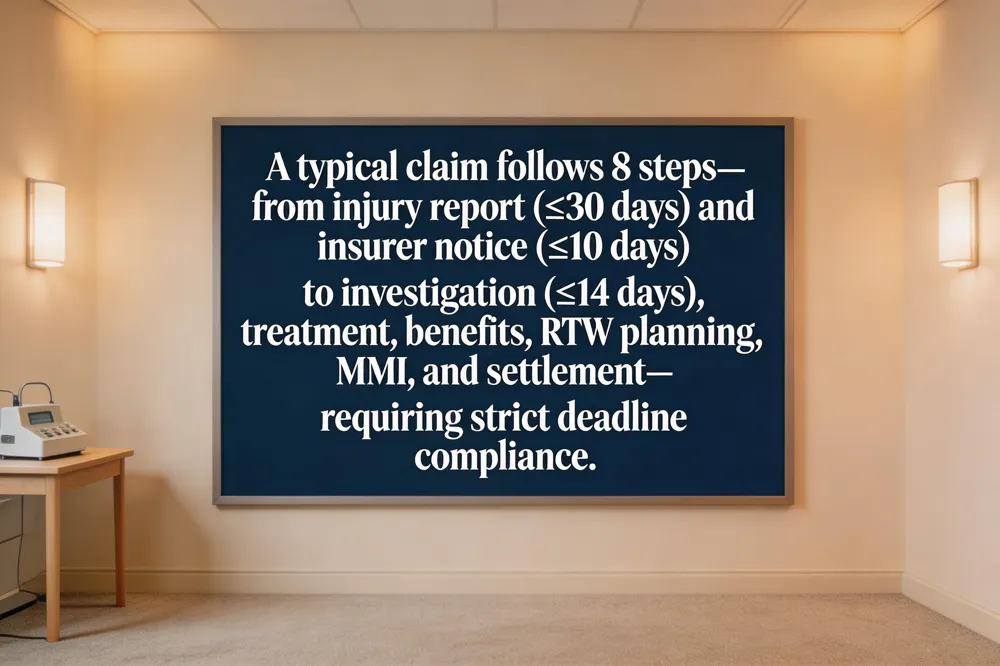 A workers’ compensation claim starts when an employee reports a workplace injury to the employer within the statutory window—generally 30 days in most U.S. states.1 The employer must then notify the workers’ compensation insurer within 10 days (or 14 days for diagnostic testing) and provide the employee with a Statement of Rights. The insurer’s response—approval, denial, or request for additional information—must be issued within 14 days of the employer’s notice. Once approved, medical treatment begins, and wage‑replacement benefits are paid bi‑weekly. The claim proceeds through a step‑by‑step timeline:2 (1) injury occurrence and immediate verbal report; (2) formal written report to employer (within 30 days); (3) employer’s incident incident to insurer (within 10 days); (4) insurer’s investigation and decision (within 14 days); (5) medical evaluation and treatment; (6) benefits issuance; (7) return‑to‑work (RTW) planning; and (8) determination of maximum medical improvement (MMI) before case closure. Critical deadlines—30‑day employer notice, 14‑day insurer response, and 18‑day benefit‑payment start when disability exceeds seven days—must be met to avoid claim denial or delayed payments.3 RTW plans are tailored to the worker’s functional capacity, with permanent adjustments until MMI is reached, at which point the claim is finalized or settlement negotiations begin. Real‑time feedback loops, enabled by secure EHR integration and automated alerts, keep clinicians, attorneys, and insurers synchronized, ensuring timely documentation, compliance with statutory timelines, and smoother settlement outcomes.4
Common Mistakes and How to Avoid Them
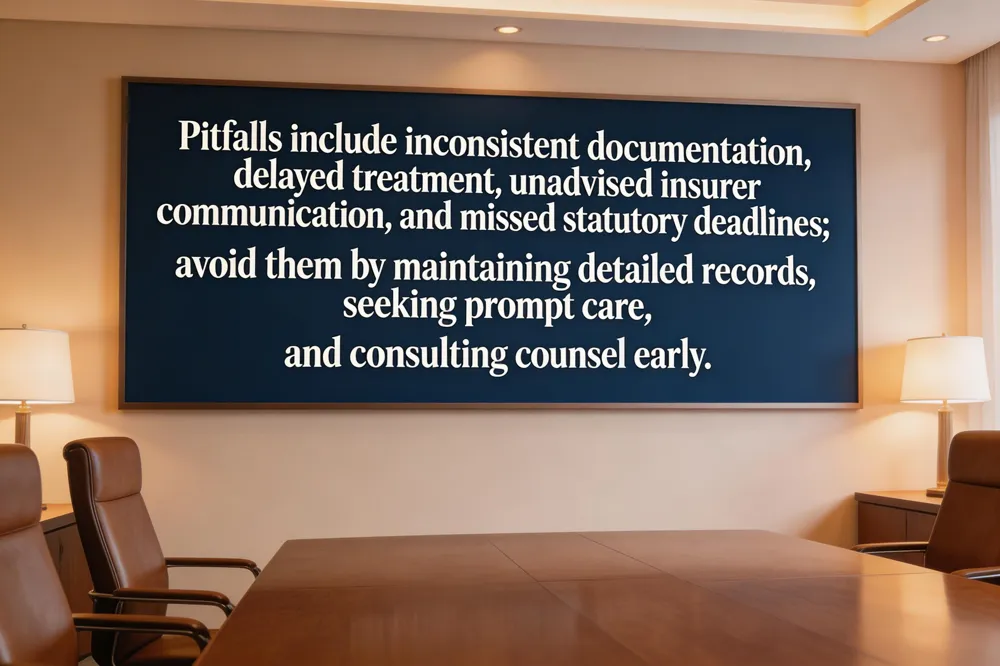 Injury claim processes can be jeopardized by a few recurring errors.
What are common mistakes in injury claims? Typical pitfalls include inconsistent documentation—failing to keep a detailed medical diary, neglecting photographs of the injury scene, or omitting witness statements. Claimants often delay seeking medical treatment, which can be interpreted as a lack of seriousness or causation. Direct, unadvised communication with insurers without legal counsel can lead to inadvertent admissions or statements that weaken the claim. Relying on memory rather than promptly recording events and missing statutory filing deadlines further increase the risk of claim denial.
Is it bad to file a workers' comp claim? Filing a workers' compensation claim is a legal right and not inherently negative. Problems arise only when the claim is filed late, contains inaccurate details, or ignores medical recommendations. To avoid issues, ensure timely reporting, accurate and complete documentation, and honest communication. Consulting an experienced attorney before interacting with insurers helps protect the claimant’s benefits and streamlines the process.
Winning a Workers’ Compensation Hearing
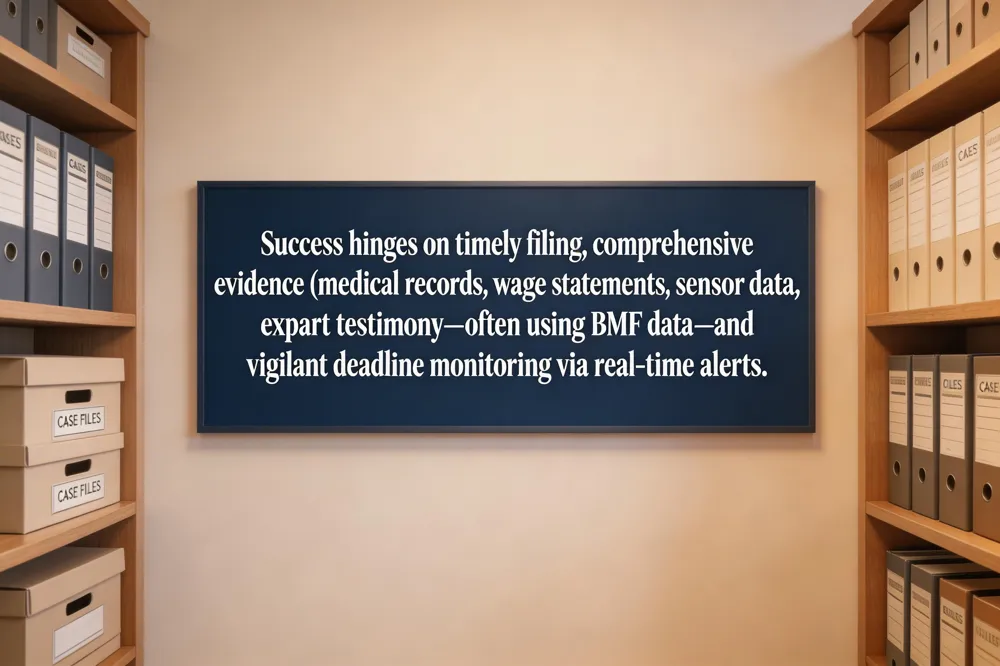 Preparation for the hearing begins the reporting the injury within the statutory window (30 days in most states) and filing all required claim forms promptly. Collect comprehensive documentation: medical records, imaging, treatment notes, wage statements, and incident reports. Use real‑time feedback loops—such as secure EHR alerts and cloud‑based case‑management portals—to monitor claim status, treatment authorizations, and benefit payments, ensuring no deadlines (e.g., the insurer’s 14‑day notice or 18‑day benefit start) are missed.
Typical questions asked by the judge focus on the exact circumstances of the injury, the worker’s treatment course, current functional limitations, any pre‑existing conditions, and proof of lost earnings. Judges also probe compliance with prescribed therapy and the completeness of the injury record.
The role of expert testimony is pivotal. An experienced medical expert, like those at NorCal Medical Consulting, provides objective, data‑driven assessments—often using real‑time biomechanical feedback and wearable sensor data—to quantify functional impairment and causation. Expert witnesses can clarify complex medical findings, support the credibility of the claimant’s injury, and address any disputes about causality or extent of disability.
Answering the key questions: To win a workers’ comp hearing, file promptly, gather robust evidence, leverage expert testimony, and retain skilled counsel who can present the facts persuasively. During the hearing, the judge will inquire about the incident, treatment history, limitations, and wage loss, testing the claimant’s documentation and expert conclusions.
Auditory‑Loss Claims and Real‑Time Feedback
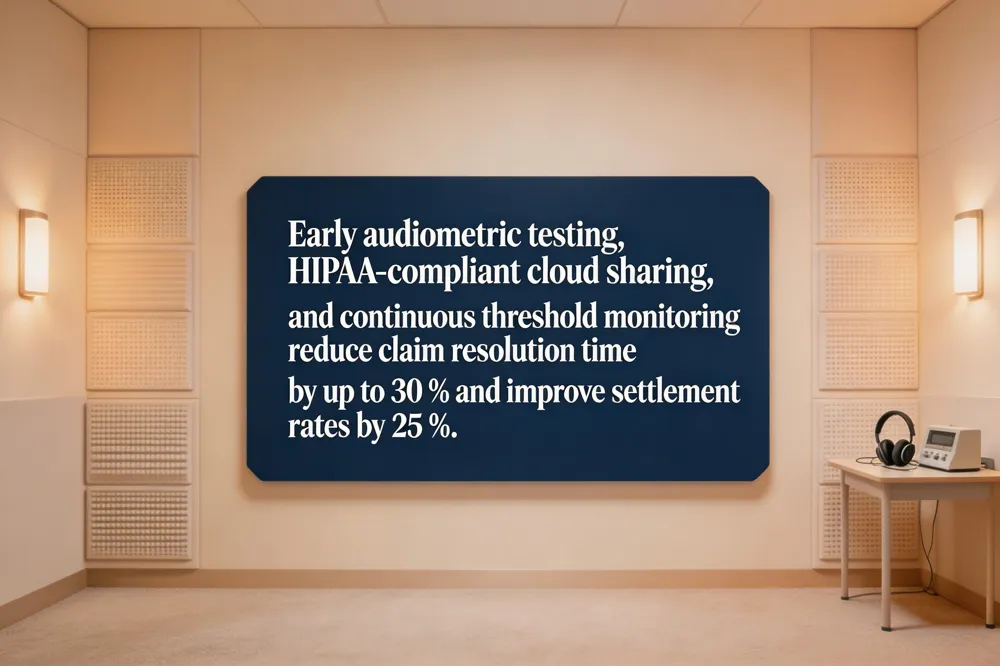 Early Audiometric Testing
Prompt audiometric testing within 30 days of a noisy‑work incident establishes a baseline and captures any immediate threshold shift. Baseline data, combined with rapid follow‑up tests, reduce recall bias and provide an objective record for claim substantiation, as recommended by NIOSH and the ADA.
HIPAA‑Compliant Data Sharing
Secure cloud‑based platforms enable clinicians, audiologists, and claims adjusters to exchange encrypted audiogram results, exposure logs, and treatment notes in real time while remaining fully HIPAA‑compliant. Automated alerts flag missing documentation, ensuring that deadlines set by state workers’ compensation boards (e.g., the 14‑day insurer notice in New York) are met.
Impact of Real‑Time Thresholds on Claim Resolution
When auditory thresholds are monitored continuously, any deteriorating loss is flagged instantly, allowing experts to adjust loss assessments and recommend interventions before permanent damage occurs. Studies show that incorporating real‑time feedback reduces average claim resolution time by up to 30 % and can increase settlement rates by 25 % due to clearer, timestamped evidence.
How does a workers comp claim affect the employer?
A workers‑comp claim raises the employer’s experience‑modification rating, leading to higher insurance premiums. Indirect costs include wages for non‑covered time, overtime for other staff, administrative burdens, and potential legal expenses. Frequent claims can affect reputation and trigger OSHA scrutiny.
The value of real‑time feedback loops in injury case reviews (2022)
Real‑time feedback loops dramatically improve the accuracy and efficiency of injury case reviews by delivering instantaneous, data‑driven insights into a worker’s condition. In 2022, wearable sensors and continuous monitoring allowed clinicians to capture objective metrics—such as auditory thresholds and biomechanical stress—while the injury was occurring, reducing reliance on retrospective recollection.
Future Directions: AI, Predictive Analytics, and Smart Textiles
 AI‑driven outcome predictions are reshaping personal‑injury assessments. Predictive analytics aggregates historical case records—medical findings, procedural milestones, and jurisdictional data to generate evidence‑based projections of claim value and settlement likelihood. Continuous learning refines these models after each resolved case, enhancing accuracy over time. When coupled with real‑time feedback loops, attorneys receive up‑to‑the‑minute valuation updates during negotiations, allowing dynamic adjustment of strategies and faster settlements.
Smart textiles and optical‑fiber sensors represent the next wave of wearable biomechanics. Inertial measurement units and surface electromyography are already providing joint‑angle and muscle‑force data within 200 ms latency; embedding these sensors in fabrics or fiber‑optic strands creates unobtrusive monitoring of ergonomic stress, balance, and auditory exposure. This data feeds predictive models that flag high‑risk patterns before injury manifests, supporting early intervention and personalized rehabilitation plans.
Integrating predictive models with real‑time loops closes the gap between detection and action. For example, a wearable system can instantly alert a worker of excessive joint‑angle asymmetry, prompting corrective cues while the AI model updates risk scores in the background. Such seamless integration promises reduced injury rates, faster claim resolution, and stronger, data‑driven expert testimony in legal and insurance contexts.
Putting Real‑Time Feedback to Work
Real‑time biomechanical and clinical feedback accelerates workplace injury assessments, giving claimants faster, evidence‑based decisions, helping employers reduce liability and downtime, and enabling insurers to process claims within statutory deadlines. NorCal Medical Consulting leverages wearable sensors, AI‑driven analytics, and secure cloud platforms to deliver instant, HIPAA‑compliant updates on functional capacity, auditory loss, gait, and ergonomic risks. Our expert witnesses integrate these data streams into comprehensive reports that satisfy legal and insurance standards. Contact NorCal today to initiate a data‑driven, timely injury review and improve claim outcomes for all parties.
Footnotes
-
https://www.pcec247.com/blog/2025/january/what-to-expect-from-a-workers-compensation-injur/ ↩
-
https://www.ffvamutual.com/blog/7-steps-of-the-workers-comp-claims-process/ ↩
-
./understanding-the-timeline-of-defense-base-act-injury-claims#the-heart-of-the-timeline-benefits-review-and-initial-resolution ↩