Why Photographic Evidence Matters for Injured Workers
Visual documentation creates an objective record that insurers and courts rely on to establish fault, injury severity, and workplace conditions. High‑resolution photos of vehicle damage, skid marks, hazardous surfaces, and the injured worker’s wounds preserve details that fade from memory, helping claim adjusters and attorneys quantify losses and justify benefits. NorCal Medical Consulting uses these images to corroborate medical findings, perform injury causation analysis, and provide expert testimony that links the visual evidence to clinical assessments. To ensure admissibility, photographs must be taken promptly, timestamped, unedited, and stored with a clear chain of custody; including a scale reference and multiple angles further supports credibility. Properly documented visual evidence thus strengthens legal and insurance arguments, accelerates claim resolution, and protects the worker’s rights.
Understanding OSHA Record‑Keeping Requirements
 OSHA 300 Log and its purpose
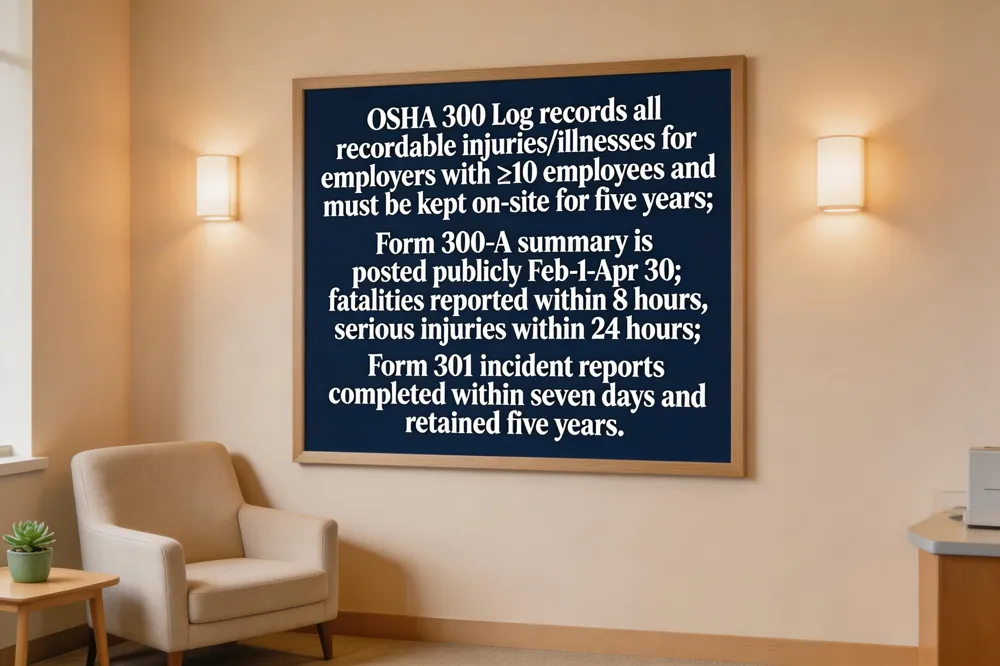
The OSHA 300 Log (Form 300) records every work‑related injury or illness that meets OSHA’s recordable criteria, documenting date, classification, severity (days away, restricted work, job transfer) and employer details. It must be kept on‑site for five years.
Reporting timelines and posting obligations
Employers with ≥10 employees must update the log promptly after each recordable event. A summary (Form 300‑A) must be posted publicly between Feb 1‑Apr 30 for the prior year. Fatalities are reported within 8 hours; amputations, loss of an eye, or hospitalizations within 24 hours.
Form 300A summary and PDF availability
Form 300‑A aggregates annual totals (recordable cases, days away, job‑limited days, fatalities). The fillable PDF is downloadable from OSHA’s website or via the Injury Tracking Application.
Form 301 incident reports
Form 301 captures detailed incident data (date, time, location, description, body part, witness statements). It must be completed within seven days and retained for five years.
Workplace injury and employee accident report forms
These standardized forms collect employee info, job duties, injury description, witnesses, and immediate medical care. Prompt completion aids OSHA compliance, workers‑compensation claims, and expert assessments.
OSHA 300 Log – Official record of all recordable injuries/illnesses; required for employers with ≥10 employees; kept for five years.
OSHA 300 Log requirements – Must document death, days away, job transfer, medical treatment beyond first aid, or loss of consciousness; posted summary (300‑A) required.
OSHA 300A Form PDF – “Summary of Work‑Related Injuries and Illnesses” PDF downloadable from OSHA; posted publicly each year.
OSHA Form 300A Summary – Annual aggregate of Log 300 data; posted within 30 days after year‑end.
OSHA Form 301 – Detailed injury/illness report; completed within seven days; retained five years.
OSHA Incident Report Form – Same as Form 301; records serious incidents (fatality, amputation, etc.) for OSHA investigation.
Workplace injury report form – Standardized document capturing essential injury details for internal and regulatory use.
Employee Accident Report form PDF – Printable PDF used to document accidents; supports workers‑compensation and legal claims.
Step‑by‑Step Guide to Photographing Injuries
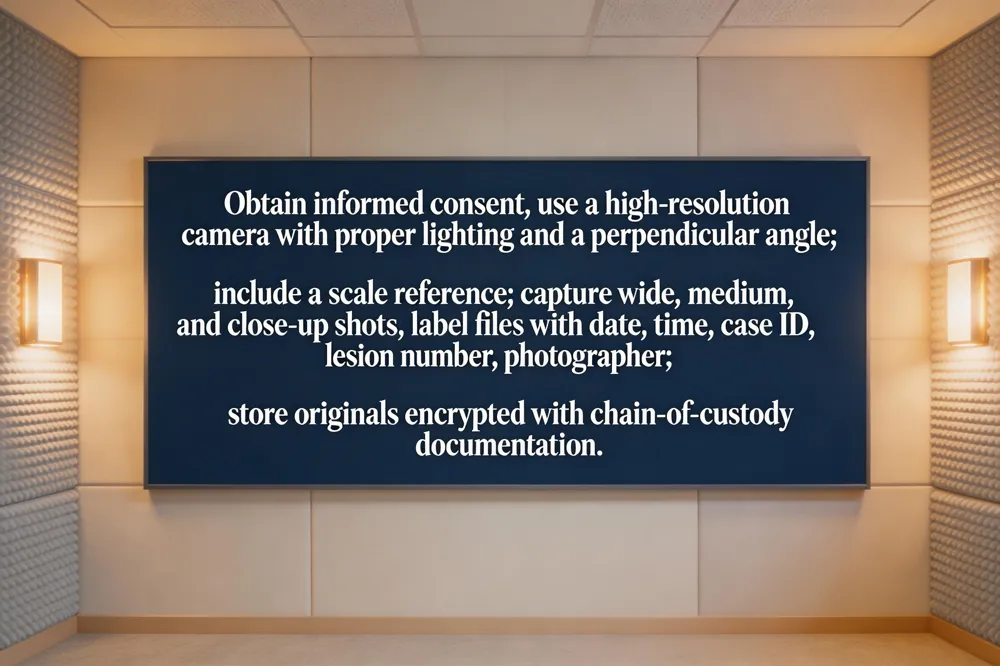
Camera setup, lighting, and angles – Use a digital camera or smartphone set to the highest resolution. Position the lens perpendicular (≈90°) to the wound to avoid distortion, and employ even, diffuse lighting or a ring light to eliminate shadows. A tripod or steady hand helps keep the shot stable.
Use of scale references and multiple distances – Place a ruler or known‑size object in the same plane as the injury. Capture three perspectives: a wide‑angle view for context, a medium‑range shot showing anatomical landmarks, and a close‑up with the scale to document size and depth.
Labeling, metadata, and secure storage – Immediately label each file with date, time, case ID, lesion number, and photographer name. Preserve original, unedited files in an encrypted, password‑protected repository and maintain a chain‑of‑custody log.
Documenting injuries in statements – Write a factual, chronological narrative of the injury, noting date, time, location, observable symptoms, and medical findings. Reference the photographs, include any witness statements, sign and date the statement, and retain a copy for legal or insurance review.
Documenting the Accident Scene Effectively
 Safety first and securing the scene: ensure everyone is safe, call emergency services if needed, and protect the area with hazard lights or flares to preserve evidence.
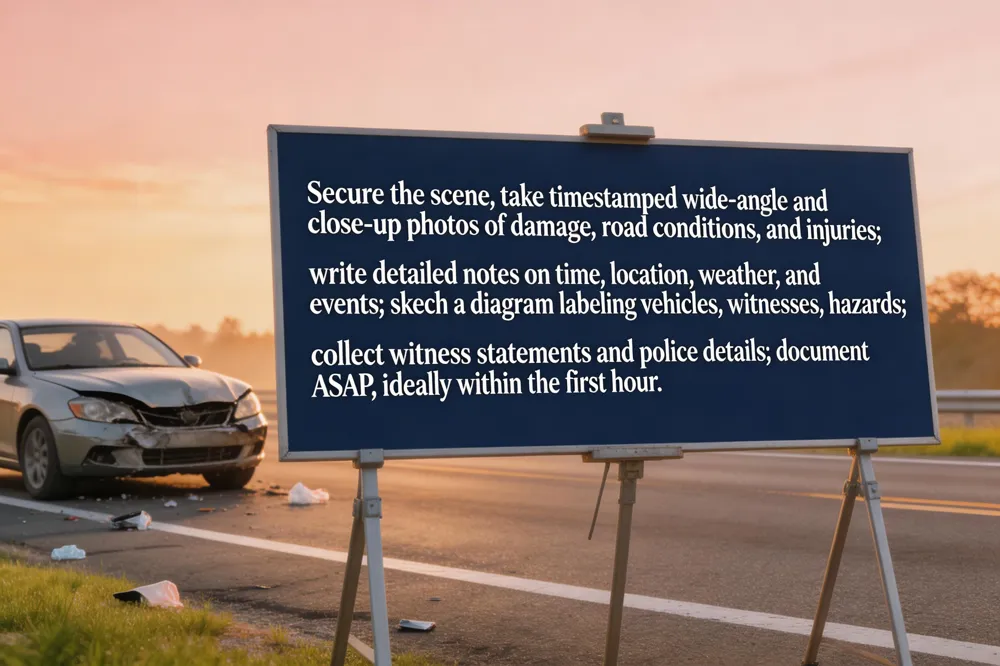
How to document an accident scene? Take a series of timestamped photographs that include wide‑angle shots of the whole scene, close‑ups of vehicle damage, road conditions, traffic signs, and any visible injuries. Write detailed notes describing the sequence of events, weather, lighting, and contributing factors, and sketch a simple diagram labeling each vehicle, witness, and hazard. Collect contact information and statements from all witnesses, and obtain the police officer’s name, badge number, and report number.
What should you document while making observations? Record date, exact time, precise location (GPS or landmarks), sketch vehicle positions, note skid marks, debris, and road or weather conditions. Capture clear photos and videos from multiple angles of damage, signage, traffic signals, and injuries.
When is the best time to document a crash? As soon as safety is secured—ideally within the first hour—capture photos, videos, witness information, and notes before the scene changes.
Can I refuse to have my photo taken by my employer? There is no federal law requiring it; you may refuse, but an employer may have legitimate business reasons for documentation.
Can photographs be used as evidence? Yes, when authenticated and accurately reflecting the scene they meet court evidentiary standards.
What is the first thing that should be done when a coworker suffers an injury? Protect the injured worker’s health immediately—call 911 for serious injuries or administer first aid for minor ones—then move them from hazards, secure the scene, and begin documentation and reporting.
Special Considerations for Complex Injuries and Worker Rights
 De‑gloving injuries are severe soft‑tissue avulsions where skin and subcutaneous tissue separate from underlying structures, often in high‑energy crashes. Open wounds expose muscle or bone; closed forms, such as Morel‑Lavallée lesions, retain skin but collect fluid. Prompt assessment, imaging, and treatment—ranging from grafts to compression and possible amputation—are critical.
When a coworker is injured, the first priority is health and safety: call 911 for serious cases, provide trained first aid for minor ones, then move the employee from hazards, secure the scene, and begin documentation.
Employees may refuse workplace photos, there is no federal mandate requiring them; however, employers may need images for safety records, and refusal can hinder documentation.
Photographs, when taken promptly, timestamped, and unedited, are strong evidentiary tools in workers’ compensation claims, helping prove injury severity, scene conditions, and causation.
Preserving Evidence for Legal and Insurance Review
 Proper chain‑of‑custody documentation begins the moment a photo is taken: record the photographer’s name, date, time, and location, and keep a log of every transfer or access. Preserve original files in their unedited format (RAW or original JPEG) and embed metadata—date, time, GPS coordinates—to verify authenticity. Use a calibrated scale (ruler, measuring tape, known coin) in each close‑up shot so size and distance can be proven later. Store images on encrypted, read‑only media, back them up in at least two secure locations (e.g., encrypted cloud and external hard drive), and restrict access to authorized personnel only. Follow OSHA’s record‑keeping rules: retain originals for a minimum of five years, label files with descriptive names, and maintain a documented chain of custody to satisfy both OSHA compliance and forensic‑photography standards.
The Role of Medical Consulting and Expert Assessment
 NorCal Medical Consulting leverages decades of otology and industrial‑medicine experience to translate visual evidence into medically sound conclusions. By pairing high‑resolution photographs of the accident scene—showing noisy machinery, missing hearing‑protection devices, and the worker’s position—with detailed injury images, consultants can reconstruct exposure levels and correlate them with audiometric findings. Their expert analysis quantifies the extent of hearing loss, attributes causation to specific workplace hazards, and articulates the link in clear, court‑ready reports. Strategically, this documentation supports claim narratives, bolsters settlement negotiations, and withstands cross‑examination. When photographs are timestamped, scaled, and stored with a chain‑of‑custody log, NorCal’s assessments become powerful, admissible evidence that reinforces the credibility of a worker’s claim and guides litigators toward favorable outcomes.
Putting It All Together: A Checklist for Injured Workers
- Safety and medical care – Secure the area, call emergency services if needed, and obtain medical evaluation. Treatment creates a medical record that insurers and courts rely on.
- Systematic photographic documentation – When safe, photograph the scene, equipment, hazards, and injuries from wide, medium, and close‑up views, adding a scale, date stamp, and GPS data; keep originals unedited.
- Accurate OSHA record‑keeping – Complete the OSHA 300 Log and 301 Incident Report promptly, attaching photos, witness statements, and a narrative.
- Preservation of digital evidence – Store images and videos in folders, back up to multiple locations, and log who accessed each file.
- Engaging consultants early – Contact forensic photographers, medical specialists, and workers‑comp attorneys to review evidence and strengthen the claim.