Start With the Hearing Evidence
An audiogram can document hearing loss and show a pattern consistent with noise exposure, but it cannot, by itself, establish that work caused the loss. For adjusters, attorneys, and injured workers, the central task is to assess whether the hearing findings, exposure history, and medical evidence fit together.
Start by identifying the exposure: repeated workplace noise, a single intense event, or both. Record its source, duration, timing, and any use of hearing protection, then compare that history with the audiogram and earlier test results. Noise-related loss often affects high frequencies, but the pattern is clinical evidence, not a standalone finding of causation (NIH review of noise-induced hearing loss).
The assessment should also consider age-related change, ototoxic chemicals, medications, and non-work noise. Under 20 C.F.R. § 702.441, an audiogram’s evidentiary value depends on compliance with specified testing, reporting, and interpretation requirements. NorCal Medical Consulting reviews auditory claims using ASSR testing from 500 Hz through 4,000 Hz, including the 3,000 Hz frequency required under the Department of Labor’s Sixth Edition impairment schedule.
How Workplace Noise Can Damage Hearing
 When you review a claim for hearing loss, understand that occupational noise-induced hearing loss is sensorineural damage caused or contributed to by hazardous sound at work. Repeated exposure can injure cochlear hair cells and other auditory structures, while a single intense event, such as a blast, can cause acute damage. NIOSH describes occupational noise and chemical exposures that can harm hearing.
The risk depends on sound intensity and exposure duration. NIOSH recommends limiting occupational exposure to 85 dBA averaged over an eight-hour workday, a risk benchmark rather than proof that a particular worker sustained hearing damage. For claims review, our team’s auditory evaluations consider hearing test results alongside the documented work and exposure history.
Noise may not be the only workplace factor. Some chemicals can damage parts of the ear or make it more sensitive to noise, so include relevant chemical agents in the exposure record along with sound levels, duration, and any acute event.
Possible signs include tinnitus, muffled or distorted speech, difficulty understanding conversation, trouble hearing high-pitched sounds, and ear fullness or pressure. Symptoms may follow one intense event or emerge gradually with repeated exposure, but they do not establish occupational cause or measure impairment. To evaluate the claim, our physicians interpret the hearing assessment alongside medical records and exposure history.
Read the Audiogram in Context
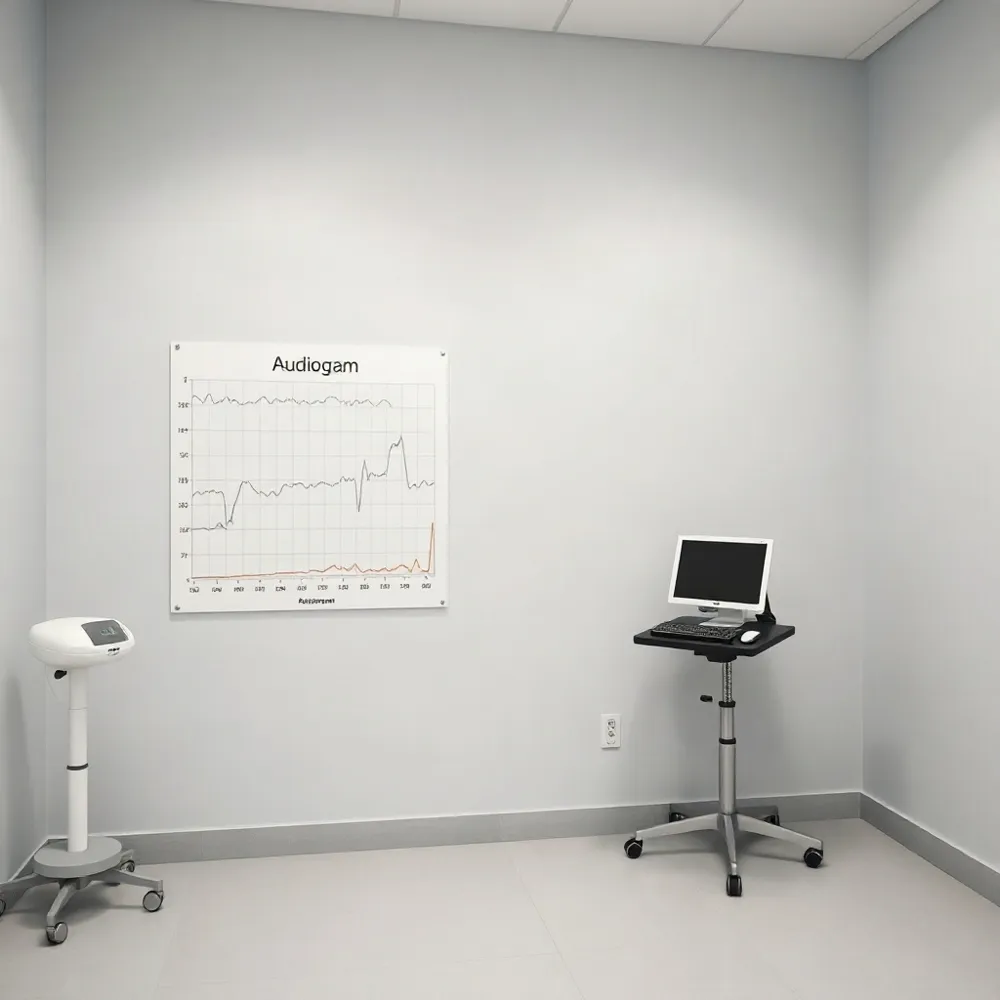 Noise-induced hearing loss (NIHL) often appears as a high-frequency dip on an audiogram, while age-related hearing loss more often slopes downward across higher frequencies. Neither pattern alone establishes what caused a worker’s hearing loss.
A common NIHL pattern has relatively better low-to-mid-frequency hearing, followed by a notch between about 3,000 and 6,000 Hz, often near 4,000 Hz, with some recovery at higher frequencies. The pattern can support a noise-related assessment, but it must be considered with exposure history and other clinical evidence. Clinical guidance on NIHL describes the notch as a characteristic finding, not proof of occupational causation.
Presbycusis, or age-related hearing loss, more often presents as gradual high-frequency decline without a distinct notch or recovery. The two conditions can coexist, so one audiogram may reflect both age and noise exposure. Our physicians at NorCal Medical Consulting assess audiometric findings alongside age, work history, and other relevant records rather than assigning a cause from one feature.
NIHL is often similar in both ears when exposure has been comparable. A directional or localized source, such as firearms or sirens, can produce asymmetry, so an ear-to-ear difference does not automatically rule out noise exposure. The NIHL audiogram pattern is one part of a broader evaluation.
Compare baseline and serial audiograms to see when thresholds changed and whether the pattern developed over time. Review workplace and recreational noise, medical history, and possible contributors such as ototoxic medications or chemicals. NorCal Medical Consulting’s chart-based reviews bring these records together so claims findings distinguish documented impairment from conclusions about its cause.
Temporary Changes and Lasting Damage
Noise-induced hearing loss can be temporary or permanent. A temporary threshold shift may cause muffled hearing, ear fullness, or ringing, then improve as the auditory system recovers. A permanent threshold shift reflects lasting injury to cochlear hair cells, hair bundles, or nerve fibers.
After moderate noise damage, hearing may recover within 24–48 hours. The clinical review notes that hearing thresholds still elevated at 14 days indicate permanent threshold shift, although recovery may continue up to 30 days. These timeframes provide clinical context, not a stand-alone test of causation in a claim. The review of noise-induced hearing loss distinguishes temporary recovery from persistent damage.
Repeated workplace exposure, prolonged noise, or one intense acoustic event can cause lasting injury. Lost sensory cells do not spontaneously regenerate, so symptoms that improve do not necessarily establish that all noise-related injury has resolved. See temporary and permanent auditory threshold shifts for more on this distinction.
Chronic noise-induced hearing loss has no cure. Hearing aids may help manage communication difficulties, while protection from further hazardous exposure can limit additional harm; neither restores lost sensory cells. NorCal Medical Consulting’s physicians use ASSR testing across 500 Hz to 4,000 Hz, including 3,000 Hz, when assessing auditory claims. Cleveland Clinic’s overview of noise-induced hearing loss discusses management options, while treatments studied for acute acoustic trauma should not be treated as a remedy for chronic cumulative loss.
Build a Defensible Claims Record
Yes. An employee may seek workers’ compensation benefits for hearing loss linked to occupational noise, often evaluated as an occupational disease. Eligibility, deadlines, and impairment rules depend on the applicable state or federal system, so identify the governing framework before assessing the evidence.
Build the record from exposure details and medical history, not from an audiogram alone. Document the noise source and character, intensity, duration, frequency, timing, hearing protection, any single blast, job records, symptoms, possible chemical exposures, and pre-employment or serial audiograms. The NIOSH overview of occupational hearing loss also identifies ototoxic chemicals as possible contributors to hearing damage.
Pure-tone audiometry records hearing thresholds, but it may not show how well a person understands conversation in background noise. Speech-in-noise testing can assess that difficulty, while other measures can evaluate outer hair-cell function or auditory responses. NorCal Medical Consulting’s auditory evaluations include ASSR testing from 500 Hz through 4,000 Hz, including 3,000 Hz.
For LHWCA-related claims, 20 C.F.R. § 702.441 sets conditions for an audiogram to receive presumptive evidentiary status. These include requirements for testing, reporting, interpretation, calibration, and delivery to the employee. The regulation directs impairment measurement to the most currently revised edition of the AMA Guides, rather than specifying a fixed edition.
A notch, reported symptoms, or an OSHA standard threshold shift does not by itself establish medical causation or functional impairment. Consider presbycusis, other medical causes, and chemical exposures alongside work history and test results. For further guidance on documenting occupational hearing claims, see eligibility and claim process for workers’ compensation.
Apply the Federal DBA Framework
 The Defense Base Act (DBA) extends the Longshore and Harbor Workers’ Compensation Act (LHWCA), with exceptions, so relevant LHWCA occupational-disease rules apply to covered DBA hearing-loss claims. The medical review assesses whether the records support a work relationship and documents the nature and extent of impairment; the federal claims process determines coverage and benefits.
A review may consider work and noise-exposure history, prior and current audiograms, and other medical records. These materials help assess whether the hearing findings fit the claimed exposure and whether other factors may also contribute. The Department of Labor’s DBA FAQ explains the federal claim framework, but it does not establish audiometric criteria or an impairment-rating method.
For an occupational-disease claim, the Department of Labor requires the employee or eligible survivor to file Form LS-203 with OWCP within two years after becoming aware of the relationship between the disease, death, or disability and the work. The FAQ also notes that additional time applies to certain hearing-loss and occupational-disease injury notices, but it does not specify the length or conditions of that extension. Record the awareness date and confirm deadlines against the governing law and case facts.
NorCal Medical Consulting provides independent evaluations and record reviews, including Auditory Steady-State Response (ASSR) testing from 500 Hz through 4,000 Hz. NorCal Medical Consulting's supplied context identifies this range as required under the Department of Labor’s Sixth Edition impairment schedule because it includes 3,000 Hz. These medical findings inform the claim; they do not decide coverage or benefits.
Keep the Findings and Conclusions Distinct
A sound hearing-loss analysis keeps three questions separate: what impairment the testing documents, what workplace noise or chemical exposure occurred, and whether the full record supports a relationship between them. An audiogram pattern, tinnitus, or a worker’s account can inform that review, but none alone establishes occupational causation.
Under 20 C.F.R. § 702.441, an audiogram’s evidentiary value depends on specified testing, reporting, and interpretation requirements. Claims decisions also depend on the applicable process, including the federal framework for DBA claims described by the Department of Labor.
An independent, evidence-based medical review can clarify how the test results, exposure history, and other clinical factors fit together without treating a possible pattern as a final answer. NorCal Medical Consulting provides written evaluations and expert testimony for federal claims, with findings grounded in the medical and occupational record.