Why Occupational Hearing Loss Matters
Noise‑induced hearing loss (NIHL) affects roughly 22 million U.S. workers each year, representing more than 30 % of all workers’‑ illness claims and making it one of the most common chronic occupational diseases. Persistent hearing loss impairs communication, increases safety risks, and reduces productivity; workers often must to instruction higher volumes, experience tinnitus, and may suffer isolation or cognitive decline. Legally, virtually every state treats NIHL as a compensable occupational injury, with statutes requiring audiometric documentation, timely reporting, and employer‑provided hearing‑conservation programs. In Pennsylvania, a loss of at least 10 % impairment is compensable, and claims must be filed within 120 days of awareness. Compensation typically covers medical expenses (audiograms, hearing aids), wage replacement, and permanent partial disability benefits calculated on the degree of loss. Failure to meet OSHA’s 85 dBA action level or to supply adequate protection can strengthen a claim, while thorough baseline and follow‑up audiograms are essential evidence for establishing work‑relatedness.
Regulatory Framework and Noise Exposure Basics
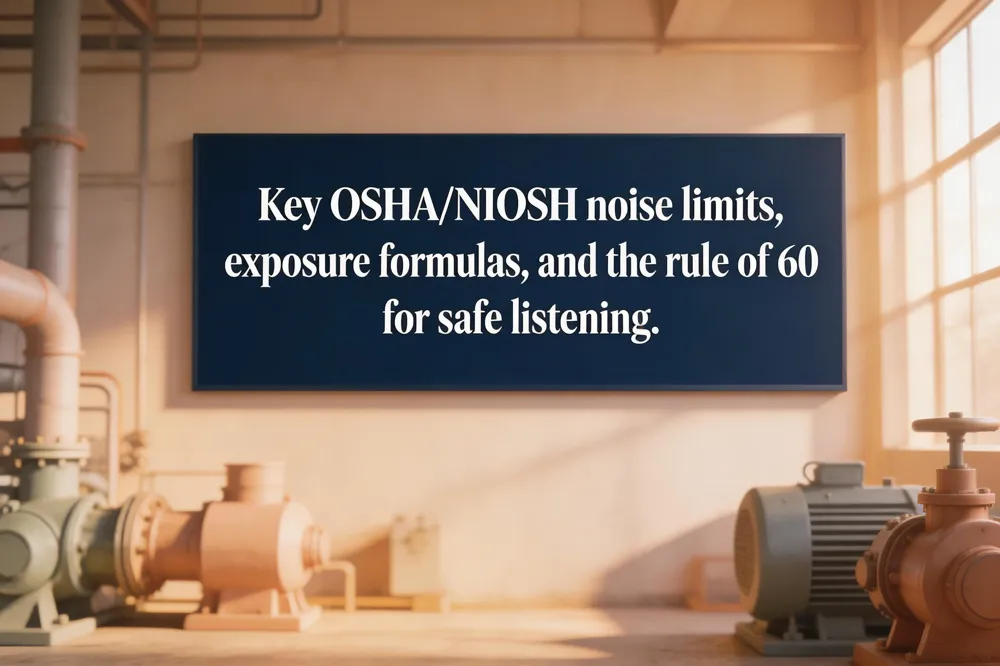 What is the rule of 60 in noise‑induced hearing loss? The rule of 60 (60/60 rule) advises keeping personal audio device volume at ≤60 % of maximum and limiting continuous listening to 60 minutes before a break. This keeps exposure below the ≈85 dB level that can cause permanent cochlear damage, translating occupational safety limits into everyday practice.
Noise exposure calculation formula: D(%) = 100 × (C/T) where C is actual exposure time and T = 8 / 2^((L‑90)/5). For multiple exposures, sum each segment’s C/T. The 8‑hour TWA (dB) = 16.61 log₁₀(D/100) + 90.
Noise exposure limits chart: OSHA’s permissible limits rise as exposure time falls (e.g., 90 dBA for 8 h, 95 dBA for 4 h, 105 dBA for 1 h, 110 dBA for ½ h, 115 dBA for ¼ h). Impulse noise must stay ≤140 dB peak.
What is the impulse impact noise level considered hazardous for hearing? A peak SPL of 140 dB or higher is hazardous; OSHA requires hearing‑conservation measures when this threshold is exceeded.
Occupational noise exposure: Defined as repeated or continuous exposure ≥85 dBA TWA. Employers must monitor, implement engineering controls, and provide hearing protection.
NIOSH noise exposure limits: REL = 85 dBA (8‑h), with a 3‑dB exchange rate (e.g., 88 dBA for 4 h). These limits are more protective than OSHA’s 90 dBA PEL.
OSHA noise level standards PDF: Accessible at https://www.osha.gov/handbooks/national/occupationalnoise.pdf (29 CFR 1910.95), which includes exposure‑time‑level tables and hearing‑conservation program requirements.
Medical Surveillance: Audiometric Testing and Monitoring
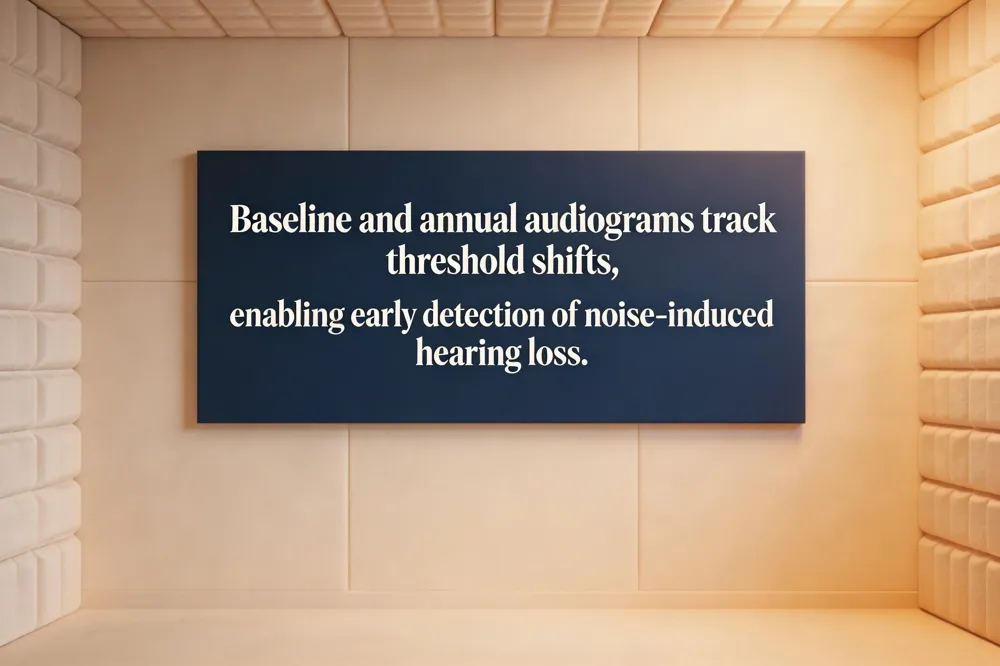 Baseline audiogram requirements – Employers must obtain a baseline audiogram within six months of an employee’s first exposure to noise at or above 85 dB TWA (or up to twelve months when a mobile testing van is used). This establishes a pre‑employment reference point for future comparisons.
Annual follow‑up testing schedule – After the baseline, a follow‑up audiogram is required at least once every twelve months, calculated from the date of the baseline or the previous test, not from the calendar year. This regular schedule enables early detection of any threshold shift.
Standard Threshold Shift (STS) definition – An STS is a worsening of at least 10 dB in the average hearing thresholds at 2,000, 3,000 and 4,000 Hz in either ear compared with the most recent baseline. OSHA mandates reporting of a confirmed STS within 21 days.
Interpretation of audiograms – Audiograms are compared to baseline and prior tests to identify patterns consistent with noise‑induced hearing loss (NIHL). A characteristic 4 kHz notch, progressive high‑frequency loss, or a cumulative 10 dB shift signals a compensable injury and triggers counseling, protective‑equipment review, and possible medical referral.
Long‑term monitoring and early detection – Continuous audiometric monitoring tracks hearing health over time, allowing employers to intervene with engineering controls, fit‑tested hearing protection, and training before permanent loss occurs. Documentation of serial audiograms, noise‑exposure records, and medical opinions forms the evidentiary backbone for workers’ compensation claims and expert testimony.
Audiometric testing monitors an employee's hearing how often – Baseline testing within six months of exposure, then at least yearly thereafter, ensures any standard threshold shift is caught promptly.
Audiometric testing monitors an employee's hearing when – The longitudinal approach compares each new audiogram to the baseline, revealing gradual declines linked to workplace noise and supporting timely protective measures.
How does hazardous noise result in hearing loss – Exposure to 85 dB(A) or higher bends and damages cochlear hair cells; repeated stress leads to irreversible sensorineural loss, while sudden impulse noises cause immediate acoustic trauma.
How long do you have to be exposed to loud noise for hearing loss – Safe exposure drops to 8 hours at 85 dBA; each 3 dB increase halves the permissible time (e.g., 88 dBA = 4 hours). Impulse noises above 140 dBP can cause instant loss.
Eligibility and Claim Process for Workers' Compensation
 Statutory filing deadlines – In Pennsylvania a hearing‑loss claim must be filed within 120 days of when the worker knows (or should know) that workplace noise caused or worsened the loss. Other states impose similar limits, often two to three years from diagnosis. Prompt reporting preserves the right to benefits.
Employer reporting obligations – Employers are required by OSHA (90 dB PEL; 85 dB action level) to maintain a hearing‑conservation program, provide calibrated audiograms, and record noise‑level monitoring. Failure to supply adequate protection or training can support claim liability.
Medical documentation requirements – A qualified audiologist or ENT must produce a current audiogram showing at least a 10 % impairment (Pennsylvania) or a Standard Threshold Shift (≥10 dB at 2‑4 kHz). Baseline pre‑employment audiograms are essential for comparing deterioration. Medical opinions linking the loss to occupational noise are required for the work‑relatedness determination.
Baseline and follow‑up audiograms as evidence – Serial audiograms, compared to the baseline, provide the strongest objective proof of progressive loss. An OSHA‑defined STS (10 dB shift) triggers employer corrective action and strengthens a workers’ comp claim.
Role of expert testimony – Physicians, audiologists, and industrial‑hygiene experts testify on causation, degree of loss, and adequacy of employer controls. Their "more probable than not" opinion often decides the outcome of a hearing‑loss settlement or hearing.
Key Q&A
- Hearing loss and Workers compensation: Eligibility requires a work‑related diagnosis, timely filing, and medical evidence such as baseline hearing tests.
- Can you make a claim for hearing loss at work?: Yes—if employer negligence in noise protection is shown, compensation for medical costs, wages, and pain may be obtained.
- Can I claim hearing loss from work?: Notify the employer, obtain an ENT assessment, and file the state‑issued claim form; settlements are based on permanent impairment percentages.
- What evidence is needed for a hearing loss claim?: Audiograms, baseline tests, noise‑level records, protection‑use documentation, and coworker statements.
- Workers' compensation hearing loss settlement: Calculated on impairment level, age, occupation, and future medical needs; settlements range from a few thousand to six‑figure amounts.
- Workers' comp hearing: A formal proceeding where medical records and expert testimony determine benefits; appeals must follow strict deadlines.
Quantifying Compensation and Benefits
 Medical Expense Coverage – Workers’ compensation reimburses all medically‑necessary costs: audiograms, physician visits, hearing‑aid purchases, batteries, servicing, and tinnitus therapy.
Hearing‑Aid and Assistive‑Device Costs – The insurer pays the full price of a hearing aid (average $2,000–$4,500) and can include cochlear‑implant expenses when the loss is severe.
Pain‑and‑Suffering & Loss of Earning Capacity – Awards for emotional distress, reduced quality of life, and diminished earning ability are added to medical payments.
State and Federal Compensation Tables – Pennsylvania, for example, provides a disability‑rating table (0‑100 % in 10‑% increments) and a wage‑replacement rate of about 66 % of lost earnings. Federal tables (e.g., VA) use similar percentages but differ in dollar amounts and cost‑of‑living adjustments.
Tinnitus‑Specific Awards – Persistent tinnitus may receive a separate lump‑sum or periodic payment, especially when it causes sleep disturbance, anxiety, or requires ongoing therapy.
How much compensation for hearing loss and tinnitus? Mild cases settle for $10‑$30 k; moderate injuries $50‑$200 k; severe or chronic tinnitus claims can exceed $300 k.
Hearing loss claims average payout Baseline settlements range $5‑$25 k for medical costs; severe permanent loss often yields $75‑$150 k or more.
Hearing loss compensation tables Disability ratings (0‑100 %) translate to monthly benefits; e.g., a 50 % rating pays roughly $1,133 per month (VA) or state‑specific equivalents.
VA hearing loss compensation tables 2026 rates: 10 % = $180.42, 30 % = $552.47, 50 % = $1,132.90, 100 % = $3,938.58 (tax‑free).
How much compensation for noise‑induced hearing loss? Partial loss $10‑$30 k; moderate $30‑$70 k; total one‑ear loss $50‑$80 k; bilateral deafness $150‑$200 k+.
Tinnitus compensation calculator – Online tools estimate claim value based on symptom severity, medical costs, and lost wages; expert audiometric data ensure accurate calculations.
Workplace Accommodations and Legal Protections
 Under the Americans with Disabilities Act (ADA) and comparable state statutes, an employee cannot be terminated solely because of a hearing impairment. Employers must first engage in an interactive process to identify reasonable accommodations—such as assistive listening devices, captioned video platforms, sign‑language interpreters, or visual fire‑alarm alerts—before considering adverse action. Only when the employee cannot perform the essential functions of the job even with a reasonable accommodation, or when the accommodation would impose an undue hardship, may termination be lawful.
The ADA requires employers with 15 or more employees to provide effective communication tools for deaf or hard‑of‑hearing workers. Common accommodations include:
- Qualified sign‑language interpreters or video‑remote‑interpreting services;
- Captioning and real‑time text (CART) for meetings and trainings;
- Visual and tactile safety alerts such as strobe‑light alarms or vibrating pagers;
- Personal amplification devices, hearing‑aid‑compatible headsets, and assistive listening systems;
- Workspace modifications that reduce background noise—sound‑absorbing panels, quiet zones, or relocation away from high‑noise equipment;
- Flexible scheduling or telework options to minimize auditory distractions.
Auditory‑processing accommodations focus on clarifying spoken information and limiting competing noise, using the same visual, text‑based, and environmental controls.
If an employer fails to provide these accommodations, the employee may file a discrimination claim with the EEOC or pursue civil action under the ADA. Tinnitus caused by occupational noise is also compensable under workers’ compensation when medical evidence links the condition to the job, covering diagnostics, treatment, and lost‑wage benefits.
Prevention, Controls, and Future Outlook
 Noise hazards and control measures
Noise hazards arise when workers are exposed to elevated sound levels, typically measured in A‑weighted decibels (dBA), which can cause irreversible sensorineural hearing loss and related health issues. The most effective way to mitigate these hazards is to eliminate or reduce the source of the noise through engineering controls such as selecting low‑noise equipment, maintaining machinery, installing acoustic enclosures, and isolating vibrations. When source reduction is not feasible, administrative controls—like scheduling noisy tasks when fewer employees are present, limiting exposure time, and increasing distance from the source—further lower risk. Personal hearing protection (earplugs or earmuffs) must be provided and used as a last line of defense, and workers should receive regular audiometric testing as part of a comprehensive hearing‑conservation program. Employers should conduct formal noise‑risk assessments, document control measures, and ensure compliance with OSHA and NIOSH guidelines to protect employees and support any legal or insurance claims related to auditory injury.
Noise hazards and control measures
Noise hazards arise when workers are exposed to elevated sound levels, typically measured in A‑weighted decibels (dBA), which can cause irreversible sensorineural hearing loss and related health issues. The most effective way to mitigate these hazards is to eliminate or reduce the source of the noise through engineering controls such as selecting low‑noise equipment, maintaining machinery, installing acoustic enclosures, and isolating vibrations. When source reduction is not feasible, administrative controls—like scheduling noisy tasks when fewer employees are present, limiting exposure time, and increasing distance from the source—further lower risk. Personal hearing protection (earplugs or earmuffs) must be provided and used as a last line of defense, and workers should receive regular audiometric testing as part of a comprehensive hearing‑conservation program. Employers should conduct formal noise‑risk assessments, document control measures, and ensure compliance with OSHA and NIOSH guidelines to protect employees and support any legal or insurance claims related to auditory injury.
Industrial hearing loss Industrial hearing loss, also called noise‑induced or industrial deafness, occurs when workers are repeatedly exposed to loud machinery, tools, or processes that damage the delicate hair cells of the inner ear, leading to permanent hearing impairment. Early signs include trouble understanding speech—especially in noisy environments—muffled sounds, and ringing (tinnitus). Employers can reduce risk by implementing hearing‑conservation programs that substitute quieter equipment, increase distance from noise sources, enforce the use of earplugs or earmuffs, and conduct baseline and annual audiometric testing. Prompt assessment and documentation of hearing loss are essential for supporting workers’ compensation or legal claims, and expert evaluators can help clients navigate these processes.
How does hazardous noise result in hearing loss Hazardous noise—typically 85 dBA or higher—exposes the inner ear to excessive sound pressure that physically bends and stresses the cochlea’s hair cells. Repeated or intense vibrations cause these cells to rupture, leading to oxidative stress and metabolic fatigue that prevent repair. When hair cells are damaged, they can no longer convert sound waves into electrical signals, resulting in permanent loss of auditory sensitivity, especially for high‑frequency sounds. Acute impulsive noises (e.g., explosions) cause immediate acoustic trauma, while chronic exposure produces a gradual permanent threshold shift. Because hair cells cannot regenerate, the loss is usually irreversible unless protective measures are taken early.
Is hearing loss a disability for children Yes—hearing loss can be classified as a disability for children when it meets the Social Security Administration’s medical criteria. The SSA’s “Blue Book” lists childhood hearing loss under Section 102.10 and specifies thresholds such as an average air‑conduction loss of 50 dB or greater in the better ear for children under 5, and higher thresholds (e.g., 70 dB air‑conduction + 40 dB bone‑conduction) or a word‑recognition score of 40 % or less for older children. When these levels are met, the child is eligible for Supplemental Security Income (SSI) benefits, providing financial assistance for therapies and assistive devices.
Noise exposure limits chart The Noise Exposure Limits chart shows the maximum permissible sound‑pressure levels for various exposure durations. For an 8‑hour workday the limit is 90 dBA; as the allowed time decreases, the limit rises (e.g., 6 hours = 92 dBA, 4 hours = 95 dBA, 1 hour = 105 dBA, ½ hour = 110 dBA, ≤¼ hour = 115 dBA). Impulsive or impact noise must not exceed 140 dB peak. These limits guide when engineering controls, administrative actions, or personal hearing protection are required.
Taking Action Today
Early detection and thorough documentation are the cornerstones of a successful workers’ compensation claim for hearing loss. Obtain a baseline audiogram before exposure begins and schedule annual follow‑up tests; compare each new audiogram to the baseline to identify any Standard Threshold Shift (STS) of 10 dB or more at 2,000‑4,000 Hz. Promptly report any hearing change, tinnitus, or acoustic‑trauma event to your employer within Pennsylvania’s 120‑day notice window and keep copies of all medical records, audiograms, and employer noise‑monitoring reports. Partnering with expert consultants—certified audiologists, occupational health physicians, and industrial hygienists—strengthens causation arguments; they can perform fit‑testing of hearing protectors, calculate exposure doses, and provide expert testimony on the work‑relatedness of your impairment. Finally, protect your hearing and your rights by using employer‑provided hearing protection, demanding proper training, and filing a claim promptly. If an employer fails to supply adequate protection or a hearing‑conservation program, that negligence can amplify your entitlement to medical benefits, wage replacement, and permanent disability compensation.