Why a Holistic Approach Matters
In workplace injury evaluations, the convergence of imaging, functional testing, and a detailed patient history creates a robust, evidence‑based picture of injury severity. Imaging (X‑ray, MRI, CT, ultrasound) visualizes structural damage; functional tests quantify how that damage translates into work‑related limitations; and a comprehensive history links the injury to occupational exposure, mechanism, and pre‑existing conditions. This triad not only enhances diagnostic accuracy but also satisfies the evidentiary standards required by OSHA, workers’ compensation statutes, and civil courts, where objective documentation is essential for causation, disability rating, and settlement negotiations. NorCal Medical Consulting applies this integrated model by coordinating radiologists, therapists, and occupational health specialists to produce synchronized reports that align imaging findings with performance metrics and patient narratives, thereby strengthening claimants’ positions and providing credible expert testimony for legal and insurance proceedings.
Imaging Modalities: Choosing the Right Tool
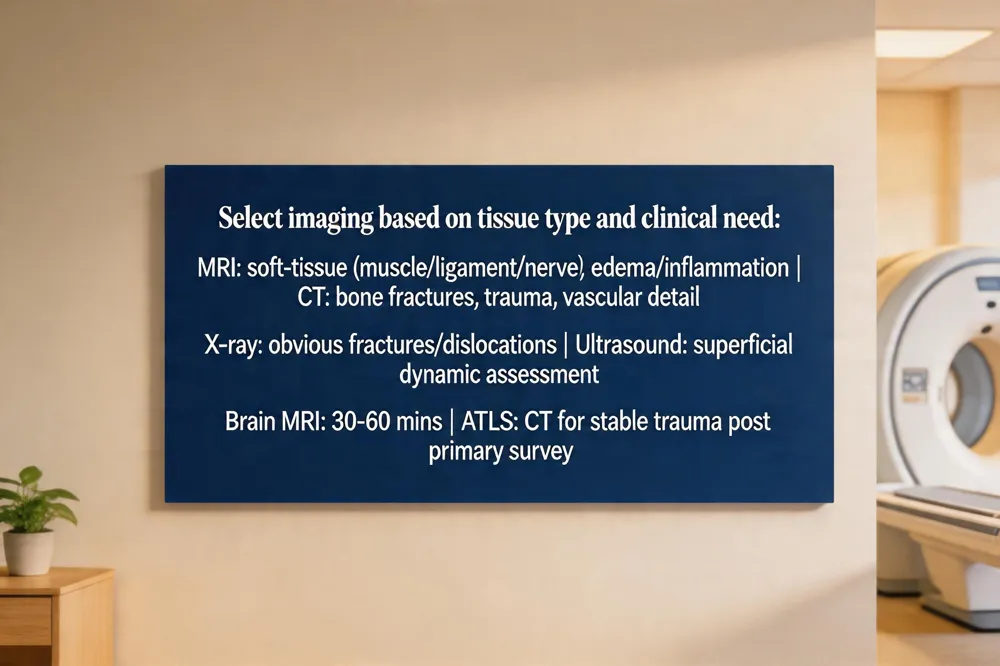 When evaluating workplace‑related injuries, selecting the appropriate imaging technique is essential for accurate diagnosis, treatment planning, and legal documentation.
MRI versus CT for soft‑tissue injuries – MRI is the gold standard for soft‑tissue injury detection because it provides high‑resolution, contrast‑enhanced images of muscles, ligaments, tendons, and nerves without ionising radiation. CT excels at visualising bone, complex fractures, and vascular structures but lacks the soft‑tissue detail needed to grade muscle tears or detect edema. Consequently, for a suspected muscle tear, an MRI should be ordered rather than a CT, reserving CT for trauma settings where fractures must be ruled out.
Typical duration of a brain MRI – A brain MRI usually requires 30–60 minutes from patient entry to image completion, with additional time if gadolinium contrast is used. Modern scanners with AI‑assisted protocols can shorten acquisition while maintaining diagnostic quality.
MRI detection of back‑muscle damage and inflammation – MRI can visualise back‑muscle pathology, showing signal changes on T2‑weighted or STIR sequences that indicate tears, edema, or inflammatory myopathy. While not routinely ordered for uncomplicated low‑back pain, it is indispensable when clinical suspicion of soft‑tissue injury or nerve compression exists.
Best scan types for different injury scenarios – X‑ray identifies bone fractures and joint dislocations. CT provides detailed cross‑sectional images for complex bone injuries. MRI is preferred for soft‑tissue, spinal cord, and brain injuries, while ultrasound offers dynamic assessment of superficial tendons and fluid collections.
ATLS recommendations for CT use in trauma – ATLS advises that CT be employed in haemodynamically stable patients after the primary survey to rapidly identify life‑threatening injuries. It should not replace urgent surgical exploration when instability is present, and contrast administration must consider renal function and allergy risk.
Integrating these imaging choices with functional performance testing and a detailed patient history creates a comprehensive, evidence‑based injury assessment that supports credible medical‑legal opinions and workers’ compensation claims.
Functional Capacity Evaluations: From Theory to Practice
 Definition and purpose of an FCE
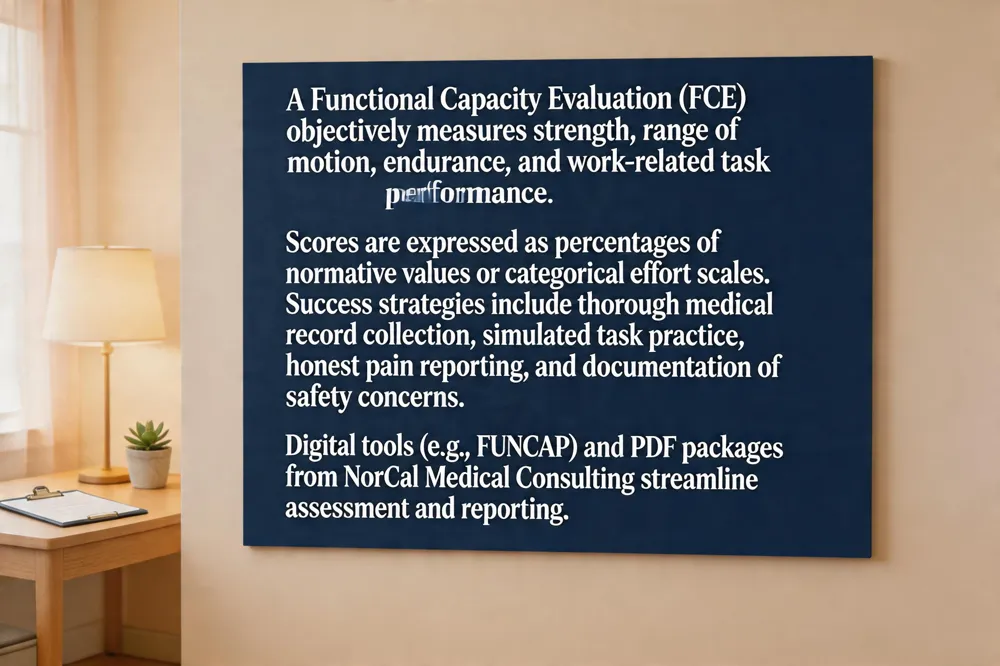
A Functional Capacity Evaluation (FCE) is a standardized, job‑specific battery of physical tests that objectively measures strength, range of motion, endurance, and the ability to perform work‑related tasks after an injury. The results guide return‑to‑work decisions, disability ratings, and legal claim support.
Definition and purpose of an FCE
A Functional Capacity Evaluation (FCE) is a standardized, job‑specific battery of physical tests that objectively measures strength, range of motion, endurance, and the ability to perform work‑related tasks after an injury. The results guide return‑to‑work decisions, disability ratings, and legal claim support.
Scoring systems and standardized forms FCEs use numeric or categorical scores (e.g., 0‑5 effort‑consistency scale, percentage of normative values) to grade lifting, pushing, pulling, and stamina. The Functional Capacity Evaluation form records personal data, task performance, and recommendations for accommodations.
Strategies to achieve a favorable FCE outcome Collect all medical records, obtain independent expert opinions, practice simulated tasks before testing, be honest about pain, request breaks as needed, and document safety concerns. If results are unfavorable, use expert reports to appeal.
Online functional capacity tools Digital questionnaires such as the FUNCAP form assess daily and occupational activities, capturing post‑exertional effects for legal and insurance use.
Availability of PDF assessment packages NorCal Medical Consulting delivers comprehensive FCA PDFs that include musculoskeletal screening, material‑handling capacities, cardio‑respiratory endurance, and customizable job‑demand tables.
Finding a local FCE provider Board‑certified therapists at NorCal Medical Consulting conduct FCEs across the Bay Area; contact our San Francisco or Oakland office to schedule an evaluation near you.
What is an example of an injury or illness incident that you must report to OSHA within 8 hours?
A workplace fatality, such as a worker killed after falling from a construction scaffold, must be reported to OSHA within eight hours.
Functional Capacity Evaluation form
The form captures demographic data, injury details, and task‑specific performance metrics (lifting weight, frequency, effort level) with comments and recommendations for return‑to‑work.
Functional Capacity evaluation scoring
Scores compare patient performance to age‑ and sex‑matched norms, yielding percentages or categorical ratings and noting any sub‑maximal effort.
How to beat a Functional Capacity Evaluation
Gather documentation, obtain independent expert evaluation, rehearse test tasks, communicate pain honestly, and, if needed, challenge unfavorable results with legal counsel.
Functional Capacity test
A structured series of push, pull, lift, and endurance tasks lasting 4‑8 hours, producing a detailed report for workers’ compensation and courts.
Functional Capacity Assessment PDF
NorCal provides secure, customized PDF reports outlining functional limits, job‑specific capacities, and recommendations.
Functional capacity test online
Online tools like FUNCAP let patients rate the impact of daily activities, delivering standardized data for claim support.
Functional Capacity Evaluation near me
NorCal Medical Consulting offers Bay Area‑based FCEs; contact our clinics to schedule an assessment.
Patient History: The Foundation of Evidence
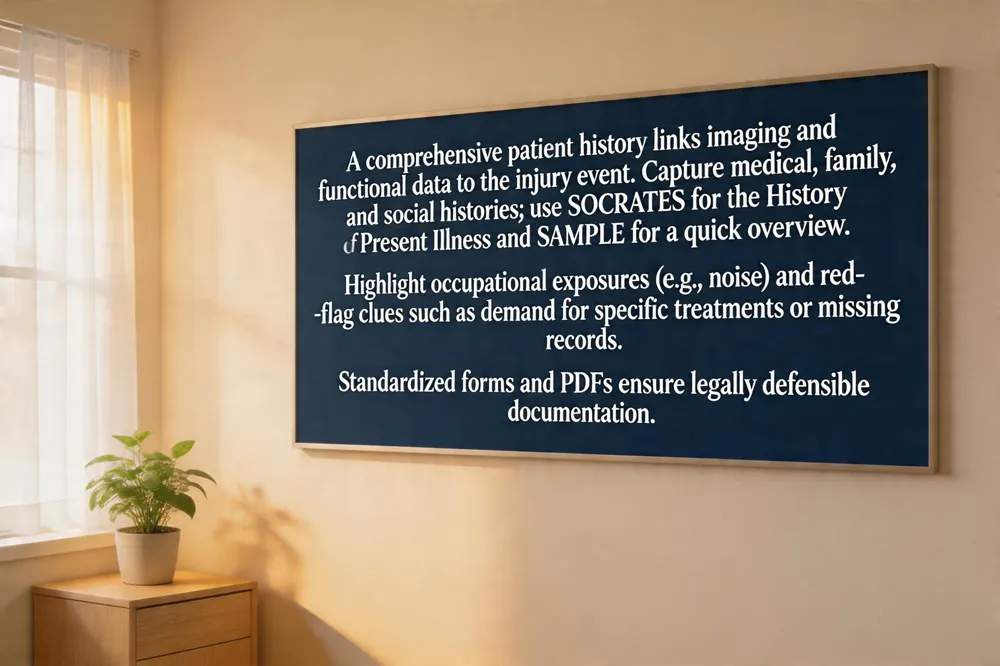 A thorough patient history is the cornerstone of any workplace injury evaluation, providing the narrative that links imaging and functional testing to the injury event. Key components include a detailed medical history (diagnosed conditions, surgeries, medications, allergies), family history of hereditary disease, and social history that captures occupation, lifestyle, and exposure to hazards such as excessive workplace noise. The History of Present Illness should be documented using the SOCRATES framework, and a Review of Systems ensures no relevant symptom is missed. For auditory‑loss claims, clinicians should ask specific exposure questions (e.g., noise type, duration, hearing‑protective equipment use) and track symptom progression. Red‑flag clues—such as patients demanding specific treatments, missing prior records, or frequent early medication refills—must be noted to safeguard against fraud. Standardized formats, like the Patient History Form, PDF interview worksheets, and the SAMPLE mnemonic, facilitate consistent, legally defensible documentation. Sample PDFs and forms illustrate how to structure chief complaints, ROS, and occupational exposure sections, while example interview questions guide clinicians in gathering precise data. By integrating this comprehensive history with imaging findings (X‑ray, MRI, CT) and functional performance tests, experts can produce objective reports that meet AMA Guides, OSHA requirements, and insurance standards, strengthening causation arguments and supporting fair compensation.
OSHA Reporting and Legal Documentation
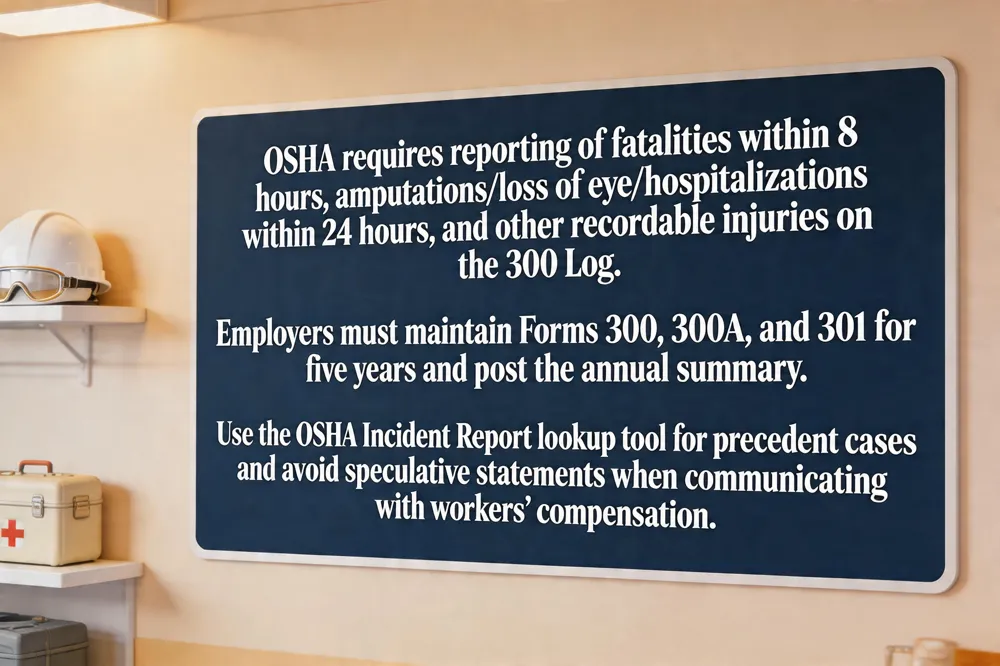 OSHA injury reporting Flowchart
The flowchart starts by confirming the incident involved an employee and was work‑related. If it meets recordable criteria (death, loss of consciousness, days away from work, restricted work, or medical treatment beyond first aid), it is entered on the OSHA 300 Log; otherwise it is a first‑aid case. For occupational hearing loss, a 10‑dB average change at 2,000‑4,000 Hz or a level ≥25 dB above zero in both ears triggers recordability. Fatalities must be reported within 8 hours; amputations, loss of an eye, or hospitalizations within 24 hours. The annual summary (Form 300A) is posted each February‑April and logs are retained for five years.
OSHA injury reporting Flowchart
The flowchart starts by confirming the incident involved an employee and was work‑related. If it meets recordable criteria (death, loss of consciousness, days away from work, restricted work, or medical treatment beyond first aid), it is entered on the OSHA 300 Log; otherwise it is a first‑aid case. For occupational hearing loss, a 10‑dB average change at 2,000‑4,000 Hz or a level ≥25 dB above zero in both ears triggers recordability. Fatalities must be reported within 8 hours; amputations, loss of an eye, or hospitalizations within 24 hours. The annual summary (Form 300A) is posted each February‑April and logs are retained for five years.
OSHA incident report lookup Visit OSHA’s website, select the "Accident Investigation Search" tool, and enter keywords such as employer name, SIC code, or injury type. Narrow the date range (default five years, extendable to ten). Review Summary Numbers to view abstracts and inspection details, which can substantiate legal or insurance claims involving workplace auditory injuries.
OSHA employee injury reporting requirements Employers must notify OSHA of any work‑related fatality within eight hours and of in‑patient hospitalization, amputation, or loss of an eye within twenty‑four hours via phone (1‑800‑321‑6742) or the online portal. Required details include establishment name, location, time, event type, employee names, contact person, and a brief description. Maintain Forms 300, 300A, and 301 for at least five years and post the annual summary.
OSHA reporting form Standard record‑keeping uses Form 300 (Log), Form 300A (Annual Summary), and Form 301 (Incident Report). Forms can be completed electronically and submitted through OSHA’s Injury Tracking Application. Serious incidents require immediate phone or online reporting. Small businesses with ≤10 employees are exempt from the Log but still must report severe incidents.
What not to say to Workers' Comp? Avoid minimizing pain, guessing recovery time, using absolutes like “always/never,” discussing legal strategy, or contradicting previous statements. Consistency and factual honesty preserve credibility with clinicians and insurers.
Quantifying Injury Impact and Costs
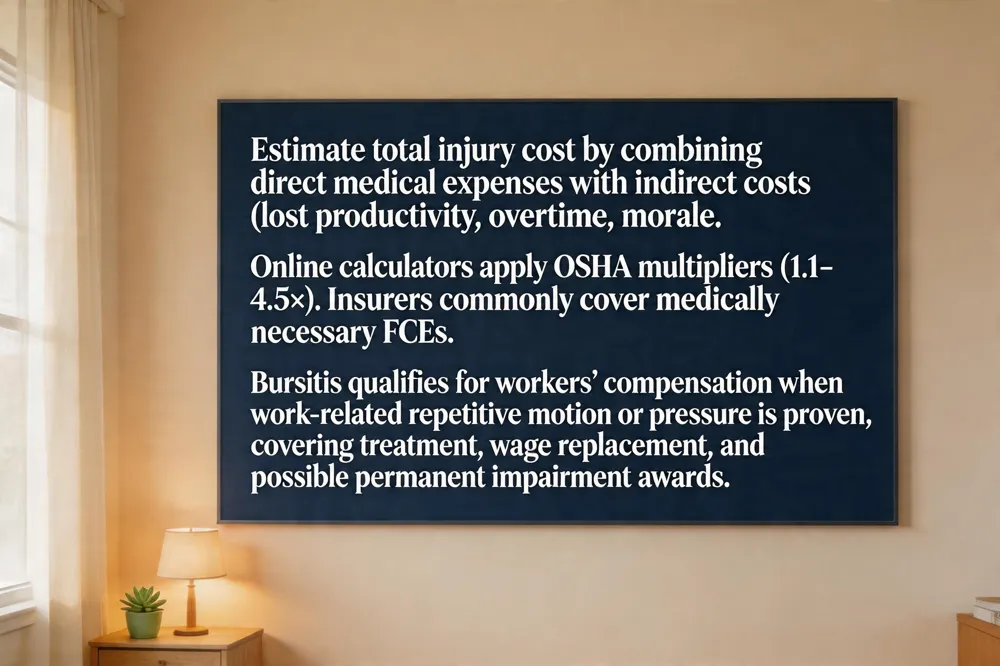 Accurate cost estimation begins with tools that combine direct expenses—medical bills, workers‑compensation payments, rehabilitation—and indirect expenses such as lost productivity, overtime, and morale impacts. Online work‑injury and injury‑cost calculators apply OSHA‑published multipliers (1.1×‑4.5×) to produce a total financial impact, helping employers understand hidden costs and prioritize safety measures.
Insurance coverage for Functional Capacity Evaluations (FCEs) is common when the test is medically necessary. Workers’ compensation insurers routinely fund FCEs to determine return‑to‑work readiness and appropriate accommodations; private health plans may also cover them with physician authorization, though prior approval is often required.
An FCE is a standardized battery of strength, range‑of‑motion, and endurance tests performed by qualified therapists. By quantifying functional limitations, the FCE provides objective evidence that insurers and courts rely on when adjudicating disability claims.
Bursitis is eligible for workers’ compensation when it results from repetitive motions, prolonged pressure, or awkward postures on the job. Approved claims cover medical treatment, wage‑replacement benefits, and, if permanent impairment remains, a lump‑sum disability payment.
Specialized Assessments: Auditory and Musculoskeletal Cases
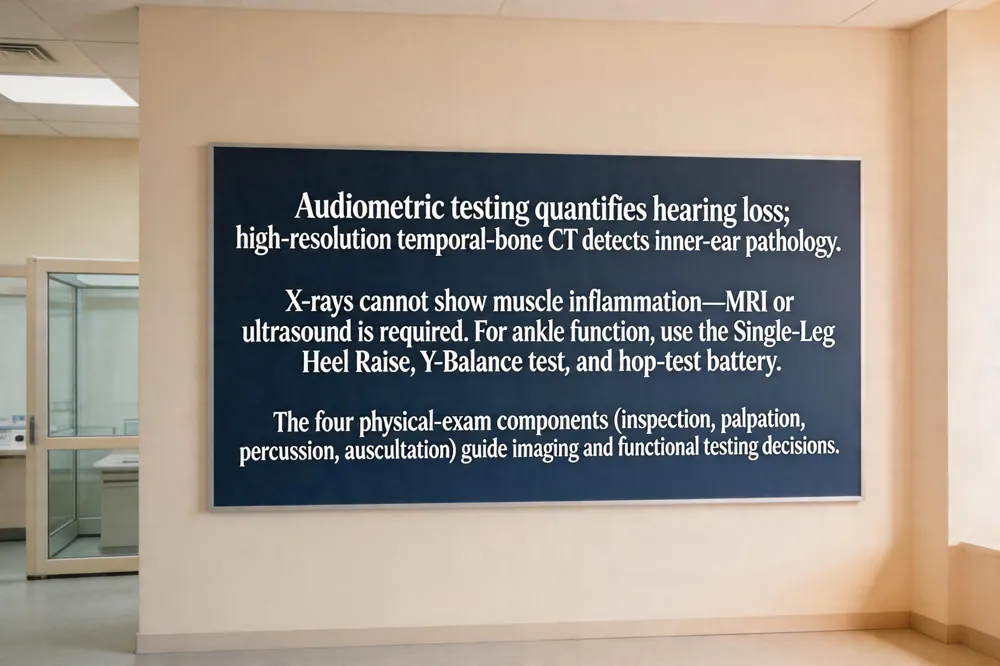 Audiometric testing and imaging for workplace hearing loss
Audiometric testing (pure‑tone, speech‑in‑noise, tympanometry) quantifies threshold shifts and distinguishes sensorineural from conductive loss. When combined with high‑resolution CT of the temporal bone, clinicians can document fractures, ossicular chain disruption, or inner‑ear pathology, creating objective evidence for workers’ compensation and legal claims.
Can an X‑ray show muscle inflammation?
No. A standard X‑ray excels at visualizing dense structures such as bone but lacks the soft‑tissue contrast needed to detect swollen or inflamed muscle. Indirect signs (e.g., joint space narrowing) may suggest an inflammatory process, but definitive assessment requires MRI or ultrasound.
MRI scan for muscle pain
MRI is the modality of choice for persistent muscle pain because it visualizes soft‑tissue contrast without radiation. It can differentiate strains from partial or full‑thickness tears, reveal edema or hemorrhage, and provide objective documentation that supports injury causation and disability ratings.
What are three functional tests of the ankle?
Three commonly used ankle functional tests are the Single‑Leg Heel Raise (calf strength/endurance), the Y‑Balance test (dynamic stability in three directions), and a battery of hop tests (e.g., Single‑Leg Lateral Hop, Figure‑8 Hop) that assess power, endurance, and neuromuscular control.
What are the four components of the injury assessment?
The classic four‑component physical exam includes inspection (visual review), palpation (tenderness and texture), percussion (tapping to assess underlying structures), and auscultation (listening for abnormal sounds, primarily in thoracic/abdominal assessments). These steps guide imaging and functional testing decisions.
Putting It All Together for Legal Success
A defensible injury report must fuse three pillars—objective imaging, quantitative functional testing, and a meticulously documented patient history—into a single, coherent narrative. Imaging (X‑ray, MRI, CT, PET) provides visual proof of structural damage; functional performance tests (FCE, range‑of‑motion, strength, audiometry) quantify the real‑world impact; and a comprehensive history anchors the findings to the workplace event, mechanism, and pre‑existing conditions. When these data are integrated, the report demonstrates causation, severity, and functional limitation in a format that courts and insurers readily accept. A multidisciplinary, evidence‑based team—radiologists, physical therapists, audiologists, and occupational physicians—ensures each component meets the highest clinical standards, reducing speculation and strengthening legal credibility. NorCal Medical Consulting applies this model, leveraging its expertise in advanced imaging modalities, standardized functional assessments, and thorough history‑taking to produce accurate, legally robust evaluations that support workers’ compensation and personal injury claims.