Why Functional Capacity Evaluations Matter
Early return‑to‑work (RTW) programs cut workers’ compensation costs, preserve earnings, and improve morale, but they hinge on accurate fitness assessments. Functional capacity evaluations (FCEs) supply objective, quantifiable data—strength, endurance, range of motion, and effort validation—that supersedes subjective physician notes and reduces disputes over a worker’s true ability. This evidence‑based approach satisfies OSHA’s medical surveillance requirements, complies with the Americans with Disabilities Act and state compensation statutes, and provides defensible testimony court and claim settlement. By linking measured capacity to job‑specific demands, FCEs enable safe, graduated RTW plans, protect employers from liability, and ensure injured employees receive appropriate accommodations.
Understanding Functional Capacity Evaluations
| Component | Description |
|---|---|
| Worker information & injury history | Demographics, injury date, mechanism, prior treatment |
| Musculoskeletal screen | Posture, gait, range of motion (ROM), strength testing |
| Capacity testing | Positional tasks, material‑handling, non‑material tasks (lifting, pushing, pulling) |
| Cardiorespiratory endurance | Treadmill or stationary bike test to assess stamina |
| Consistency/effort validation | Heart‑rate monitoring, symptom replication, repeat trials for effort checks |
| Psychosocial questionnaires | Assess pain perception, mood, fear‑avoidance, return‑to‑work confidence |
| Scoring & recommendations | Percentages of normative/job‑specific standards → categorical rating (full duty, modified, restricted) |
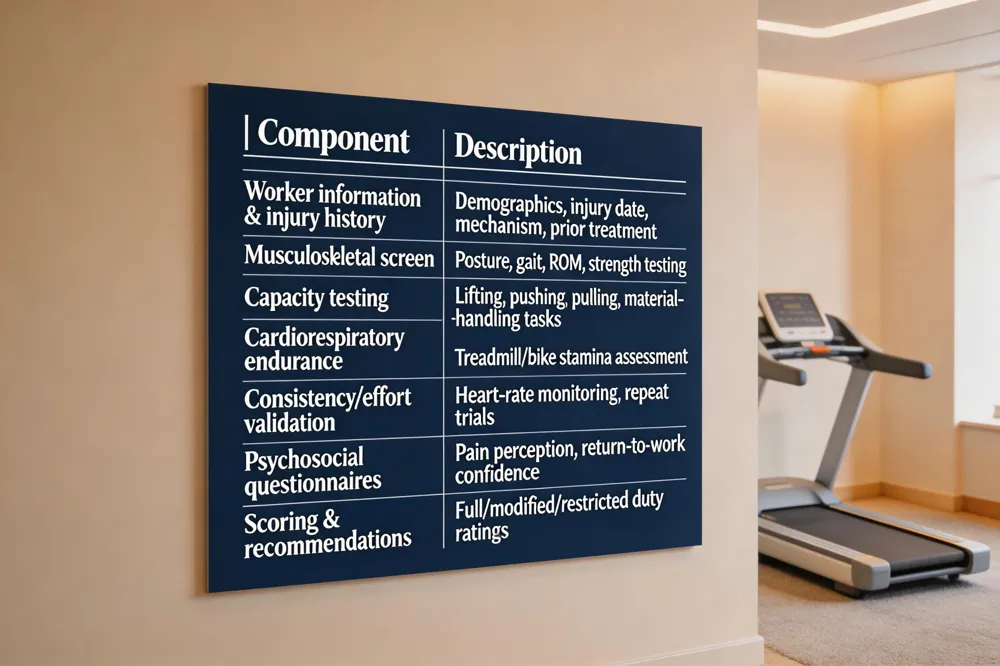 A Functional Capacity Evaluation (FCE) is a standardized, objective assessment that quantifies a worker’s physical abilities—strength, range of motion, endurance, and functional task performance—to determine safe return‑to‑work (RTW) capacity. Definition and purpose: FCEs bridge the gap between medical opinion and job demands, providing measurable data for employers, insurers, and legal stakeholders to support RTW decisions, accommodations, and disability ratings.
Standard components of the assessment: 1) Worker information and injury history; 2) Musculoskeletal screen (posture, gait, ROM, strength); 3) Capacity testing (positional tasks, material‑handling, non‑material tasks); 4) Cardiorespiratory endurance; 5) Consistency/effort validation; 6) Psychosocial questionnaires. Results are recorded on a detailed FCE form that captures weight limits, repetitions, duration, hand‑dominance, and therapist observations.
Scoring methods and effort validation: Raw performance metrics are converted to percentages of normative or job‑specific standards and assigned categorical ratings (full duty, modified, restricted). Effort checks—heart‑rate monitoring, symptom replication, and consistency across trials—ensure validity. Scores guide RTW recommendations and legal/insurance negotiations.
Sample Q&A:
- Functional capacity evaluation sample – Begins with demographic and injury data, musculoskeletal screen, then capacity‑testing results with quantitative limits, effort consistency, and a summary matching abilities to job‑demand categories.
- Functional capacity evaluation form – Structured document recording demographics, daily tolerance, specific movements, weight limits, observations, and final recommendations.
- Functional capacity evaluation cost – U.S. pricing ranges $1,200‑$3,000; single‑day baseline ≈ $1,500, two‑day ≈ $2,000, hourly rates ≈ $150.
- Functional capacity evaluation scoring – Percentages of pre‑injury capacity combined with categorical ratings, adjusted for effort consistency and validity checks.
Finding and Accessing FCE Services
| Step | Action |
|---|---|
| 1 | Web search: "functional capacity evaluation" + city/ZIP |
| 2 | Identify local occupational‑health centers, PT/OT clinics, medical‑consulting firms |
| 3 | Verify network status via insurer provider‑search tool |
| 4 | Ask primary‑care physician or workers‑comp rep for recommended specialists |
| 5 | Call clinics: confirm availability, request intake questionnaire, ensure legal/claim documentation capability |
| 6 | For occupational health screenings, search "occupational medicine clinic" + location and confirm accreditation & insurance acceptance |
| 7 | Example specialist: NorCal Medical Consulting for hearing loss or other injury‑related claims |
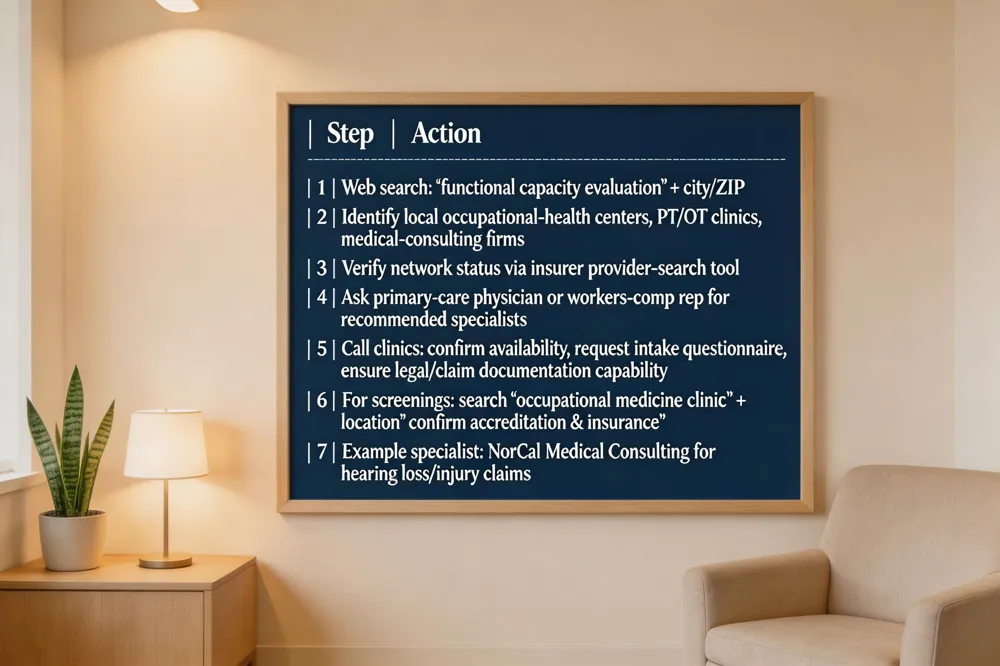 To locate a Functional Capacity Evaluation (FCE) near you, start with a web search for "functional capacity evaluation" or "FCE clinic" plus your city or ZIP code. Review the sites of local occupational‑health centers, physical‑therapy practices, and medical‑consulting firms, as many list FCE services and contact information. Verify network status through your insurer’s provider‑search tool, and ask your primary‑care physician or workers‑comp representative for recommended specialists. Call the shortlisted clinics to confirm availability, request an intake questionnaire, and ensure they can produce the legal or claim‑related documentation you need.
For occupational health screenings, search for "occupational medicine clinic" or "workplace health screening" with your location. Identify clinics that offer the specific tests you require—DOT physicals, audiometric testing, respiratory fit testing, or TB screening—and confirm accreditation and insurance acceptance. If you need a specialist assessment for hearing loss or other injury‑related claims, consider firms like NorCal Medical Consulting, which provide expert examinations and detailed reports for legal and insurance purposes. Contact the clinic ahead of time to learn about hours, required paperwork, and portal‑based check‑ins.
An occupational health risk assessment example for auditory loss begins by measuring the noise hazard (e.g., 92 dB(A) continuous on a production line). The assessor quantifies risk by estimating the likelihood of exceeding OSHA exposure limits and the severity of potential hearing impairment. Control measures are prioritized: engineering solutions (acoustic enclosures), administrative actions (worker rotation), and personal protective equipment (earplugs/earmuffs). Findings, recommended actions, responsible parties, and a monitoring schedule are documented in a formal report, with annual review and follow‑up audiometric testing to verify effectiveness.
Integrating FCE Data into Return‑to‑Work Plans
| Data from FCE | How it informs RTW |
|---|---|
| Lifting capacity (weight, reps) | Matches to job’s weight‑handling demands; sets maximum lift limits |
| Pushing/pulling forces | Determines feasible handling equipment or ergonomics |
| Endurance (duration, heart‑rate) | Sets work‑hour limits, break frequency |
| ROM & functional task performance | Identifies tasks that need modification or assistive devices |
| Effort validation results | Confirms reliability of capacity data for legal/insurance negotiations |
| Medical certification (physiatrist/orthopedic) | Formal fit‑for‑work determination shared with employer & insurer |
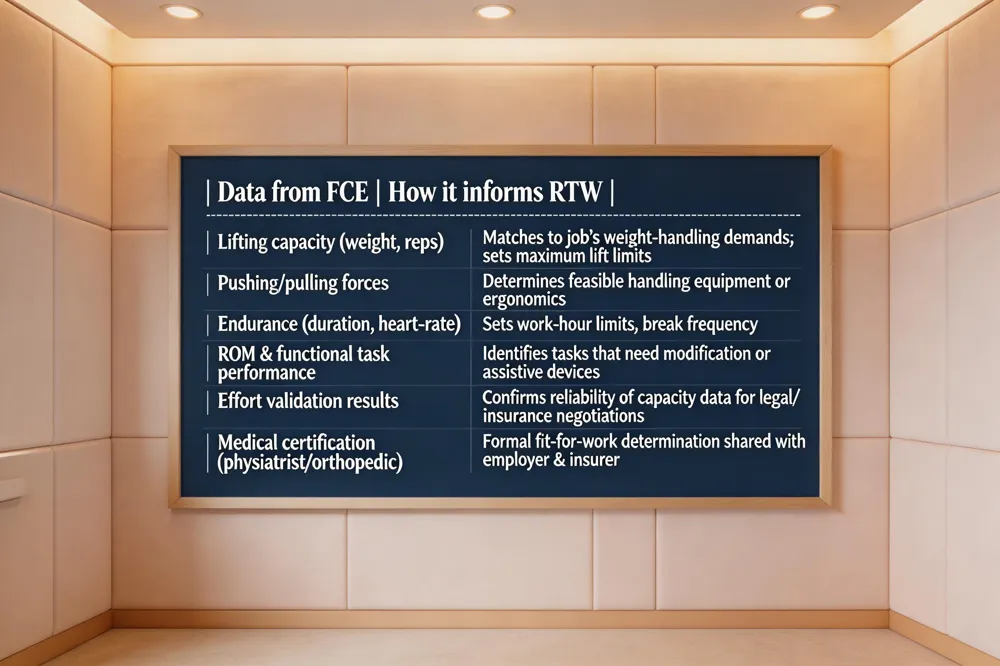 Designing RTW programs using objective data begins with a valid Functional Capacity Evaluation (FCE). The standardized tests—lifting, pushing, endurance, and range‑of‑motion—provide quantifiable metrics that can be directly matched to the physical demands of a specific job. By aligning the worker’s measured capacities with a job‑demand analysis, employers can create modified‑duty assignments that respect strength, frequency, and tolerance limits, reducing re‑injury risk.
Legal, insurance, and medical decision points converge on the FCE report. Workers’ compensation carriers routinely cover the cost of an FCE when it is medically necessary, and many health insurers will pay after a physician’s order. The treating physician or occupational‑health doctor, often a physiatrist or orthopedic specialist, reviews the FCE results and issues a fit‑for‑work certification with any required accommodations. This medical determination is shared with the employer and insurer to ensure compliance with OSHA, ADA, and state compensation statutes.
Does insurance pay for Functional Capacity Evaluation? Yes—most workers’ compensation policies cover an FCE when deemed medically necessary; other health plans may also reimburse pending verification.
Who decides if you are fit for work? A qualified medical professional (physician, occupational‑health doctor, PT, or OT) makes the final fitness determination, issuing a medical certification.
What kind of doctor does Functional Capacity Evaluation? Licensed physical or occupational therapists conduct the testing, while a physiatrist or orthopedic physician oversees interpretation and signs the final report.
Pre‑employment occupational health screening In confidential evaluation performed after a job offer to confirm the candidate can safely perform essential duties, including vision, hearing, and job‑specific physical tests, in compliance with ADA and OSHA requirements.
Key Occupational Health Topics
| Occupational disease | Primary cause | Typical health effect |
|---|---|---|
| Asbestosis | Inhalation of asbestos fibers | Progressive lung scarring, dyspnea |
| Silicosis | Inhalation of crystalline silica dust | Nodular lung fibrosis, cough, reduced lung function |
| Occupational hearing loss | Prolonged exposure to high noise levels | Permanent sensorineural hearing impairment |
| Contact dermatitis | Repeated exposure to irritants/allergens | Skin inflammation, itching, rash |
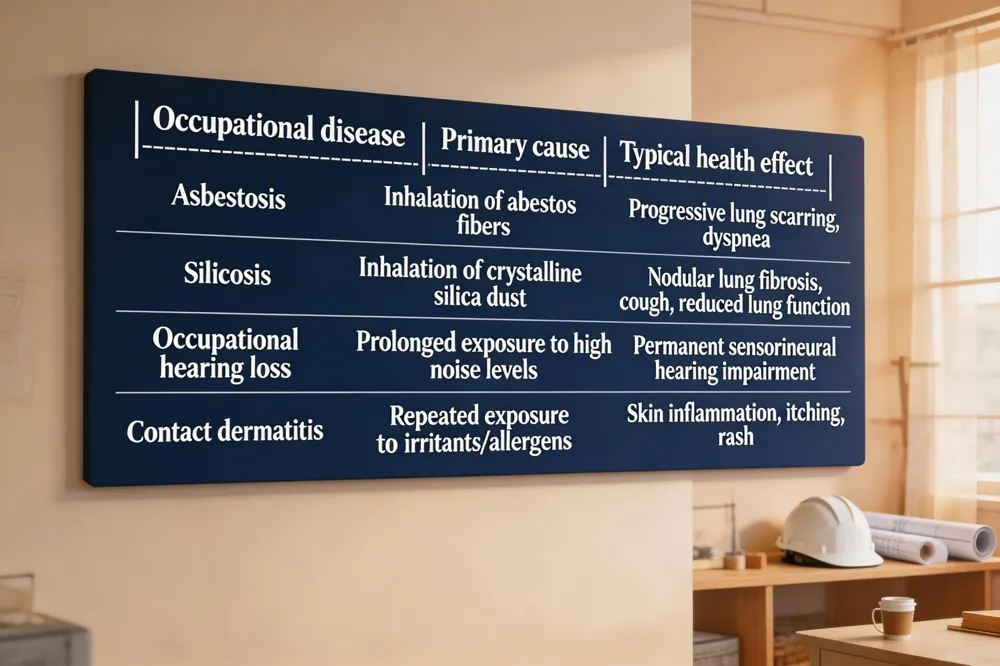 What are the 4 occupational diseases?
The four most frequently cited occupational diseases are asbestosis, silicosis, occupational hearing loss, and contact dermatitis. Asbestosis results from inhaling asbestos fibers and leads to progressive lung scarring. Silicosis is caused by inhalation of crystalline silica dust, producing nodular fibrosis in the lungs. Occupational hearing loss occurs after prolonged exposure to loud noise or sudden acoustic trauma. Contact dermatitis is a skin inflammation triggered by repeated exposure to irritants or allergens on the job.
What do they do at an occupational health screening?
During an occupational health screening, a qualified clinician conducts a comprehensive physical examination to determine whether the employee can safely perform the essential functions of their job. The screening typically includes vital‑sign measurements, vision and hearing tests (often with specialized audiometry for detecting auditory loss), musculoskeletal assessments, and drug or urine testing. A detailed occupational exposure history is reviewed to identify any work‑related hazards or previous injuries that could affect current health. Depending on the role, additional evaluations—such as respirator fit testing, DOT physicals, or immunization checks—may be performed. Results are documented and used to guide fitness‑for‑duty decisions, workplace accommodations, and injury‑prevention strategies.
Practical Guidance for Employers and Workers
| Action | Responsible party | Frequency |
|---|---|---|
| Initiate physician referral for FCE | Employer/Worker (via health provider) | At injury onset or when RTW needed |
| Conduct FCE testing | Licensed PT/OT (with physiatrist oversight) | Once per injury episode; repeat as needed |
| Develop RTW plan using FCE data | Employer & occupational‑health doctor | Immediately after FCE report |
| Monitor progress & adjust duties | Supervisor & worker | Every 4–6 weeks (or per plan) |
| Re‑evaluate functional capacity | PT/OT | Periodic re‑assessment (e.g., every 6 weeks) |
| Evaluate safety & health program effectiveness | Safety manager/NIOSH model | Annual review |
 Implementing FCE‑guided RTW programs
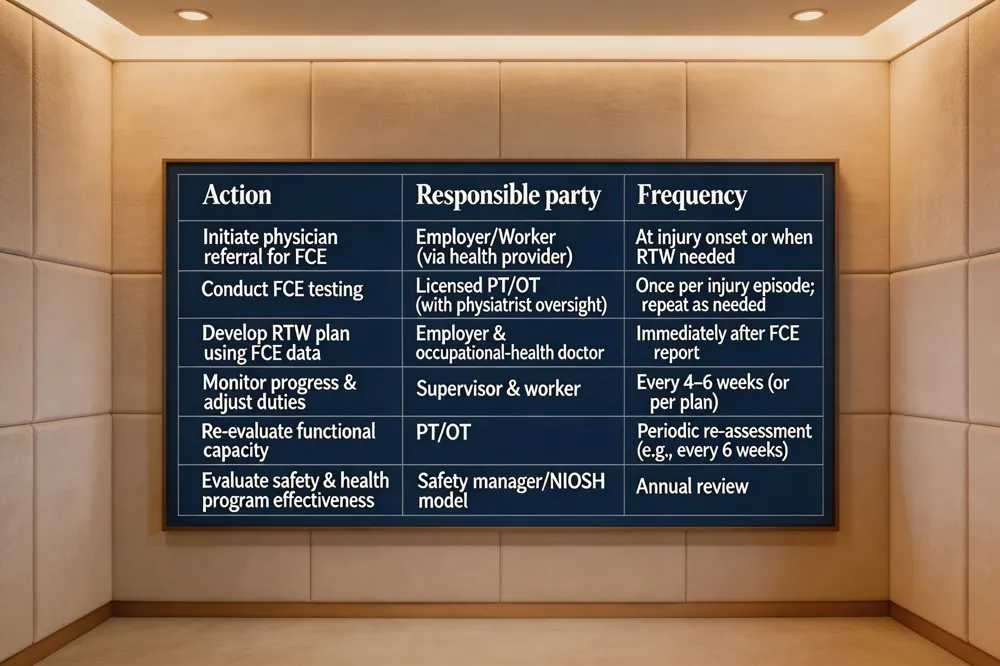
Employers should begin with a physician‑initiated referral for a Functional Capacity Evaluation (FCE). A licensed physical or occupational therapist conducts standardized tasks—lifting, pushing, pulling, endurance drills—while recording weight, repetitions, speed, pain, and effort consistency. The therapist compares these objective metrics to the job’s physical demand levels (Sedentary to Very Heavy) and issues a detailed report with clear return‑to‑work (RTW) recommendations, restrictions, and accommodation needs. Embedding the FCE report into the RTW plan ensures that modified duties match verified functional limits, reducing re‑injury risk and liability.
Monitoring and adjusting plans over time
RTW plans must be dynamic. Schedule periodic re‑evaluations (e.g., every 4–6 weeks) to track progress, update capacity data, and adjust work‑hour schedules or task assignments. Regular supervisor‑employee check‑ins and objective performance metrics help identify emerging gaps and support timely interventions such as work‑conditioning or ergonomic modifications.
Evaluating safety and health program effectiveness
The evaluation of the safety and health program requires a systematic review of written policies, on‑site inspections, and interviews with management and workers to gauge commitment and participation. It also involves analyzing incident and injury data—such as DART rates—to assess whether the program is reducing workplace hazards and illnesses. Compliance with OSHA or state regulations is measured by the frequency of citations and the effectiveness of corrective actions after high‑rate letters or inspections. The evaluation should follow an established framework (e.g., the NIOSH logic‑model approach) that examines inputs, activities, outputs, and both intermediate and end outcomes. Finally, the results are used to set measurable goals, allocate resources, and drive continuous improvement in the organization’s safety culture.
How do you evaluate functional capacity?
Functional capacity is assessed through a formal Functional Capacity Evaluation (FCE) that begins with a physician or stakeholder referral describing the injury and the specific job demands. A licensed physical or occupational therapist then administers a series of standardized physical tasks—such as lifting, carrying, pushing, pulling, and endurance drills—while observing technique, symmetry, and fatigue. Each task is measured for weight, repetitions, speed, and pain level, and the therapist records these performance metrics in real‑time. The results are compared against the functional requirements of the claimant’s occupation to determine what activities can be performed safely and without restriction. Finally, the therapist compiles a detailed report with recommendations for return‑to‑work accommodations, restrictions, or further treatment.
Putting It All Together
Functional Capacity Evaluations (FCEs) give employers objective, quantifiable data that match an employee’s measured strength, endurance, flexibility, and task‑specific performance to the physical demands of their job. This evidence supports safe, early return‑to‑work (RTW) decisions, reduces re‑injury risk, and lowers workers’ compensation costs.
For employers, the next step is to obtain a qualified FCE—typically from a licensed physical or occupational therapist—review the report, and integrate its recommendations into a customized RTW plan that includes modified duties, graduated hours, and ergonomic adjustments. Injured workers should cooperate with the evaluation, communicate pain or fatigue promptly, and follow prescribed therapy or conditioning to meet the plan’s milestones.
Continuous improvement requires regular monitoring, periodic re‑evaluation, and updating policies to stay compliant with OSHA, ADA, and state workers‑comp regulations, ensuring that RTW programs remain evidence‑based and legally defensible.