Why a Hybrid Approach Matters
Hybrid occupational‑health programs combine an initial on‑site physical examination with scheduled telehealth follow‑ups, providing the best of both worlds for remote workers. By allowing clinicians to perform visual inspections, guided self‑palpation, and functional movement screens via video, they evaluate musculoskeletal strain, ergonomic hazards, and early signs of auditory loss without requiring daily travel. The model cuts costs—telehealth visits average $40‑$90 versus $150‑$600 for in‑person care—while reducing lost workdays; studies show a 20‑30 % decline in downtime when injuries are triaged virtually within hours. Importantly, hybrid documentation satisfies OSHA, NYS Workers’ Compensation, and HIPAA requirements, offering legally defensible records that support workers’ compensation claims, insurance reimbursements, and compliance audits. Patients actively participate by checking pulse, performing jump‑test balance, and reporting symptom changes, which enhances clinical data quality and ensures continuity of care across settings.
Virtual Exam Platforms, Documentation, and Billing
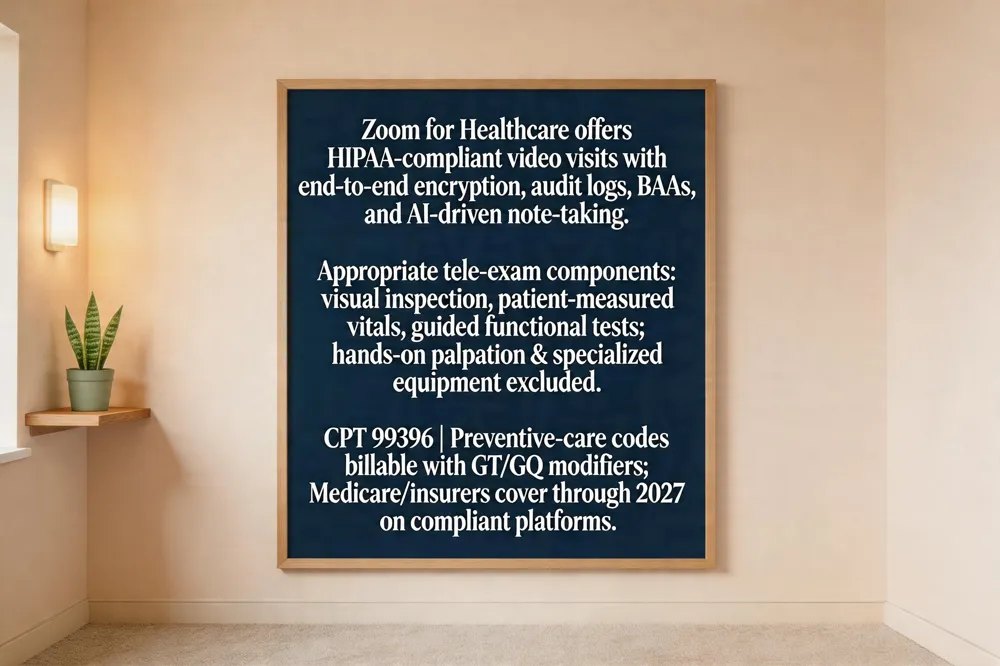 Zoom for Healthcare is a HIPAA‑compliant video platform that requires an admin to create a deployment, set privacy settings, share a password‑protected link and admit the employee from the waiting room. It offers end‑to‑end encryption, audit logs, a Business Associate Agreement, and AI‑driven note‑taking—features absent in standard Zoom, which lacks formal health‑privacy safeguards. During a tele‑physical exam, clinicians start with a narrative of appearance, mental status, and patient‑reported vitals obtained via home devices, then observe visual cues (skin, gait, posture) and guide self‑palpation or functional tests. All observations, remote data, and images are attached to the record to support legal and insurance claims. Appropriate components include inspection, patient‑measured vitals, and guided functional maneuvers; inappropriate components are hands‑on palpation, auscultation, urgent emergency care, and procedures requiring specialized equipment. CPT 99396 and other preventive‑care codes can be billed as telehealth when the payer permits, using modifiers GT/GQ and documenting the virtual delivery. Most insurers, including Medicare, continue to cover virtual occupational‑health visits through 2027, provided a HIPAA‑compliant video platform is used.
Occupational Telemedicine and Mobile Health Services
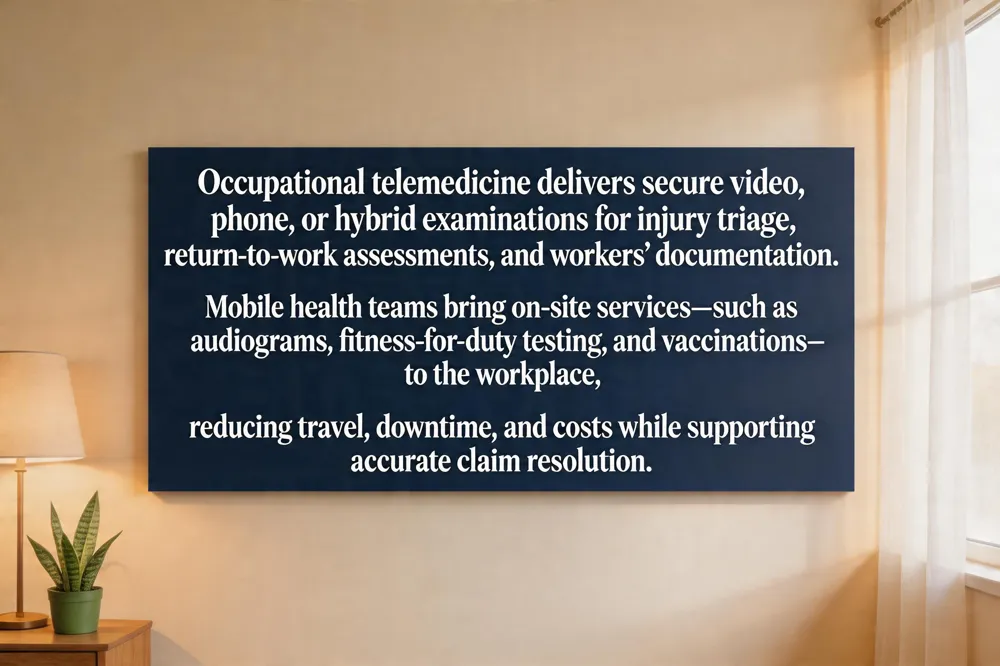 Occupational telemedicine delivers workplace‑related medical services via secure video, phone, or hybrid platforms, allowing clinicians to conduct virtual examinations, injury triage, and return‑to‑work assessments without an on‑site visit. It expands access for dispersed or remote work sites, shift‑based roles, and high‑risk environments, reducing travel time, downtime, and costs while supporting accurate documentation for workers’ compensation and insurance claims.
Mobile occupational health services bring on‑site evaluations—such as audiograms, physical exams, and fitness‑for‑duty testing—to the workplace, minimizing disruption and accelerating claim resolution. On‑site teams increase participation, provide immediate results, and deliver preventive care, vaccinations, and ergonomics education.
Delivery uses real‑time video conferencing, screen‑sharing, and asynchronous tools (worksheets, recorded videos) to monitor progress, document care in the EHR, and meet billing and legal requirements.
Remote Worker Health Assessment Framework
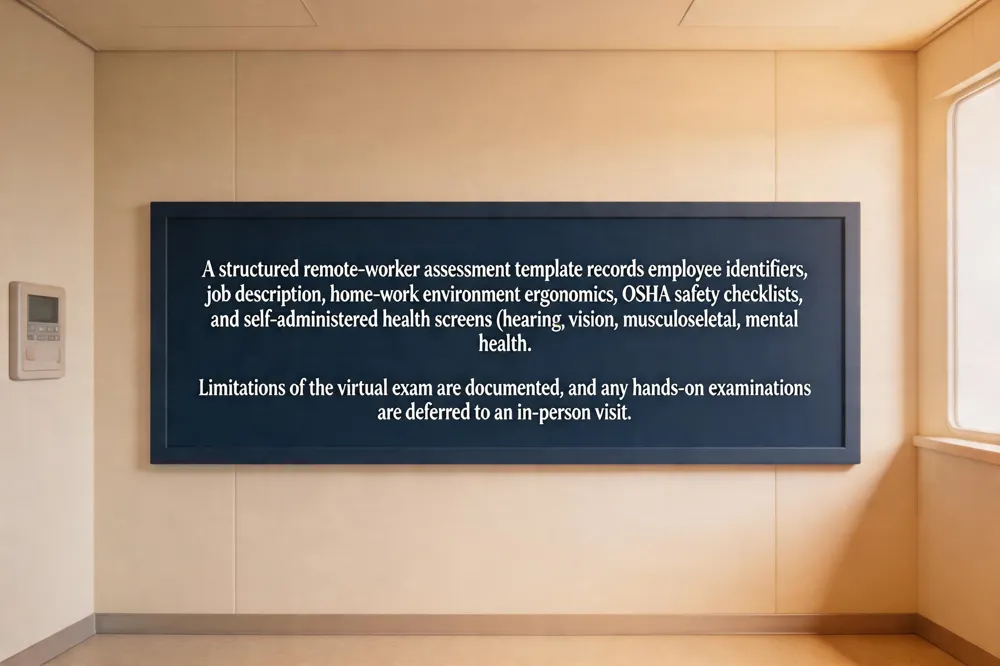 A structured remote‑worker health assessment template starts with employee identifiers, job description, and a brief description of the home‑work area. It then includes ergonomic and environmental safety checklists that capture workstation setup (chair, desk, monitor height, lighting), posture and movement patterns, and controls for temperature, ventilation, and noise levels. OSHA duties‑to‑duty compliance is addressed by documenting fire safety, electrical hazards, slip‑trip‑fall prevention, and emergency contact procedures, as required under the General Duty Clause for home offices. The template also records health‑screening data—self‑administered hearing and vision checks, musculoskeletal symptom surveys, and brief mental‑health screens—to flag occupational‑related concerns. For legal and insurance claims, clinicians must document all observations, patient‑performed measurements, any limitations of the virtual exam, and a concise summary with recommendations for ergonomic adjustments or further in‑person evaluation. Hands‑on examinations requiring palpation, auscultation, or urgent interventions are not appropriate for telehealth and should be deferred to an in‑person visit.
Common Workplace Injuries and Early Telehealth Interventions
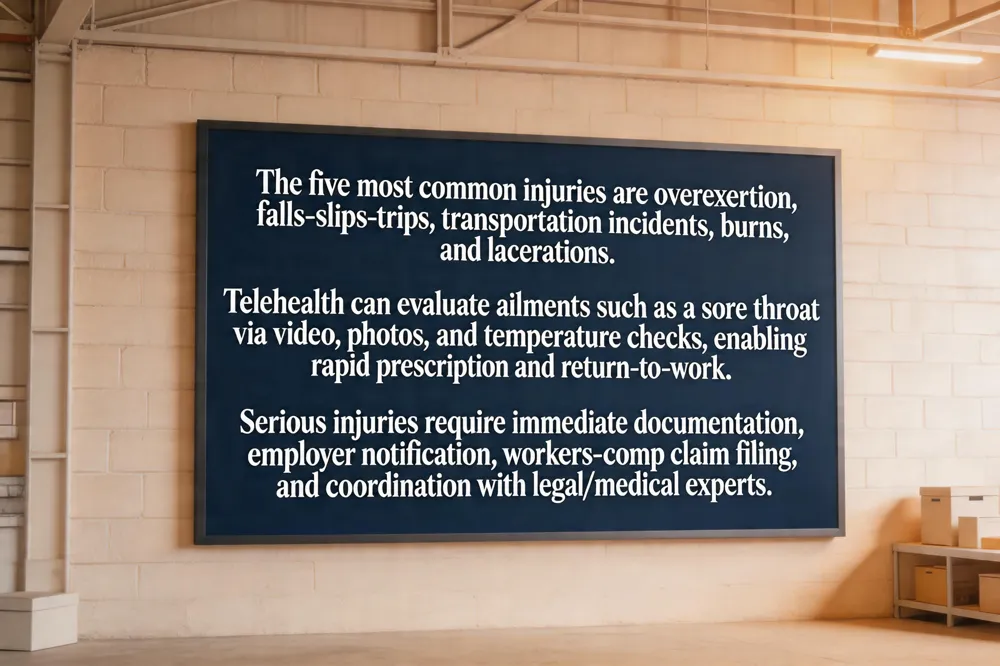 The five most common workplace injuries are overexertion (sprains and strains, especially of the back), falls‑slips‑trips, transportation‑related incidents, burns, and lacerations or cuts. Overexertion accounts for the largest share of non‑fatal cases, while falls often result in fractures or sprains, and transportation incidents include vehicle and forklift collisions.
Can telehealth help with a sore throat? Yes. A video visit enables the clinician to ask targeted questions, review throat photographs, and guide a temperature check. The provider can distinguish likely viral from bacterial causes, order a rapid strep test if needed, prescribe antibiotics or analgesics, and send the prescription to a pharmacy within minutes, keeping the employee productive and limiting workplace exposure.
What actions should be taken following a serious injury at work? Immediately document the incident with notes, photos, and witness statements. Seek prompt evaluation from an occupational‑health‑experienced clinician, notify the employer, and file a workers‑compensation claim within the statutory deadline. Preserve all medical records, test results, and correspondence as core evidence. Consult a specialized injury‑law attorney or a firm like NorCal Medical Consulting for claim preparation, and maintain regular communication with the return‑to‑work coordinator while following the treatment plan.
Integrating Physical Exams with Virtual Consultations
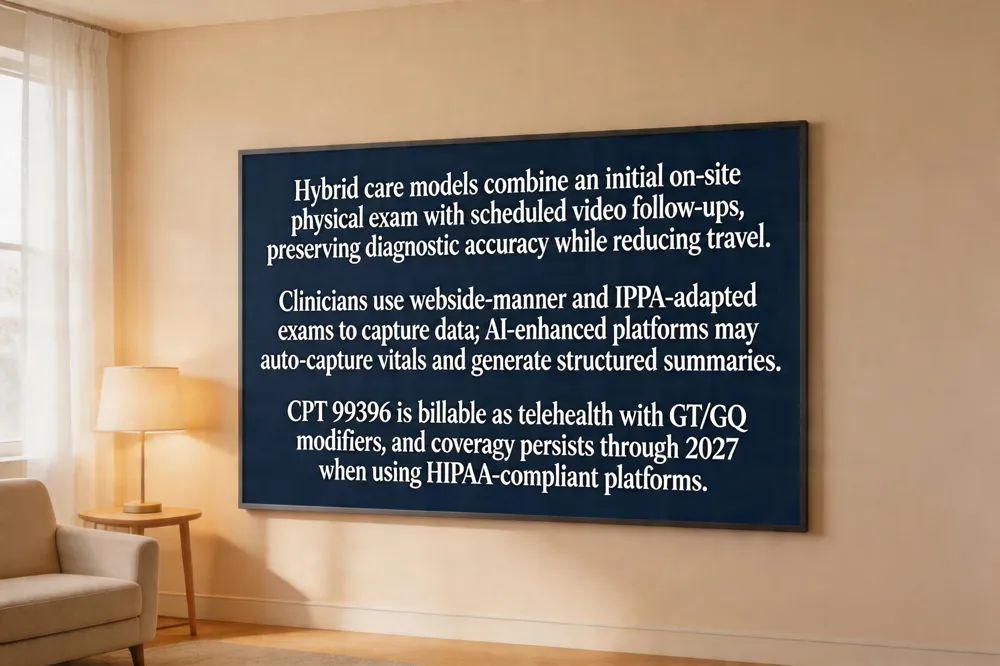 Hybrid care models combine an initial on‑site physical exam with scheduled video follow‑ups, preserving diagnostic accuracy while reducing travel for remote workers. Clinicians trained in video‑visit mastery and webside‑manner—using eye‑level camera placement, clear patient instructions, and structured IPPA‑adapted exams—improve engagement and data quality. Documenting virtual findings is essential; thorough notes protect legal defensibility and streamline workers’ compensation and insurance claims, as insurers now accept telehealth‑generated evidence when it meets coding standards. Future directions include AI‑enhanced platforms that auto‑capture vitals, generate structured exam summaries, and integrate with electronic health records for seamless claim documentation.
Can 99396 be billed as telehealth? Yes—CPT 99396 can be submitted as a telehealth service when the payer permits virtual delivery and the encounter includes a comprehensive history, exam, counseling, and screenings; appropriate telehealth modifiers (e.g., GT or GQ) must be used.
Does insurance still cover virtual visits? Yes—Medicare and most private insurers continue to reimburse virtual occupational health visits through Dec 31 2027, provided a HIPAA‑compliant platform is used, the service is medically necessary, and the claim follows each carrier’s telehealth policies.
Putting It All Together for a Safer Remote Workforce
Integrating in‑person and virtual assessments creates a synergistic model that captures the objective data of a traditional exam while leveraging the convenience of telehealth for remote workers. Clinicians begin with a focused on‑site physical exam—often audiometry, range‑of‑motion testing, or initial wound evaluation—to establish a baseline. Subsequent video visits guide patients through self‑inspection, self‑palpation, and functional movement screens, allowing early detection of ergonomic strain, auditory changes, or infection. Documentation must meet OSHA, workers’ compensation, and insurance standards: detailed observations, patient‑performed measurements, technology limitations, and clear timestamps protect claim defensibility. As AI‑driven devices, wearable sensors, and secure video platforms mature, the hybrid workflow will become more precise, reducing travel costs and accelerating return‑to‑work while maintaining regulatory compliance. Employers can also embed ergonomic checklists and noise monitoring into the telehealth portal, strengthening documentation.