Why Technology Matters for Claims Teams
Workers‑comp claims have become increasingly complex, involving detailed medical assessments, multilingual documentation, and strict statutory deadlines. Real‑time, secure communication—through encrypted portals, AI‑driven transcription, and instant messaging—ensures that adjusters, attorneys, and medical experts share the latest audiograms, expert reports, and settlement offers without exposure to confidential information. Cloud‑based platforms such as Sonix, CARET Legal, and ClaimDeck provide a single source of truth, automating transcription (99%+ accuracy, automatic speaker identification, and multilingual translation, while maintaining HIPAA and SOC 2 compliance. AI‑powered analytics flag high‑risk claims, streamline document review, and generate searchable timelines, cutting manual effort by up to 75 % and shortening claim cycles by 15‑30 %. Together, these technologies reduce disputes, improve billing transparency, and accelerate accurate, evidence‑based injury assessments.
Xactimate as the Backbone of Adjuster Estimating
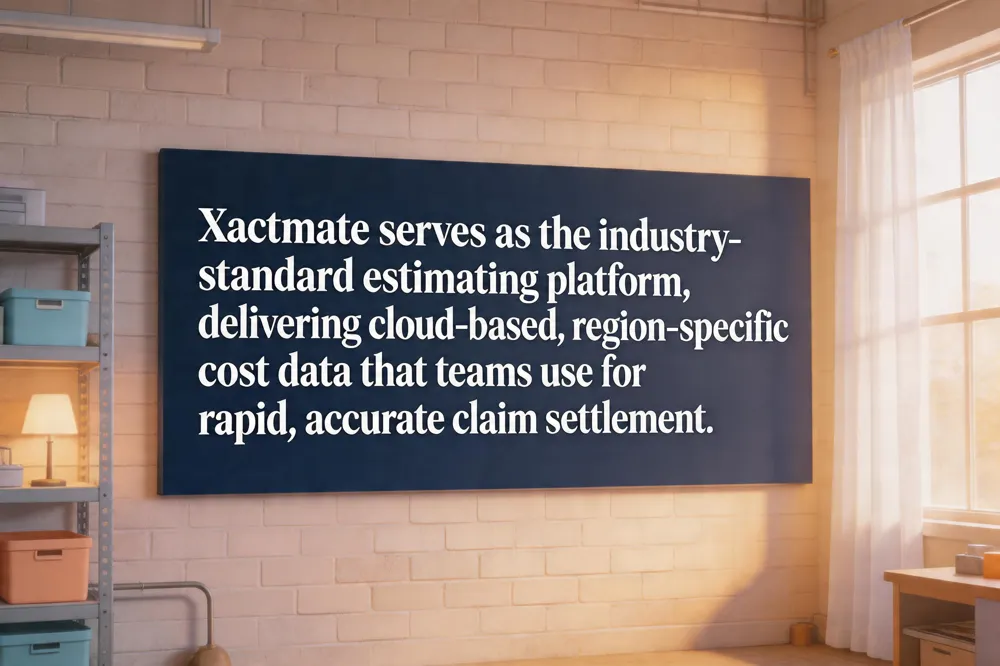 Xactimate is the de‑facto standard for property‑damage estimating, and recent industry surveys show that roughly 75 %–80 % of U.S. adjusters rely on it for accurate cost calculations. Its strength lies in a continuously updated pricing database that reflects regional labor and material rates, which of paired with cloud‑based tools that let adjusters produce full estimates from any device in minutes. Integration capabilities are robust: platforms such as DeltaClaims.AI ingest Xactimate outputs to enable real‑time estimate comparison, automated scope‑gap detection, and instant sharing with legal teams via API‑connected portals. This seamless flow of data reduces transcription errors and ensures that attorneys receive a single source of truth for settlement negotiations. Legal reviewers benefit from precise timestamps, speaker identification, and subtitle generation when video evidence is paired with Xactimate‑based loss estimates, accelerating claim resolution and supporting defensible, evidence‑based outcomes.
Do adjusters use Xactimate? Yes—insurance adjusters regularly use Xactimate for their claim work. The software has long been regarded as the “gold standard” in estimating, and studies show that roughly 75 % to 80 % of adjusters rely on it to calculate restoration costs. Xactimate’s extensive, regularly‑updated pricing database and cloud‑based tools make it ideal for producing fast, accurate estimates that meet insurer requirements. While other platforms such as Symbility exist, Xactimate remains the most widely adopted solution among adjusters handling property‑damage claims. Its prevalence ensures that estimates generated in Xactimate are readily accepted by insurers and legal teams.
The 7 C’s of Communication in Healthcare
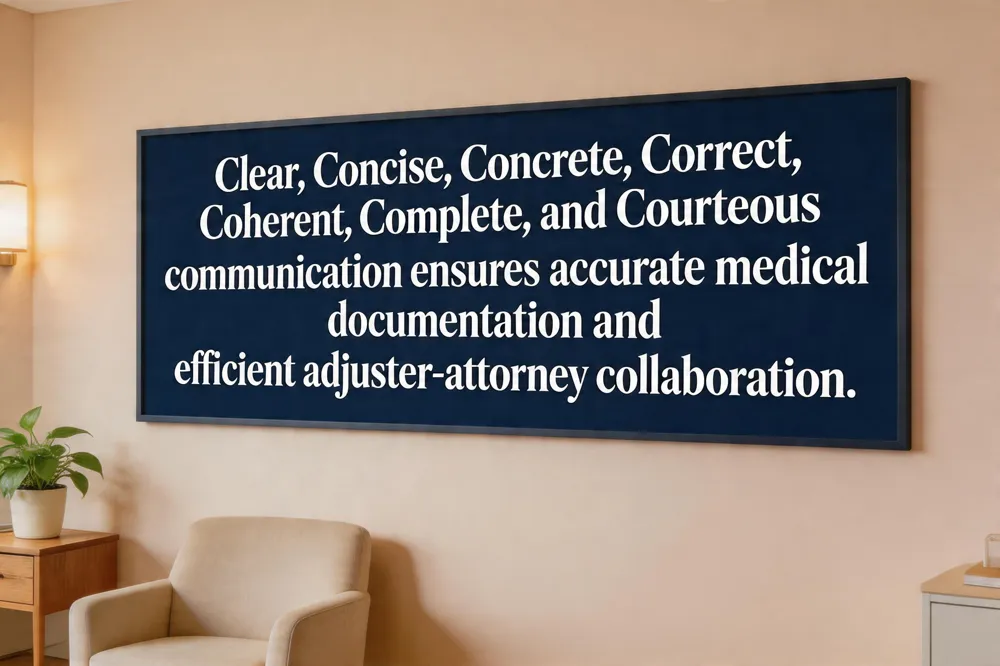 The 7 C’s of communication guide healthcare professionals to convey information clearly and effectively, which is essential for accurate medical evaluations, injury assessments, and seamless attorney‑adjuster collaboration. Clear – messages should be easy to understand, avoiding jargon that could cause confusion among adjusters, attorneys, and injured workers. Concise – keep communications brief, focusing on essential facts without unnecessary detail, which speeds claim review and reduces administrative burden. Concrete – use specific data, such as audiogram results, exposure levels, and timestamps, so the information is tangible and reliable. Correct – ensure every datum, medical term, and reference is accurate, meeting HIPAA and legal compliance standards. Coherent – organize ideas logically, presenting background, findings, and recommendations in a natural flow that supports quick decision‑making. Complete – provide all necessary information, including context, next steps, and any required actions, so no follow‑up is needed to fill gaps. Courteous – communicate with respect, empathy, and professionalism, fostering trust between adjusters, attorneys, and claimants. Adhering to these principles improves efficiency, reduces disputes, and enhances overall claim outcomes.
Communication Tools in Nursing Practice
 Nurses use a blend of verbal and digital tools to keep information flowing accurately and quickly. Structured hand‑off techniques such as SBAR (Situation‑Background‑Assessment‑Recommendation) and patient‑focused protocols like BATHE help nurses organize conversations with physicians, patients, and families. Electronic health‑record (EHR) messaging, secure texting applications, and bedside whiteboards enable real‑time updates and documentation while maintaining privacy compliance. Standardized forms and checklists provide consistent written communication for medication orders, discharge plans, and incident reports. Together, these tools reduce misunderstandings, improve patient safety, and support coordinated, high‑quality care.
SBAR: A Structured Clinical Communication Framework
 The SBAR tool—standing for Situation, Background, Assessment, and Recommendation—provides a concise, four‑step structure that standardizes how critical information is exchanged. Situation identifies the immediate issue; Background supplies relevant history and context; Assessment offers a professional evaluation of the data; and Recommendation proposes the next steps. This format dramatically improves hand‑offs by reducing ambiguity, limiting errors, and creating a clear audit trail that satisfies both clinical and legal documentation standards. In workplace injury cases, especially those involving auditory loss, SBAR enables medical consultants, adjusters, and attorneys to capture essential medical findings quickly and consistently, ensuring that injury assessments are accurate, defensible, and readily integrated into claim files and litigation strategies.
Top Adjuster‑Attorney Collaboration Platforms
 Effective collaboration between claims adjusters and attorneys hinges on platforms that combine real‑time data, secure document exchange, and AI‑driven insights. Xactware XactAnalysis & ClaimXperience provide a shared source of truth for claim files, loss estimates, and medical records, allowing both parties to track status and deadlines instantly. CARET Legal serves as a centralized hub where case notes, settlement negotiations, and compliance alerts are stored in an encrypted, HIPAA‑compliant portal, reducing billing disputes and missed deadlines. Sonix AI transcription cuts documentation time by up to 90%: delivering 99%+ accurate, timestamped transcripts of recorded statements and depositions that can be linked directly to the claim file for quick reference. ClaimDeck creates visual summaries—concise PowerPoint or PDF decks that distill key facts, auditory‑loss evaluations, and legal arguments into an easily digestible format, helping attorneys, insurers, and medical experts align on strategy.
Best adjuster‑attorney collaboration tools: Xactware’s XactAnalysis/ClaimXperience, CARET Legal’s secure case‑management hub, Sonix’s AI transcription, and ClaimDeck’s visual decks together streamline communication, enhance transparency, and accelerate resolution of occupational injury claims.
Claim deck: A claim deck is a visual, concise presentation of a workplace‑injury case that highlights medical assessments (including audiograms), supporting documents, and legal arguments, enabling rapid review, gap identification, and strategic alignment for faster settlements.
Standardized Communication Tools in Healthcare
 Standardized communication tools are essential for ensuring clear, concise, and accurate information exchange across healthcare teams. Common frameworks such as SBAR (Situation, Background, Assessment, Recommendation) and its variation ISBAR, which adds an introductory element, help structure hand‑offs and clinical escalations. In nursing and patient‑focused encounters, the BATHE protocol (Background, Affect, Trouble, Handling, Empathy) supports holistic communication while maintaining a standardized format. Checklists and electronic order sets reinforce consistency in documentation and reduce omission errors, especially when integrated with interoperable health‑information exchanges (HIEs). These tools streamline workflow, improve patient safety, and generate reliable data that can be readily accessed for legal and insurance evaluations of workplace injuries. By adopting such standardized methods, adjusters, attorneys, and medical experts gain a shared language that minimizes misunderstandings, speeds case processing, and strengthens the evidentiary foundation for injury assessments and settlements.
Nurse‑Physician Communication Solutions
 Effective nurse‑physician communication hinges on structured tools and secure technology. SBAR hand‑offs and bedside huddles standardize the exchange of Situation, Background, Assessment, and Recommendation, giving both parties a concise, repeatable format that reduces misunderstandings. HIPAA‑compliant secure messaging platforms—such as TigerConnect, Microsoft Teams with a Business Associate Agreement, or dedicated legal‑health portals—allow rapid, documented queries without interrupting workflow, while preserving patient confidentiality. Shared electronic health record (EHR) access provides real‑time visibility into medication orders, lab results, and care plans, ensuring that nurses and physicians are always referencing the most current data. Multidisciplinary rounds and collaborative bedside rounding bring nurses, physicians, specialists, and patients together, fostering a unified mental model of the case and supporting timely decision‑making. Together, these tools create a seamless, compliant, and evidence‑based communication environment that improves patient safety, respects professional roles, and accelerates care delivery.
Patient‑Facing Communication Technologies
 Secure patient portals give claimants encrypted, 24/7 access to medical records, audiograms and claim updates, while built‑in messaging lets them exchange symptom notes with adjusters and attorneys in real time. Telehealth video visits and mobile health apps enable remote auditory examinations, allowing clinicians to capture hearing‑test data and visual cues without travel. Visual aids such as color‑coded audiogram charts, pictograms of noise exposure and illustrated care‑plan timelines help patients describe loss severity in a language‑neutral way, supporting accurate documentation for legal review. For claimants who cannot speak, augmentative and alternative communication (AAC) tools—including picture boards, speech‑generating tablets like Proloquo2Go, eye‑tracking devices and simple writing pads—provide a reliable way to convey symptoms, consent and treatment preferences. Structured frameworks such as SBAR and teach‑back techniques ensure that the information gathered is clear, complete and ready for inclusion in settlement negotiations. All platforms maintain encryption, and integrate via APIs with claims‑management systems such as CARET Legal or ClaimXperience, creating an accurate truth for adjusters, attorneys and medical experts.
Future Outlook: Seamless Collaboration Through Integrated Tech
AI‑driven transcription and analytics will soon become routine, turning recorded statements into searchable, timestamped text with 99% accuracy, while natural‑language processing highlights key medical findings for adjusters and attorneys. Secure cloud‑based hubs will act as a single source of truth, storing encrypted audio, video, and documents and granting role‑based access to insurers, legal counsel, and medical experts. Ongoing standardization—SBAR templates, audit trails, and HIPAA‑compliant APIs—will ensure consistency, reduce disputes, and keep compliance at the forefront of every claim for all parties.