Why Asking the Right Questions Matters
Preparing thoroughly before a legal‑medical consultation dramatically improves the odds of a favorable outcome. When a client brings a detailed timeline, complete medical records, and a list of exposure data, the attorney can quickly pinpoint strengths—such as clear causation or expert‑witness opportunities—and weaknesses like missing documentation. Precise questions about the diagnosis, the causal link between workplace noise and auditory loss, and the expected functional limitations guide the expert’s assessment, ensuring the resulting report is both clinically accurate and legally defensible. Expert evaluations, whether for workers’ compensation or medical‑malpractice claims, provide objective evidence that quantifies injury severity, projects future costs, and supports settlement or trial strategies. In short, strategic questioning transforms vague concerns into actionable evidence that drives successful claim resolution. It also clarifies fee structures and communication expectations, reducing surprises later.
Preparing for the Consultation: Documentation and Forms
| Item | Details |
|---|---|
| Consultation Form | U.S. GSA printable Medical Consultation Form PDF (SF 513) – captures patient ID, request reason, provisional diagnosis, physician signature. |
| Template Customization | Include claimant name, DOB, employer, case #, occupational exposure (job duties, noise levels, hearing‑protection use), symptom timeline, medical history, meds, audiogram summary, consultant assessment, signatures, notarization. |
| Patient Intake Form | Standardized Patient Consultation Form PDF – HIPAA‑compliant, optional secure e‑submission via NorCal Medical Consulting. |
| Preparation Checklist | • Draft symptom list & prioritize questions |
| • Bring all medical records, prescriptions, recent test results | |
| • Wear easy‑to‑remove clothing | |
| • Record clinician explanations in notebook/device | |
| • Bring a trusted companion for recall. |
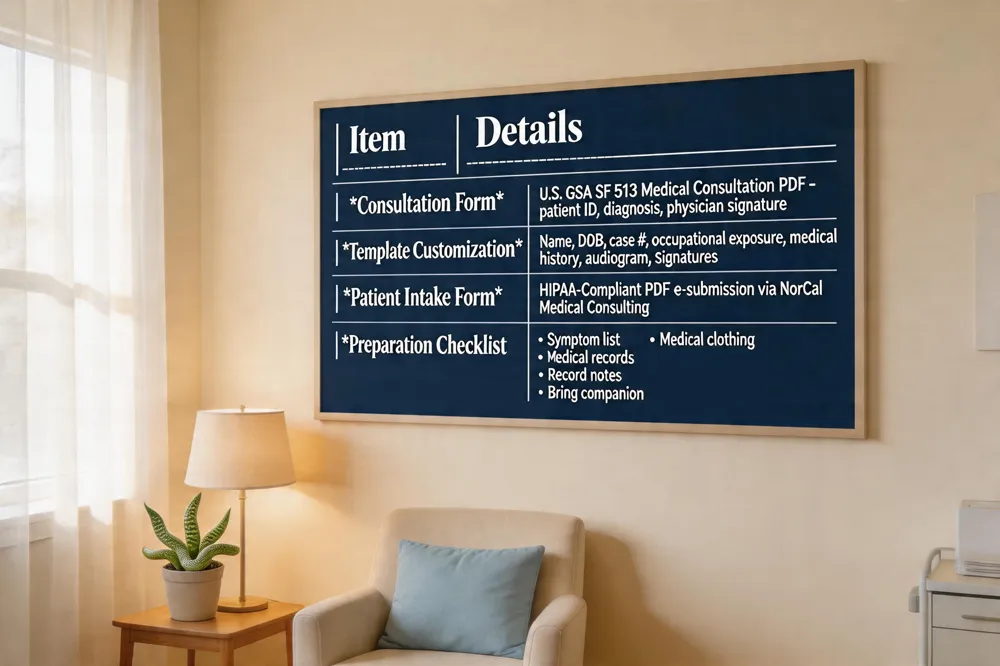 A solid medical‑legal file starts with a reliable consultation form. The U.S. General Services Administration offers a free, printable Medical Consultation Form PDF (search for "SF 513 Medical Consultation Sheet"); it captures patient ID, reason for request, provisional diagnosis, and physician signature, making it ideal for workplace‑injury assessments. For auditory‑loss cases, customize the “Reason for Request” and “Provisional Diagnosis” sections to note audiometric findings and hearing‑related symptoms.
A tailored Medical Consultation Form Template should begin with the claimant’s name, DOB, employer, and case number, then record occupational exposure (job duties, noise levels, hearing‑protection use). Include a detailed symptom timeline, medical history, current medications, and a concise audiogram summary (thresholds, speech‑in‑noise scores). End with the consultant’s assessment, conclusions, and recommended next steps, plus space for signature and notarization.
The Patient Consultation Form PDF is a standardized intake used by clinicians to document history, visit reason, and precautions. NorCal Medical Consulting can supply a version that meets HIPAA standards and is ready for secure electronic submission to attorneys or insurers.
How to prepare for a medical consultation: Draft a symptom list, prioritize questions, bring all medical records, prescription lists, and recent test results, and wear easy‑to‑remove clothing. Use a notebook or device to record the clinician’s explanations and follow‑up instructions, and consider a trusted companion to help retain details after the appointment.
Understanding Legal Milestones and Benefits
| Question | Answer |
|---|---|
| Is reaching MMI a good thing? | Indicates condition stabilized; may end medical benefits and disability payments. Positive if fully functional; otherwise may need legal protection for ongoing compensation. |
| Is bursitis covered? | Yes – compensable when work‑related. Benefits: medical treatment, PT, joint injections, wage‑replacement up to 95 % of pre‑injury earnings. |
| VA hearing‑loss compensation | VA rating (6100 schedule) converts audiograms to % rating. Example: 10 % → ≈ $180/mo; 70 % with spouse → ≈ $1,960/mo. |
| Whiplash & tinnitus compensation | Whiplash: $10‑20 K (higher with chronic pain/lost earnings). Tinnitus: few K → $20‑50 K+ depending on severity. |
| Industrial hearing‑loss lawsuit | Must prove employer negligence (noise‑control failures) and causal link. Evidence: audiograms, noise‑level data, safety logs, expert testimony. Early attorney contact preserves evidence. |
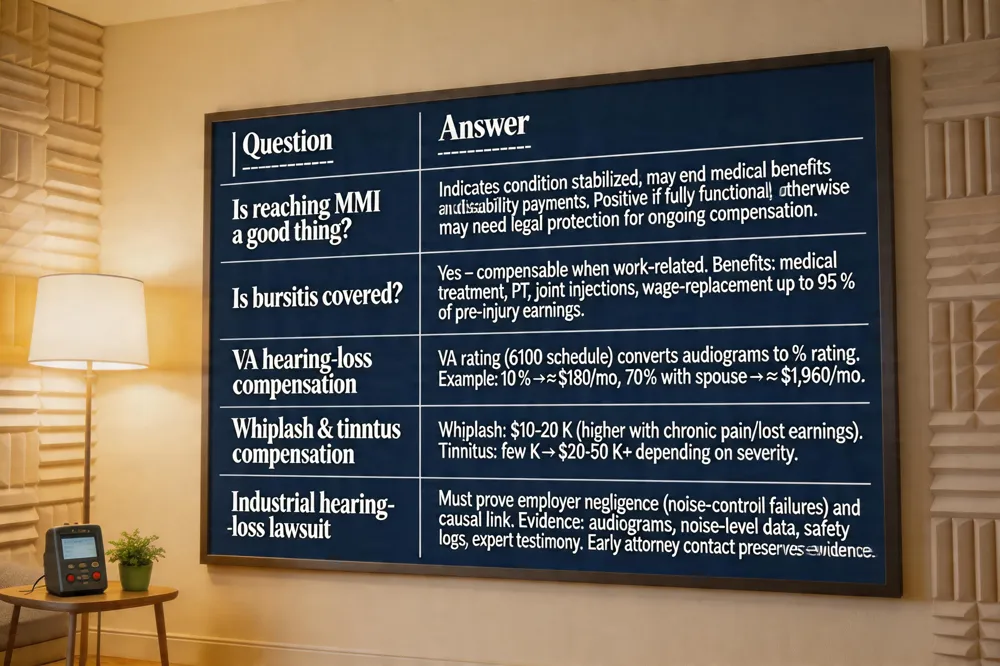 Navigating workers’ compensation and related benefits requires clear knowledge of medical milestones and the specific coverage for various injuries. Below are concise answers to common questions that often arise during a claim.
Is reaching MMI a good thing?
Maximum Medical Improvement (MMI) means the treating physician believes the condition will not improve further with additional care. While it signals that you have healed as much as possible, it also often ends ongoing medical benefits and may halt disability payments. If you are fully functional, this is positive; if lingering limitations remain, you may need legal assistance to protect any entitled compensation.
Is bursitis covered under workers' compensation?
Yes. Bursitis arising from repetitive motions, prolonged pressure, or awkward postures at work is compensable. Claimants can receive medical treatment, physiotherapy, joint injections, and wage‑replacement benefits (up to 95 % of pre‑injury earnings) when the injury is properly documented and reported promptly.
VA hearing loss compensation tables
The VA rates hearing loss using the 6100 schedule, converting audiometric results into a percentage rating. Monthly compensation follows VA tables—for example, a 10 % rating yields about $180/month, while a 70 % rating with a spouse pays roughly $1,960/month. These figures guide legal and insurance negotiations involving veteran hearing loss.
How much compensation for whiplash and tinnitus?
Whiplash settlements typically range $10‑20 K, increasing with chronic pain or lost earnings. Tinnitus awards vary from a few thousand dollars for mild cases to $20‑50 K or more for severe, lasting impairment. Detailed medical records and expert testimony are essential to substantiate higher awards.
Industrial hearing‑loss lawsuit
A successful claim must prove employer negligence in noise‑control (e.g., inadequate hearing protection, OSHA violations) and a direct causal link to the employee’s hearing loss. Evidence includes audiograms, noise‑level data, workplace safety logs, and occupational‑health expert testimony. Early consultation with a specialized attorney preserves evidence and maximizes potential recovery.
Strategizing Settlement and Communication
| Key Point | Guidance |
|---|---|
| Communication Rules | Do NOT admit fault, downplay injury, speculate on amounts, or reveal personal finances. Focus on documented medical evidence. |
| Typical Settlement Ranges | • Total permanent loss: avg $1.6 M (median $1.1 M) |
| • Partial loss: avg $139 K (median $55 K) | |
| • Inner‑ear dysfunction: avg $45 K (low $14 K). | |
| Net Recovery After Fees | After $100 K settlement, plaintiffs retain ~60‑75 % ($60‑75 K) after contingency fees, expert costs, and medical liens. |
| Questions for Lawyers | 1. Experience with hearing‑loss/workplace claims? |
- Comparable case outcomes?
- Fee, cost, and lien handling?
- Timeline & communication plan? |
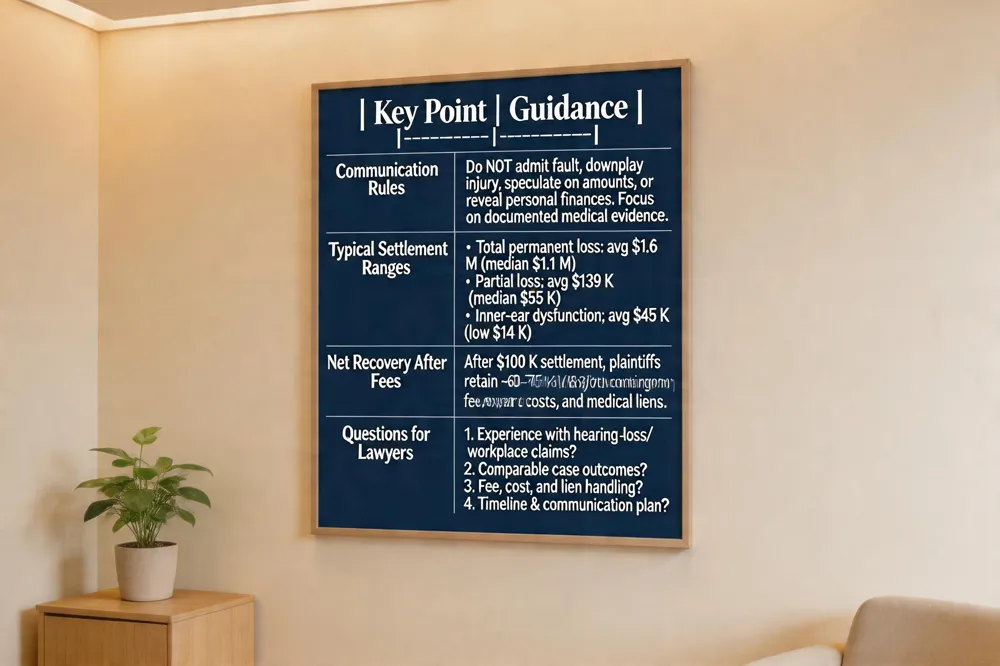 When entering settlement discussions, it is crucial to stay factual and avoid statements that could diminish the perceived value of the claim. Do not admit fault, downplay the injury, speculate about compensation amounts, or disclose personal financial needs. Keep the focus on documented medical evidence and treatment history.
Typical settlement ranges for hearing‑loss claims depend on severity. Total, permanent loss averages about $1.6 million (median $1.1 million). Partial loss settles for roughly $139,000 (median $55,000), while inner‑ear dysfunction averages $45,000, with some cases as low as $14,000.
Attorney fees and medical liens directly affect net recovery. After a $100,000 settlement, plaintiffs usually retain 60 %–75 % ($60,000–$75,000) after contingency fees, expert costs, and any outstanding medical liens are deducted. The exact percentage varies by fee agreement and case expenses.
Key questions to ask a lawyer before hiring include:
- What experience do you have with hearing‑loss or similar workplace injury claims?
- What outcomes have you achieved in comparable cases?
- How will fees, costs, and liens be handled and communicated?
- What is the expected timeline and communication plan for my case?
Navigating the Legal Process: Attorney Interaction
| Preparation Step | Details |
|---|---|
| Document Gather | Medical records, audiology reports, incident logs, employment history, insurance/claim forms. |
| Chronological Narrative | Concise timeline of incident, symptoms, treatments. |
| Consultation Checklist | Bring copies, list targeted lawyer questions (experience, fee structure, strategy). |
| Red‑Flag Indicators | Chronic lateness, interruptions, dismissive attitude, frequent cancellations/rescheduling. |
| IME Preparation | Know condition specifics, bring witness if allowed, cooperate fully, present honest symptom history. |
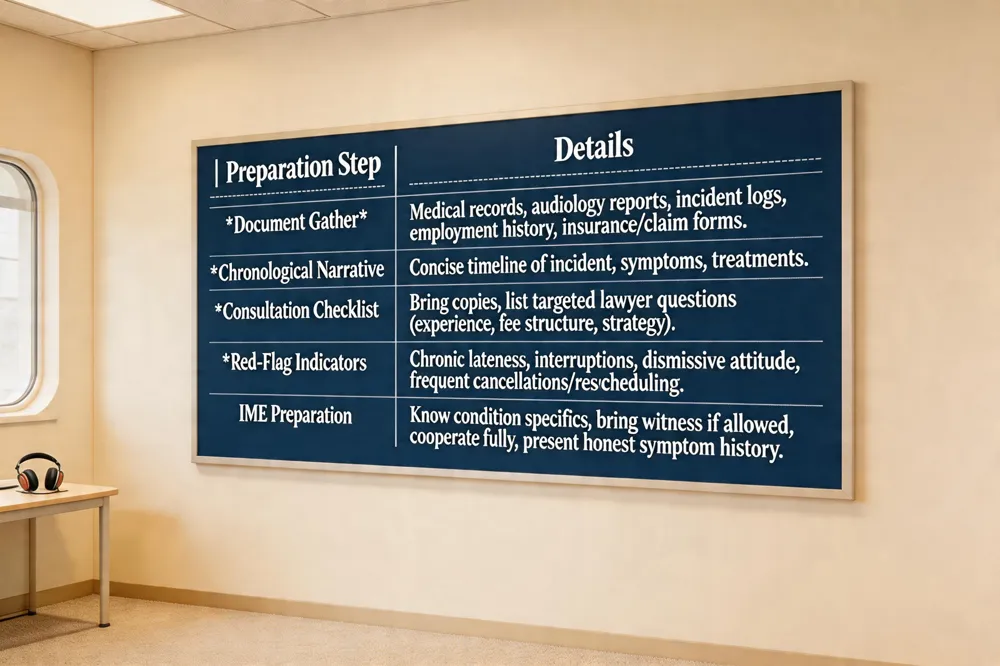 Preparing for the first meeting with an attorney is essential. Gather every piece of paperwork that relates to your injury – medical records, audiology reports, workplace incident logs, employment history, and any insurance or claim forms. Write a concise, chronological narrative that outlines what happened, the symptoms you experienced, and the treatment steps you have already taken. Bring copies of the documents and a short list of targeted questions about the lawyer’s experience with auditory‑loss or other workplace‑injury cases, their fee structure, and the anticipated strategy for your claim. Being ready to answer detailed queries honestly will help the attorney quickly assess the strength of your case.
During the consultation, watch for red flags. Chronic lateness without apology, frequent interruptions, or a dismissive attitude toward prior medical opinions can indicate a lack of respect for your case and a potential unwillingness to collaborate. A pattern of last‑minute cancellations or rescheduling may signal indecision that could stall progress.
If an Independent Medical Examination (IME) is scheduled, preparation can improve the outcome. Know the specifics of your condition, bring a witness if allowed, and cooperate fully with the examiner. Honesty about symptoms and a clear, documented medical history are the most reliable ways to present a credible, defensible claim.
Additional Resources and Follow‑Up Strategies
| Resource | Action |
|---|---|
| Expert Witness Selection | Choose board‑certified clinicians (otolaryngology, audiology, occupational medicine) with litigation experience; ensure timely record review and deposition availability. |
| Firm Financial Resources | Confirm firm has dedicated budget for expert retainers, diagnostics, and investigative costs to avoid delays. |
| Continued Documentation | Maintain organized timeline of symptoms, treatments, audiograms, employer communications; update experts with new information. |
| Telemedicine & Virtual Opinions | Use secure platforms (e.g., Doxy.me) for remote expert exams, allowing imaging/audiogram review, reducing travel costs, accelerating reports. |
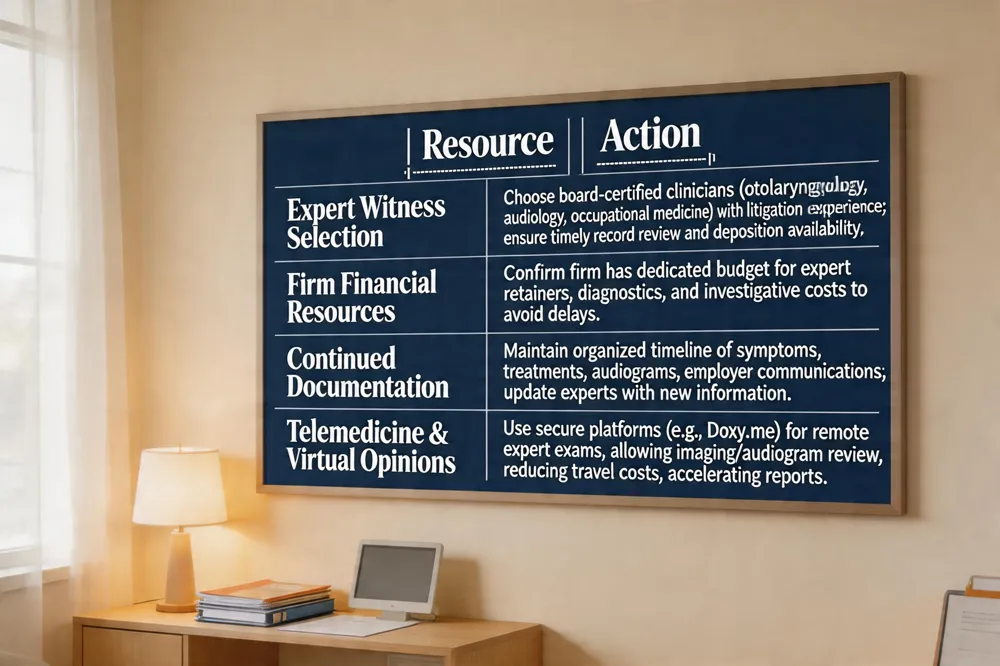 Expert Witness Selection and Coordination – Choose clinicians who are board‑certified in the relevant specialty (e.g., otolaryngology, audiology, occupational medicine) and have prior experience test legal testimony. Confirm their ability to review records promptly, draft a clear causation opinion, and be available for depositions or trial.
Financial Resources of Law Firms for Expert Fees – Verify that the firm has dedicated funds or a contingency budget to cover expert witness retainers, diagnostic testing, and investigative costs up front, preventing delays caused by financial constraints.
Continued Documentation After the Initial Consultation – Maintain an organized timeline of symptoms, medical treatments, audiograms, and employer communications. Update the expert with any new records or changes in condition to keep the opinion current and defensible.
Using Telemedicine and Virtual Expert Opinions – Leverage secure telehealth platforms (e.e [ Doxy.me) for timely virtual examinations, allowing experts to assess imaging and audiograms remotely, reducing travel costs and accelerating report delivery for workers’ compensation claims.
Putting It All Together for a Successful Claim
During the initial legal‑medical consultation, the attorney should ask eight essential questions: (1) experience with similar medical‑negligence or workers’ compensation cases; (2) success record and typical settlement or trial outcomes; (3) statutes of limitations and filing deadlines; (4) required medical evidence and expert‑witness needs; (5) anticipated strengths and weaknesses of the case; (6) financial resources for investigative and expert fees; (7) primary point of contact and communication plan; and (8) fee structure and client responsibilities. Each answer shapes the litigation strategy—experience guides case selection, the record informs settlement expectations, deadlines dictate filing timelines, and evidence requirements determine the scope of medical evaluation and expert testimony. Early, organized preparation—gathering records, timelines, and audiograms—creates a defensible factual foundation and speeds expert engagement. After the personalized consultation, the client should finalize documentation, schedule the required medical examination, and confirm the firm’s communication protocol to keep the claim moving forward.