Introduction
Prompt reporting of a workplace injury is the cornerstone of a successful workers’ compensation claim. Most states require a written notice within days‑30 days (or state‑specific deadlines) to preserve eligibility for medical and wage‑replacement benefits. Immediate medical evaluation creates an official record that links the injury to the job, ensures proper treatment, and provides the documentation—doctor’s notes, imaging, and treatment plans—required by insurers and tribunals. Failure to report or seek care promptly can trigger denial, reduce benefits, or limit the ability to appeal. Understanding the legal timeline, including filing limits and appeal windows, protects the employee’s rights and positions the claim for optimal compensation while reducing insurer tactics that aim to minimize payouts.
1. Immediate Reporting and Medical Care
| Item | Details |
|---|---|
| Statutory Reporting Deadline | Most states: written notice within 30 days (e.g., GA, CA, FL); PA up to 120 days |
| Written Injury Report | Email/text supervisor, retain copy, request DWC‑1 or equivalent form |
| Prompt Medical Evaluation | Obtain immediate care, inform physician of work‑related nature, follow treatment plan |
| Accident Prevention | Eliminate distractions, use proper PPE, follow safety protocols, regular training |
| Injury Prevention Program | Written safety program, ergonomic assessments, PPE enforcement, reward safe behavior |
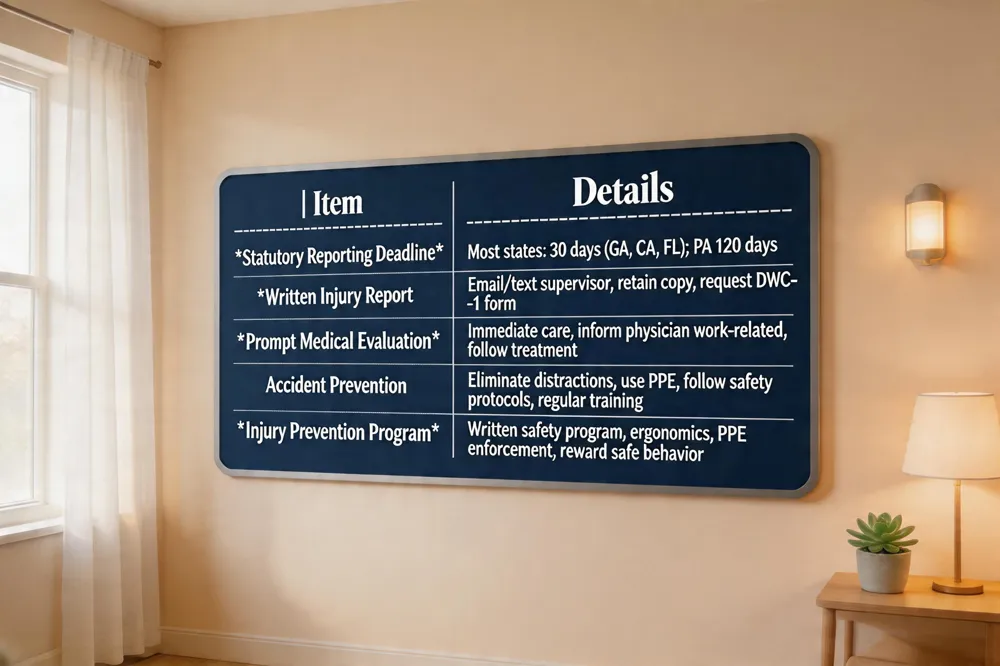 Statutory Reporting Deadlines by State
Most U.S. states require a written injury notice within a short window—often 30 days (e.g., Georgia, California, Florida) and up to 120 days in Pennsylvania. Missing these deadlines can force a claim under the statute of limitations and eliminate workers’ compensation benefits.
Statutory Reporting Deadlines by State
Most U.S. states require a written injury notice within a short window—often 30 days (e.g., Georgia, California, Florida) and up to 120 days in Pennsylvania. Missing these deadlines can force a claim under the statute of limitations and eliminate workers’ compensation benefits.
Written Injury Reports A contemporaneous written report creates a verifiable record. Employees should email or text the supervisor, retain a copy, and request the employer’s DWC‑1 or equivalent form. This documentation supports the claim and prevents disputes over verbal reports. Create a written injury report to establish a tangible record for workers’ compensation evidence.
Prompt Medical Evaluation Immediate medical care links the injury to the work incident, establishes an official record, and satisfies state filing requirements. Workers should inform the physician that the injury is work‑related and follow all prescribed treatment and follow‑up appointments.
How to Prevent Accidents Eliminate distractions, use proper PPE (e.g., hearing protection), and follow safety protocols. Regular training and clear communication reduce risk.
Workplace Safety Accidents Accidents range from historic industrial disasters to modern preventable incidents. Documentation of hazards, PPE use, and corrective actions helps insurers and attorneys assess claims.
Injury Prevention at Work Implement a written safety program, conduct ergonomic assessments, enforce PPE, and foster a culture that rewards safe behavior and timely injury reporting. Encouraging employees to report hazards promptly is a key OSHA recommendation.
2. Documentation, Records, and Communication
| Documentation Type | Purpose |
|---|---|
| Forms & Bills | PDFs of OSHA 300 log, DWC‑1, medical invoices – create reproducible paper trail |
| Symptom Journal & Photos | Track pain progression, link to work activity, counter downplay attempts |
| Written Communications | Limit insurer/adjuster contact to written statements reviewed by counsel |
| Common Injuries | Overexertion, falls‑slips‑or‑trips, transportation incidents, burns, lacerations |
| Injury Source | Slip, trip, and fall incidents = 37 % of reported injuries |
| Prevention Rules | Vary tasks, warm‑up, build strength, use proper technique, wear PPE, monitor fatigue |
| Administrative Controls | Safety policies, permit‑to‑work, incident reporting, toolbox talks, centralized database |
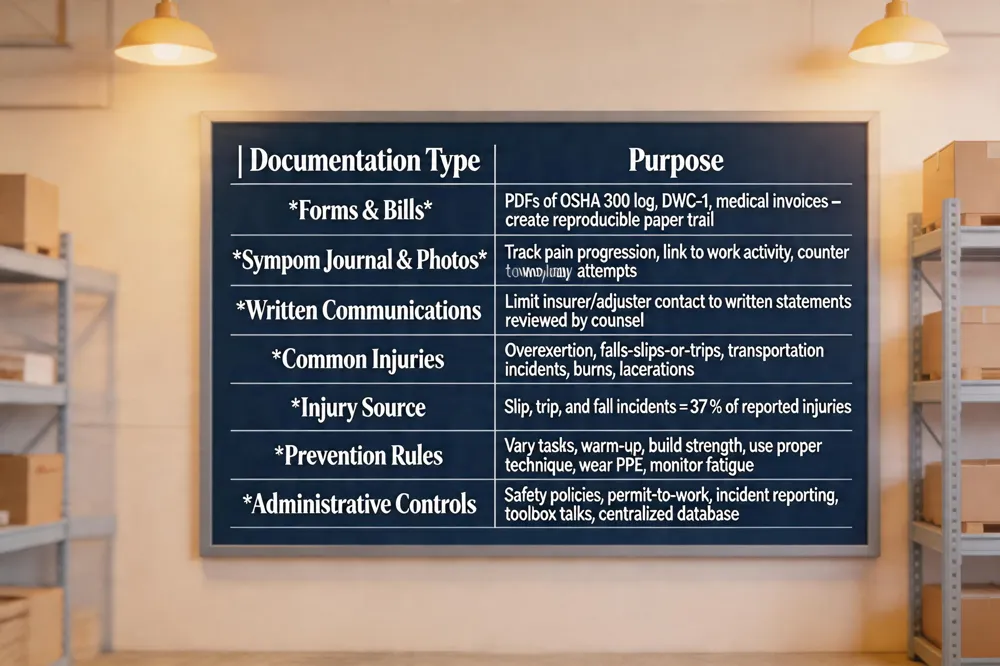 Effective documentation protects a worker’s claim and guides a safe return‑to‑work. First, keep copies of every form, bill, and employer notice—PDFs of the OSHA 300 log entry, the DWC‑1 claim form, and all medical invoices create a paper trail that can be reproduced if a dispute arises. Second, maintain a daily symptom journal and photograph the injury site; these records link the pain’s progression to workplace activity and counter any insurer’s attempt to downplay severity. Third, limit communications with insurers and adjusters to written statements reviewed by counsel; avoid recorded oral statements, and never sign settlement releases without understanding their impact.
Common injuries: Overexertion, falls‑slips‑or‑trips, transportation incidents, burns, and lacerations.
Injury source: Slip, trip, and fall incidents account for 37 % of reported workplace injuries.
Prevention rules: 1) Vary tasks to avoid overuse; 2) Warm‑up and stretch before work; 3) Build strength and stability; 4) Use proper technique; 5) Wear appropriate PPE; 6) Monitor fatigue and pain.
Administrative controls: Written safety policies, permit‑to‑work systems, mandatory incident reporting, regular toolbox talks, and a centralized record‑keeping database help prevent repeat accidents.
3. Return‑to‑Work and Accommodation Issues
| Step | Description |
|---|---|
| ADA Accommodation | Light‑duty or modified duties after physician clearance |
| Employer Refusal | Permissible only for safety concerns or inability to perform essential functions |
| Benefits After Return | Temporary Partial Disability (TPD) if earnings < 80 % of pre‑injury wages; permanent impairment benefits thereafter |
| Standard RTW Program | 1) Policy statement, 2) Eligibility criteria, 3) Designated responsibilities, 4) Pre‑approved transitional duties, 5) Clearance & documentation procedures |
| Injury Prevention Culture | Risk assessments, ergonomic controls, hazard remediation, health programs |
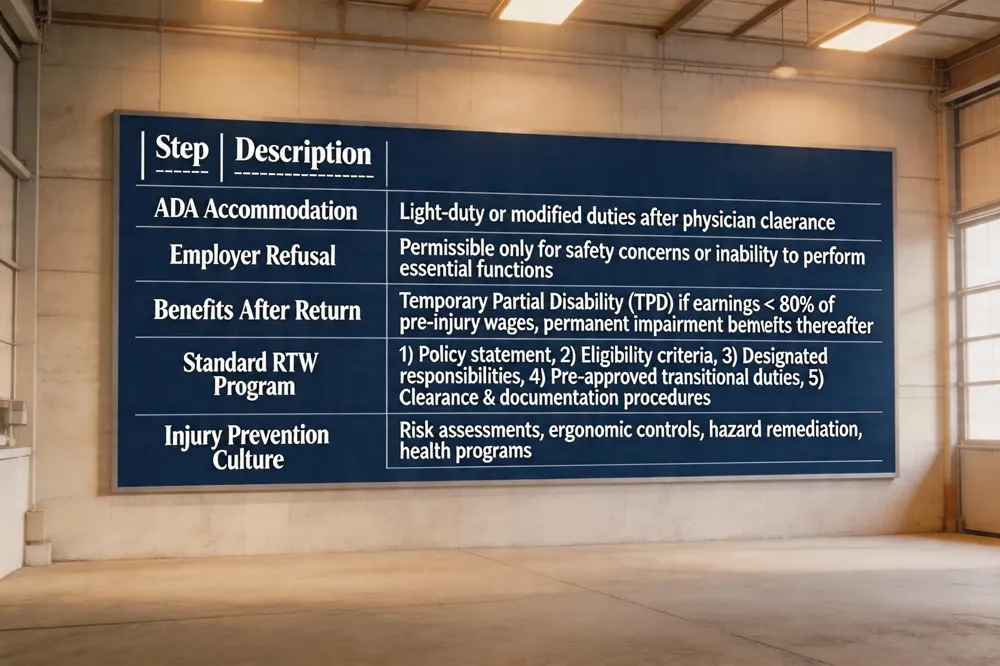 Employers must honor the Americans with Disabilities Act (ADA) by exploring reasonable accommodations—such as light‑duty or modified duties—once a treating physician clears an employee to return. Refusal to allow a return is permissible only for a lawful reason, e.g., genuine safety concerns or inability to perform essential job functions. If an employer blocks a medically cleared return without valid justification, the worker can pursue legal recourse, including filing a workers’ compensation appeal or a discrimination claim under the ADA.
Workers’ compensation benefits may continue after a return to work. When the employee works under restrictions and earnings fall below roughly 80 % of pre‑injury wages, temporary partial disability (TPD) benefits are available until maximum medical improvement. Permanent impairment benefits follow thereafter, based on the physician’s impairment rating.
A standard return‑to‑work program includes: (1) a policy statement of commitment, (2) eligibility criteria covering all compensable injuries, (3) designated responsibilities for coordinators, supervisors, medical providers, and the employee, (4) a pre‑approved list of transitional duties with physical limits, and (5) procedures for medical clearance, ongoing communication, and documentation.
Preventing injuries hinges on a proactive safety culture: regular risk assessments, ergonomic controls, prompt hazard remediation, and employee health programs all reduce the incidence of workplace accidents.
4. Legal, Appeal, and Settlement Considerations
| Item | Details |
|---|---|
| Filing Deadlines | Written injury report within 30‑120 days; formal claim within 120‑365 days |
| Appeal Window | Typically 3 years for occupational disease claims |
| Settlement Evaluation | Compare lump‑sum to projected medical costs, lost wages, future disability |
| Bursitis Coverage | Covered if caused/aggravated by job duties, with timely reporting & physician documentation |
| 5 E’s of Prevention | Education, Encouragement, Engineering, Enforcement, Evaluation |
| What Not to Say | Avoid downplaying pain, speculating recovery time, absolute statements (“always/never”) |
| Post‑Injury Actions | Immediate medical care, written report, preserve evidence, consult specialist, retain attorney |
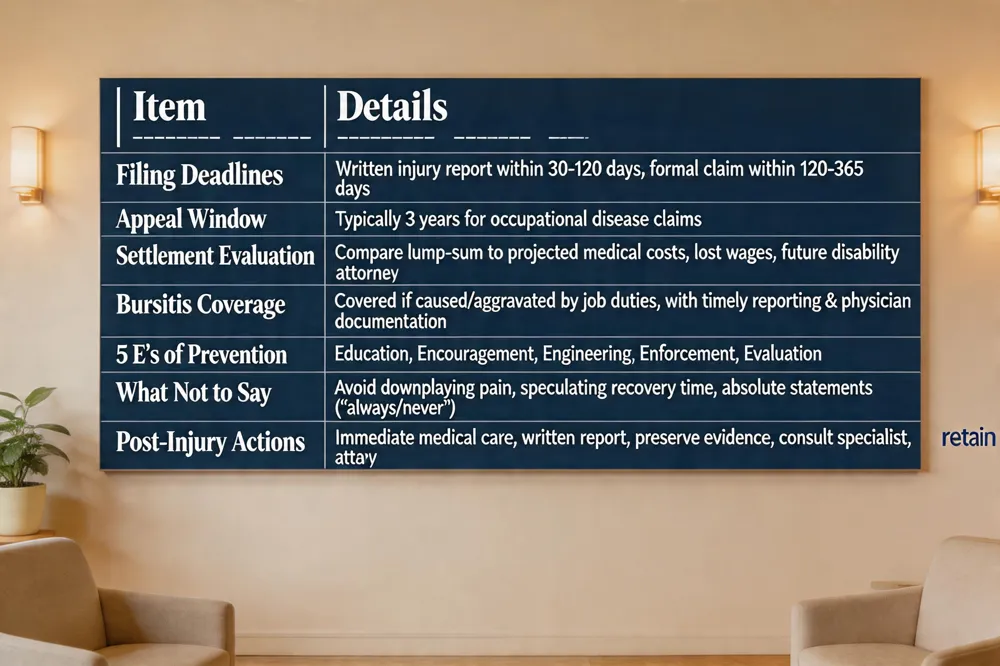 Filing deadlines and appeals are strict: most states require a written injury report within days (often 30‑120 days) and a formal claim within 120‑365 days; missed deadlines can bar benefits and any denial must be appealed within the statutory window (typically three years for occupational disease claims). When evaluating a settlement offer, compare the lump‑sum against projected medical costs, lost wages, and future disability; early offers are usually lower than the claim’s true value and may waive rights to later benefits. Engaging an experienced workers’‑comp attorney early ensures deadlines are met, documents are preserved, and negotiations reflect the full economic impact of the injury.
Is bursitis covered under workers' compensation? Yes—if the condition is caused or aggravated by job duties, bursitis qualifies for medical and wage‑replacement benefits, provided timely reporting and physician documentation.
What are the 5 E's of injury prevention? Education, Encouragement, Engineering, Enforcement, Evaluation.
What not to say to Workman's Comp? Do not downplay pain, speculate on recovery time, or use absolute statements such as “always” or “never.”
What actions should be taken following a serious injury at work? Obtain immediate medical care, report the incident in writing, preserve evidence (photos, witness statements), consult an occupational specialist, and retain a workers’‑comp attorney to protect rights and benefits.
5. Systemic Safety Programs and Continuous Improvement
| Component | Description |
|---|---|
| Safety Committee | Includes frontline workers; identifies hazards, recommends PPE, mental‑health resources |
| Technology Tools | Digital incident‑reporting platforms, EMR integration, deadline tracking |
| Audits & Training | Periodic audits, hierarchy of controls (eliminate, engineer, admin, PPE) |
| Root‑Cause Investigations | Lead to engineering fixes, behavioral training, real‑time monitoring of near‑misses |
| Continuous Review | Update policies, reward compliance, health screenings (e.g., audiograms) |
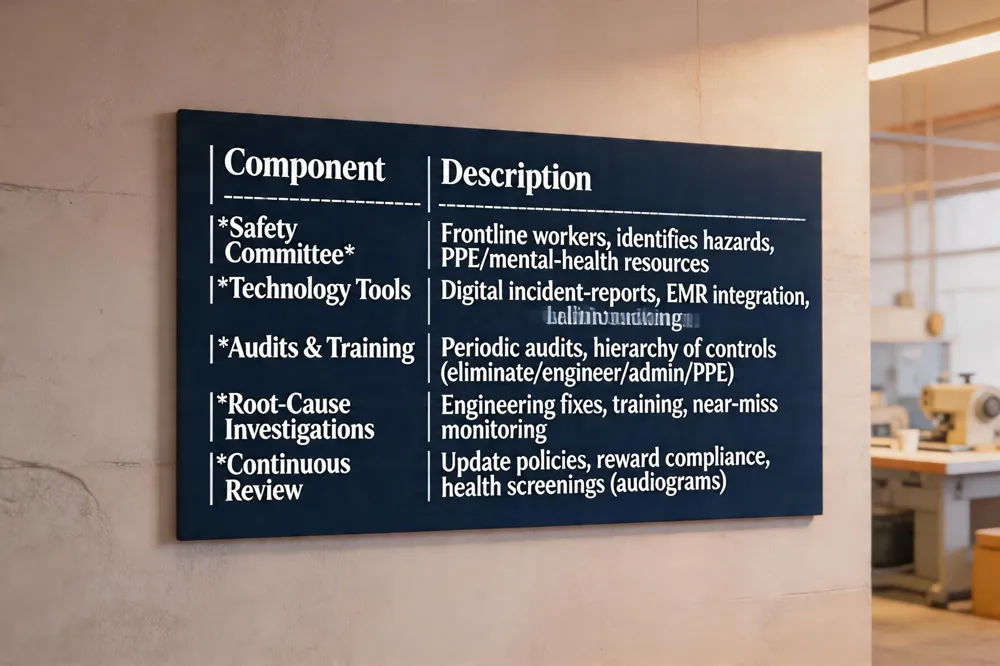 Effective systemic safety programs combine strong culture, technology, and regular audits. A safety committee that includes frontline workers fosters a “safe and healthy workplace” by identifying hazards—such as excessive noise that can cause auditory loss—and recommending PPE, hearing‑conservation measures, and mental‑health resources. Technology tools for case management, such as digital incident‑reporting platforms and electronic medical‑record integration, streamline documentation, track deadlines, and preserve evidence for workers‑‑comp claims. Periodic audits and training reinforce the hierarchy of controls: eliminate or substitute hazards, apply engineered safeguards, adjust administrative procedures, and provide PPE only as a last resort. Continuous improvement relies on thorough incident investigations that uncover root causes, leading to engineering fixes, behavioral‑based training, and real‑time monitoring of leading indicators like near‑miss reports. By regularly reviewing corrective actions, updating policies, and rewarding compliance, organizations prevent repeat incidents, protect employees, and strengthen legal and insurance outcomes. Employers should also integrate periodic health screenings, such as audiograms, to detect early signs of occupational illnesses and adjust work assignments accordingly.
6. Real‑World Examples and Specialized Contexts
| Example | Key Practices |
|---|---|
| NBA Injury Management | Detailed medical reports, game‑day updates, central verification, evidence‑based recovery plans |
| Sports Injury Protocol (R‑I‑C‑E) | Rest, Ice, Compression, Elevation; immobilization, surgery, rehab as needed |
| Common Injury Categories | Overexertion, falls‑slips‑or‑trips, transportation, burns, lacerations |
| Musculoskeletal Injuries | Rotator‑cuff tears, lateral epicondylitis, patellofemoral pain, ankle sprains, carpal‑tunnel, lower‑back strain, hip groin pulls |
| Overlap with Workplace | Same injuries appear in both sports and occupational settings → early evaluation & documentation essential |
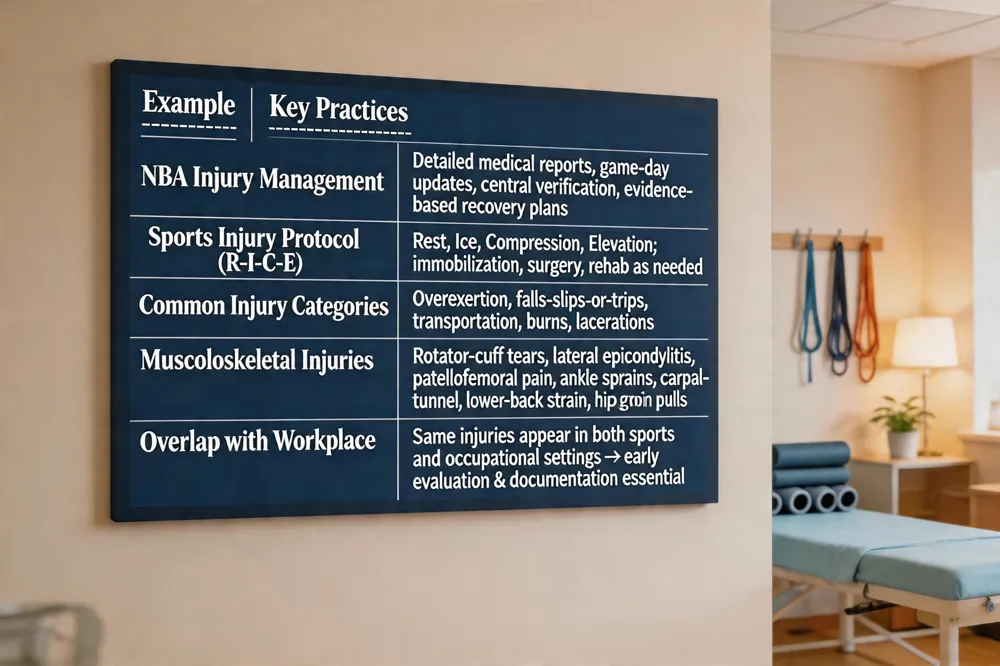 NBA injury management follows a league‑mandated protocol that requires each team to submit detailed medical reports before games and provide game‑day updates. Athletic trainers and team physicians conduct physical exams, imaging, and functional testing, while the NBA’s central medical office verifies the information. This systematic approach mirrors best practices for workplace injury assessments: timely documentation, clear status classifications, and evidence‑based recovery plans are essential for supporting legal and insurance claims.
Effective sports injury management begins with prompt identification, accurate diagnosis, and the R‑I‑C‑E regimen (rest, ice, compression, elevation). More serious cases may need immobilization, surgery, and structured rehabilitation. Comprehensive records of each step protect workers’‑comp claims and aid return‑to‑work planning.
The five primary work‑related injury categories are overexertion, falls‑slips‑or‑trips, transportation incidents, burns, and lacerations. Among them, the seven most common musculoskeletal injuries—shoulder rotator‑cuff tears, elbow lateral epicondylitis, knee patellofemoral pain, ankle sprains, wrist carpal‑tunnel syndrome, lower‑back strains, and hip groin pulls—appear in both sports and occupational settings, underscoring the need for early professional evaluation and documented treatment.
Conclusion
Workers who ignore the most common pitfalls after an injury quickly jeopardize their claim. The biggest mistakes include delaying the written report to the employer, postponing medical treatment, failing to follow the physician’s orders, neglecting detailed records, speaking freely with adjusters, posting on social media, and refusing suitable light‑duty work. Acting promptly preserves statutory deadlines, creates a reliable medical trail, and prevents insurers from arguing the injury is unrelated or pre‑existing. Comprehensive documentation—photos, symptom journals, bills, and correspondence—strengthens evidence and supports accurate benefit calculations. NorCal Medical Consulting provides expert occupational‑health evaluations, audiometric testing, and detailed medical opinions that link workplace hazards to specific impairments, giving claimants the authoritative evidence needed to secure full workers’ compensation benefits. Their expertise further protects rights and eases appeals.