Introduction: The High Stakes of Falls at Work
The Prevalence and Cost of Workplace Falls
Slips, trips, and falls represent one of the most common and costly categories of workplace injuries. Annually, these incidents account for a significant portion of preventable injuries and fatalities. In 2023 alone, falls accounted for 21% of all preventable injury-related deaths in the United States, with nearly 900 workers dying in falls and hundreds of thousands more suffering injuries severe enough to require time away from work.
Financially, the burden is immense. Workers' compensation and medical expenses associated with workplace falls are estimated to cost the U.S. economy approximately 70 billion dollars each year. The average cost per workplace injury is substantial, and the indirect costs—including lost productivity, training replacements, and regulatory fines—further amplify the economic impact on businesses.
Falls Are a Universal Workplace Hazard
While the construction industry experiences the highest rate of fatal falls from height, no sector is immune. The highest counts of nonfatal fall injuries occur in sectors like educational and health services, healthcare, social assistance, and building maintenance. These incidents are often slips and falls on the same level, not from elevated heights.
This data underscores a critical point: fall hazards exist in every work environment, from industrial sites and warehouses to office settings and hospitals. A worker does not have to fall from a great height to suffer a severe or even fatal injury; in 2022, 144 workers were killed in falls on the same level.
The Foundational Principle: Falls Are Preventable
The most important message for employers and safety professionals is that evidence consistently shows workplace falls are preventable. With proper planning, risk assessment, and the implementation of effective controls, these incidents can be avoided. This proactive approach aligns with core occupational safety principles, emphasizing hazard elimination and engineering controls as the most effective strategies.
Prevention is not solely about compliance; it is a sound business and ethical practice. Implementing robust safety programs has been shown to reduce injury rates, lower insurance costs, enhance productivity, and protect a company's most valuable asset—its workforce.
Relevance to Healthcare Consulting and Injury Assessment
For a firm specializing in workplace injury assessments, understanding the mechanics, causes, and regulatory context of falls is paramount. These incidents frequently result in complex medical evaluations, particularly for musculoskeletal injuries, head trauma, and long-term disability.
Expert analysis of a fall incident often involves determining whether recognized safety standards and preventative measures were in place. This includes evaluating compliance with OSHA regulations on walking-working surfaces, fall protection systems, housekeeping, and employee training. Such assessments are crucial for supporting accurate legal and insurance claims processes, where the preventability of an incident is a central question.
| Incident Metric | Annual Statistic | Key Implication |
|---|---|---|
| Fatal Falls (Workers) | Approximately 885 deaths | Leading cause of death in construction |
| Nonfatal Fall Injuries | Hundreds of thousands | Major driver of lost workdays and claims |
| Economic Cost (U.S.) | ~70 billion dollars | Significant financial burden on businesses |
| ER Visits (All Falls) | Over 8.8 million people | Immense strain on healthcare systems |
| Same-Level Fall Deaths | 144 worker fatalities (2022) | Hazard exists without elevation |
Understanding the Hazards: From Unguarded Edges to Wet Floors
What are common examples of slip, trip, and fall hazards in the workplace?
Common slip hazards include wet, oily, or freshly waxed floors; spills of liquids or powders; loose mats or rugs; and weather hazards like ice, snow, or rain. Trip hazards include cluttered walkways, exposed electrical cords or air hoses, poor lighting, wrinkled carpets, uneven flooring, open desk drawers, and unexpected changes in elevation. Fall-from-height hazards involve unprotected sides and edges of platforms, open holes (including skylights), unsafely positioned or damaged ladders, unstable scaffolding, and working over dangerous equipment.
A Closer Look at Slip Hazards
Slips happen when there is insufficient traction between footwear and a walking surface. The leading causes are surfaces contaminated by water, grease, oil, or dust. Common examples in various workplaces include:
- Wet floors from spills, cleaning, or poor drainage in kitchens, healthcare facilities, and manufacturing areas.
- Ice and snow on outdoor walkways, parking lots, and loading docks.
- Polished stone or gloss-finished tile in lobbies and office buildings.
- Loose, unsecured rugs or mats at building entrances.
Identifying Trip Hazards
Trips occur when a foot collides with an object, disrupting balance. These hazards are often related to poor housekeeping and environmental design. Key examples are:
- Clutter, debris, or improperly stored materials obstructing walkways, especially on construction sites.
- Electrical cords, power cables, or air hoses stretched across traffic paths.
- Inadequate lighting in stairwells, warehouses, or outdoor areas, making hazards difficult to see.
- Uneven walking surfaces, such as cracked pavement, loose floorboards, or transitions between flooring types.
- Open file cabinets or desk drawers in office environments.
The Dangers of Falls from Height
Falls from an elevation are a leading cause of workplace fatalities, particularly in construction. Hazards often stem from a lack of engineering controls. Critical examples include:
- Unguarded edges of roofs, mezzanines, platforms, and runways.
- Floor holes, wall openings, and uncovered skylights.
- Ladders that are not secured, placed on unstable ground, or are damaged.
- Scaffolding that is improperly erected or missing guardrails.
- Working above dangerous machinery or equipment without fall protection over dangerous equipment.
Prevalence and High-Risk Industries
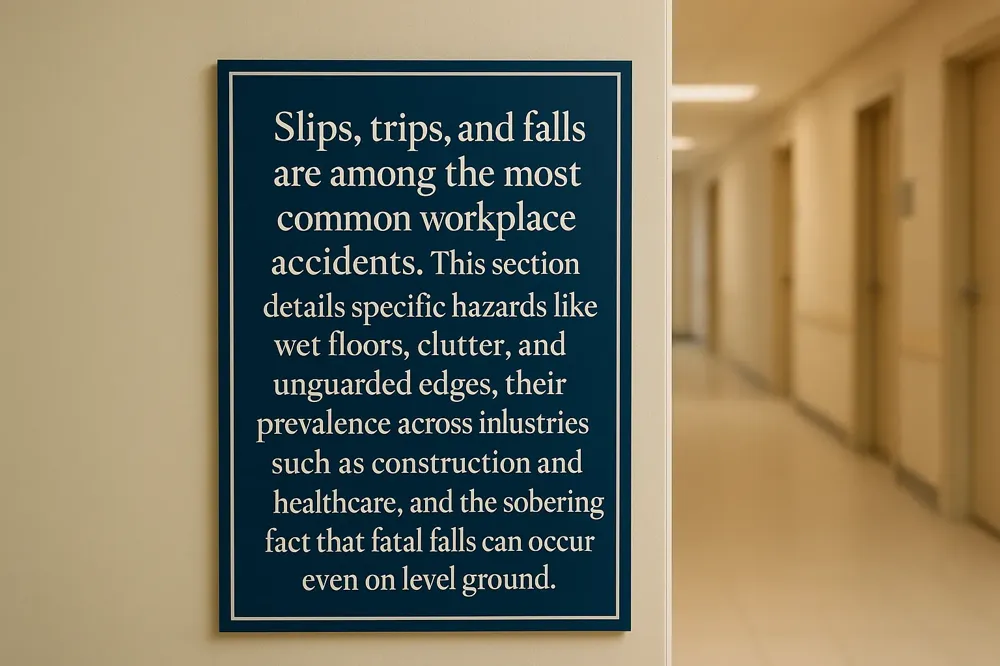
Slips, trips, and falls are among the most common workplace accidents. Statistics underscore their severity:
- In 2023, 885 workers died due to falls, with hundreds of thousands more injured severely enough to require time off work.
- Falls, slips, and trips accounted for 38% of all workplace deaths in the construction industry in 2022. Construction workers face fatal falls from height at more than seven times the rate of other industries.
- For nonfatal injuries, the highest counts occur in healthcare and social assistance, where slips and falls on the same level are prevalent.
- Other high-risk sectors include transportation, building cleaning and maintenance, and nursing care.
Fatal Falls Can Happen on Level Ground
A critical point for injury assessment is recognizing that a fall does not require significant height to be fatal or cause severe disability. In 2022, 144 workers were killed in fatal same-level falls. A slip or trip on a wet floor or over a cluttered walkway can result in a traumatic head injury, fracture, or other life-altering condition. This underscores the importance of controlling slip and trip hazards in all work environments, including offices and healthcare facilities.
| Hazard Category | Common Examples | Typical Work Environments |
|---|---|---|
| Slip Hazards | Wet/oily floors, ice/snow, loose mats, spills | Kitchens, hospitals, loading docks, entrances |
| Trip Hazards | Clutter, exposed cords, poor lighting, uneven floors | Construction sites, offices, warehouses, retail |
| Fall-from-Height Hazards | Unguarded edges, open holes, unsafe ladders, no scaffolding guardrails | Roofing, construction, manufacturing, maintenance |
The Regulatory Backbone: Key OSHA and ANSI Standards Explained
What are the main OSHA and ANSI standards for fall protection?
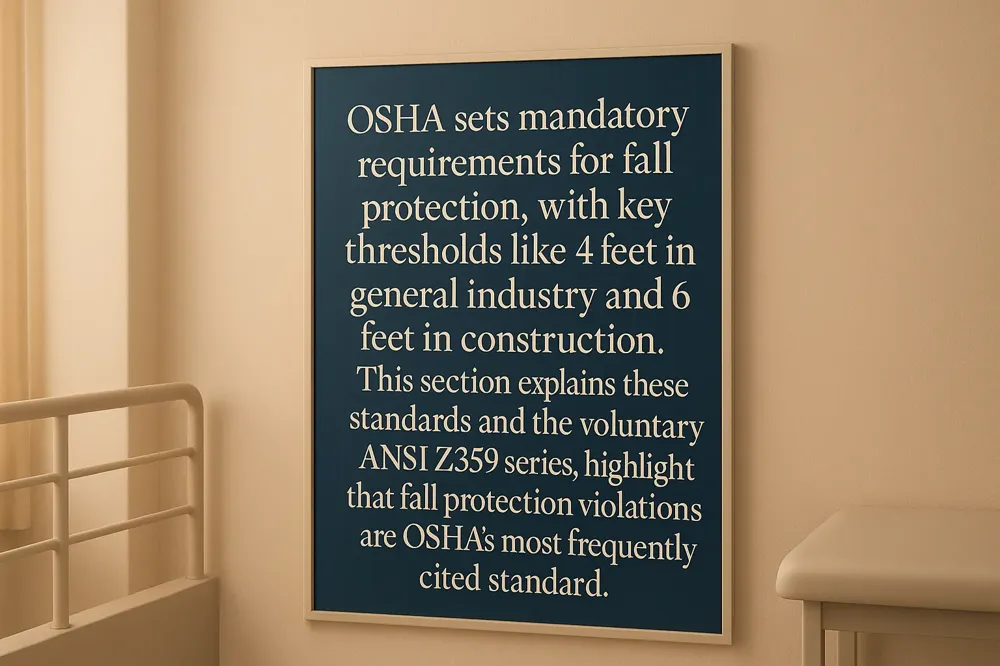
The primary federal standards for fall protection are set by the Occupational Safety and Health Administration (OSHA). For general industry workplaces—including factories, warehouses, and healthcare facilities—the core regulation is 29 CFR 1910.28, 'Duty to have fall protection and falling object protection.' For construction work, the stricter 29 CFR 1926 Subpart M applies. These standards mandate that employers provide specific fall protection systems when employees are exposed to hazards like unprotected edges, holes, or dangerous equipment.
Voluntary consensus standards, particularly the ANSI/ASSE Z359 series, provide detailed technical specifications for equipment and program management. While not legally enforceable like OSHA rules, the Z359 standards are widely adopted as industry best practices. They often exceed OSHA minimums, offering enhanced guidelines for personal fall arrest systems, horizontal lifelines, and comprehensive managed fall protection programs.
What are the key OSHA fall protection height and distance requirements?
OSHA mandates fall protection based on specific elevation thresholds for fall protection, which vary by industry. These triggers are critical for compliance assessments in injury cases.
| Industry/Sector | Height Threshold Requiring Fall Protection | Key Scenarios and Notes |
|---|---|---|
| General Industry | 4 feet (1.2 m) | Applies to unprotected sides & edges, holes, dockboards, runways, and stairway landings. |
| Shipyards | 5 feet (1.5 m) | Covers work on vessels and dry docks. |
| Construction | 6 feet (1.8 m) | The most common trigger for roofs, scaffolds, leading edges, and walking-working surfaces. |
| Longshoring | 8 feet (2.4 m) | Pertains to cargo handling and vessel access. |
| All Industries | Any height | When working over dangerous equipment (e.g., machinery, vats of acid). |
Beyond height, the standards prescribe performance criteria. For example, personal fall arrest systems must limit free fall distance and ensure maximum arresting force. Guardrail systems must be approximately 42 inches high and withstand 200 pounds of force.
Required Protective Systems and Compliance Landscape
When a hazard meets the applicable height threshold, employers must implement one or more of the following primary protective systems:
- Guardrail Systems: A physical barrier installed along exposed edges. Must include top rails, midrails, and toeboards where falling objects are a risk.
- Safety Net Systems: Installed as close as practicable under the work area, but not more than 30 feet below. Must be tested and inspected regularly.
- Personal Fall Arrest Systems (PFAS): Consist of a full-body harness, connecting device (lanyard or lifeline), and a secure anchor point capable of supporting at least 5,000 pounds per employee.
Fall protection violations have been OSHA's most frequently cited standard for multiple years, with thousands of citations and significant proposed penalties annually. This underscores widespread compliance challenges. Employers must also be aware of OSHA-approved State Plans, which may have different or more stringent requirements than federal rules. Additionally, maritime operations (29 CFR 1915, 1917, 1918) have separate standards addressing unique hazards like deck openings and slippery surfaces.
| Standard / Guideline | Primary Application | Core Focus |
|---|---|---|
| OSHA 29 CFR 1910.28 | General Industry | Duty to provide fall & falling object protection on walking-working surfaces. |
| OSHA 29 CFR 1926 Subpart M | Construction | Fall protection criteria for all construction work at 6+ feet. |
| ANSI/ASSE Z359.1 | All Industries (Voluntary) | Design & testing specs for fall arrest systems and components. |
| ANSI/ASSE Z359.2 | All Industries (Voluntary) | Guidelines for a comprehensive managed fall protection program. |
| OSHA Maritime Standards | Shipyards, Marine Terminals | Guarding deck openings, access points, and slippery conditions. |
Building a Multi-Layered Defense: From Prevention to Protection
Building a Multi-Layered Defense: From Prevention to Protection
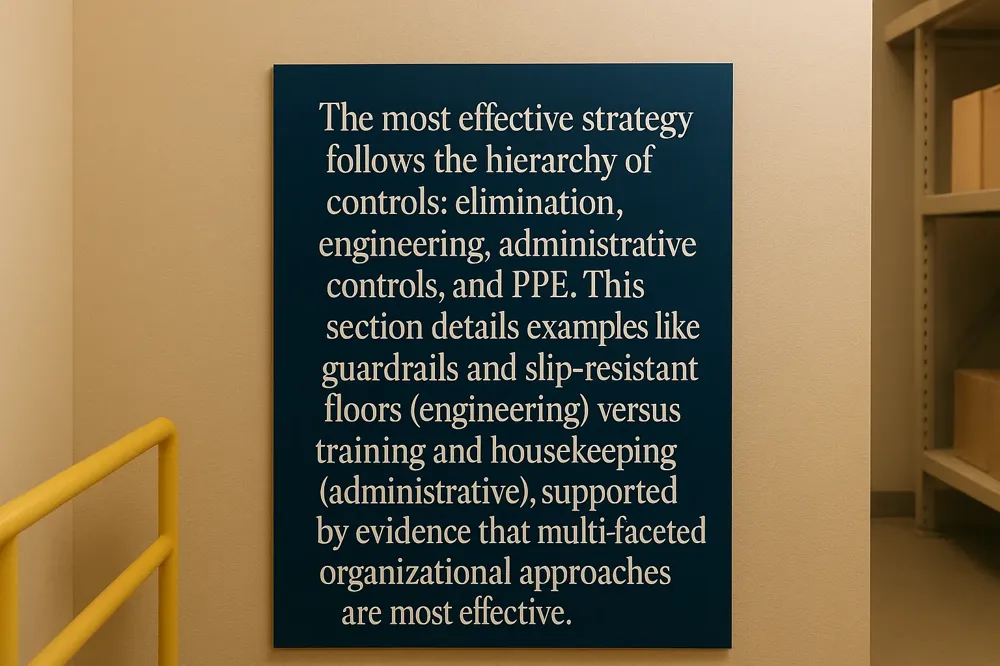
A robust strategy against workplace falls integrates several defensive layers, structured around the established hierarchy of controls. This systematic approach prioritizes the most effective methods for mitigating risk, beginning with eliminating hazards entirely and proceeding through engineering, administrative, and personal protective measures.
What are effective control measures to prevent slips, trips, and falls?
Effective control measures are structured within a proven hierarchy. The most reliable method is to eliminate the hazard through design, such as avoiding unnecessary changes in walking surface elevation. When elimination isn't possible, engineering controls create physical barriers between workers and hazards. These include installing permanent guardrails, applying slip-resistant coatings to floors, ensuring adequate lighting in all walkways, and securely covering floor holes. Administrative controls involve organizational policies and work practices that reduce exposure. Key examples are enforcing strict housekeeping protocols for immediate spill cleanup, conducting regular safety inspections, posting clear warning signs for wet floors, and implementing comprehensive fall protection training for workers. The final layer, Personal Protective Equipment (PPE), serves as a last line of defense. This includes mandating slip-resistant footwear and, for work at height, providing and enforcing the use of full-body harnesses and lanyards as part of a certified personal fall arrest system.
What are the differences and examples of fall prevention versus fall protection?
Fall prevention and fall protection are distinct concepts, both critical for OSHA compliance and safety. Fall prevention focuses on stopping a fall from occurring through passive, always-present measures. These controls do not rely on a worker's timely action. Primary examples include the installation of standard guardrails around open-sided platforms, the use of secure covers over floor openings, and maintaining clean, dry, and uncluttered walking surfaces to eliminate slip and trip hazards. In contrast, fall protection is designed to safeguard a worker if a fall happens. These systems often require active worker engagement and proper use. Common examples are personal fall arrest systems—comprising an anchor point, connecting lanyard, and full-body harness—and safety nets installed below work areas. OSHA standards mandate both approaches, with a strong preference for implementing fall prevention measures first, as they offer more reliable and passive safety.
Detail engineering controls: guardrails, slip-resistant flooring, adequate lighting, hole covers.
Engineering controls are physical modifications that remove or reduce hazards. OSHA standards for general industry specify that guardrail systems must be provided around every elevated open-sided platform, floor, or runway where a drop of 4 feet or more exists in general industry. These rails must withstand significant force. For slip resistance, modifying walking surfaces with abrasive strips, non-slip coatings, or mats in high-risk areas directly combats a leading cause of loss of traction. Adequate lighting is a fundamental engineering control for hazard recognition; poorly lit stairwells and walkways are frequent contributors to trips. Furthermore, OSHA requires that every floor hole into which a worker could accidentally walk must be guarded by a secure cover or a standard railing and toeboard. These covers must support expected loads and effectively prevent a fall through the opening.
Detail administrative controls: housekeeping, inspections, training, signage, safe work plans.
Administrative controls are procedural safeguards. Consistent housekeeping—immediately cleaning spills, keeping aisles clear of clutter and cords, and securing loose rugs—is a baseline requirement. OSHA regulations mandate that employers keep floors clean and dry to the greatest extent possible. Regular, documented inspections of walking surfaces, ladders, and fall protection equipment are necessary to identify and correct hazards proactively. Training is a cornerstone administrative control. Employers must train workers on hazard recognition and avoidance in a language they understand. This includes specific instruction on ladder safety, such as maintaining three points of contact, and general protocols for reporting unsafe conditions. Posting clear “Wet Floor” signage and developing formal, site-specific fall protection plans for tasks like roofing work are other critical administrative actions that guide safe behavior.
Detail PPE: harnesses, lanyards, slip-resistant footwear.
When higher-level controls cannot fully eliminate risk, PPE becomes essential. For fall protection from heights, a personal fall arrest system (PFAS) is required. This system includes a full-body harness, a connecting device like a lanyard or lifeline, and a secure anchorage point capable of supporting at least 5,000 pounds. The harness must be individually fitted, and the entire system inspected by the user before each shift. For slip prevention on level surfaces, slip-resistant footwear is a vital form of PPE. Shoes should have soles appropriate for the specific work environment, such as deep treads for outdoor winter conditions. Employers are required to provide required PPE, including fall arrest gear and specialized footwear, at no cost to workers and ensure employees are trained on its correct use and limitations.
Reference evidence that engineering and multi-faceted organizational approaches are most effective.
Research supports the superior effectiveness of engineering controls and comprehensive programs. A systematic review of 100 workplace safety studies found strong evidence that interventions at the group or organizational level are more effective than those targeting individual behavior alone. Engineering controls, such as machine safeguards and hazard elimination, proved most effective, particularly when they were “passive” and did not require a worker’s decision to use them. The review further concluded that multifaceted approaches combining intervention elements across organizational levels provide moderate to strong effects, especially when they include engineering controls. This aligns with the public health hierarchy of hazard control, which prioritizes eliminating the hazard at the source over relying on procedural changes or personal protective equipment. For businesses, this means the most impactful fall prevention strategy integrates safe design, physical guards, strong policies, and continual training.
| Control Hierarchy Level | Primary Objective | Specific Examples for Falls | Key OSHA Reference / Note |
|---|---|---|---|
| Elimination | Remove hazard entirely | Design workplace without floor holes; avoid elevated work | Most effective, but not always feasible |
| Engineering | Isolate people from hazard | Guardrails, slip-resistant floors, hole covers, good lighting | 29 CFR 1910.28(b); passive protection |
| Administrative | Change work procedures | Housekeeping, fall protection training, inspections, signage, work plans | Requires ongoing management & compliance |
| PPE | Protect the worker | Harnesses, slip-resistant shoes, hard hats | Last line; 29 CFR 1910.132; requires fit & training |
Cultivating a Culture of Safety: Training, Engagement, and Program Management
Cultivating a Culture of Safety: Training, Engagement, and Program Management
Effective fall prevention extends beyond installing guardrails and providing harnesses. It requires a foundational commitment to a comprehensive safety culture, where proactive program management, continuous training, and genuine employee engagement are paramount. For healthcare consultants and legal professionals assessing workplace incidents, the strength of these systemic factors is often a critical area of evaluation.
The Role of Training and OSHA Mandates
Training is not a one-time event but an ongoing process. OSHA explicitly requires employers to train workers on recognizing job hazards—including fall risks—in a language they understand. This mandate covers the proper use of equipment like personal fall arrest systems and ladders. Effective training transforms theoretical knowledge into practical, life-saving actions, such as maintaining three points of contact on a ladder or immediately marking a wet floor.
Applying the 5 Es to Fall Hazards
A structured framework like the 5 Es of accident prevention provides a blueprint for a robust safety program:
- Education: Formal training sessions on hazard recognition and safe work procedures.
- Encouragement: Fostering a positive safety culture through leadership buy-in, safety committees, and incentive programs that reward safe behavior.
- Engineering: Implementing the most effective controls first, such as installing permanent guardrails, improving lighting, or applying non-slip coatings to floors.
- Enforcement: Consistently applying safety rules and protocols for all personnel.
- Evaluation: Regularly auditing the worksite, reviewing incident reports, and assessing the program's effectiveness to drive continuous improvement.
Leadership, Communication, and Program Strategies
Leadership commitment sets the tone. Establishing clear safety policies, forming active safety committees, and creating straightforward, non-punitive incident reporting protocols are essential. Daily toolbox talks, regular safety inspections, and open communication channels where employees can voice concerns are practical strategies that keep safety top-of-mind and integrate it into daily operations.
Proactive Wellness and Ergonomic Assessments
Prevention also involves addressing human factors before an incident occurs. Proactive wellness initiatives and ergonomic assessments by qualified professionals can identify physical stressors or mismatches between a worker and their tasks that may increase fall risk. These assessments often yield high-impact, low-cost solutions, such as workstation modifications, that support sustained safe performance.
The Compelling Business Case
Investing in a strong safety culture directly impacts the bottom line. A well-managed program reduces costly workers' compensation claims, lowers experience modification rates (EMR) that influence insurance premiums, minimizes lost productivity from injuries, and helps avoid significant OSHA fines. Ultimately, it protects the organization's most valuable asset: its people.
| Program Element | Key Actions | Primary Benefit for Fall Prevention |
|---|---|---|
| Training & Education | OSHA-compliant hazard training; toolbox talks; equipment use drills. | Ensures workers can recognize and react to slip, trip, and fall risks. |
| Engineering Controls | Installing guardrails; improving lighting; applying non-slip surfaces. | Removes or isolates the hazard at its source, offering passive protection. |
| Engagement & Culture | Safety committees; incentive programs; open reporting channels. | Empowers employees to act safely and report hazards without fear. |
| Program Management | Regular site audits; incident reviews; updating safety plans. | Enables continuous evaluation and improvement of all safety measures. |
| Business Integration | Linking safety KPIs to management goals; ergonomic assessments. | Aligns safety outcomes with productivity, cost control, and wellness. |
Critical Actions: Post-Incident Response and Proactive Safeguards
What Should Be Done Immediately After a Slip, Trip, or Fall Incident at Work?
Your immediate response to a workplace slip, trip, or fall is critical for health, legal, and compliance reasons. First, prioritize safety and medical care. Assess yourself or the injured worker for injuries. For any severe pain, loss of consciousness, or potential head or spinal injury, seek emergency medical attention immediately. Do not attempt to move if a serious injury is suspected.
Next, initiate formal reporting. Inform your supervisor or employer about the incident without delay. This starts the official record and triggers the employer's obligation to investigate and report to OSHA if required. Prompt reporting is essential for preserving workers' compensation and insurance claim rights.
Begin documentation immediately. If safe to do so, take clear photographs of the hazard—whether it's a spill, uneven floor, unguarded edge, or tripping obstacle. Capture the overall scene and any specific conditions that contributed to the fall. Collect contact information from any witnesses. Their independent accounts can be invaluable for understanding the incident's cause.
Obtain a comprehensive medical evaluation, even for seemingly minor injuries. This creates an official, timely record linking the injury to the workplace event. Documentation from a healthcare provider is a cornerstone for any subsequent injury assessment, workers' compensation claim, or legal action. It establishes the nature and extent of injuries objectively.
Finally, cooperate fully with your employer's internal investigation. This process aims to identify the root cause—such as a lack of guardrails, poor housekeeping, or inadequate training—to implement corrective actions and prevent future incidents. Your firsthand account is a key part of this safety improvement cycle.
The Importance of Thorough Documentation for Legal and Insurance Processes
Meticulous documentation following a fall incident is not just procedural; it is the foundation for expert injury assessments and claim resolution. A well-documented case allows medical and legal consultants to reconstruct events accurately.
| Component | Details to Capture | Importance for Claims & Assessments |
|---|---|---|
| Scene Photos | Hazard, floor condition, lighting, lack of signage/guardrails. | Provides visual evidence of unsafe conditions for liability determination. |
| Witness Statements | Contact info and a brief, factual account of what they saw. | Corroborates the injured worker's account and establishes incident facts. |
| Incident Report | Time, location, actions taken, description of hazard. | The official employer record; discrepancies can be significant. |
| Medical Records | Initial evaluation, diagnosis, treatment plan, follow-up notes. | Quantifies injury severity, links it to the event, and tracks recovery. |
| Communication Log | Notes of conversations with supervisors, HR, or insurance adjusters. | Creates a timeline of post-incident actions and responses. |
This comprehensive file supports expert witnesses in providing testimony on the causality of injuries and the adequacy of the employer's safety measures, which is crucial for legal and insurance proceedings.
The Necessity of a Formal Medical Evaluation for an Official Injury Record
A prompt, professional medical evaluation serves multiple vital functions. It ensures injuries are not overlooked—some conditions, like soft tissue damage or concussions, may have delayed symptoms. The medical report becomes the primary objective document detailing the injury's mechanism, diagnosis, and recommended course of treatment.
This formal record is indispensable for the workers' compensation system. It is the evidence used to approve or deny claims for medical benefits and lost wages. For legal cases alleging negligence, the medical evaluation links the physical harm directly to the workplace incident, establishing damages. Without this contemporaneous medical documentation, it becomes significantly more challenging to prove the origin and extent of work-related injuries later.
Cooperation with Employer Investigations to Identify Root Causes
Participating in the employer's post-incident investigation is a shared responsibility for safety. The goal of a proper investigation is not to assign blame but to perform a root cause analysis. This looks beyond the immediate cause (e.g., a wet floor) to underlying system failures, such as inadequate spill response procedures, lack of absorbent materials, or insufficient employee training.
By providing a factual account, workers help identify these systemic gaps. The employer is then obligated to implement corrective actions, such as modifying work practices, repairing equipment, or enhancing training. This cooperative process is a proactive safeguard that protects all employees from future harm and demonstrates a commitment to a safe workplace culture.
Proactive Safeguard: The New OSHA Rule on Properly Fitted PPE
What Is OSHA's New Rule Regarding Personal Protective Equipment Fit?
A significant proactive measure for fall prevention is OSHA's updated rule on personal protective equipment (PPE) fit, effective January 13, 2025. This rule revises the construction standard (29 CFR 1926.95(c)) to explicitly require employers to provide PPE that properly fits each affected employee. It mandates that protective equipment—including fall arrest harnesses, helmets, and safety shoes—must be correctly sized and adjusted to the individual worker.
Ill-fitting PPE is a critical safety failure. A harness that is too large can allow a worker to slip out during a fall; one that is too small may not deploy correctly. This rule aims to close that gap, aligning construction with general industry standards and ensuring that PPE functions as designed for workers of all body types. Employers must now assess and provide a range of sizes to achieve proper fit for everyone.
The Value of Partnerships with Healthcare Providers for Early Intervention
Establishing relationships with occupational health clinics or physical therapists is a strategic business safeguard. These partnerships enable early intervention, which can dramatically alter an injury's trajectory. On-site or rapid-access care provides immediate assessment, reducing unnecessary emergency room visits and beginning treatment sooner.
Early intervention programs, including ergonomic assessments and prompt physical therapy, are shown to reduce the severity and duration of musculoskeletal injuries. This approach not only supports better health outcomes for the employee but also minimizes lost workdays, lowers workers' compensation costs, and facilitates a faster, safer return to work. For employers, this is a proactive investment in workforce resilience and operational continuity.
| Covered Topic | Key Actions for Employers & Employees | Relevance to Injury Assessment & Claims |
|---|---|---|
| Immediate Response | Assess injury, report incident, seek medical care. | Establishes timeline and initial injury record. |
| Thorough Documentation | Photos, witness info, detailed incident report. | Creates evidence base for liability and damages. |
| Medical Evaluation | Obtain prompt, professional diagnosis and treatment. | Provides the official medical record for claims. |
| Employer Investigation | Cooperate to find root causes, not just blame. | Leads to corrective actions, prevents recurrence. |
| PPE Fit Rule (2025) | Provide correctly sized harnesses, helmets, footwear. | Proactive step to ensure safety equipment efficacy. |
| Healthcare Partnerships | Enable early intervention and ergonomic assessments. | Reduces injury severity and associated claim costs. |
Conclusion: An Integrated Approach to a Safer Tomorrow
Reiterate that falls are preventable with a committed, multi-faceted strategy.
Falls, slips, and trips are consistently a leading cause of workplace injury and death, but they are not inevitable. Research strongly indicates that these incidents are 100 percent preventable. This requires more than isolated actions; it demands a committed, multi-faceted strategy that addresses hazards at their source.
Summarize the integration of regulatory compliance, engineering controls, and safety culture.
An effective strategy integrates several layers. First, strict adherence to OSHA regulations provides a critical baseline for protection at specific heights and over dangerous equipment. Second, the most effective prevention comes from passive engineering controls, such as guardrails, non-slip flooring, and proper lighting, which protect workers without relying on their constant vigilance. Finally, a proactive safety culture, built through ongoing training, open communication, and strong leadership, ensures these measures are understood, maintained, and respected by everyone in the workplace.
Emphasize the financial and human benefits of a robust prevention program.
Investing in this integrated approach yields significant returns. Beyond the paramount goal of protecting workers from serious injury or death, businesses benefit financially. Preventing falls avoids costly workers' compensation claims, medical expenses averaging tens of thousands of dollars per incident, and potential OSHA fines. It also preserves productivity, maintains morale, and protects a company's reputation.
Position NorCal Medical Consulting as a resource for expert assessment in the aftermath of workplace injuries.
Despite the best prevention efforts, accidents can still occur. In the aftermath of a workplace fall, a precise medical and occupational assessment is crucial for recovery and any subsequent legal or insurance processes. NorCal Medical Consulting provides expert, evidence-based evaluations to clarify injury causation, extent, and impact, supporting fair outcomes for all parties involved.
| Prevention Layer | Core Components | Primary Benefit |
|---|---|---|
| Regulatory Compliance | Following OSHA height thresholds, hole covers, training mandates. | Establishes a legal safety foundation and minimum standards. |
| Engineering Controls | Guardrails, slip-resistant surfaces, adequate lighting, clutter removal. | Proactively eliminates or separates workers from hazards. |
| Safety Culture & Training | Ongoing education, hazard reporting, leadership commitment, proper PPE use. | Engages workers as active participants in maintaining a safe environment. |
| Proactive Assessment | Job hazard analyses, ergonomic reviews, regular inspections. | Identifies and mitigates risks before an incident occurs. |