Why Understanding Hearing Loss Matters
By 2050 nearly 2.5 billion people worldwide will have some degree of hearing loss, with more than 700 million requiring rehabilitation (WHO, 2025). Unaddressed loss incurs an annual global economic burden of almost US$1 trillion and contributes to cognitive decline, reduced communication, and lower socioeconomic participation (WHO, 2025). Early identification—ideally before the loss becomes disabling—allows timely intervention that can mitigate these health and economic impacts. Objective electrophysiologic tests such as the Auditory Steady‑State Response (ASSR) are crucial when patients cannot cooperate with behavioral audiometry (infants, NICU patients, or those with cognitive impairment). ASSR provides frequency‑specific thresholds within 5‑15 dB of behavioral audiograms, can be performed while sleeping or sedated, and supplies reproducible data for medico‑legal documentation and workers’‑ compensation claims. Thus, understanding the prevalence and consequences of hearing loss, combined with objective testing, underpins effective clinical care and reliable injury assessment.
Global Impact and Overview of Hearing Loss
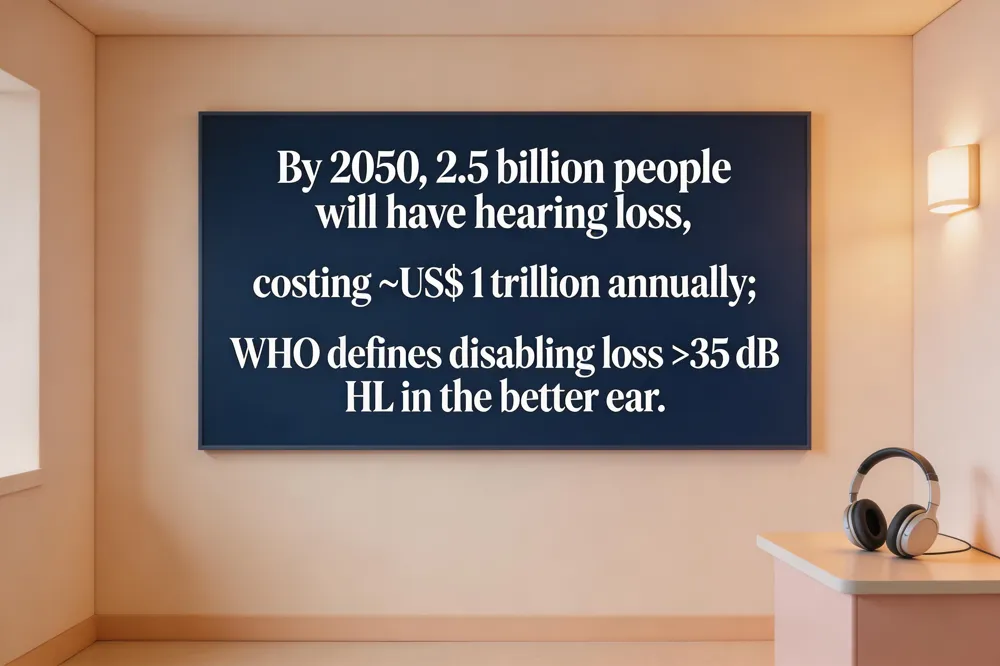 WHO projections for 2050 and economic impact
By 2050 nearly 2.5 billion people worldwide are expected to have some degree of hearing loss, with >700 million requiring rehabilitation. Unaddressed loss incurs an annual global cost of almost US$ 1 trillion, underscoring the economic urgency of early detection.
Definitions, classifications and disability criteria
Hearing loss is a threshold >20 dB HL in one or both ears, classified as conductive, sensorineural, or mixed. Severity is graded by WHO/ASHA: normal (‑10‑15 dB), slight (16‑25 dB), mild (26‑40 dB), moderate (41‑55 dB), moderately severe (56‑70 dB), severe (71‑90 dB), and profound (≥91 dB). The WHO defines disabling loss as >35 dB in the better ear, a benchmark used for public‑health statistics and legal compensation.
Common causes and the 4 P’s
Age‑related presbycusis is the leading cause of bilateral loss. Other major contributors include chronic noise exposure, ototoxic drugs, infections, genetic factors, and ear‑wax impaction. The 4 P’s—Painless, Progressive, Permanent, Preventable—highlight that loss often goes unnoticed, worsens over time, is usually irreversible, yet can be prevented through protection and screening.
Key facts and Q&A
- 10 facts about hearing loss: 2.5 billion affected by 2050, US$ 1 trillion cost, over 1 billion at risk from unsafe listening, 5 % of world population disabled, age‑related rise after 60, multiple etiologies, ear‑wax and smoking contributors, cognitive/social impacts, educational/employment deficits, high‑return investment (<US$ 1.40 /yr).
- Hearing loss definition: Partial/complete inability to perceive sound, measured >20 dB HL, classified as conductive, sensorineural, or mixed.
- WHO classification: Grades from normal to profound based on dB HL; disabling >35 dB in better ear.
- Most common cause of bilateral loss: Age‑related sensorineural degeneration (presbycusis).
- What are the 4 P’s?: Painless, Progressive, Permanent, Preventable.
- Hearing‑impairment disability: Functional loss that interferes with communication and work, often ≥35 dB in the better ear, qualifying for workers’ compensation or legal claims.
Objective Audiological Testing: ABR vs ASSR and Other Tools
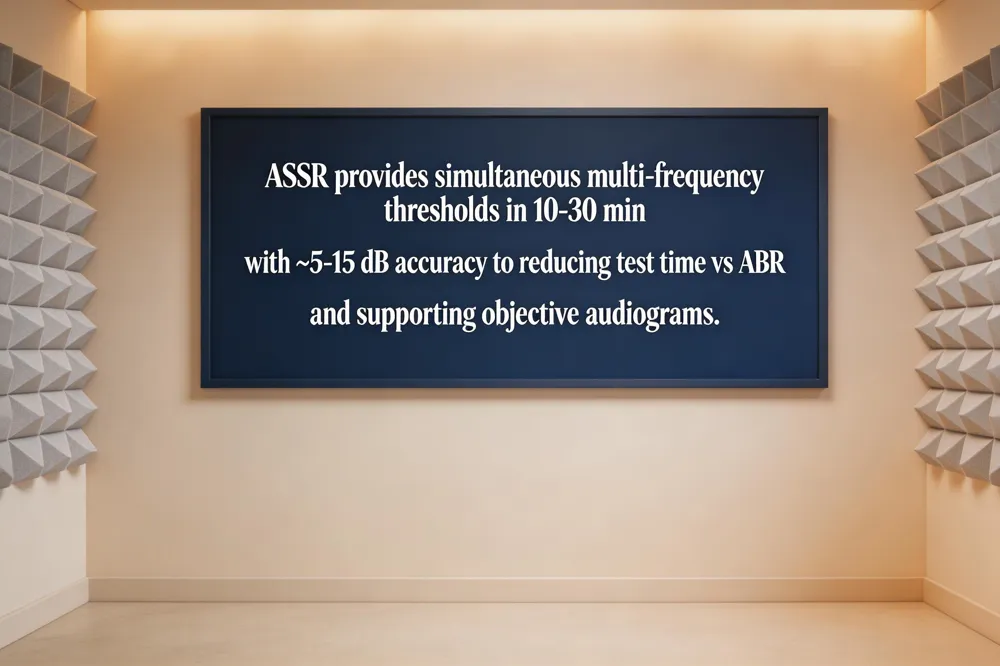 Auditory Brainstem Response (ABR) and Auditory Steady‑State Response (ASSR) are both objective electrophysiological tests, but they differ in stimulus delivery and information yielded. ABR uses brief clicks or tone‑bursts and records time‑locked waveforms, making it ideal for confirming neural integrity and diagnosing auditory neuropathy, especially in infants or sedated patients. ASSR presents continuous, amplitude‑ and frequency‑modulated tones at specific carrier frequencies (commonly 500 Hz, 1 kHz, 2 kHz, and 4 kHz) and analyzes amplitude and phase in the frequency domain with a statistical detection algorithm. This allows simultaneous testing of multiple frequencies, reducing overall test time by up to 40 % and often providing thresholds within 5‑15 dB of behavioral audiometry for moderate‑to‑severe loss, whereas ABR may require longer recording sessions (15‑20 minutes per ear) and may be less informative when responses are absent.
Five core hearing‑evaluation tools complement ABR/ASSR: pure‑tone audiometry (gold‑standard behavioral thresholds), bone‑conduction testing (differentiates conductive from sensorineural loss), speech audiometry (functional communication ability), tympanometry (middle‑ear status), and objective evoked‑potential tests (ABR, ASSR). ASSR testing typically lasts 10‑30 minutes for a full bilateral exam; a standard protocol of 500‑4000 Hz can be completed in about 20 minutes, thanks to its ability to assess up to eight frequencies simultaneously. The procedure begins with low‑impedance scalp electrodes (vertex, mastoids, ground), insertion of earphones, and presentation of modulated tones while the patient remains still, asleep, or lightly sedated. Recorded data are processed by Fast Fourier Transform and an F‑test; a response is marked “present” when amplitude‑phase consistency exceeds the preset significance level (usually p < 0.05).
Interpretation focuses on statistically derived thresholds, which are reported in normalized hearing level (nHL) and converted to estimated hearing level (eHL) using manufacturer‑specific correction factors (typically 5‑15 dB). Clinicians construct an objective audiogram, noting degree and configuration of loss, and cross‑check with other measures (ABR, OAEs, tympanometry) to confirm etiology. For medico‑legal and occupational injury cases, the ASSR report provides quantifiable, reproducible evidence of hearing impairment when behavioral testing is unreliable, supporting compensation and rehabilitation decisions.
ASSR in Clinical and Medico‑Legal Settings
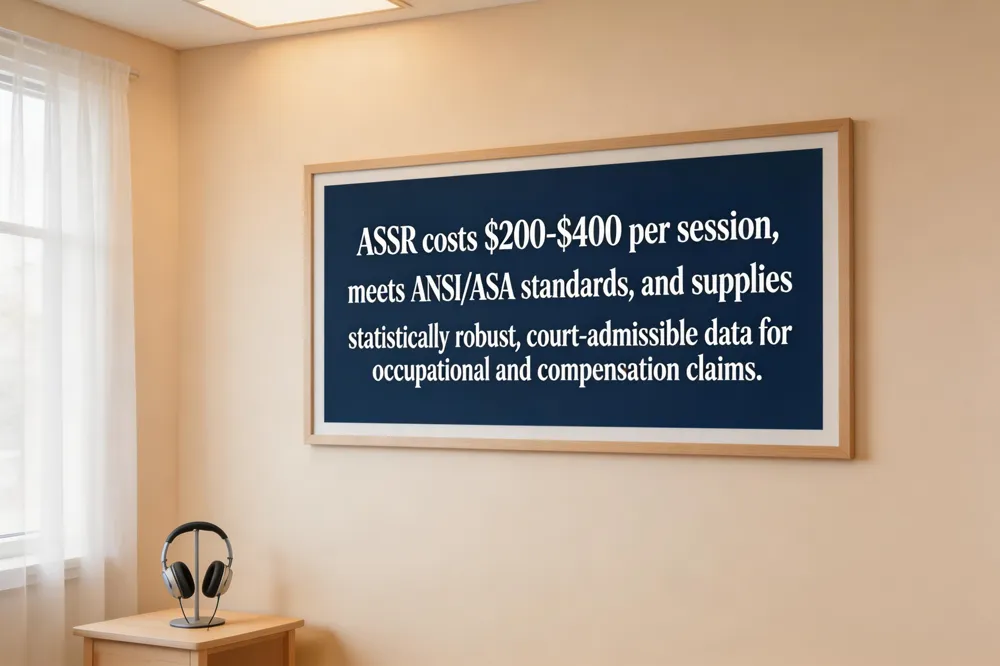 Cost and reimbursement – An Auditory Steady‑State Response (ASSR) evaluation typically costs $200‑$400 per session in the United States, with California clinics often near the upper end ($500) due to higher overhead and documentation demands. Insurance may cover a portion when the test is deemed medically necessary, but verification of benefits is essential before scheduling.
Legal documentation standards – ASSR results must be recorded on a calibrated audiometer (ANSI/ASA standards), include stimulus parameters, patient state, and a statistical confidence level (95 % or 99 %). Reports should reference correction tables, note any masking, and be signed by a board‑certified audiologist. This objective, frequency‑specific data satisfies OSHA hearing‑conservation program requirements and AMA Guides criteria for medico‑legal audiograms.
Audit and litigation considerations – In occupational injury cases, ASSR provides reproducible thresholds for workers‑compensation claims. Auditors evaluating “litigation and claims” should request legal‑counsel letters confirming no unasserted claims (per ASC 450) and ensure the 1‑3‑6 screening timeline was met for affected employees. Audit‑response letters must follow ABA policies, preserving attorney‑client privilege while affirming the absence of pending contingencies.
Hearing‑conservation program requirements – A compliant program includes: (1) baseline audiograms within six months of first exposure; (2) annual follow‑up ASSR or pure‑tone testing; (3) noise monitoring and provision of hearing‑protection devices; (4) annual training on noise hazards; and (5) meticulous record‑keeping of audiograms, training logs, and threshold‑shift calculations. ASSR’s ability to test multiple frequencies simultaneously (500 Hz‑4 kHz) reduces testing time, supporting timely compliance with OSHA’s 5‑element program and the CDC’s 1‑3‑6 early‑intervention rule.
Emerging Therapies and Prevention Strategies
 The Auditory Steady‑State Response (ASSR) is an objective, frequency‑specific electrophysiologic test that estimates hearing thresholds without requiring patient cooperation. By presenting rapid, amplitude‑ and frequency‑modulated tones (typically 500 Hz, 1 kHz, 2 kHz, and 4 kHz) simultaneously to both ears, ASSR can generate a detailed audiogram in 10‑30 minutes, reducing test time up to 40 % compared with serial ABR testing (AAO, 2023). Its statistical detection algorithm (F‑test) and use of high‑modulation rates (80‑100 Hz) ensure reliable brainstem‑derived responses even when patients are asleep or lightly sedated, making ASSR invaluable for newborn screening, developmental disabilities, and occupational injury assessments where behavioral audiometry is unreliable (WHO, 2025; NorCal Medical Consulting, 2024).
Latest treatment for hearing loss
While ASSR provides objective documentation for legal and insurance claims, emerging pharmacologic therapies aim to restore cochlear function. Nanoparticle‑based delivery of growth‑factor drugs, Notch‑inhibiting agents that trigger supporting‑cell regeneration, and extracellular‑vesicle gene‑editing platforms are in early‑clinical stages, representing a shift from amplification to biological repair.
What are the 4 P’s of hearing loss?
Painless, Progressive, Permanent, Preventable – hearing loss often begins silently, worsens over time, becomes irreversible, yet most cases can be avoided with early detection and protection.
5 required elements of a hearing conservation program
- Systematic noise monitoring (≥85 dBA action level). 2. Baseline and annual audiometric testing (including ASSR when needed). 3. Provision and enforcement of hearing‑protection devices. 4. Annual training on noise hazards. 5. Detailed record‑keeping of exposure, audiograms, and training.
Hearing test online
Online screenings offer quick, low‑cost tone‑detection checks but lack the rigor of calibrated audiometric or ASSR testing required for medico‑legal documentation. Positive results should be followed by a comprehensive evaluation in a sound‑treated booth.
How to reverse hearing loss naturally
Evidence‑based natural strategies focus on protection rather than reversal: antioxidant‑rich diets, avoidance of ototoxic exposures, and prompt medical treatment of conductive issues (e.g., earwax removal). Supplements such as ginkgo biloba have limited support, and any regimen should be discussed with an audiologist.
In occupational injury cases, ASSR’s objective, reproducible thresholds—typically within 5‑15 dB of behavioral audiograms—serve as robust evidence for causation, severity, and compensation determinations.
Practical Guidance for Patients and Providers
 Access to Auditory Steady‑State Response (ASSR) testing is now routine in many audiology clinics and specialty centers; patients can be referred by primary‑care physicians, occupational health services, or court‑ordered evaluations. PDFs and educational resources—such as the British Society of Audiology’s practice‑guidance document—provide detailed stimulus parameters, electrode placement, and interpretation guidelines, helping clinicians deliver evidence‑based reports for legal and insurance claims. ASSR should be integrated with a comprehensive audiologic battery (pure‑tone audiometry, tympanometry, OAEs, and ABR) to confirm the type and degree of loss and to rule out middle‑ear pathology.
Auditory steady state response pdf – downloadable PDFs outline ASSR theory, 40‑Hz vs. 80‑Hz testing rates, and statistical detection methods, supporting accurate occupational loss assessments.
ASSR test results – the test yields an estimated audiogram in dB HL (converted to eHL), showing frequency‑specific thresholds for 0.5, 1, 2, and 4 kHz, which are reproducible and admissible in court.
ASSR test price – in the U.S., a full ASSR evaluation typically costs $200–$400, up to $500 for extensive diagnostic packages; insurance may cover part of the expense.
ASSR Interacoustics – Interacoustics hardware/software (Eclipse, Titan) generates modulated tones, records brain‑stem responses, and applies statistical algorithms, providing reliable data for workplace injury claims.
ASSR report – a formal ASSR report includes protocol details, threshold estimates, and any limitations, serving as a court‑admissible document that quantifies hearing loss when behavioral audiometry is unavailable.
Key Take‑aways for Employers, Clinicians, and Claimants
Objective ASSR testing provides reliable, frequency‑specific hearing thresholds when behavioral audiometry is impossible, such as with infants, sedated patients, or those unable to cooperate. By using amplitude‑ and phase‑modulated tones and statistical detection algorithms, ASSR estimates thresholds within 5‑15 dB of pure‑tone audiograms, reducing test time by up to 40 % and allowing binaural, multi‑frequency assessment. In medico‑legal contexts the objective data satisfy Daubert and AMA‑Guide standards, creating a defensible record for workers’ compensation, insurance, and litigation claims. Reports must document protocol, stimulus parameters, patient state, and calibration details. Preventive strategies—early newborn screening, regular occupational audiograms, and hearing‑conservation programs—limit progression of noise‑induced loss. Emerging treatments such as gene‑therapy, pharmacologic otoprotection, and advanced hearing‑aid algorithms complement early detection, offering clinicians and claimants a comprehensive pathway from diagnosis to rehabilitation. Integrating ASSR results with tympanometry, OAEs, and ABR ensures accurate differentiation of sensorineural and conductive loss.