Introduction to Auditory Testing
Overview of auditory testing
Auditory testing comprises a variety of methods to assess hearing acuity, ranging from behavioral tests like Pure-Tone Audiometry (PTA), which require active patient participation, to objective electrophysiological techniques such as Auditory Steady-State Response (ASSR) and Auditory Brainstem Response (ABR). PTA remains the gold standard for determining hearing thresholds by measuring responses to specific pure tone frequencies and plotting them on an audiogram. Objective methods like ASSR provide frequency-specific hearing threshold estimates without the need for patient cooperation, making them invaluable for populations where behavioral testing is impractical.
Importance of accurate hearing evaluation in adults
Accurate hearing assessments are critical in adults for diagnosing types and degrees of hearing loss, guiding treatment options like hearing aids or cochlear implants, and monitoring auditory health. Older adults often present additional challenges due to cognitive impairment or difficulty cooperating during behavioral tests. Objective techniques such as ASSR can reliably estimate hearing thresholds within clinically acceptable ranges, ensuring timely detection and intervention. Given the association of untreated hearing loss with depression, social isolation, and cognitive decline, precise auditory evaluations are essential for improving quality of life.
Context of auditory testing in medico-legal and workplace injury assessments in the United States
Auditory testing plays a significant role within medico-legal environments, including workplace injury evaluations and insurance claim processes in the U.S. Objective tests like ASSR are instrumental in providing unbiased, frequency-specific data when traditional methods are unsuitable or unreliable, particularly in litigation or compensation scenarios. The ability of ASSR to test multiple frequencies simultaneously and its independence from active patient response streamline evaluations in forensic and clinical audiology settings. Thus, auditory assessment is integral to expert witness services and healthcare consulting in auditory injury cases, ensuring evidence-based determinations in legal contexts.
Key Facts on Auditory Testing Methods and Applications
- Pure-tone audiometry is the gold standard for assessing overall hearing sensitivity across frequencies 250 Hz to 8000 Hz.
- ASSR provides an objective, frequency-specific, and rapid hearing assessment, especially valuable for difficult-to-test populations.
- Bone conduction testing helps differentiate conductive from sensorineural hearing loss by bypassing air conduction.
- Speech audiometry evaluates the ability to detect and understand speech, essential for real-world communication functionality.
- Tympanometry assesses middle ear function and tympanic membrane mobility to detect issues like fluid or ossicular dysfunction.
- Otoacoustic emissions (OAE) testing objectively measures cochlear outer hair cell function without requiring patient response.
- ASSR differs from ABR by using continuous/modulated tones allowing simultaneous multi-frequency and bilateral testing in less time.
- ASSR thresholds generally overestimate hearing loss by 5-15 dB compared to pure-tone audiometry but correlate highly (r > 0.9).
- Automated ABR (AABR) is used for newborn hearing screening as a quick pass/fail neural conduction test.
- Auditory training improves key skills such as sound awareness, discrimination, identification, localization, and auditory comprehension for rehabilitation.
1. Traditional Audiometry: Pure-Tone and Behavioral Hearing Tests
What are the most common types of hearing tests for adults?
In adult audiology evaluation, the most commonly administered hearing tests include pure-tone audiometry, bone conduction testing, speech audiometry, tympanometry, and otoacoustic emissions (OAE) testing.
- Pure-tone audiometry remains the gold standard for assessing overall hearing sensitivity. It measures the softest sound levels a person can detect at specific frequencies ranging from 250 Hz to 8000 Hz.
- Bone conduction testing distinguishes if hearing loss originates in the outer or middle ear (conductive) or from inner ear or auditory nerve dysfunction (sensorineural) by bypassing the air conduction pathway.
- Speech audiometry evaluates the capability to detect and understand speech, often assessing speech reception thresholds and word discrimination abilities, crucial for real-world communication functionality.
- Tympanometry directly assesses middle ear function and mobility of the tympanic membrane, detecting issues such as fluid buildup, eardrum perforation, or ossicular chain dysfunction.
- Otoacoustic emissions (OAE) testing objectively tests cochlear outer hair cell function by detecting faint sounds emitted in response to auditory stimuli, providing insight into inner ear health without requiring active patient responses.
How is an audiometric hearing test typically performed?
The standard procedure for an audiometric hearing assessment involves conducting the test in a sound-treated environment to minimize ambient noise interference. The patient is fitted with headphones or insert earphones connected to an audiometer, a specialized instrument that generates and controls sound stimuli.
The test begins by presenting pure tones of varying frequencies and intensities to each ear independently. Patients are instructed to indicate when they detect the tone, commonly by pressing a button or raising a hand. This evaluation defines the minimum hearing threshold—the quietest sound detected across frequencies.
Additional tests may be simultaneously or sequentially performed:
- Speech audiometry, where recorded or live speech stimuli are delivered while the patient repeats words or sentences.
- Tympanometry, measuring eardrum responses to controlled air pressure changes, provides data on middle ear status.
The culmination of these tests results in an audiogram, graphically representing hearing sensitivity levels and guiding clinical interpretations.
Diagnostic Value and Limitations of Pure-Tone Audiometry
Pure-tone audiometry is essential for differentiating types of hearing loss:
- Conductive hearing loss: Hearing loss due to obstruction or dysfunction in the outer or middle ear.
- Sensorineural hearing loss: Damage or dysfunction within the cochlea or auditory nerve pathways.
- Mixed hearing loss: A combination of both conductive and sensorineural elements.
While pure-tone audiometry is highly effective in cooperative adults, its reliance on active patient participation limits its reliability in difficult-to-test populations. For example, older adults experiencing cognitive impairment often struggle with test consistency and accuracy, potentially underestimating or overestimating hearing thresholds.
Role in Workplace Injury Auditory Loss Evaluation in the United States
In U.S. clinical practice and medico-legal contexts, pure-tone audiometry is the foundational test for auditory evaluations related to workplace noise-induced hearing loss (NIHL) and other auditory injuries. Particularly within occupational health and workers' compensation frameworks, precise hearing threshold documentation supports claims validation and treatment planning.
Complementary objective tests, such as tympanometry and OAE, further enhance evaluation by clarifying middle ear status or cochlear integrity, assisting experts in delivering comprehensive assessments relevant in legal or insurance contexts.
Given the high prevalence of work-related auditory damage and its impact on quality of life, pure-tone audiometry's role in detecting, diagnosing, and monitoring hearing loss remains indispensable in U.S. healthcare services and injury evaluation protocols.
2. Auditory Steady-State Response (ASSR): An Objective Alternative for Hearing Assessment
What is Auditory Steady-State Response (ASSR)?
Auditory Steady-State Response (ASSR) overview is an electrophysiological evaluation of hearing where steady electrical responses are elicited from the brain by repeated, modulated sound stimuli. These responses are recorded via surface electrodes placed on the scalp, capturing neural activity synchronized to the modulation frequencies of the auditory stimulus. Unlike traditional behavioral tests, ASSR requires little to no active participation, making it particularly useful for populations who cannot reliably respond, such as infants or older adults with cognitive impairment.
How Does ASSR Differ from Auditory Brainstem Response (ABR)?
Auditory Steady-State Response (ASSR) vs Auditory Brainstem Response (ABR) testing methods uses brief, transient sounds at low repetition rates and primarily assesses the integrity of the auditory pathway up to the brainstem by analyzing waveform timing and morphology. In contrast, ASSR employs continuous or rapidly repeated amplitude- or frequency-modulated tones at high repetition rates, permitting frequency-specific threshold estimation. This difference allows ASSR to simultaneously test multiple frequencies and both ears, providing detailed audiometric information in a more time-efficient manner.
Frequency-Specific and Simultaneous Bilateral Testing
Auditory Steady-State Response (ASSR) objective audiometry test testing can concurrently assess multiple designated frequencies typically including 500, 1000, 2000, and 4000 Hz in both ears. This simultaneous bilateral frequency-specific testing shortens total test time relative to behavioral audiometry, which assesses one frequency and ear at a time. The objective statistical algorithms analyze neural response amplitudes and phases at modulation frequencies and their harmonics, discerning true auditory responses from background noise.
Usefulness in Difficult-to-Test Populations
Objective alternative testing with ASSR vs behavioral PTA is particularly valuable for patients unable to cooperate with traditional pure-tone audiometry (PTA) such as older adults experiencing cognitive decline, infants, or individuals with developmental disabilities. Its non-reliance on behavioral responses circumvents compliance and attention challenges, offering reliable frequency-specific hearing threshold estimates when behavioral tests are impractical or unreliable.
Typical ASSR Testing Procedure and Equipment Setup
During an ASSR test, surface electrodes are placed at standard locations on the scalp: an active electrode commonly at the vertex, reference electrodes on the mastoid or earlobes ipsilateral to the stimulated ear, and a ground electrode on the forehead. Insert earphones deliver continuous or modulated tones. The clinician uses specialized hardware and software systems which apply statistical detection enhancements incorporating both amplitude and phase data across multiple harmonics to determine auditory thresholds objectively. These procedures and equipment are described in detail under Auditory Steady-State Response (ASSR) overview and ASSR Hearing Testing.
Advantages of ASSR
Auditory Steady State Response (ASSR) testing's ability to test multiple frequencies and both ears simultaneously greatly reduces examination time—often completed within about 20 minutes. Its automated, statistical response detection minimizes examiner bias and subjective waveform interpretation found in ABR assessments. Additionally, ASSR can measure auditory thresholds at higher stimulus intensities than ABR, beneficial for assessing severe-to-profound hearing loss.
Limitations of ASSR Testing
ASSR accuracy can be influenced by patient behavioral state; sleep, sedation, or wakefulness may affect neural synchrony and response amplitude, particularly in infants or older adults. High modulation rates (>80 Hz) generally used to evoke brainstem responses may also cause reduced response amplitude due to age-related neural processing changes, leading to threshold overestimation especially at low frequencies like 500 Hz. Electrode placement, patient movement, and internal neurological variability further contribute to occasional response inconsistencies. Moreover, ASSR may be less sensitive in detecting mild low-frequency conductive loss compared to ABR as noted in Limitations and challenges of ASSR.
Clinical Relevance in Medico-Legal and Workplace Injury Contexts
In the United States, Hearing loss importance and impact is a common occupational and age-related concern with medico-legal implications. ASSR provides an objective, frequency-specific, and relatively rapid alternative or supplement to pure-tone audiometry for accurate hearing level estimation in patients who cannot reliably participate in behavioral tests. This makes ASSR particularly relevant for workplace injury assessments, insurance claims, and legal evaluations where objective data is critical for decision-making.
Correlation and Differences Between ASSR and Pure-Tone Audiometry
Multiple studies show a high correlation between Comparison of ASSR and PTA hearing thresholds in older adults, often with correlation coefficients above 0.9 across key speech frequencies (0.5 to 4 kHz). ASSR thresholds typically overestimate hearing loss by 5 to 15 dB compared to pure-tone audiometry, a deviation usually within clinically acceptable margins. Such offset can be accounted for by frequency- and age-specific correction factors. ASSR thresholds correlate with PTA thresholds compensates for inconsistencies in behavioral tests common in older adults with cognitive challenges.
Future Directions to Improve ASSR Accuracy for Older Adults
Current research focuses on optimizing modulation rates appropriate for aging neural processing to reduce low-frequency threshold overestimations. Refinement of correction factors tailored to older adult populations is another priority to enhance diagnostic precision. Advances in stimulus design, such as narrowband chirps and multi-harmonic detection algorithms, continue to improve response reliability and reduce testing time. Integration with complementary audiological tests will further strengthen comprehensive auditory evaluations in clinical and medico-legal settings as discussed in Research needs to optimize ASSR protocols for older adults.
Common Auditory Assessments: Beyond Pure-Tone Testing
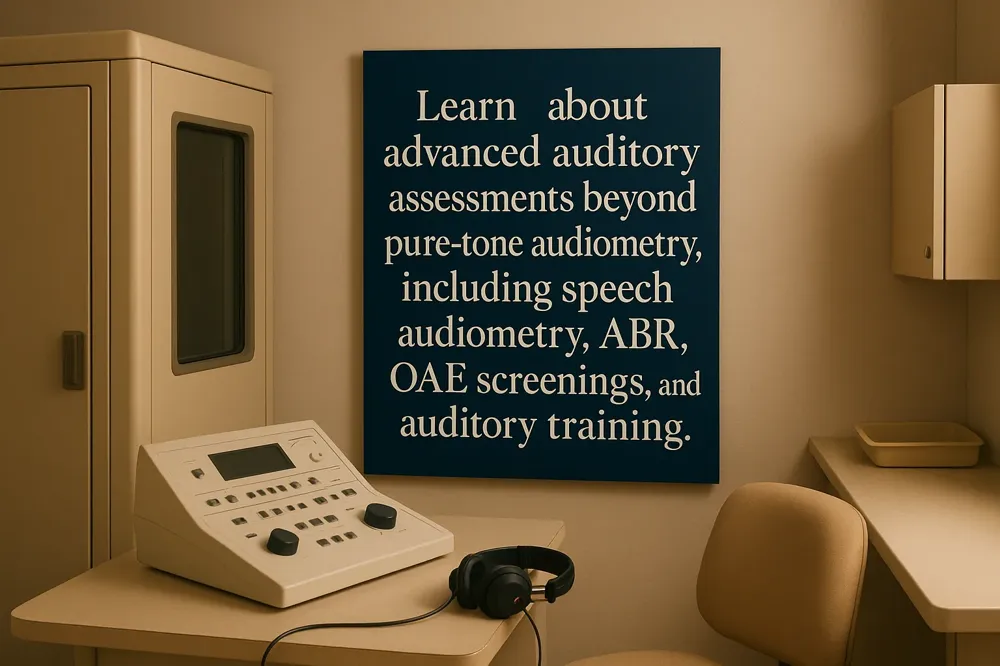
What are the two types of speech audiometry tests?
Speech audiometry includes two primary test types: Speech Awareness or Detection Threshold (SAT/SDT) and Speech Reception Threshold (SRT).
- Speech Awareness Threshold (SAT or SDT) measures the lowest sound level at which a person can detect the presence of speech without necessarily understanding it. It reflects basic awareness rather than comprehension.
- Speech Reception Threshold (SRT) determines the minimal intensity at which speech is recognized and correctly repeated or identified. This test assesses the clarity and comprehension aspect of hearing.
Both tests help to characterize different dimensions of speech perception. They are widely used in clinical audiology assessments and workplace injury evaluations to gauge hearing capabilities and inform treatment or legal decisions.
What are the two main types of auditory brainstem response (ABR) tests?
ABR testing comes in two variants:
-
Screening ABR (Automated Auditory Brainstem Response, AABR): A rapid pass/fail test conducted at a single stimulus intensity, commonly applied in newborn hearing screenings. It detects individuals at risk for hearing loss needing further evaluation.
-
Diagnostic ABR: A more comprehensive assessment involving multiple stimuli and measuring brainstem responses in detail. This test identifies the type and severity of hearing impairment, aiding in differential diagnosis. It requires specialized interpretation and longer test durations.
Both procedures involve electrodes placed on the scalp to record neural activity triggered by sound via earphones.
What is the difference between AABR and OAE hearing screenings?
AABR and OAE (Otoacoustic Emissions) are frequently used newborn screening tests but assess distinct auditory components:
- AABR: Evaluates neural conduction by recording electrical activity from the auditory nerve to brainstem in response to sound, thereby detecting pathologies in the neural auditory pathway.
- OAE: Assesses cochlear outer hair cell function by measuring sound emissions generated by the cochlea in response to stimuli. This test focuses on mechanical cochlear health but does not assess neural pathways.
OAE is faster and easier but less comprehensive than AABR. Together, these complementary methods provide thorough early detection of hearing issues.
What are the key auditory skills involved in auditory training?
Auditory training targets multiple auditory processing skills to improve hearing and communication, especially for individuals with hearing loss. These skills include:
- Sound Awareness: Recognizing the presence or absence of sound.
- Sound Discrimination: Differentiating between sounds.
- Identification and Localization: Recognizing what the sound is and where it originates.
- Auditory Comprehension: Understanding spoken language.
Enhancing these skills through structured therapy supports improved auditory function, crucial in clinical rehabilitation and workplace-related hearing interventions.
How are these assessments applied in clinical and medico-legal contexts in the US?
Speech audiometry tests, AABR and OAE screenings, and auditory training evaluations are integral to the standard auditory assessment battery in the United States. They serve multiple roles:
- Clinical Diagnosis: Facilitating accurate identification of hearing loss types and severity to guide medical or rehabilitative intervention.
- Newborn Hearing Screening: Early detection programs routinely employ AABR and OAE to identify impairments promptly, allowing timely intervention.
- Medico-Legal Evaluation: Objective and detailed auditory assessments inform legal and insurance claims regarding workplace and other auditory injuries.
- Treatment Planning: Speech audiometry outcomes assist in tailoring hearing aids or cochlear implant candidacy.
Together, these tests ensure comprehensive auditory evaluation aligned with US healthcare standards and occupational health requirements.
Conclusion: Integrating ASSR and Traditional Audiometry for Comprehensive Hearing Evaluation
Traditional audiometry and Auditory Steady-State Response (ASSR) testing each offer distinct advantages in assessing hearing function.
Pure-tone audiometry (PTA) remains the gold standard behavioral method for determining hearing thresholds, particularly effective for cooperative patients capable of consistent responses. It provides direct, subjective measurement of auditory sensitivity across frequencies crucial for diagnosis and treatment planning.
Conversely, ASSR offers an objective measure of frequency-specific hearing sensitivity without requiring active participation. This makes ASSR especially valuable for populations with cognitive impairments or limited cooperation, such as older adults or infants. ASSR's ability to test multiple frequencies and both ears simultaneously enhances testing efficiency.
These methods are complementary: PTA yields direct patient-centered data while ASSR supplies objective neural response information. In medico-legal contexts, such as workplace injury claims in the United States, integrating both strengthens diagnostic accuracy when behavioral testing is not feasible or reliable.
Ongoing research to optimize ASSR parameters—such as modulation frequencies and correction factors specific to older adults—is critical to enhance its precision and clinical utility. Improved ASSR testing protocols will support earlier detection of hearing loss, better individual treatment strategies, and robust evidence for legal and insurance evaluations.
Ultimately, combined use of ASSR and traditional audiometry facilitates comprehensive auditory assessment, promoting accurate diagnosis, appropriate rehabilitation planning, and informed expert testimony in clinical and legal settings.