The Critical Timing of Expert Involvement
Engaging an expert witness at the earliest stage of a workers‑compensation claim offers three decisive benefits. First, early involvement preserves crucial evidence—medical records, site inspections, and noise‑exposure data can be gathered before witnesses degrade or become contested. Second, the expert can assess the injury’s full scope, quantify causation, and project future treatment needs, thereby strengthening the factual foundation of the case. Third, the expert’s findings shape the overall case strategy, informing settlement negotiations, discovery plans, and trial positioning. By retaining qualified, independent professionals—medical, vocational, engineering, or economic—before discovery deadlines, plaintiffs safeguard credibility, avoid missed documentation, and improve the likelihood of a favorable award.
Why an Expert Witness Might Be Used During a Lawsuit
Core Functions of an Expert Witness
| Function | Description |
|---|---|
| Translation | Converts complex technical/medical data (e.g., audiograms, biomechanical analyses) into lay‑person language for judges and juries. |
| Standards Evaluation | Identifies and assesses relevant professional standards (OSHA noise limits, CA workers’ comp impairment criteria) to determine if employer practices breached them. |
| Damages Quantification | Calculates lost wages, future medical expenses, and economic impact using actuarial or vocational methods. |
| Credibility | Provides credentials, methodology, and peer‑reviewed publications vetted under Daubert‑Kay standards. |
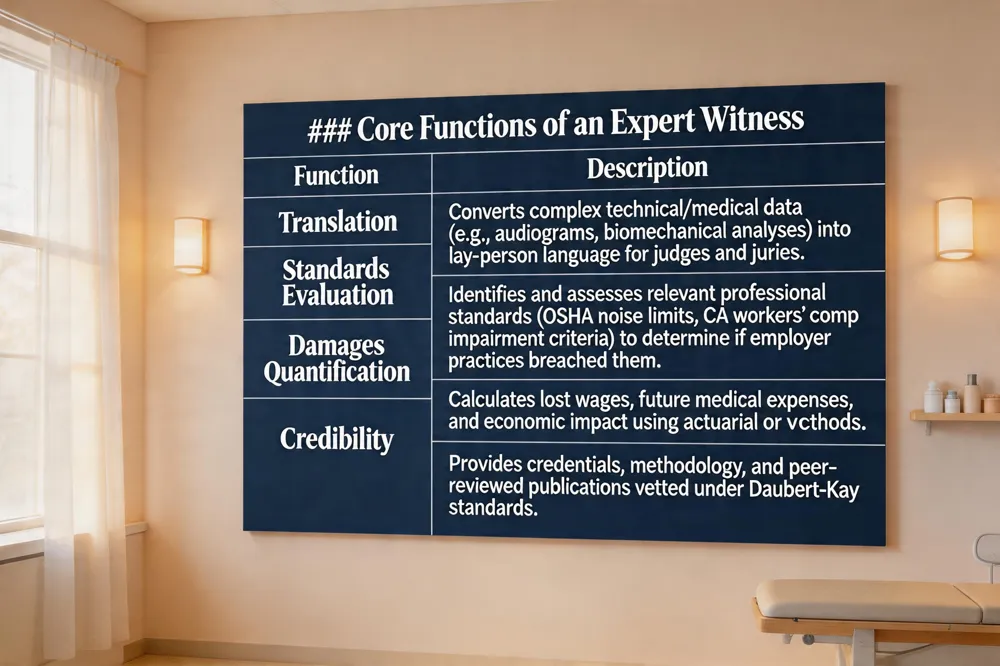 In a workers’ compensation lawsuit, the expert witness serves three critical functions. First, they translate complex technical or medical data—such as audiograms, noise‑dosimetry reports, or biomechanical analyses—into clear, lay‑person language that judges and juries can understand. Second, they establish the relevant professional standards (e.g., OSHA noise‑exposure limits, California Workers’ Compensation impairment rating criteria) and evaluate whether the employer’s practices met or breached those standards. Third, they quantify damages by calculating lost wages, future medical expenses, and the economic impact of injuries like auditory loss, often using actuarial or vocational methods. An expert’s credentials, methodology, and peer‑reviewed publications are vetted under Daubert‑Kay standards, adding credibility to the plaintiff’s case. By converting specialized evidence into persuasive, actionable insight, the expert witness strengthens the factual foundation, supports causation and severity arguments, and ultimately improves the likelihood of a favorable settlement or verdict.
Early Involvement: What Workers’ Comp Lawyers Won’t Tell You
Risks of Delayed Expert Engagement
| Pitfall | Consequence | Mitigation |
|---|---|---|
| Missed Documentation | Lost medical records, site photos, noise‑exposure logs weaken causation/impairment arguments. | Retain expert early to secure and preserve all evidence. |
| Opaque Settlement Timing | Insurers push premature offers before Maximum Medical Improvement (MMI). | Expert analysis of long‑term value forces fair settlement. |
| Unchallenged IMEs | Independent medical examinations may downplay injuries without counter‑expert opinion. | Have pre‑existing independent expert ready to critique IME methodology. |
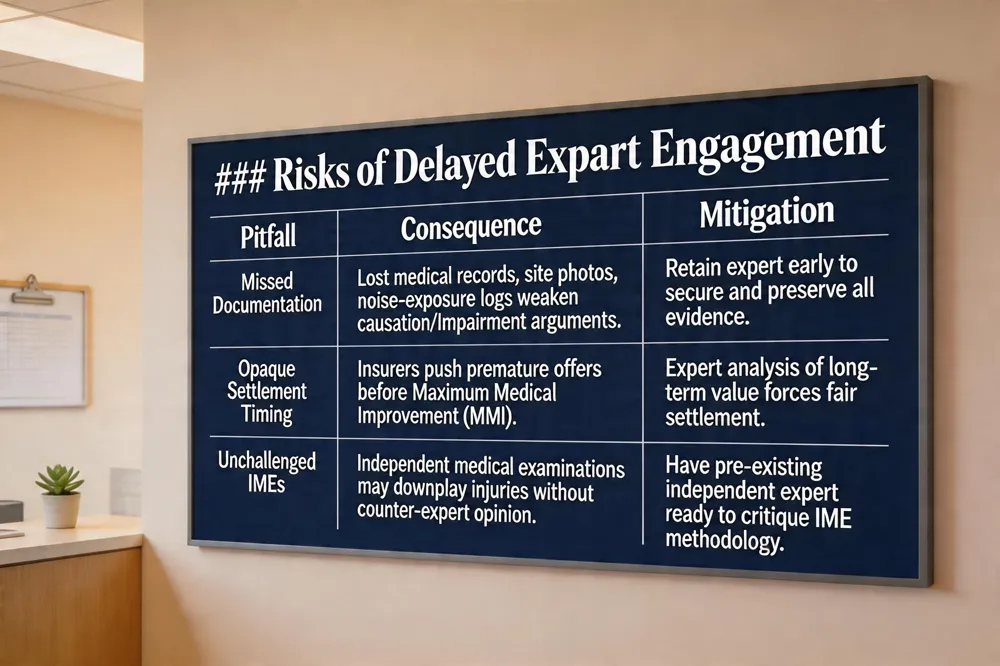 Workers’ comp attorneys often keep the full scope of a claim hidden, which can cost you dearly. First, missed documentation is a common pitfall – if an expert witness isn’t engaged early, critical medical records, site photos, or noise‑exposure logs may be lost, weakening causation and impairment arguments. Second, settlement timing is rarely transparent; insurers push for quick offers before the injury reaches maximum medical improvement, hoping to lock in a low payout before future treatment needs are documented. Finally, independent medical examinations (IMEs) are frequently used by carriers to downplay injuries, and without a pre‑existing independent expert to challenge the IME’s methodology, the examiner’s opinion can dominate the board’s decision. By retaining a qualified, unbiased expert at the outset, you preserve evidence, force the insurer to consider the full long‑term value of the claim, and ensure any IME is met with a solid, data‑driven counter‑opinion.
Choosing the Right Type of Expert and the Four C’s
Matching Expert Types & the Four C’s
| Expert Type | Primary Role | Four C’s (Key Qualities) |
|---|---|---|
| Medical (e.g., audiologist) | Establish causation, impairment, future treatment needs. | Clear Communication, Coachability, Confidence, Candor |
| Vocational | Evaluate loss of earning capacity, job‑placement options. | Clear Communication, Coachability, Confidence, Candor |
| Engineering / Safety | Link workplace conditions to injury (e.g., noise exposure). | Clear Communication, Coachability, Confidence, Candor |
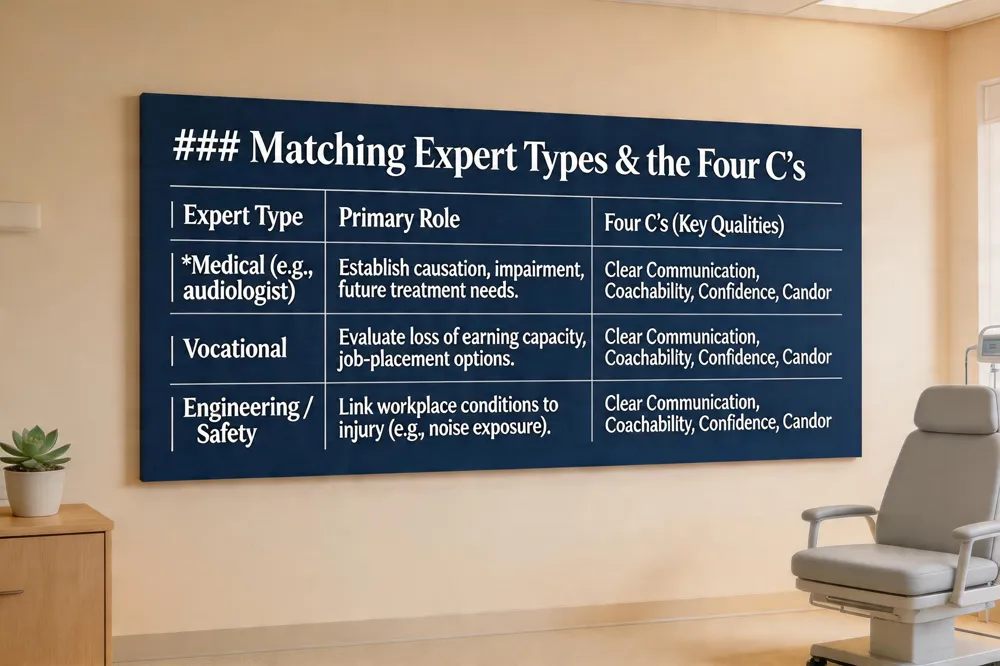 When building a workers’ compensation case, attorneys must match the expert’s specialty to the injury’s nature. Medical experts (e.g., audiologists for hearing loss) establish causation, impairment, and future treatment needs. Vocational experts evaluate loss of earning capacity and job‑placement options, while engineering or safety experts link workplace conditions to the injury. Selecting the right professional is only the first step; the expert must also possess the four C’s that make testimony credible and persuasive.
What are the four C's of expert witness?
The four C’s are Clear Communication, Coachability, Confidence, and Candor. Clear Communication means translating complex data into plain language a judge or jury can understand. Coachability reflects willingness to work with counsel, adjust explanations, and incorporate feedback without compromising objectivity. Confidence demonstrates mastery of the subject and reassures the court that conclusions are well‑grounded. Candor ensures the expert remains honest, admits limitations, and avoids bias, which is essential for credibility and persuasiveness.
Experts who excel in these areas help preserve evidence, strengthen settlement negotiations, and increase the likelihood of a favorable award.
Understanding Expert Fees and Settlement Calculations
Fee Structure & Net Recovery Estimates
| Component | Typical Value | Notes |
|---|---|---|
| Hourly Rate – File Review | $450 | Median per SEAK 2024 study |
| Hourly Rate – Deposition | $475 | |
| Hourly Rate – Testimony | $500 | |
| Attorney Contingency | 33 %–40 % of gross settlement | Applied before other deductions |
| Medical Liens | Varies (often 10‑30 % of settlement) | Negotiated early |
| Net Recovery – $100k Settlement | $60k‑$75k (~60‑75 %) | After 33 % fee & typical liens |
| Net Recovery – $25k Settlement | ≈ $15k | After $2k deduction & 33 % fee |
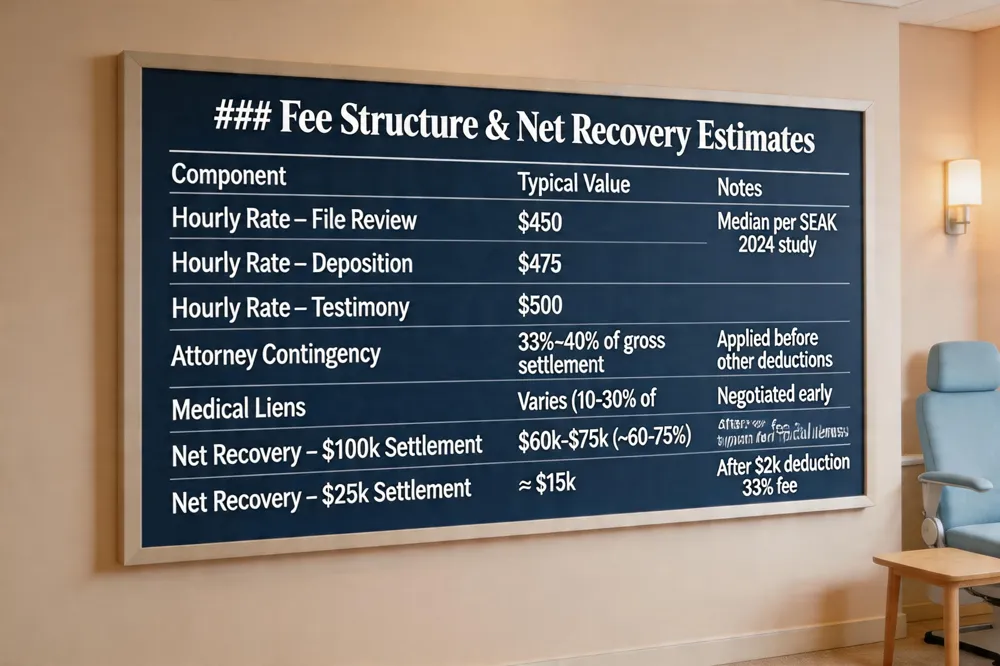 When planning a workers’ compensation or personal‑injury case, budgeting for expert testimony and estimating net recovery are critical steps.
Hourly rates – Most qualified experts charge roughly $475 per hour on average. SEAK’s 2024 study shows a median of $450 for file‑review, $475 for depositions, and $500 for courtroom testimony. Medical specialists tend to be slightly higher, while non‑medical experts average lower preparation and testimony fees.
Contingency fees – Attorneys typically receive 33 % to 40 % of the gross settlement. This percentage is applied before other deductions.
Medical liens – Health‑care providers and lienholders may claim a share of the settlement to cover past and future medical expenses. These liens are negotiated early and can vary widely.
Net recovery – From a $100,000 settlement, after a 33 % attorney fee and typical medical liens, plaintiffs usually retain about 60 %–75 % (≈ $60,000‑$75,000). For a $25,000 settlement, after a $2,000 deduction and a 33 % fee, the net amount is roughly $15,000.
Understanding these components helps you set realistic expectations and allocate resources for expert retention, ultimately strengthening your claim.
Legal Standards, Disclosure Rules, and When Expert Testimony Is Unnecessary
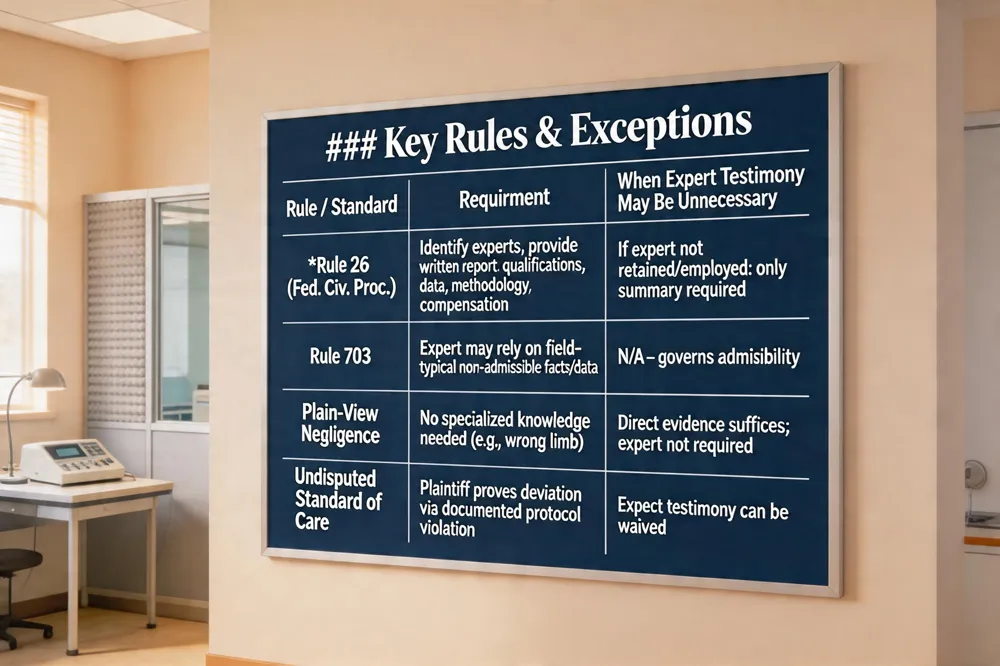
Key Rules & Exceptions
| Rule / Standard | Requirement | When Expert Testimony May Be Unnecessary |
|---|---|---|
| Rule 26 (Fed. Civ. Proc.) | Identify experts, provide written report with qualifications, data, methodology, compensation. | If expert is not retained or employed, only a summary is required. |
| Rule 703 | Expert may rely on facts/data not themselves admissible if typical for the field. | N/A – governs admissibility, not a waiver. |
| Plain‑View Negligence | No specialized knowledge needed (e.g., operating on wrong limb). | Direct evidence suffices; expert not required. |
| Undisputed Standard of Care | Plaintiff can prove deviation via documented protocol violation. | Expert testimony can be waived. |
 What is Rule 26 for expert witnesses?
Rule 26 of the Federal Rules of Civil Procedure governs expert disclosures in federal litigation. Under Rule 26(a)(2), each party must identify any expert it intends to call at trial and provide a written report if the expert is retained, specially employed, or regularly testifies as an employee. The report must contain the expert’s qualifications, a complete statement of opinions, the facts or data relied upon, supporting exhibits, relevant publications and prior cases, and a description of compensation. For non‑retained experts, only a summary of the subject matter and anticipated opinions is required. Disclosures are due within the timeline set by the Rule 26(f) conference, typically 14 days thereafter unless the court orders otherwise.
What is the 703 rule of evidence?
Rule 703 governs the basis of an expert’s opinion testimony, allowing the expert to rely on facts or data that the expert has been made aware of or personally observed, even if those facts are not themselves admissible evidence. The expert may base conclusions on inadmissible material provided the type of information is one that experts in the same field would reasonably rely upon. The expert must be able to explain how the underlying facts support the opinion and disclose them if requested.
In what circumstances is expert testimony unnecessary in medical malpractice?
Expert testimony is unnecessary when negligence is plain‑view and can be understood by a juror without specialized knowledge—e.g., operating on the wrong limb, leaving a surgical instrument inside a patient, or prescribing a clearly contraindicated drug. It is also unnecessary when the standard of care is undisputed and the plaintiff can prove deviation through direct, non‑expert evidence such as a documented protocol violation. Courts may waive expert testimony when facts are not in dispute and the jury can determine liability from the record alone.
Strategic Use of Expert Testimony in Settlement and Trial
Expert‑Driven Process Flow
| Phase | Key Actions | Do / Don’t |
|---|---|---|
| Preparation | Early involvement, record review, independent examinations, draft lay‑person report. | Do: Keep methodology transparent. Don’t: Guess or speculate. |
| Depositions | Rehearse answers, tighten methodology, anticipate cross‑examination. | Do: Clarify uncertainties. Don’t: Offer opinions outside expertise. |
| Trial | Use visual aids, avoid jargon, answer succinctly. | Do: State “I do not know” when appropriate. Don’t: Use qualifiers like “I think” or “maybe”. |
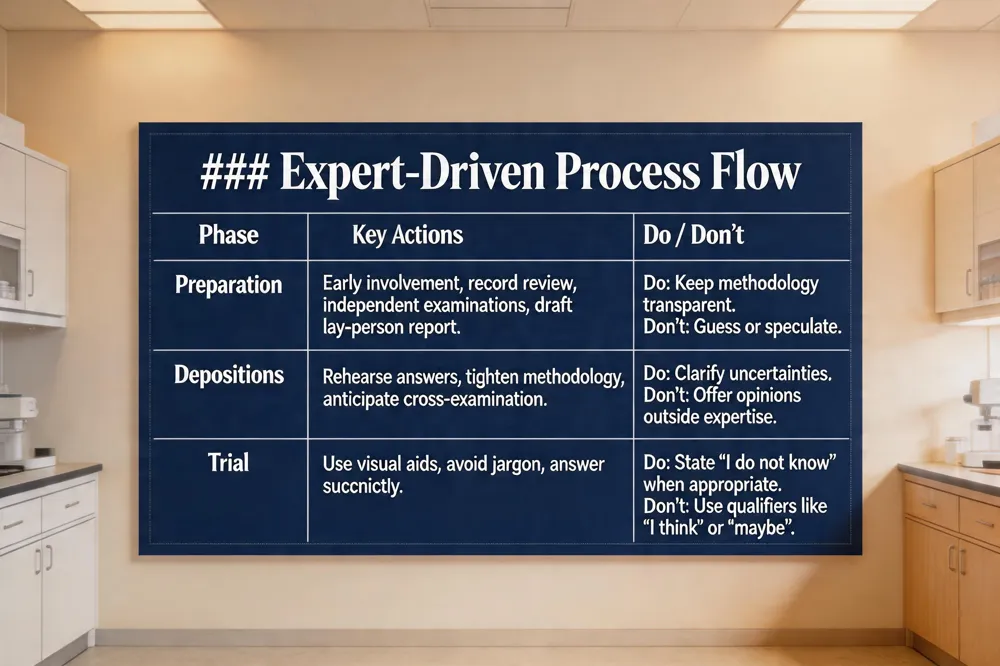 Trial testimony preparation begins with early expert involvement so the witness can review records, conduct independent examinations, and draft a clear, lay‑person‑friendly report. Depositions are used to rehearse answers, tighten methodology, and anticipate cross‑examination.
In the courtroom, experts must communicate complex data succinctly, use visual aids, and avoid jargon.
What not to say on the stand: never guess, speculate, or use qualifiers such as “I think” or “maybe.” Do not answer questions you do not understand; instead, state that you do not know. Refrain from discussing the case outside the courtroom and keep responses brief, direct, and truthful.
Answer to key questions: Is it worth suing for pain and suffering? Yes—if the injury caused significant loss, such as reduced earning capacity or permanent impairment, a claim can compensate for both tangible and intangible harms; a qualified attorney can assess the case’s strength. What should you not say when testifying? Avoid speculation, absolute statements, and any information not directly asked; admit lack of knowledge rather than guess, and do not discuss testimony with anyone outside the court.
How to Get Hired as an Expert Witness and the Four Rules to Follow
Path to Engagement & Four Governing Rules
| Step | Action | Rule Applied |
|---|---|---|
| 1. Build Reputation | Publish peer‑reviewed research, present at conferences. | Clarity – Demonstrate expertise clearly. |
| 2. Network with Attorneys | Attend legal seminars, join expert panels. | Qualified Credentials – Meet Daubert/Kay standards. |
| 3. Maintain Directories | List certifications, case history, courtroom experience. | Documented Work – Keep thorough records. |
| 4. Deliver Strong Reports | Clear, logical, fact‑based opinions with methodology. | Logical, Evidence‑Based Conclusions – Ground opinions in data. |
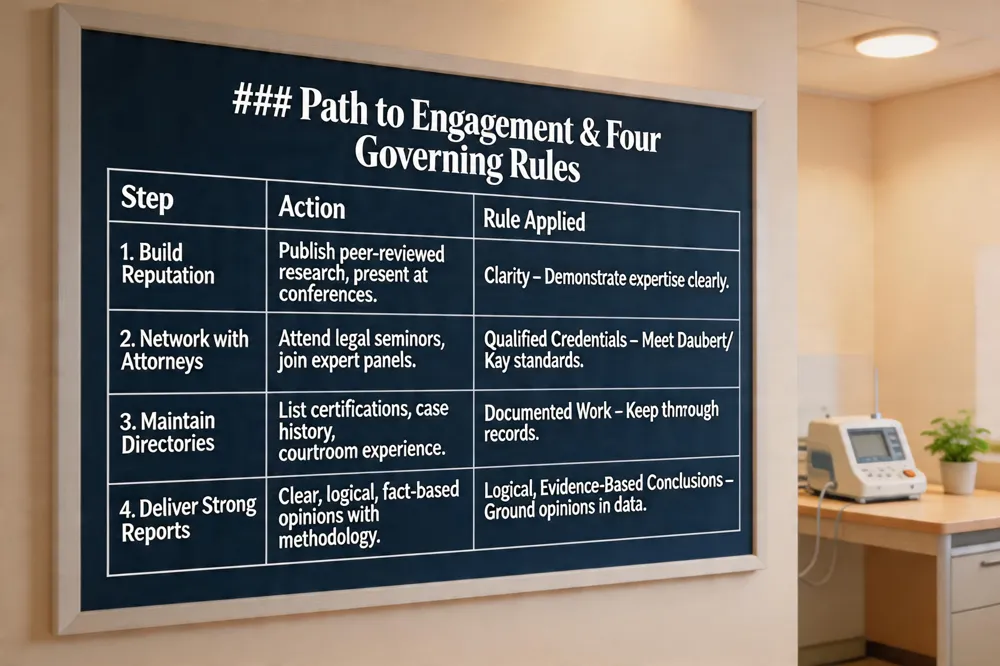 Building a reputation begins with publishing peer‑reviewed research, presenting at industry conferences, and contributing to professional journals. These activities create a documented track record that attorneys can verify when they search for credible specialists.
Networking with attorneys is equally vital. Attend legal seminars, join bar‑association expert panels, and seek mentorship from seasoned witnesses. Referrals from lawyers, insurers, and fellow experts often open the first doors to retainers.
Maintain a current profile on expert‑witness directories. Highlight certifications, years of relevant experience, case history, and any prior courtroom testimony. A concise, searchable entry makes it easy for counsel to locate you during discovery.
Report quality seals the deal. Deliver clear, lay‑person‑friendly opinions that follow a logical, fact‑based methodology; include detailed data, methodology, and conclusions. Consistently strong reports generate repeat referrals and reinforce your standing as a go‑to expert.
How to get hired as an expert witness? Develop a strong reputation, cultivate attorney relationships, list yourself on directories, and consistently produce clear, well‑structured reports.
What are the four rules of expert witnesses? 1️⃣ Clarity of testimony – teach the court. 2️⃣ Qualified credentials – meet Daubert/Kay standards. 3️⃣ Documented work – keep records of all analysis. 4️⃣ Logical, evidence‑based conclusions – ground opinions in facts.
Special Injury Types: Auditory Loss, Bursitis, and OSHA Considerations
Injury‑Specific Expert Requirements
| Injury Type | Required Expert Assessment | Key Regulations / Standards |
|---|---|---|
| Auditory Loss | Audiogram analysis, noise‑exposure assessment, otologic exam. | OSHA 29 CFR 1910.95 noise limits; CA Workers’ Comp impairment rating; Daubert‑Kay reliability. |
| Bursitis | Clinical evaluation of repetitive motion/pressure, imaging, functional limitation. | Workers’ Comp coverage for medical treatment, rehab, wage replacement (up to 95 %). |
| OSHA Considerations | Safety/engineering analysis linking workplace conditions to injury. | OSHA standards for noise, ergonomics, and injury prevention. |
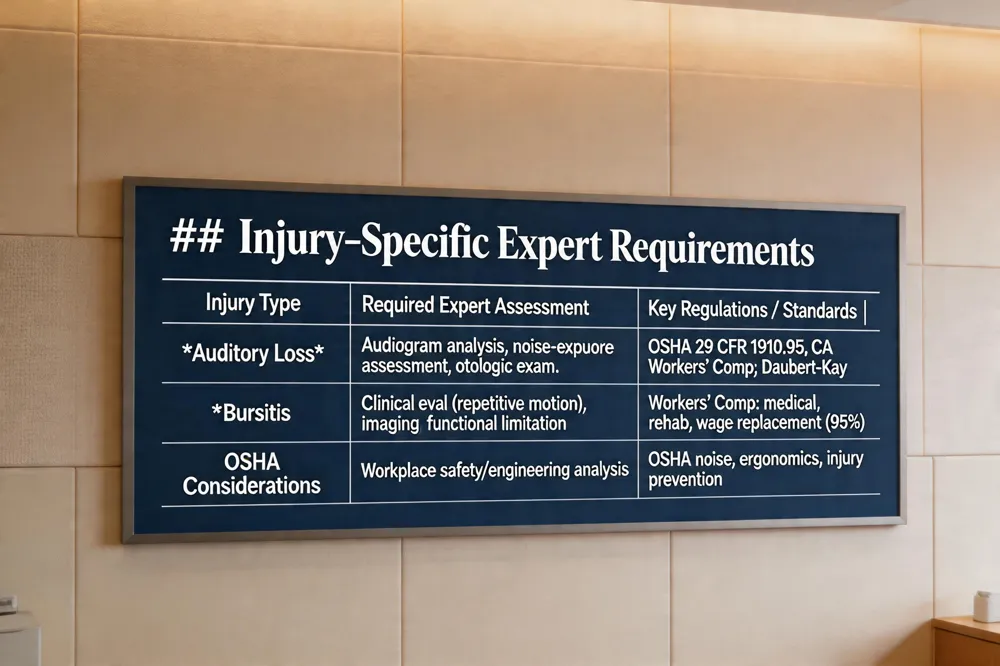 Auditory‑loss claims hinge on a thorough expert assessment that includes pure‑tone audiometry, occupational noise‑exposure analysis, and otologic examination. In California, the Workers’ Compensation Appeals Board requires an independent medical expert to link the hearing impairment to workplace noise levels that exceed OSHA’s 29 CFR 1910.95 limits. The Daubert‑Kay standard codifies that the expert’s methodology must be scientifically reliable and clearly explained in lay‑person language.
Bursitis is covered when the injury is caused or aggravated by job duties—repetitive motion, prolonged pressure, or awkward posture can trigger inflammation of a bursa. Workers’ comp can pay for physician visits, imaging, physical therapy, joint injections, surgery, and partial wage replacement (up to 95 % of pre‑injury earnings). Permanent impairment may yield a lump‑sum payment.
Is bursitis covered under workers' compensation? Yes—if a direct work‑related cause is documented, the claim qualifies for medical expenses, rehabilitation, and wage benefits.
What workers' comp lawyers won’t tell you? Many downplay the full value of a claim, omit discussion of long‑term disability benefits, and fail to warn that insurers often use biased independent medical exams to low payouts. A knowledgeable attorney can protect deadlines, secure comprehensive documentation, and pursue the maximum entitled compensation.
Putting It All Together: Timing, Expertise, and Strategy
Securing an expert witness at the outset of a workers’ compensation case preserves critical evidence, allows independent medical examinations, and gives the attorney time to integrate technical opinions into the case narrative. Early retention also prevents missed documentation and costly delays that erode credibility. Budgeting should begin with a realistic estimate of hourly rates—$150‑$500 for consulting, report preparation, and $250‑$500 for depositions or trial testimony—plus ancillary costs such as travel, imaging, and expert‑drafted reports; many firms advance the fees and recover them from the final award. California and Florida impose strict disclosure deadlines (often 30 days before trial), so the expert’s report must be completed and exchanged promptly to avoid sanctions or exclusion under Daubert‑Kay standards. Finally, a coordinated multidisciplinary team—medical, vocational, economic, and safety engineers—translates complex data into clear, lay‑person language, strengthening settlement negotiations and increasing the likelihood of a favorable award significantly.