Navigating the Critical Milestones After an Overseas Work Injury
The Crucial First 30 Days for Reporting an Injury
Upon sustaining a work-related injury overseas, immediate action is paramount. Injured workers are required to provide their employer with written notice of the injury. While you typically have up to 30 days from the date of the incident—or from when you first became aware a condition was work-related—to submit this notice, immediate reporting is strongly advised.
Prompt reporting initiates the formal claims process and helps preserve evidence. Delays can complicate your case, giving insurance carriers grounds to dispute the claim's validity. You should seek medical attention immediately from a physician of your choice. Keep detailed records of the incident, your symptoms, and all medical visits.
Common forms for this initial notification are Form LS-201 or Form CA-1 for traumatic injuries. For conditions that develop gradually, such as occupational illnesses or hearing loss, the 30-day clock generally starts when you recognize the connection between your condition and your employment.
Essential Employer Actions After Notification
Once an employer receives notice of an injury, specific legal obligations are triggered. The primary responsibility is to notify their Defense Base Act insurance carrier immediately. The employer must also authorize and facilitate necessary medical treatment for the injured worker without delay.
A critical procedural step is the employer's duty to file the Employer's First Report of Injury, typically using Form LS-202, with the U.S. Department of Labor. This report must be submitted within 10 days of the employer learning of an injury that causes the loss of one or more work shifts.
This formal filing creates an official case record with the Office of Workers' Compensation Programs (OWCP). Failure by the employer to file this report can stall the entire claims process. In situations where a subcontractor fails to secure the required insurance, the primary contractor becomes liable for providing benefits.
The 14-Day Deadline for Initial Compensation Payments
If an injury causes a disability that prevents work for more than three days, the DBA mandates the start of wage replacement benefits. The insurance carrier must issue the first compensation payment no later than 14 days after the employer first gains knowledge that the injury has resulted in a loss of wages.
This first payment covers the period starting the day after the injury occurred. The standard compensation rate is two-thirds of your average weekly wage, subject to a statutory maximum. Following this initial payment, ongoing compensation is typically disbursed on a bi-weekly basis by the insurance carrier.
If payments do not begin within this 14-day window, it is considered a delay. Injured workers should first contact the insurance carrier. If the issue persists, you can file a complaint with the Department of Labor's OWCP to seek intervention.
The One-Year (or Two-Year) Statute of Limitations
Filing a formal claim for benefits is a separate, and crucial, step from initially reporting the injury to your employer. To officially claim DBA benefits, you must file Form LS-203 (Employee’s Claim for Compensation) with the OWCP. The general deadline for filing this claim is within one year of the date of injury.
There are important nuances to this rule:
- The one-year period can also be calculated from the date of the last compensation payment you received, whichever is later.
- For occupational diseases, including conditions like PTSD or certain respiratory illnesses, the filing deadline is extended to two years. This two-year clock starts when you become aware, or reasonably should have become aware, of the relationship between the disease and your employment.
Missing this statutory deadline can bar your claim entirely. It is a strict limitation, making timely filing one of the most critical steps in securing your rights to benefits.
The Role of the Department of Labor's OWCP
The Office of Workers’ Compensation Programs, specifically its Division of Longshore and Harbor Workers’ Compensation (DLHWC), is the federal agency that administers the Defense Base Act. The OWCP oversees the entire claims process, ensuring compliance and facilitating resolutions.
After a claim is filed, the OWCP district office monitors payments and medical care. Its staff provide technical assistance and can conduct informal conferences to help resolve disputes between injured workers and insurance carriers. These conferences are often a key step in moving a stalled or contested claim forward.
If an insurance carrier denies a claim or refuses to pay benefits, the injured worker can file a request (Form LS-7) for OWCP intervention. The resulting informal conference is a non-binding process where a claims examiner reviews evidence and issues a recommendation to encourage settlement.
Potential for Extended Timelines in Disputed Cases
While straightforward, uncontested claims can result in benefits starting within weeks, disputed cases follow a much longer and more complex path. If disputes cannot be resolved informally through the OWCP, the case escalates to formal litigation.
The next phase involves requesting a formal hearing before an Administrative Law Judge (ALJ) by filing Form LS-18. The timeline for this process is lengthy:
- Scheduling a hearing can take several months after filing.
- The hearing itself may be set months in the future.
- After the hearing, the judge may take several additional months to issue a written decision.
Following an ALJ decision, either party may appeal to the Benefits Review Board within 30 days. Further appeals to federal courts are also possible. Consequently, a heavily contested DBA claim, from initial injury through all appeals, can take several years to reach final resolution. Settlement negotiations can occur at any point, often providing a faster resolution to complex cases.
| Milestone Phase | Key Action Required | Primary Responsible Party | Standard Legal Deadline |
|---|---|---|---|
| Injury Reporting | Provide written notice of injury | Injured Employee | Within 30 days of incident/awareness |
| Employer Reporting | File First Report of Injury (LS-202) | Employer | Within 10 days of employer knowledge |
| Compensation Start | Issue first disability payment | Insurance Carrier | Within 14 days of employer knowledge of wage loss |
| Formal Claim Filing | File Claim for Compensation (LS-203) | Injured Employee | Within 1 year of injury (2 years for occupational disease) |
| Dispute Resolution | Request informal OWCP conference | Injured Employee/Attorney | No set deadline; advised after claim delay or denial |
| Formal Litigation | Request hearing with Administrative Law Judge | Either Party | After informal resolution fails; appeals have short windows |
Foundation and Eligibility: Understanding the Scope of the DBA
What is the Defense Base Act?
The Defense Base Act (DBA) is a cornerstone federal law enacted in 1941 that mandates workers' compensation insurance for overseas employees for civilian employees working on U.S. government projects overseas. It is an extension of the Longshore and Harbor Workers' Compensation Act (LHWCA). This legislative framework ensures that workers injured or killed while supporting activities related to national defense, public works, or foreign assistance receive essential Defense Base Act benefits.
These benefits include medical care, DBA disability compensation, and death benefits for survivors. The U.S. Department of Labor's Office of Workers' Compensation Programs (OWCP), specifically its Division of Longshore and Harbor Workers' Compensation (DLHWC), administers the DBA system. The law requires U.S. government contractors and subcontractors to secure this insurance before work begins and maintain it throughout a contract.
Failure to secure the mandated insurance can lead to severe DBA penalties for non-compliance for employers. This legal structure provides a vital safety net for a diverse global workforce engaged in defense, construction, logistics, and humanitarian projects far from home.
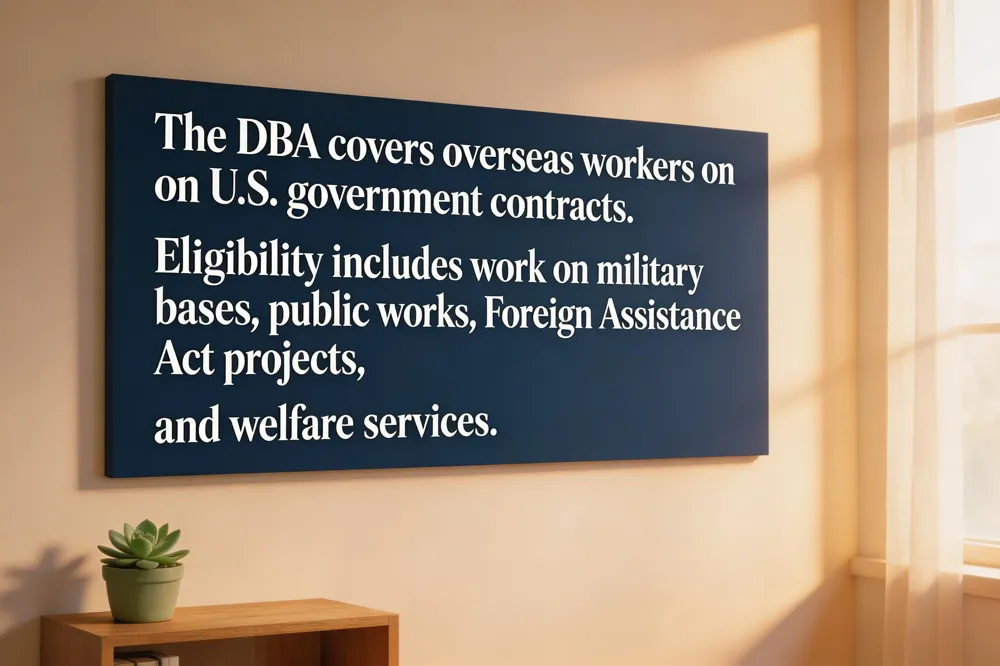
Who is eligible for coverage under the Defense Base Act?
Eligibility for DBA coverage is defined by the specific nature of the overseas employment. The Act protects employees across four primary categories of work. First, it covers employment on any U.S. military base or land used for U.S. military purposes outside the United States. Second, it applies to work on public work contracts with any U.S. government agency if the work pertains to national defense or war activities abroad.
The third category includes work performed on contracts approved and funded under the Foreign Assistance Act. Finally, the DBA covers employees of American employers providing welfare or similar services, such as the United Service Organizations (USO), for the Armed Forces overseas. A fundamental principle is that coverage applies to all employees engaged in this work, irrespective of nationality.
This includes U.S. citizens, legal residents, host-country nationals (local hires), and third-country nationals. The DBA's broad eligibility ensures that the entire workforce on a covered project is protected under a uniform compensation system.
The DBA's Administration and Insurance Framework
The DBA is not a standalone program but is integrated into the existing Longshore Act system. The U.S. Department of Labor's OWCP/DLHWC oversees all DBA claims, provides technical assistance, and facilitates DBA dispute resolution. New claims are typically filed with the DLHWC's centralized processing office in Jacksonville, Florida, either by mail or through a secure electronic portal.
Employers fulfill their DBA obligation by purchasing insurance from authorized carriers. Major insurance providers in this market include AIG, CNA, ACE-USA, and Starr Indemnity. Employers may also seek permission to be self-insured under the Defense Base Act. This DBA insurance requirements is a non-negotiable condition of performing work on covered U.S. government contracts.
Employer Responsibilities and Penalties for Non-Compliance
The law places clear and significant employer responsibilities on employers. They must secure and maintain proof of DBA insurance for all employees on a covered contract. If a subcontractor fails to obtain the required insurance, the primary or upper-tier contractor becomes legally liable for providing benefits to the subcontractor's employees.
The consequences for non-compliance are stringent. An employer who fails to secure the mandatory compensation insurance can be fined up to $10,000 and face imprisonment for up to one year. For corporate entities, presidents, secretaries, and treasurers can be held personally liable.
Furthermore, if an employer is uninsured, an injured employee may elect to bypass the DBA system entirely and sue the employer for damages under general tort law, where the employer cannot use common defenses like assumption of risk or negligence of a fellow employee. These DBA penalties for non-compliance enforce the system's integrity and underscore the critical importance of compliance.
Scope of Covered Employment and Common Roles
The DBA's four coverage categories encompass a wide array of professions and projects. Common eligible roles include construction workers building infrastructure on military bases, security personnel, translators, logistics and supply chain employees, engineers, and humanitarian aid workers.
Projects can range from building embassies and military facilities under public works contracts to humanitarian and development projects funded by agencies like USAID under the Foreign Assistance Act. The key factor is the connection to a U.S. government contract for qualifying work performed outside the United States. The location of the injury itself does not need to be on a military base; coverage applies while performing any duty related to the employment.
| Coverage Category | Example Work Settings | Common Employee Roles | Key Insurance Requirement |
|---|---|---|---|
| Military Bases | Bases in Iraq, Kuwait, Germany | Security, maintenance, food service | Insurance from carrier like AIG or CNA |
| Public Works Contracts | Embassy construction, defense infrastructure | Engineers, electricians, crane operators | Mandatory for prime contractor and subs |
| Foreign Assistance Act | USAID development projects | Aid workers, health professionals, advisors | Coverage required for all project staff |
| Welfare Services | USO recreation centers | Support staff, entertainers, managers | Employer must secure policy before work |
| All Categories | Any overseas worksite | Translators, drivers, medical personnel | Applies to all nationalities on contract |
Critical First Steps and Firm Deadlines
Immediate Reporting and Employer Notification
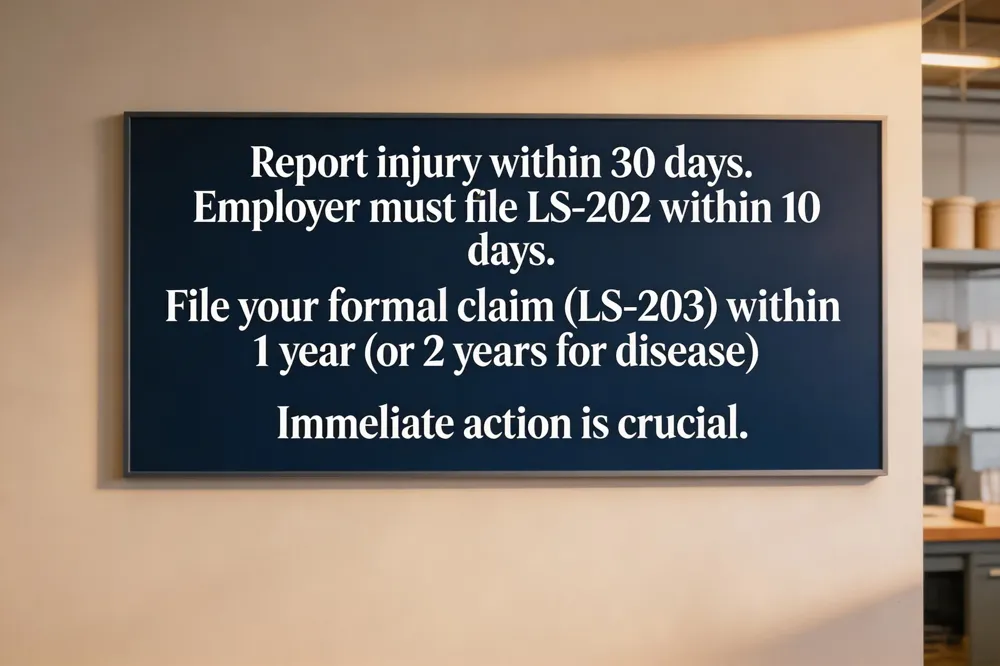
Your immediate actions after an injury set the foundation for a Defense Base Act (DBA) claim. You must report an injury or illness to your employer as soon as possible. While the law allows up to 30 days for reporting an injury under the Defense Base Act, immediate reporting is strongly advised to prevent complications and expedite the entire process.
Delays in reporting can jeopardize your claim. The clock for formal deadlines starts ticking from the moment of injury or when you become aware a medical condition is work-related. Reporting promptly ensures your employer can begin their employer responsibilities and helps preserve evidence.
This initial report should be detailed. Include the date, time, location, and circumstances of the incident. If your injury developed over time, such as hearing loss from prolonged noise exposure, report it as soon as symptoms interfere with your work or daily life. Always request written confirmation that your employer received your report.
Formal Written Notice with Form LS-201
Providing verbal notice to a supervisor is not sufficient. The DBA requires formal written notice to your employer. This is typically done using Form LS-201, the "Notice of Employee’s Injury or Death." You must provide this written notice within 30 days of the injury or of becoming aware of its work-related nature.
Form LS-201 officially documents your injury for the record. It requires information about you, your employer, and the details of the incident. Submitting this form triggers critical legal obligations for your employer and their insurance carrier. Keep a copy of the completed form and any proof of submission for your personal records.
Employer's Duty to Report with Form LS-202
Your employer has specific, time-sensitive responsibilities after you report an injury to them. If the injury causes you to lose one or more full work shifts, your employer is legally required to file Form LS-202, the "Employer’s First Report of Injury," with the U.S. Department of Labor’s Office of Workers' Compensation Programs (OWCP).
This report must be filed within 10 days of your employer learning about the injury. The form notifies the OWCP that a potential claim exists and initiates the official administrative case. Your employer must also immediately authorize and provide necessary medical treatment. If your employer or their subcontractor fails to secure the required DBA insurance requirements, the primary contractor becomes liable for your benefits.
Filing the Formal Claim with Form LS-203
Reporting the injury to your employer is separate from filing a claim for benefits under the Defense Base Act. To claim compensation, you must file Form LS-203, the "Employee’s Claim for Compensation," with the OWCP. This is your formal application for DBA benefits.
The statute of limitations for Defense Base Act claims for filing Form LS-203 is generally one year from the date of injury. However, if the employer or insurance carrier makes voluntary compensation payments, the deadline extends to one year from the last payment. For occupational diseases like PTSD, hearing loss, or respiratory illnesses, you typically have two years from the date you became aware, or should have become aware, of the relationship between the disease and your employment.
The Heart of the Timeline: Benefits, Review, and Initial Resolution
The 14-day Rule: Initiating Compensation Payments
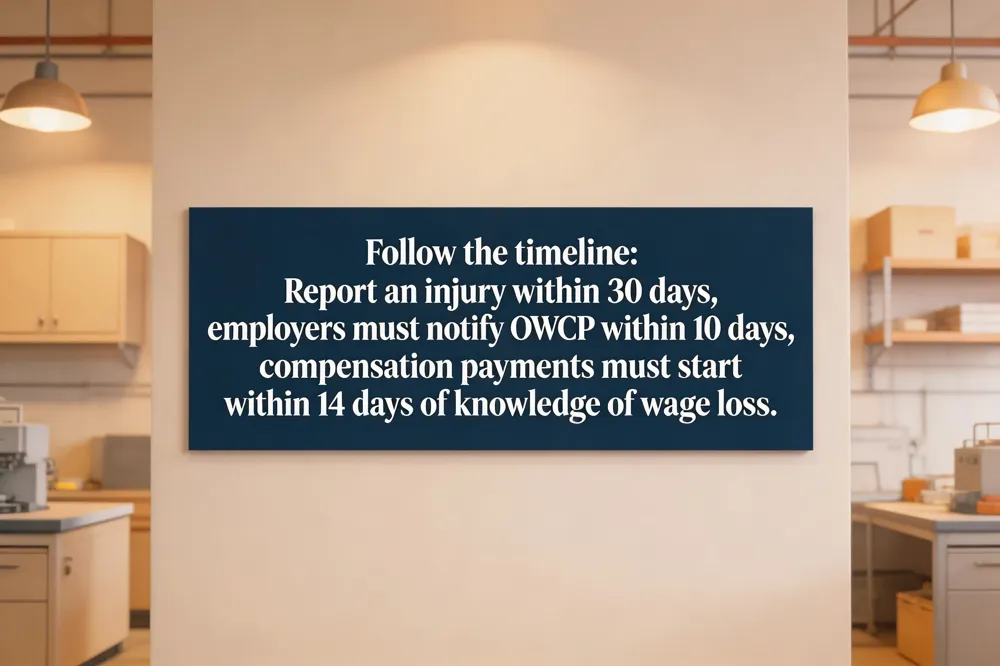
Under the Defense Base Act, the timeline for receiving wage replacement benefits is governed by a strict statutory rule. If an injury disables a worker for more than three days, the first payment of disability compensation is due. The law mandates that this initial DBA compensation payment within 14 days must start no later than 14 days after the employer first gains knowledge that the injury has caused a loss of wages.
This 14-day period is a critical benchmark. The clock starts ticking from the moment the employer is notified of the disabling injury, not necessarily from the date of the incident itself. The initial payment must cover the period beginning the day after the injury occurred. If the insurance carrier fails to initiate these timely DBA compensation after injury payments within this 14-day window, the injured worker has several recourse options.
They can directly contact the carrier, file a formal claim with OWCP, or seek legal assistance. While carriers technically have up to 28 days to deliver the first payment before it is considered officially overdue, the 14-day mark is the legal standard for timely commencement of benefits.
Calculation of Benefits and Payment Structures
DBA disability benefits are calculated based on a statutory formula. For temporary or permanent total disability, compensation is generally set at two-thirds (66 ⅔%) of the employee's average weekly wage prior to the injury. This average weekly wage calculation should include all forms of earnings, such as salary, bonuses, per diems, and housing allowances.
There is a federally established maximum weekly compensation rate that this calculation cannot exceed. This maximum rate is adjusted annually. For partial disabilities, where a worker can return to some form of work but at a lower wage, compensation is calculated as two-thirds of the difference between the pre-injury and post-injury wages.
Following the initial payment, ongoing compensation is typically disbursed by the insurance carrier on a bi-weekly compensation schedule. This regular payment schedule continues for the duration of the disability, as determined by medical evidence. The structure ensures a steady income stream while the injured contractor is unable to work.
The Path of an Uncontested Claim
When an insurance carrier accepts a claim without dispute, the process moves relatively quickly. After the initial reporting an injury under the Defense Base Act and submission of all required forms—primarily Form LS-203 by the employee and Form LS-202 by the employer—the insurer conducts a review. This review verifies the incident, employment status, and medical evidence.
For a straightforward, well-documented claim, this insurer review can be completed in a matter of weeks. Once the claim is approved, the first benefit payments often begin within two to four weeks after that approval. This timeline encompasses the initial when DBA payments should begin for wages and the immediate authorization of necessary medical treatment.
Medical benefits under an approved claim are comprehensive. They cover all necessary care related to the work injury, including doctor visits, hospital stays, surgery, prescription medications, physical therapy, and rehabilitation. The injured employee has the right to select a physician of their choice for this treatment.
Components of DBA Benefits
The DBA provides a suite of benefits under the Defense Base Act designed to support an injured worker and their family. The primary components are:
- Medical Benefits: Full coverage for all treatment, by a chosen physician, for as long as the injury requires. This includes costs for medical transportation or repatriation if necessary.
- Disability Compensation: Wage loss compensation under DBA payments for temporary or permanent disability, calculated as described above.
- Death Benefits: In the case of a work-related fatality, compensation is paid to eligible dependents. A surviving spouse or one child receives one-half of the employee's average weekly earnings. Two or more dependents receive two-thirds. Reasonable funeral expenses are also covered, up to a statutory limit.
- Vocational Rehabilitation: For workers who cannot return to their previous job, the DBA may provide retraining and rehabilitation services to prepare for new employment.
A key feature for severe cases is that permanent total disability and death benefits may be payable for the life of the beneficiary and are subject to annual cost-of-living adjustments.
Common Causes for Initial Delays
Despite the clear timelines, delays in DBA compensation payments at the outset are common. Insurers frequently initiate disputes that pause the process. The most frequent reasons for delay or initial denial include:
- Disputing whether the injury is truly work-related.
- Arguing that a condition is a pre-existing ailment, not caused by employment.
- Requesting additional medical evaluations or opinions.
- Citing incomplete or inconsistent supporting documentation from the employee or employer.
- Questioning the necessity or cost of specific medical treatments.
When a carrier controverts (disputes) a claim, they must file a Form LS-207 (Notice of Controversion) with the OWCP. This action triggers a more complex disputed DBA claim process, moving the claim from a straightforward administrative approval into a disputed case requiring intervention.
From Approval to Ongoing Support
Once a claim is accepted and payments begin, the focus shifts to managing long-term care and compensation. For temporary disabilities, bi-weekly payments continue until a doctor clears the worker to return to work or declares a permanent condition. Medical benefits continue for as long as treatment is required, which can be a lifetime for serious injuries.
For permanent conditions, the case may eventually move toward a DBA settlement agreement. Settlements are voluntary agreements that can be negotiated at any time. They often occur once an injured worker reaches maximum medical improvement (MMI) determination process DBA. A settlement typically accounts for the present value of all future medical costs and any ongoing disability compensation.
| Phase | Action & Responsibility | Typical Timeline | Key Outcome/Note |
|---|---|---|---|
| Initial Reporting | Worker reports an injury or illness to employer (in writing). | Within 30 days of injury/awareness. | Immediate reporting is strongly advised. |
| Employer Action | Employer notifies insurer; files Form LS-202 with OWCP. | Within 10 days of learning of injury. | Triggers official case creation. |
| First Payment Due | Insurer must initiate wage compensation. | Within 14 days of employer's wage-loss knowledge. | Covers period from day after injury. |
| Claim Review | Insurer verifies incident, employment, and medical evidence. | Several weeks. | Can be prolonged by requests for more info. |
| Benefits Start | Medical care authorized; ongoing wage payments begin. | 2-4 weeks after claim approval. | Payments typically made bi-weekly. |
| Dispute Initiation | Insurer files Form LS-207 to controvert (dispute) claim. | Can happen during review phase. | Moves claim to informal conference process. |
When Claims are Disputed: The Extended Resolution Path
The Role of the Insurance Adjuster and Claimant Caution
After a DBA claim is filed, the insurance company assigns an adjuster to manage the case. It is crucial to remember that this adjuster works for the insurer, not the injured worker. Their primary objective is to investigate the claim and, from the insurer's perspective, manage financial exposure. This can include requesting additional medical evaluations, questioning the work-related nature of the injury, or seeking to minimize benefit amounts. Claimants should be cautious in all communications, avoid providing unguided statements, and consider consulting an attorney before engaging in detailed discussions. Insurers may argue a claimant has reached 'maximum medical improvement (MMI) determination process DBA' to limit future benefits.
Filing Form LS-7 to Request an OWCP Informal Conference
If DBA compensation payments are delayed or disputed, the injured worker or their attorney can file Form LS-7, 'Request for Informal Conference,' with the Department of Labor's Office of Workers' Compensation Programs (OWCP). This step formally requests intervention from a government claims examiner. The OWCP district office will schedule a conference to review the evidence and attempt to resolve the dispute informally. This stage is a critical administrative checkpoint before litigation.
- Process Duration: Scheduling and conducting an informal conference with OWCP can take anywhere from several weeks to several months, depending on case complexity and agency workload.
- Potential Outcome: The OWCP claims examiner will issue a recommendation. If the insurance carrier accepts it, the case may resolve. If not, the dispute moves to a formal hearing.
Requesting a Formal Hearing with the Office of Administrative Law Judges (OALJ)
When an informal conference fails to resolve the dispute, the next step is a formal legal proceeding. The claimant or their attorney must file Form LS-18 to request a hearing before an Administrative Law Judge (ALJ) at the Office of Administrative Law Judges. This action initiates the litigation phase of a DBA claim. The filing must clearly state the issues in dispute, such as the extent of disability, coverage denials, or benefit calculations.
The Lengthy OALJ Timeline
The OALJ process is notably lengthy and involves multiple stages that significantly extend the claim's resolution time.
- Docketing and Scheduling: After filing Form LS-18, it can take weeks or months for the case to be formally docketed with the OALJ. Once docketed, a hearing date is set, often for several months in the future.
- Pre-Hearing Phase: This period involves discovery, where both parties exchange evidence, take depositions of medical experts and witnesses, and file legal motions.
- The Hearing and Decision: The formal hearing before an Administrative Law Judge involves a detailed presentation of evidence, including medical records, expert testimony, and witness statements. After the hearing concludes, the ALJ may take five months or longer to research the law and issue a formal written decision. Complex cases can extend this deliberation period.
The Appeals Ladder
An ALJ's decision is not necessarily final. Either party has the right to appeal if they believe the decision was legally incorrect.
| Appeal Level | Filing Deadline | Reviewing Body | Typical Process Duration |
|---|---|---|---|
| First Appeal | Within 30 days of the ALJ's decision | Benefits Review Board (BRB) | Several months to over a year for a decision. |
| Second Appeal | Within 60 days of the BRB decision | U.S. Court of Appeals | Can add one to several years to the total timeline. |
| Final Appeal | Discretionary review | U.S. Supreme Court | Exceptionally rare in DBA cases. |
The BRB reviews the ALJ's decision for errors of law or findings of fact not supported by substantial evidence. A further appeal to a federal circuit court is possible, adding another layer of time and complexity.
Overall Extended Timeline for Contested Claims
For claims that are disputed from the outset, the path to resolution is protracted. While an uncontested claim might be resolved in a few months, a contested claim can easily extend for 18 months to several years. Historical timelines show many cases lasting over 18 months, with complex appeals pushing this to three years or more. External factors like significant case backlogs—such as those experienced after the closure of major military operations—can further extend these timelines. Settlements can occur at any point in this process, often through mediation, which may provide a faster, though sometimes less comprehensive, resolution.
What is the Typical Process for a Defense Base Act Claim?
The typical process for a Defense Base Act claim begins by immediately reporting the injury to your employer and seeking medical treatment to document the condition. Next, you must formally notify your employer and the Department of Labor by filing an LS-201 form. It is highly advisable to consult with a specialized DBA attorney at this stage to navigate strict deadlines and complex requirements. The formal claim is then filed with the Department of Labor using Form LS-203, supported by medical evidence. Finally, the process may involve cooperation with a claims examiner and, if the claim is disputed, participation in mediation or a formal hearing before an administrative law judge.
How can you check the status of a Defense Base Act claim?
Claimants can check the status of a DBA claim by contacting the assigned OWCP claims examiner directly. The U.S. Department of Labor's Division of Longshore and Harbor Workers' Compensation (DLHWC) district offices manage case files and can provide updates. For cases at the OALJ level, status inquiries should be directed to the specific OALJ office handling the docket. Maintaining organized records of all claim numbers, correspondence, and legal documents is essential for efficient status checks. Legal representatives typically handle these inquiries on behalf of their clients.
| Dispute Stage | Key Action / Form | Responsible Office | Typical Time Frame |
|---|---|---|---|
| Initial Dispute | Insurer investigation & adjuster contact | Insurance Carrier | Several weeks |
| Informal Resolution | File Form LS-7 for conference | OWCP District Office | Weeks to months |
| Formal Litigation | File Form LS-18 for hearing | Office of ALJ (OALJ) | Several months to over a year |
| First Appeal | Appeal to Benefits Review Board | Benefits Review Board | Several months to a year+ |
| Second Appeal | Appeal to Federal Court | U.S. Court of Appeals | One to several years |
Medical Evidence: The Cornerstone of the DBA Timeline
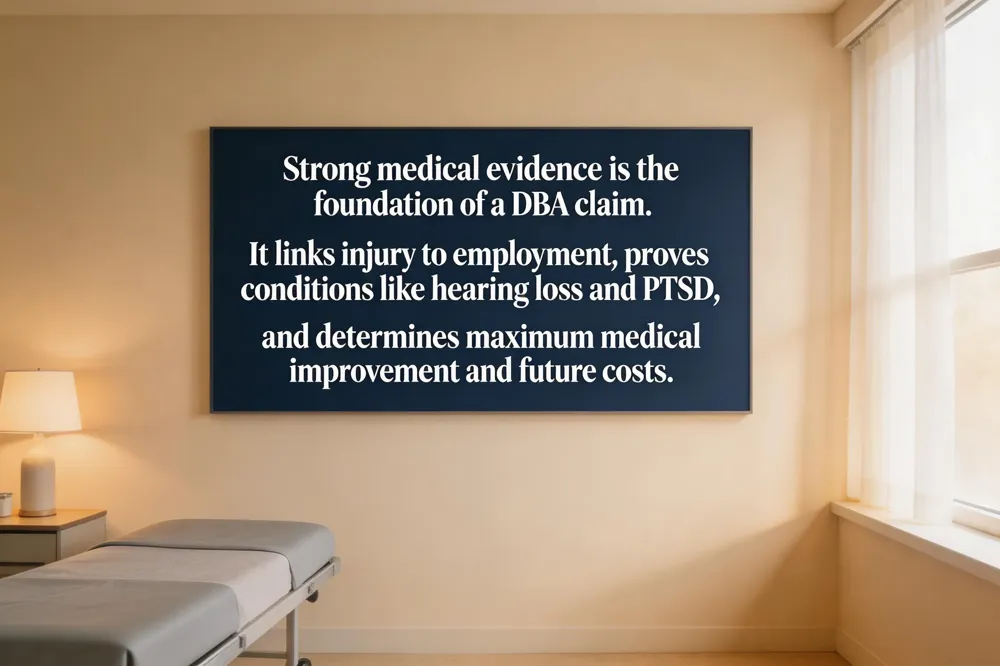
The critical need for comprehensive medical records linking the injury to employment.
Establishing a clear, documented connection between an injury and overseas employment is the most critical step in a Defense Base Act (DBA) claim. The burden of proof rests entirely on the claimant. Medical records are not just supporting documentation; they are the primary evidence that determines eligibility for benefits. Insurers and the Department of Labor require objective proof that the condition arose out of and in the course of covered work.
A complete medical file should include initial treatment records from the worksite, all follow-up care, diagnostic test results, physician notes detailing the cause of injury, and a clear narrative linking symptoms to job duties. For conditions that develop over time, like many occupational illnesses, the records must demonstrate a timeline showing symptom onset and progression during the contract period. Incomplete or inconsistent records are a leading cause of claim delays and denials.
Specifics of claiming hearing loss (auditory loss) and PTSD, including unique challenges.
Occupational Hearing Loss: The DBA covers hearing loss from both sudden traumatic events (e.g., blast exposure) and long-term noise exposure. Proving work-relatedness requires specific evidence: a baseline audiogram (if available), post-injury audiograms showing the deficit, and documentation of hazardous noise levels in the work environment. Claims often hinge on an audiologist's report that rules out non-occupational causes and confirms the loss is consistent with the noise exposure described.
Post-Traumatic Stress Disorder (PTSD): How are psychological injuries like PTSD handled under the Defense Base Act? PTSD is a recognized and compensable condition. The unique challenge lies in establishing the causal link between the diagnosis and a specific, work-related traumatic event. A diagnosis alone is insufficient. Successful claims require detailed psychological evaluations that document the traumatic incident, the resulting symptoms (like flashbacks, anxiety, sleep disturbances), and an expert opinion explicitly connecting the PTSD to the claimant's employment duties overseas. Insurers frequently contest these claims due to their subjective nature, making robust, objective medical-legal documentation paramount.
The concept of Maximum Medical Improvement (MMI) and its role in determining long-term disability and settlement values.
Maximum Medical Improvement is a pivotal medical and legal concept in DBA claims. It signifies the point at which a condition has stabilized and no further functional improvement is expected, even with additional medical treatment. Reaching MMI does not mean the claimant is "cured"; it means their permanent limitations can be assessed.
Determining MMI is essential for calculating permanent disability ratings and settling claims. Until MMI is established, the full long-term impact of the injury—including future medical needs and loss of wage-earning capacity—remains uncertain. Settlements negotiated before a claimant reaches MMI risk significantly undervaluing the claim, as they cannot accurately account for lifetime care costs or permanent impairments. A treating physician's formal declaration of MMI is often the trigger for serious settlement discussions or litigation on permanent disability benefits.
Why insurers may request Independent Medical Evaluations (IMEs) and how this can delay the process.
Insurance carriers frequently request claimants to undergo an Independent Medical Evaluation by a doctor of their choosing. While presented as neutral, these IMEs are often used to challenge the treating physician's findings, dispute the severity of the injury, or argue that the condition is not work-related. Common points of contention include the need for specific treatments, the validity of a PTSD diagnosis, or the attribution of hearing loss.
An IME request can add weeks or months to the claims timeline. Scheduling the exam, waiting for the doctor's report, and then potentially disputing its findings through additional medical reviews creates significant delays. This tactic can pressure claimants into accepting lower settlements. It underscores why having strong, consistent medical evidence from the outset is a crucial defense against such strategies.
The essential role of medical experts in documenting the full extent of injury, future medical needs, and loss of wage-earning capacity.
Beyond initial treatment, specialized medical experts are often needed to fully document a claim's value. How does the Defense Base Act address occupational hearing loss? An otologist or audiologist provides the essential link between audiometric data and occupational exposure. For PTSD, a psychiatrist or psychologist establishes the causal connection to work trauma.
These experts play a vital role in assessing permanent impairment, projecting future medical costs (e.g., hearing aids, therapy sessions, medications), and evaluating loss of wage-earning capacity. Their detailed reports translate medical conditions into the specific economic terms used in disability ratings and settlement calculations. This expert analysis is what turns a medical file into a compelling case for fair compensation, especially for lifelong or severe injuries.
How objective medical assessments support all stages of the claim, from initial filing to settlement negotiations or trial.
Strong medical evidence streamlines every phase of a DBA claim. At filing a DBA claim, it helps secure immediate acceptance and payment of benefits. During negotiations, it provides an objective foundation for settlement value, discouraging lowball offers. If a claim proceeds to a formal hearing before an Administrative Law Judge, this evidence is the cornerstone of testimony.
How can a medical consulting firm assist with a Defense Base Act claim? A specialized medical consulting firm provides critical support by ensuring medical evidence meets legal standards. They can coordinate independent medical evaluations from trusted specialists, review and organize complex medical records, clarify causal relationships for conditions like hearing loss and PTSD, and help prepare medical experts for depositions or trial testimony. Their expertise bridges the gap between clinical medicine and the procedural demands of the DBA system, helping to build a robust, evidence-based case that withstands insurer scrutiny and supports timely resolution.
| Claim Stage | Key Medical Evidence Required | Common Insurer Challenges | Role of Medical Expert/Consultant |
|---|---|---|---|
| Initial Filing | Acute injury reports, initial diagnosis, proof of treatment. | Disputing work-relatedness; arguing injury is minor. | Ensure records explicitly link injury to job duties and incident. |
| Ongoing Treatment | Progress notes, therapy records, medication logs. | Arguing treatment is excessive or unnecessary. | Provide rationale for treatment plan and document functional limitations. |
| MMI & Permanent Impairment | Treating physician's MMI declaration, permanency ratings (e.g., audiogram for hearing loss). | Disputing permanency rating; claiming pre-existing condition. | Perform definitive testing and authoritatively assign impairment rating. |
| Settlement Negotiation | Future care cost projections, loss of wage capacity evaluation. | Undervaluing future needs; disputing earning capacity impact. | Quantify lifelong medical costs and translate impairment to economic loss. |
| Formal Hearing/Trial | Expert witness report, deposition testimony, rebuttal to IME. | Attacking credibility of claimant's medical evidence. | Testify clearly on causation, diagnosis, and long-term prognosis. |
Navigating Challenges and Ensuring a Fair Outcome

Why consulting a DBA attorney early is strongly advised for navigating deadlines and complex procedures.
The Defense Base Act (DBA) claims process is governed by strict federal regulations and tight deadlines. An experienced DBA attorney provides critical guidance from the outset. They ensure that all procedural steps, such as filing Form LS-203 within the one-year statute of limitations, are completed correctly. Attorneys understand how to calculate your average weekly wage accurately, which directly impacts your benefit rate. They can also help navigate complex issues like proving a psychological injury is work-related or dealing with insurance carrier tactics. Legal representation is especially important for protecting your rights during interactions with insurance adjusters, who work for the carrier, not for you.
Given the potential for lengthy disputes and appeals, having an attorney early helps build a strong case from day one. Many DBA attorneys work on a contingency basis, with fees typically paid by the insurance company from a successful settlement or award. This means you can access expert legal help without upfront costs, making it a prudent step to take soon after an injury occurs.
Common reasons for claim denial or delay: incomplete documentation, disputes over work-relation, pre-existing conditions.
Claims face hurdles at several stages. A primary reason for denial or delay is incomplete or inconsistent documentation. This includes missing medical records, improperly filled forms like LS-201 or LS-203, or a lack of proof connecting your employment to the overseas contract. Insurance carriers often dispute whether an injury is work-related, especially for conditions like PTSD, hearing loss, or occupational diseases that may manifest later.
Another frequent point of contention is the aggravation of a pre-existing condition. Carriers may argue the current disability is not new or directly caused by the work. Delays are also common when insurers request additional medical evaluations or more detailed evidence, stretching the review process over several weeks. Employers failing to promptly file required forms, such as the LS-202 within 10 days of an injury, can further stall the process.
The settlement process: negotiations, mediation, and DLHWC/OALJ approval requirements.
Many DBA claims are resolved through settlement rather than a full trial. The settlement process often begins with negotiations between your attorney and the insurance carrier. If direct talks stall, parties may opt for mediation—a structured process with a neutral third party to facilitate a mutual agreement. This can be a faster, less adversarial path to resolution.
All settlements under the DBA must be approved as “reasonable” by the Division of Longshore and Harbor Workers’ Compensation (DLHWC) or an Administrative Law Judge (OALJ). The approving authority reviews factors like medical evidence, the extent of disability, future medical needs, and any disputed legal issues. The DLHWC typically has thirty days to review a submitted settlement agreement. If approved, they issue a formal Compensation Order.
Typical settlement ranges and factors affecting amounts (severity, future medical needs, wage loss).
Settlement amounts vary widely based on the specifics of each case. Typical ranges reported are from $150,000 to over $500,000. Cases involving severe, permanent disabilities can exceed $1 million. The final amount is not determined by a simple formula but is negotiated based on key factors.
These factors include the severity and permanency of the injury, the total cost of past and future medical care, the extent of lost wage-earning capacity, and whether the injury results in a permanent partial or total disability. Vocational rehabilitation costs and the impact on your ability to return to any work are also considered. A well-documented case with clear medical evidence supporting long-term needs generally supports a higher settlement value.
The 10-day payment rule for approved settlements and the 20% penalty for late payment.
Once a settlement is approved and a Compensation Order is issued, the law mandates prompt payment. The employer and insurance carrier have ten days to issue the settlement payment. This rule applies regardless of whether the injured worker lives in the United States or abroad.
If the payment is not made within this ten-day period, the carrier faces a significant financial penalty. They must pay an additional twenty percent of the outstanding settlement amount. This penalty is designed to enforce timely payment and protect the claimant from unnecessary delays after the case is resolved.
Protecting your rights: keeping detailed personal records, following up consistently, and not relying solely on the employer.
Actively managing your claim is crucial. Do not assume your employer will handle everything. You must file your own formal claim (Form LS-203) with the Office of Workers' Compensation Programs. Maintain a personal file with secure, digital copies of all documents: your employment contract, injury reports, all medical records and bills, correspondence with your employer and insurer, and a personal log detailing your symptoms, treatments, and work limitations.
Follow up consistently with all parties—your doctor, employer, and the claims administrator—to prevent delays. Respond promptly to any requests for information. If you encounter uncooperative behavior, delays without explanation, or pressure to settle early, these are clear signs to seek legal assistance. Your proactive documentation and communication create a solid evidence base that supports your claim at every stage.
What are common mistakes to avoid when filing a Defense Base Act claim?
Avoiding pitfalls is essential for a successful claim. The most critical mistake is missing the strict deadlines: the 30-day window to report the injury to your employer and the one-year statute of limitations to file Form LS-203. Providing inaccurate information about the incident or your earnings can undermine your credibility. Speaking with an insurance adjuster without legal counsel is risky, as statements can be used to minimize your claim.
Submitting incomplete paperwork or insufficient medical documentation is a frequent cause of delay and denial. Failing to establish a clear, documented link between your injury and your job duties makes it easy for an insurer to dispute compensability. Finally, not consulting with an experienced DBA attorney from the beginning is a significant error, as navigating the complex legal and procedural landscape alone often leads to lower settlements or denied benefits.
What strategies might insurance carriers use on Defense Base Act claims?
Insurers employ various strategies to manage claim costs. A primary tactic is to dispute the work-relatedness of an injury, particularly for conditions like PTSD or illnesses with delayed onset. They may argue the condition is pre-existing or not compensable under the Act. Carriers often challenge the calculation of your average weekly wage to reduce the benefit rate.
They may also dispute the extent and permanency of your disability, sometimes asserting you have reached “maximum medical improvement” to avoid covering future medical care. Delaying the process through repeated requests for documentation or independent medical exams can pressure claimants. Insurers rely on the DBA's exclusive remedy provision to limit liability and often seek lump-sum settlements that are less than the potential long-term value of ongoing benefits.
Once settled, how long does it take to receive a Defense Base Act payment?
After a settlement is formally approved by the DLHWC or an ALJ and a Compensation Order is issued, the insurance carrier is legally required to issue payment within 10 days. This rule ensures you receive funds promptly after the administrative process concludes. The total time from final settlement agreement to receiving payment can be a few weeks, accounting for the issuer's internal processing and the official order issuance. Delays can occasionally occur due to administrative backlogs. If the payment is not made within the mandated 10-day period, the carrier becomes liable for an additional 20% penalty on the unpaid amount.
| Phase | Key Action | Responsible Party | Typical Timeframe | Potential Pitfall |
|---|---|---|---|---|
| Initial Filing | Report injury & file LS-203 | Employee | 30 days / 1 year | Missing deadline denies claim |
| Carrier Review | Assess claim & evidence | Insurance Company | Several weeks | Requests for more info cause delay |
| Dispute Resolution | Informal conference or hearing | OWCP / OALJ | Months to over a year | Backlogs extend timeline |
| Settlement | Negotiate & get DLHWC approval | Parties & Attorney | Varies widely | Lowball offers if unrepresented |
| Payment | Issue funds after order | Insurance Carrier | 10 days after order | Late payment incurs 20% penalty |
From Immediate Reporting to Long-Term Resolution: A Step-by-Step Timeline for DBA Claims
Understanding the timeline for a Defense Base Act (DBA) claim is crucial for ensuring timely medical care and compensation. The process is governed by specific deadlines and administrative steps, which can extend from the day of injury to resolution years later. This timeline outlines the key phases, from initial reporting to final resolution.
Immediate Reporting & Initial Employer Actions (Days 0-30)
Injured employees must report the injury to their supervisor or employer as soon as possible. Formal written notice, typically using Form LS-201, must be provided within 30 days of the incident or the date the employee became aware the condition was work-related. Immediate reporting is strongly advised to prevent delays.
Upon notification, the employer has specific responsibilities. They must promptly notify their DBA insurance carrier and are required to file the Employer's First Report of Injury (Form LS-202) with the U.S. Department of Labor's Office of Workers' Compensation Programs (OWCP) within 10 days if the injury causes loss of one or more work shifts. Seeking immediate medical attention from a physician of your choice is a key right, and initial medical records are foundational evidence.
The Formal Claim & Administrative Clock Begins (Weeks 1-52)
To officially claim benefits, the injured worker must file Form LS-203, the Employee's Claim for Compensation, with the OWCP. The statute of limitations for filing this formal claim is generally one year from the date of injury or one year from the last payment of compensation, whichever is later.
For occupational diseases, such as hearing loss or PTSD, the claim filing deadline is extended. A claim must be filed within two years after the employee becomes aware (or reasonably should have become aware) of the relationship between the disease and their employment. The legal definition of 'awareness' is nuanced, requiring knowledge that the condition is work-related and impairs earning capacity, not just diagnosis.
Once filed, the insurance carrier reviews the claim. This investigation phase involves verifying the incident, assessing medical evidence, confirming employment status under a covered contract, and possibly requiring independent medical evaluations. This review can take several weeks.
Benefit Commencement & Ongoing Support (Weeks 2-4 and Beyond)
If a claim is approved, benefits should commence promptly. By law, the first compensation payment for wage loss is due no later than 14 days after the employer receives notice of the injury. In practice, initial benefits often begin within two to four weeks after formal approval by the insurer.
Benefits are provided on an ongoing basis. Medical benefits cover all necessary and related care, including hospital stays, surgeries, rehabilitation, and future treatment. These benefits cannot be commuted to a lump sum. Lost wage compensation is typically calculated at two-thirds of the employee's average weekly earnings, subject to a maximum rate, and payments are usually made bi-weekly.
Disputed Claims & The Path to Resolution (Months to Years)
If an insurer disputes or denies a claim, the timeline extends significantly. The first step is often an informal conference requested by the injured worker or their attorney (using Form LS-7). A claims examiner from the OWCP will attempt to mediate a resolution; this process can take several weeks to months.
If the dispute persists, either party can request a formal hearing before an Administrative Law Judge (ALJ) at the Office of Administrative Law Judges (OALJ) by filing Form LS-18. Getting a hearing docketed and scheduled can take months, and the ALJ may take several additional months to issue a written decision after the hearing.
Further appeals are possible to the Benefits Review Board within 30 days of the ALJ's decision and subsequently to a U.S. Court of Appeals. Settlements can be negotiated at any point in this process, often through mediation. A contested DBA claim can take anywhere from several months to several years to resolve fully.
The Importance of Medical Documentation & Expert Assessment
Medical evidence is the cornerstone of a DBA claim. Comprehensive and consistent documentation from the onset of treatment is vital. This includes initial emergency reports, treatment notes, diagnostic test results, and physicians' statements linking the injury to work duties and outlining work restrictions.
For conditions like auditory loss or PTSD, a clear, explicit medical opinion establishing a causal link to employment is often required to prove the claim and define 'awareness' for filing deadlines. Insurers frequently challenge medical evidence, requesting additional evaluations. An independent medical examination by a specialist can provide crucial, objective evidence to support the extent of disability and long-term care needs.
Key Considerations: Deadlines, Appeals, and the Role of Legal Counsel
Adhering to statutory deadlines is non-negotiable. Missing the 30-day notice window or the one-year (or two-year for occupational disease) claim filing deadline can bar a claim entirely, though certain legal presumptions and exceptions may apply. It is the employee's responsibility to file the formal claim; relying solely on the employer's report is insufficient.
Legal counsel familiar with DBA law is highly recommended, especially for disputed or complex claims. Attorneys can ensure proper filing, gather evidence, navigate negotiations, and represent clients in hearings. Typically, attorney's fees are paid by the insurance carrier from the settlement or award, not out-of-pocket by the injured worker.
| Process Phase | Primary Action | Key Deadline/Timeframe | Responsible Party |
|---|---|---|---|
| Injury & Reporting | Report injury to employer; seek medical care | Within 30 days of incident/awareness | Employee |
| Employer Notification | Notify insurer; file Form LS-202 with OWCP | Within 10 days of employer knowledge | Employer |
| Formal Claim Filing | File Form LS-203 with OWCP | Within 1 year of injury/last payment (2 years for occupational disease) | Employee |
| Benefit Start | First compensation payment for wage loss | No later than 14 days after employer notice | Insurance Carrier |
| Informal Dispute | Request OWCP informal conference | Varies; can take weeks to months | Employee/Attorney |
| Formal Litigation | Request hearing with OALJ; ALJ decision | Hearing scheduling: months; Decision: additional months | Either Party |
| Settlement | Negotiate and submit for OWCP/ALJ approval | Can occur at any point in the process | Parties & Counsel |