Opening Overview
Tailored consultation sessions are designed to bridge the gap between medical expertise and legal strategy in workplace injury litigation. By aligning audiometric findings, occupational exposure analysis, and functional impairment data with persuasive case narratives, attorneys can present a clear, evidence‑based story that resonates with jurors and decision‑makers. Integrating legal insight early—such as causation theory, statutory standards, and ADA accommodations—ensures that medical reports meet evidentiary thresholds and address the specific elements of workers’ compensation and personal‑injury claims. For auditory‑loss injuries, this collaborative approach clarifies the link between noise exposure and hearing impairment, quantifies economic and non‑economic damages, and strengthens expert testimony, ultimately increasing the likelihood of favorable settlements or verdicts. The combined expertise also streamlines documentation, reduces discovery time, and supports robust settlement negotiations.
Foundations of Tailored Interventions in Auditory Injury Cases
Key Points & Data
| Component | Description | Evidence of Effectiveness |
|---|---|---|
| Tailored Strategy Mix | Education, audit‑and‑feedback, reminders, decision‑support | Cochrane review (32 trials) pooled OR = 1.56 |
| Patient Impact | ~10 more per 100 receive guideline‑concordant care | Statistically significant, modest gain |
| Legal Integration | Audiometric findings linked to OSHA standards, visual aids (interactive audiograms) | Improves jury‑friendly narratives and settlement values |
| Consultation Model | ADA‑compliant job‑demand analysis + return‑to‑work plan | Strengthens causation arguments |
Tailoring interventions customizes treatment, legal strategy, and communication to the worker’s specific injury, role, and circumstances.
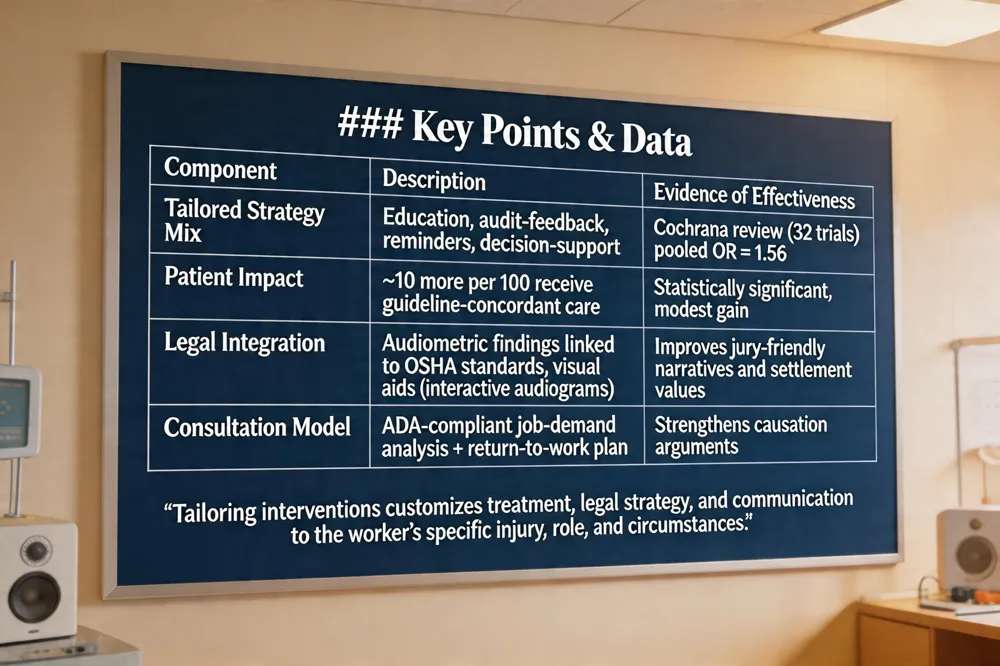 Tailoring interventions means customizing a treatment, program, or communication strategy to fit the specific characteristics, needs, or preferences of an individual or a particular group. In the workplace‑injury context, this may involve adjusting audiometric testing protocols, rehabilitation plans, and legal narratives to the worker’s job duties, exposure history, and severity of hearing loss.
Evidence from a Cochrane review of 32 cluster‑randomised trials shows that interventions designed to address identified determinants of practice improve implementation of recommended care (pooled odds ratio = 1.56). Tailored strategies—often a mix of education, audit‑and‑feedback, reminders, and decision‑support—yield about ten more patients per 100 receiving guideline‑concordant care. While the effect is modest, it is statistically significant and demonstrates that a personalized approach can raise the quality of clinical and legal outcomes.
Applying this to hearing‑loss claims, firms such as NorCal Medical Consulting and MRC combine expert audiometric assessments with legal‑strategy sessions. They translate complex medical findings into clear, jury‑friendly narratives, align documentation with OSHA noise‑exposure standards, and use visual aids (e.g., interactive audiograms) to illustrate functional impact. Tailored consultation sessions also incorporate ADA‑compliant job‑demand analyses and return‑to‑work plans, strengthening causation arguments and supporting higher settlement values.
Tailoring interventions meaning – Customizing a program to the unique injury, job role, severity, and personal circumstances of the worker to improve engagement and claim outcomes.
What is the 60‑60 rule in audiology? – The 60/60 rule advises listening at no more than 60 % of maximum volume for a maximum of 60 minutes at a time to protect hearing.
Legal Strategy Sessions and the Role of Consultants
Role Comparison
| Role | Primary Function | Court Appearance | Typical Fee (per hour) |
|---|---|---|---|
| Lawyer | Full‑scale litigation, pleadings, negotiations | Yes (licensed JD) | $200‑$400 (varies) |
| Legal Consultant | Advisory, risk assessment, expert translation of medical data | No (no JD required) | $150‑$1,000 (specialists $600‑$1,000) |
Strategy sessions map medical findings into persuasive legal narratives, with consultants bridging the gap between clinical data and courtroom storytelling.
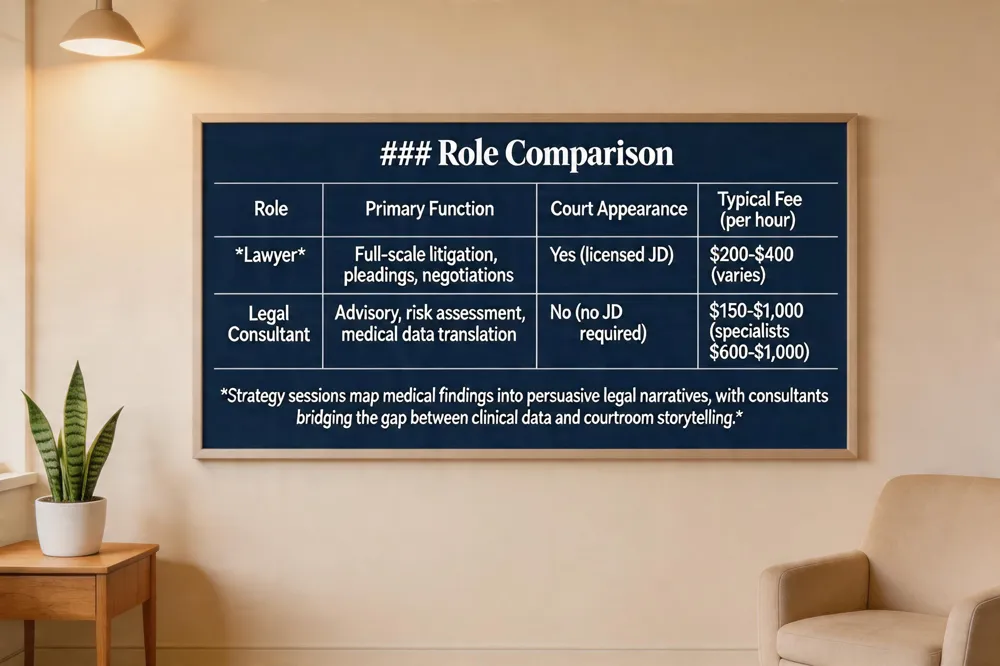 A strategy session with a lawyer is a focused, attorney‑led meeting that maps out the most effective plan for a workplace‑injury claim. The lawyer prioritizes issues, identifies legal constraints, and creates a clear roadmap for litigation, insurance negotiations, or settlement discussions, ensuring that medical findings—such as audiometric testing and occupational exposure analysis performed by firms like NorCal Medical Consulting—are woven into a persuasive narrative.
The key difference between a lawyer and a legal consultant lies in representation versus advisory roles. A lawyer is a licensed attorney who can appear in court, draft pleadings, and manage full‑scale litigation. A legal consultant provides expert advice, risk assessment, and strategic guidance—often leveraging medical‑legal expertise—without courtroom advocacy. Consultants may not hold a JD but bring subject‑matter expertise (e.g., audiology, OSHA compliance) and can translate complex medical data into lay language for juries.
Legal consulting services thus bridge medical facts and actionable strategy, helping attorneys align causation, severity, and impact of auditory loss with statutory requirements and jury psychology to improve claim outcomes.
Medical‑Legal Professional Pathways and Certifications
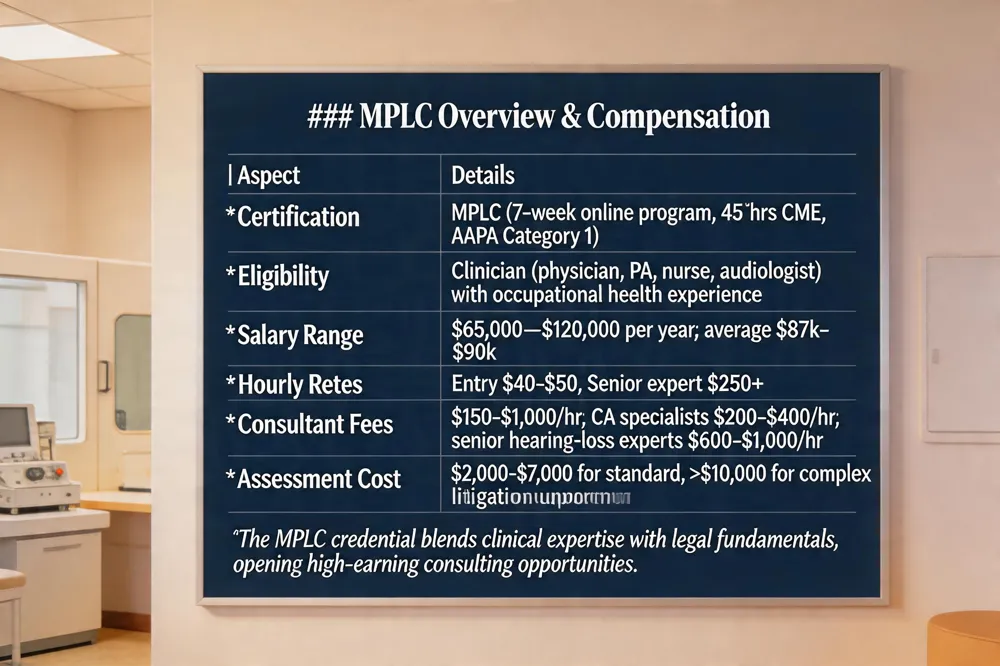
MPLC Overview & Compensation
| Aspect | Details |
|---|---|
| Certification | MPLC (7‑week online program, 45 hrs CME, AAPA Category 1) |
| Eligibility | Clinician (physician, PA, nurse, audiologist) with occupational health experience |
| Salary Range | $65,000 – $120,000 per year; average $87k‑$90k |
| Hourly Rates | Entry $40‑$50; Senior expert $250+ |
| Consultant Fees | $150‑$1,000/hr; CA specialists $200‑$400/hr; senior hearing‑loss experts $600‑$1,000/hr |
| Assessment Cost | $2,000‑$7,000 for standard; >$10,000 for complex litigation support |
The MPLC credential blends clinical expertise with legal fundamentals, opening high‑earning consulting opportunities.
 Medical professional legal consultant certification
A Medical Professional Legal Consultant (MPLC) credential is earned after completing a specialized training program that blends clinical expertise with legal fundamentals. Typically a seven‑week online course offered by the Center for Legal Studies or university partners, it requires assignments, a passing exam, and awards AAPA Category 1 CME credits (≈45 hours). Graduates receive a certificate recognized across personal‑injury, workers’‑compensation, malpractice, and toxic‑tort litigation, enhancing credibility for workplace‑injury assessments such as auditory‑loss evaluations.
Medical professional legal consultant certification
A Medical Professional Legal Consultant (MPLC) credential is earned after completing a specialized training program that blends clinical expertise with legal fundamentals. Typically a seven‑week online course offered by the Center for Legal Studies or university partners, it requires assignments, a passing exam, and awards AAPA Category 1 CME credits (≈45 hours). Graduates receive a certificate recognized across personal‑injury, workers’‑compensation, malpractice, and toxic‑tort litigation, enhancing credibility for workplace‑injury assessments such as auditory‑loss evaluations.
How to become a medical legal consultant Begin with a solid clinical background (physician, PA, nurse, audiologist, etc.) and experience in occupational health. Complete a medical‑legal training program (e.g., MPLC), covering workers‑compensation law, litigation strategy, and expert‑witness testimony. Build a portfolio of case reports, join professional networks that connect consultants with law firms, and continuously update medical and legal knowledge.
Medical legal consultant salary Annual earnings range from $65,000 to $120,000, with a national average near $87,000–$90,000. Hourly rates start at $40‑$50 for entry‑level work and can exceed $250 per hour for senior expert witnesses, especially in high‑cost markets like California.
How much does a legal consultant cost? Hourly fees vary from $150 to $1,000; California specialists typically charge $200‑$400 per hour, with senior occupational‑hearing‑loss experts at $600‑$1,000. Standard workplace‑injury assessments cost $2,000‑$7,000, while complex litigation support may exceed $10,000.
Financial Assistance and Resources for Hearing Loss
Funding Sources & Coverage
| Program | Target Population | Coverage Details |
|---|---|---|
| VA | Eligible service members | No‑cost hearing devices |
| Medicaid (state‑specific) | Low‑income adults/children | Exams, hearing‑aid devices (varies by state) |
| Help America Hear / Hearing Aid Project | Low‑income adults | Free/low‑cost devices |
| Starkey Cares | Individuals with documented loss | Discounted or donated devices |
| Miracle‑Ear Foundation | Children & adults | Free hearing aids |
| Professional Societies (AAA, ASHA) | Members & referrals | Financial aid referrals, vocational rehab links |
Eligibility typically requires proof of loss, income documentation, and a medical necessity prescription.
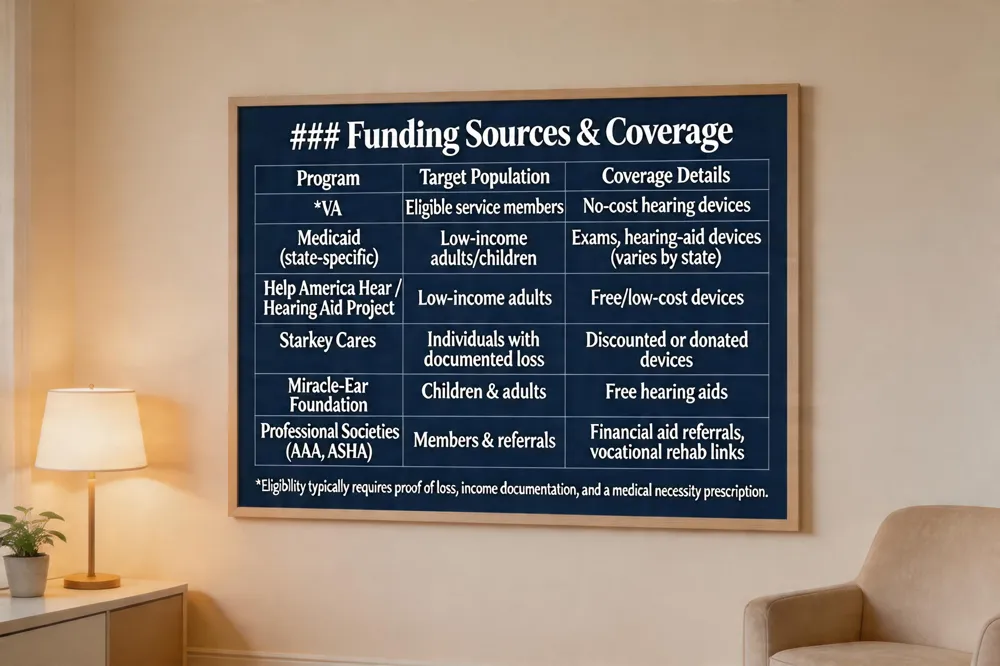 Government and state programs for hearing aids provide a safety net for low‑income adults, children, and veterans. The VA offers no‑cost hearing devices to eligible service members while many states’ Medicaid plans cover hearing‑aid exams and, for children and medically‑necessary adults (e.g., Colorado’s Health First Colorado). When Medicaid coverage varies, applicants must obtain a prescription from a qualified audiologist and use in‑network providers.
Non‑profit and charitable organizations fill gaps left by public programs. Groups such as Help America Hear, the Hearing Aid Project, Starkey Cares, and the Miracle‑Ear Foundation supply free or low‑cost devices to documented hearing loss. Professional societies (Academy of Doctors of Audiology, American Speech‑Language‑Hearing Association) and state vocational‑rehabilitation agencies also provide referrals and financial aid.
Eligibility and application steps typically require proof of hearing loss, income documentation, and a medical necessity determination. Applicants should contact their local Medicaid office, VA health center, or a hearing‑care provider to verify program specifics, submit required paperwork, and receive guidance through the enrollment process.
NorCal Medical Consulting: Integrated Services and Impact
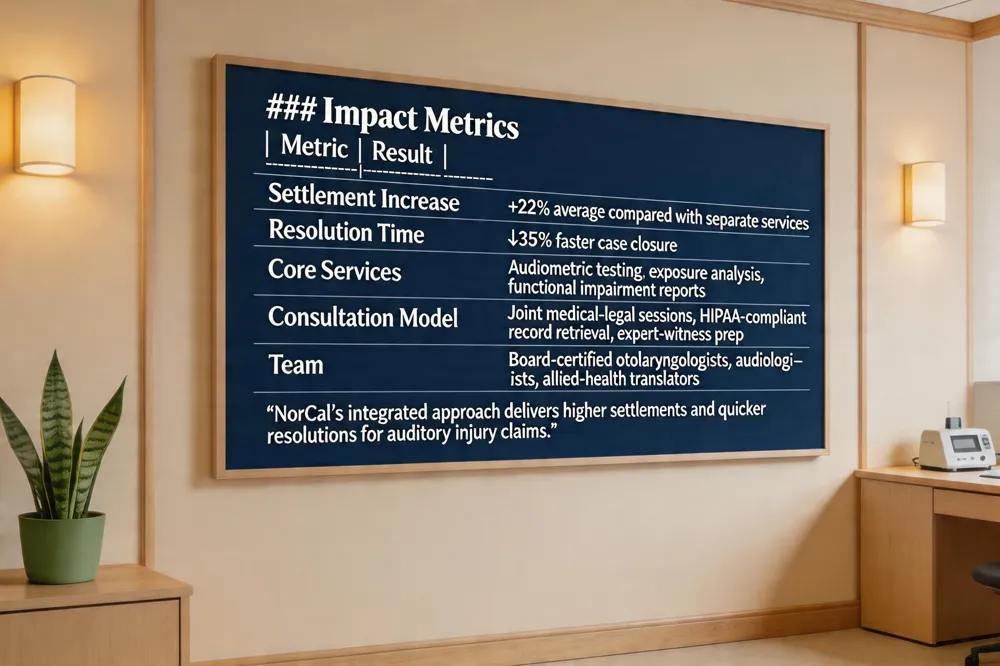
Impact Metrics
| Metric | Result |
|---|---|
| Settlement Increase | +22 % average compared with separate services |
| Resolution Time | ↓35 % faster case closure |
| Core Services | Audiometric testing, exposure analysis, functional impairment reports |
| Consultation Model | Joint medical‑legal sessions, HIPAA‑compliant record retrieval, expert‑witness prep |
| Team | Board‑certified otolaryngologists, audiologists, allied‑health translators |
NorCal’s integrated approach delivers higher settlements and quicker resolutions for auditory injury claims.
 Core expertise in auditory loss assessments
NorCal Medical Consulting provides hearing‑loss evaluations—including audiometric testing, exposure analysis, and functional impairment reports. Board‑certified otolaryngologists and audiologists produce legally admissible opinions that establish causation and severity for workers’ compensation and personal‑injury claims.
Core expertise in auditory loss assessments
NorCal Medical Consulting provides hearing‑loss evaluations—including audiometric testing, exposure analysis, and functional impairment reports. Board‑certified otolaryngologists and audiologists produce legally admissible opinions that establish causation and severity for workers’ compensation and personal‑injury claims.
Tailored consultation model Medical experts partner with legal strategists in sessions, aligning data with case themes, aids, and timelines that resonate with jurors. Services include HIPAA‑compliant record retrieval and expert‑witness preparation.
Evidence of improved claim outcomes Integrated medical‑legal consultations raise settlements about 22 % and shorten resolution time by up to 35 % versus separate services.
What does a medical legal consultant do? They bridge healthcare and law, reviewing records, assessing standards of care, and creating courtroom‑ready reports that translate medical issues into clear legal arguments.
Legal medical consulting services jobs Positions are filled by physicians, nurses, or allied‑health professionals who act as translators between clinical data and legal claims, working remotely for firms such as NorCal.
Best legal medical consulting services NorCal’s focus on auditory loss and litigation support makes it a leading provider.
Final Thoughts
Integrating medical expertise with legal strategy creates a cohesive narrative that clarifies causation, severity, and impact of workplace injuries, especially auditory loss. Tailored consultation sessions align audiometric data, OSHA exposure analysis, and ADA accommodations with persuasive case themes, boosting credibility and settlement potential. Attorneys and claimants who need comprehensive, HIPAA‑compliant support should contact NorCal Medical Consulting to schedule a customized strategy session and strengthen their workers’ compensation or personal‑injury claim. They will also provide expert reports, testimony preparation, and case management.