Why Mental Health Matters After a Workplace Injury
Physical injuries often trigger a cascade of psychological responses—including anxiety, depression, PTSD, and substance‑use disorders—that can impede recovery and delay return‑to‑work. Cohort studies of over 7,500 surgically treated workplace‑injured workers show that, although pre‑injury mental‑health rates are lower, post‑injury anxiety and any mental disorder rise sharply, outpacing comparable growth in non‑workplace injuries. Early detection of these changes is critical: timely mental‑health screening, referral to qualified therapists, and integration of psychosocial care into rehabilitation plans have been linked to lower long‑term disability costs and faster functional recovery. Expert medical assessments—conducted by psychologists, neuropsychologists, or physicians with mental‑health expertise—document the causal link between the physical injury and ensuing psychological sequelae, quantify severity, and guide appropriate treatment. Such assessments are essential for workers’ compensation and personal‑injury claims, providing the objective evidence insurers and courts require to approve mental‑health benefits and to support claim settlement. In short, recognizing and treating mental‑health effects early, and backing them with expert evaluations, protects both the injured worker’s wellbeing and the financial interests of employers and insurers.
Common Physical Injuries and Their Immediate Impact
| Injury Type | Typical Cause | Immediate Impact | Preventive Measures |
|---|---|---|---|
| Strains & Sprains | Improper lifting, awkward postures (back, neck, shoulders) | Pain, reduced range of motion, time‑off work | Ergonomic workstations, lifting aids, training on safe lifting |
| Slips, Trips & Falls | Wet floors, clutter, poor lighting | Fractures, head trauma, soft‑tissue injuries | Clean, well‑lit areas; slip‑resistant flooring; housekeeping protocols |
| Repetitive‑Use Disorders | Repeated motions (e.g., carpal‑tunnel) | Numbness, tingling, weakness | Job rotation, micro‑breaks, ergonomic tools |
| Cuts & Lacerations | Sharp tools, machinery, materials | Bleeding, tissue damage, infection risk | Guarded tools, PPE, safe‑handling training |
| Collisions/Impacts | Forklifts, vehicles, falling objects | Bruises, fractures, concussions | Vehicle‑operation protocols, exclusion zones, PPE |
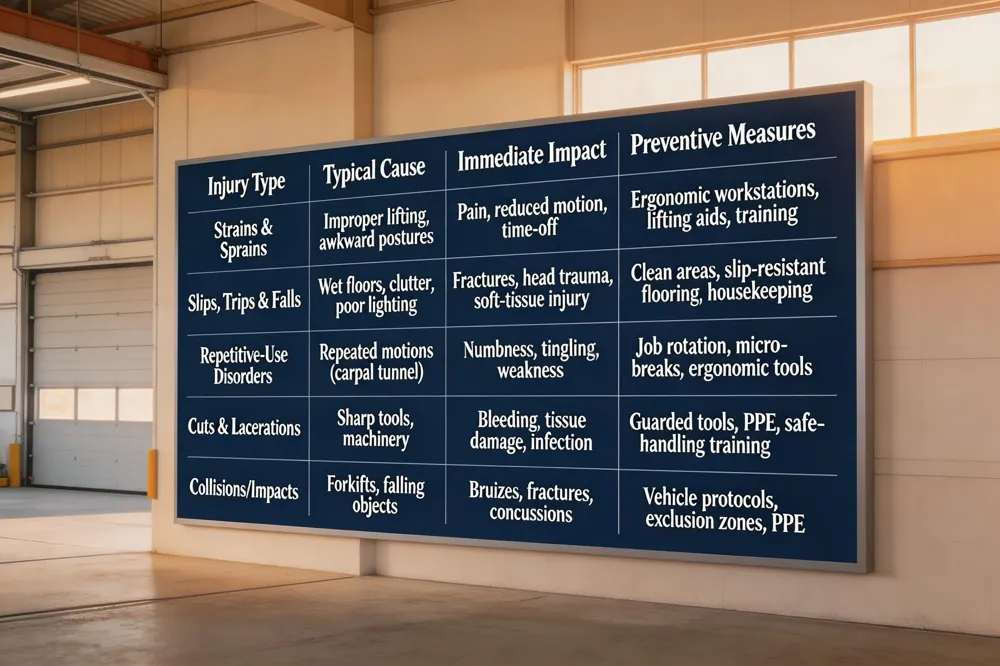 Workplace injuries are a leading source of disability and cost for both employees and employers. The five most common injuries observed in workers’ compensation data are: (1) strains and sprains, especially of the back, neck and shoulders, often resulting from improper lifting or awkward postures; (2) slips, trips and falls, which can cause fractures, head trauma or soft‑tissue injuries; (3) repetitive‑use disorders such as carpal‑tunnel syndrome, arising from sustained motions; (4) cuts and lacerations from sharp tools, machinery or materials; and (5) collisions or impacts involving forklifts, vehicles, falling objects or equipment. These hazards account for the bulk of non‑fatal claims and generate substantial medical expenses and lost work time.
Preventive workplace practices are essential to curb these incidents. Employers should maintain clean, well‑lit work areas, provide ergonomic workstations and lifting aids, enforce regular break schedules, train staff on safe tool handling, and implement strict vehicle‑operation protocols. Early reporting and comprehensive medical evaluation are equally critical. Workers must notify their employer promptly—typically within 30 days—and employers must file the required workers’ compensation forms (e.g., Oregon Form 801) within five days of injury. A thorough clinical assessment, including imaging when needed, establishes the injury’s severity, guides treatment, and supports a timely, accurate claim. Integrating these safety and reporting measures protects employee health and reduces liability for businesses.
Psychological Factors That Shape Injury Risk
Psychological Factor | Description | Evidence (Key Study) | Employer Strategy |
|------------------------|-------------|----------------------|-------------------| | Stressors | High‑level stress, daily hassles, anxiety increase muscle tension | Retrospective cohort of 7,556 surgical injuries – post‑injury anxiety ARR = 1.00 | Implement stress‑reduction programs, provide mental‑health resources | | Coping Resources | Adaptive coping (problem‑solving, social support) buffers stress | Limited coping linked to higher depressive/substance‑use rates | Foster supportive culture, offer counseling, promote modified‑duty options | | Emotional/Personality Traits | Somatic anxiety, irritability, catastrophizing affect attention & risk‑taking | Meta‑analysis: ρ = 0.21 between negative cognitions & post‑injury mental‑health issues | Train supervisors to recognize maladaptive coping, provide early psychological screening |
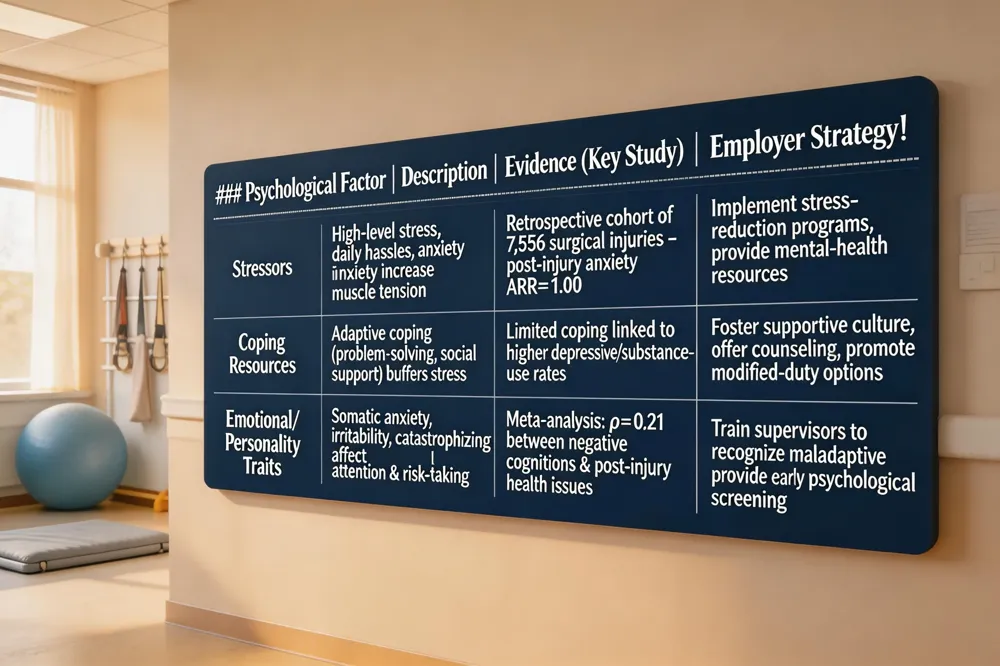 Research consistently shows that three psychological domains drive injury likelihood in the workplace.
-
Psychological stressors – High‑level stress, daily hassles, and anxiety raise physiological arousal and muscle tension, making workers more susceptible to slips, falls, and over‑exertion. The retrospective cohort of 7,556 surgical workplace injuries found that post‑injury anxiety rates surged (ARR = 1.00) compared with non‑workplace injuries, underscoring how stress amplifies risk.
-
Coping resources – The ability to manage stress through adaptive strategies (e.g., problem‑solving, social support) buffers the harmful effects of stressors. Workers with limited coping mechanisms are more likely to develop depressive or substance‑use disorders after injury, which in turn delay return‑to‑work and increase claim costs.
-
Emotional and personality traits – Traits such as somatic anxiety, irritability, and catastrophizing shape attention, decision‑making, and risk‑taking behavior. Meta‑analytic evidence links negative cognitions (rumination, catastrophizing) to a 0.21 correlation (ρ) with mental‑health challenges after injury.
Employer strategies – To mitigate these risks, employers should: (a) implement stress‑reduction programs and provide access to mental‑health professionals; (b) foster a supportive culture that encourages early reporting and use of modified‑duty options; and (c) train supervisors to recognize and address maladaptive coping and catastrophic thinking. Early identification and integrated physical‑mental care can curb the post‑injury mental‑health trajectory, improve functional outcomes, and reduce long‑term workers’ compensation costs.
The Emotional Journey: Stages of Grief After an Injury
Stage | Typical Feelings | Typical Behaviors | Clinical Implications |
|-------|------------------|-------------------|-----------------------| | Denial | “This can’t be happening” – numbness | Avoidance of medical care, under‑reporting symptoms | Early screening for hidden pain or functional limitation | | Anger | Frustration, perceived unfairness | Aggressive communication, blame of employer | Provide clear information, empathetic listening | | Bargaining | “If I rest longer…” – negotiation for control | Requesting alternative duties, excessive questioning of prognosis | Offer realistic timelines, involve multidisciplinary team | | Depression | Sadness, helplessness, low motivation | Missed appointments, reduced participation in rehab | Prompt referral to mental‑health professionals | | Acceptance | Adjusting to new reality, goal‑setting | Engagement in therapy, planning return‑to‑work | Support gradual RTW programs, monitor for relapse |
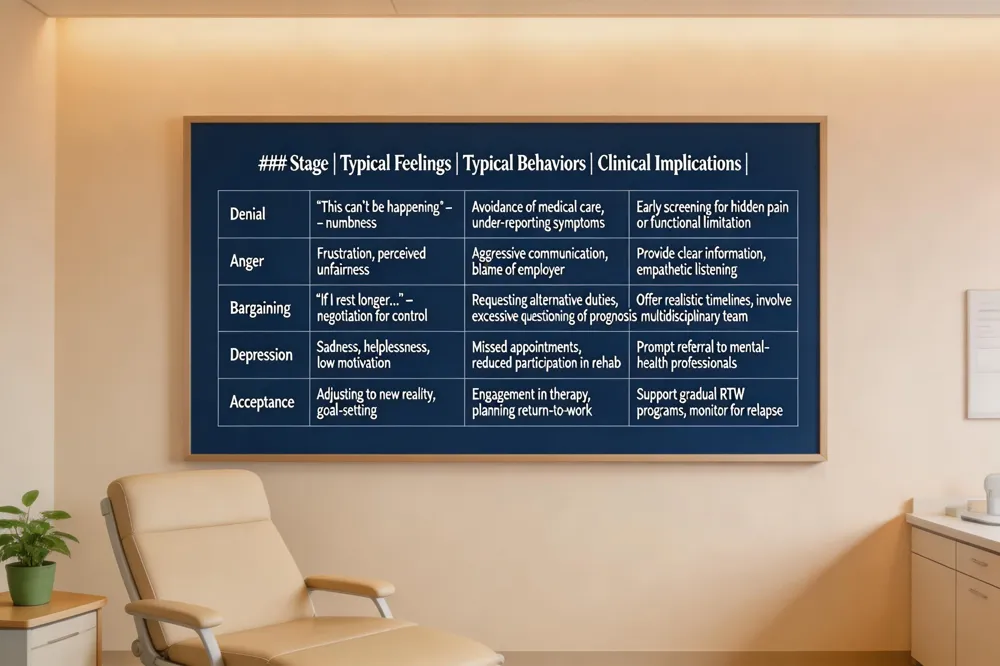 After a workplace injury, most individuals experience the five classic stages of grief: denial, anger, bargaining, depression, and acceptance. Denial often appears first as a numb, "this can’t be happening" reaction. Anger follows, directed at the loss of function, the injury’s circumstances, or the perceived unfairness of the situation. Bargaining manifests as mental negotiations—"if I rest longer, maybe I’ll recover fully"—as the person seeks to regain control. Depression reflects deep sadness, frustration, and a sense of helplessness about reduced abilities. Finally, acceptance emerges when the injured worker begins to adjust to the new reality, set realistic goals, and plan for a return to work or a new career path.
The grieving process is rarely linear. Workers may cycle back through earlier stages, experience several stages simultaneously, or skip stages altogether. Recognizing this fluidity is crucial for clinicians who must tailor mental‑health screening and interventions, and for claim professionals who need to anticipate fluctuating symptom reports that can affect treatment compliance and return‑to‑work timelines.
Implications: Early identification of anxiety, depression, or substance‑use concerns—particularly after the anxiety or bargaining phases—allows timely referral to mental‑health providers, improves rehabilitation outcomes, and strengthens the evidentiary basis for workers’ compensation or personal injury claims. Integrating psychological assessments into the claims process mitigates long‑term disability costs and supports a smoother transition back to productive employment.
Financial Realities: Payouts for Psychological Injuries
Metric | Value | Influencing Factors |
|--------|-------|---------------------| | Median Settlement | ≈ $65,000 | Diagnosis severity, jurisdictional caps, presence of co‑existing physical injury | | Range | $60,000 – $70,000 (typical) | High‑severity cases can exceed $100,000 | | Average Time Off Work | ≈ 35 weeks | Speed of treatment, claim processing efficiency | | Drivers of Payout Variance | State statutes, mental‑health diagnosis (anxiety, depression, PTSD), treatment duration | Early identification & treatment can reduce both time off and settlement size |
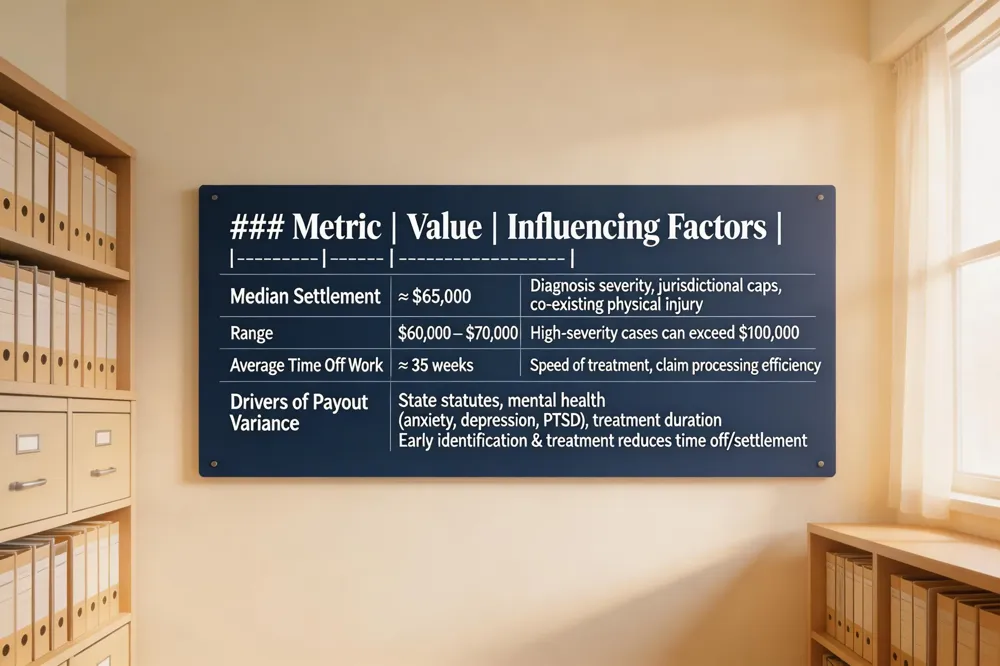 In the United States, psychological‑injury claims typically settle between $60,000 and $70,000, with a median around $65,000 and a slightly higher mean because a few high‑severity cases exceed $100,000. The duration of time off work is a primary driver of compensation; most claimants miss roughly 35 weeks, which directly inflates lost‑wage benefits. Payout variance is influenced by jurisdiction (states differ in caps and statutory guidelines), the specific mental‑health diagnosis (anxiety, depression, PTSD, or substance‑use disorder), and whether a physical injury co‑exists, which can increase overall medical costs. Early identification and treatment of mental‑health conditions can shorten disability periods, thereby reducing total compensation. Conversely, delayed treatment or complex workers’ compensation processes, such as navigating benefit and workers’ canB can extend time off work, raising the final settlement amount. Overall, a typical psychological‑injury settlement falls in the mid‑$60‑k range, reflecting both wage‑replacement calculations and the added costs of mental‑health care.
Communication Pitfalls: What Not to Say in a Claim
Pitfall | Example Statement | Why It's Harmful | Recommended Approach |
|---------|-------------------|-----------------|----------------------| | Down‑playing symptoms | “I’m fine, the pain isn’t bad.” | May be construed as no injury, weakens claim | Describe pain accurately, quantify intensity and impact | | Admitting fault | “It’s my fault, I should have been more careful.” | Can shift liability to the worker | Focus on factual description of the event, avoid blame language | | Speculating on cause | “I think the slip happened because the floor was wet.” | Unverified statements can be challenged | State only known facts; defer speculation to investigators | | Discussing unrelated history | “I had a back issue last year.” | May suggest pre‑existing condition | Speak about current injury only; let medical experts address prior history | | Agreeing to be recorded without counsel | “Sure, go ahead and record this.” | Recorded statements become part of evidence | Request legal counsel before any recorded interview or signing documents |
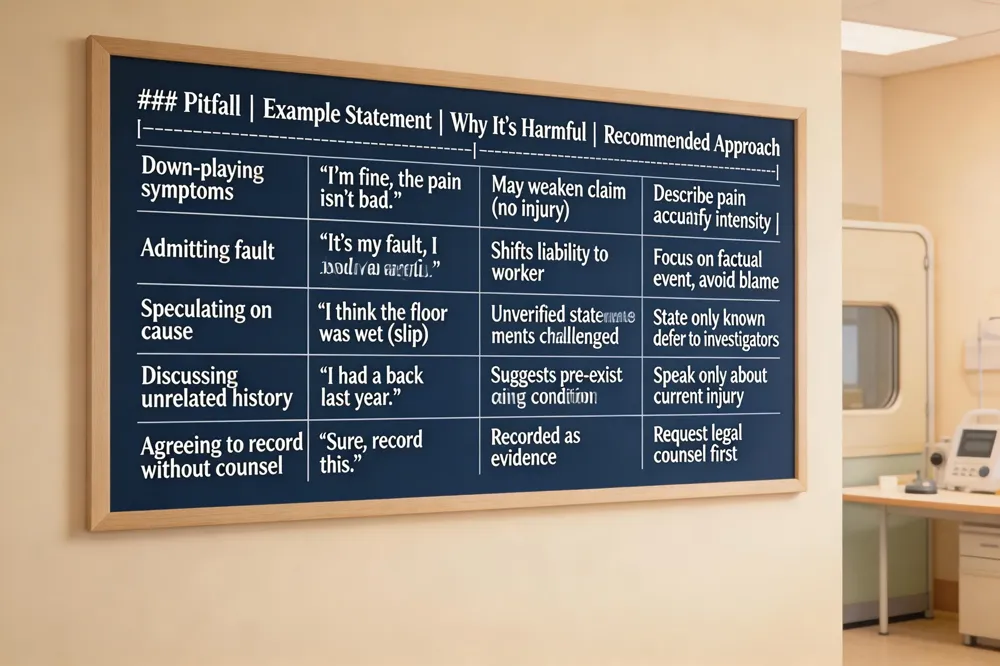 When a worker begins a workers’ compensation or personal‑injury claim, every verbal exchange can become part of the evidentiary record. Common statements that weaken a claim include down‑playing symptoms (e.g., saying you’re “fine” or that the pain isn’t bad), admitting fault or apologizing for the incident, and speculating about how the injury occurred without factual support. Discussing unrelated medical history or previous injuries without a lawyer’s guidance can also create confusion and suggest pre‑existing conditions.
Because insurers and employers may record conversations, it is critical to consult legal counsel before speaking on the record or agreeing to any recorded interview. An attorney can help you frame responses that protect your rights while still providing necessary information.
Maintaining a consistent medical narrative is equally important. All descriptions of pain, functional limitations, and treatment plans should align with the documentation prepared by your treating physicians and any expert assessors. Inconsistent statements can be used to question credibility and undermine the causal link between the workplace event and your mental‑health or physical injuries.
What should I avoid saying in an injury claim? 1. Don’t say you’re “fine” or downplay your pain. 2. Avoid admitting fault or apologizing for the incident. 3. Don’t speculate about how the injury occurred. 4. Refrain from discussing medical history without a lawyer’s guidance. 5. Never agree to be recorded or sign documents without review.
Integrating Mental‑Health Care Into Workers’ Compensation
Component | Description | Tools / Assessments | Benefits |
|-----------|-------------|--------------------|----------| | Early Screening | Identify mental‑health risk within days of injury | DASS‑21, IES‑R, PHQ‑9 | Reduces chronic distress, shortens disability duration | | Interdisciplinary Protocols | Combine physical rehab with psychological care | Joint case conferences, coordinated treatment plans | Improves functional outcomes, lowers total claim costs | | Expert Medical Assessments | Objective documentation of psychological impact | Neuro‑psychological evals, audiology‑related stress assessments | Strengthens claim credibility, supports appropriate benefit calculations | | Ongoing Monitoring | Track mental‑health status throughout recovery | Periodic reassessments, symptom logs | Early detection of setbacks, timely intervention |
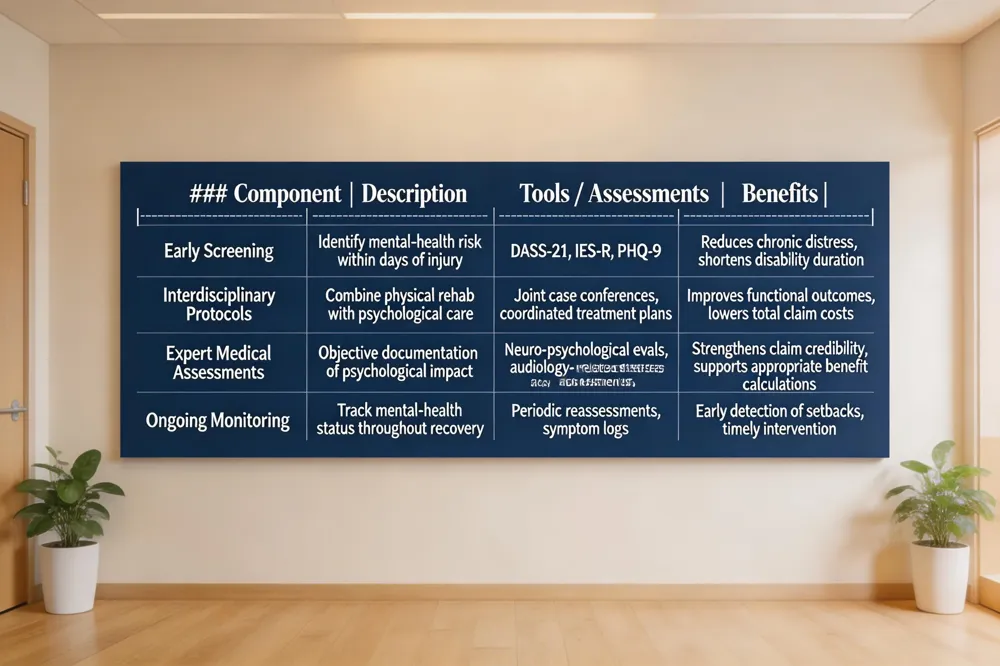 A growing body of evidence shows that workplace injuries precipitate a measurable decline in mental health. A large retrospective cohort of 7,556 surgically treated workplace injury patients demonstrated that, although pre‑injury anxiety and depression rates were lower than in non‑workplace injuries (adjusted rate ratios 0.82 and 0.78 respectively), post‑injury trajectories reversed: anxiety rates rose to parity (ARR ≈ 1.00) and any mental disorder showed a significant interaction (p < .0001). Substance‑use disorder also increased after injury (ARR 0.83). These findings align with meta‑analytic data linking work‑related injury to heightened anxiety, depression and PTSD. Early mental‑health screening within the workers’ compensation system can interrupt this trend. Interdisciplinary protocols that pair physical rehabilitation with prompt psychological assessment—using validated tools such as the DASS‑21 and IES‑R—identify at‑risk workers before chronic distress develops. Expert medical assessments, including neuro‑psychological evaluations and documentation of auditory loss‑related stress, provide objective evidence for claimants and insurers. Timely expert reports support accurate benefit calculations, justify coverage for therapy, and strengthen legal arguments for adequate compensation, ultimately reducing long‑term disability costs and facilitating faster, sustainable return‑to‑work outcomes.
Key Takeaways for Injured Workers and Employers
Injured workers and employers must first recognize that workplace injuries often trigger mental‑health risks such as anxiety, depression, substance‑use disorders and PTSD. Large cohort studies show that, although pre‑injury mental‑health rates are lower among employed workers, anxiety and any mental‑disorder rates rise sharply after a workplace injury, especially when workers face lost income, pressure to return, and complex compensation processes. Second, act quickly to document and treat psychological symptoms. Early screening for distress, pain intensity and catastrophizing within the first weeks can identify individuals at risk; prompt referral to qualified mental‑health professionals and initiation of evidence‑based therapies (CBT, mindfulness, EMDR) have been shown to improve return‑to‑work outcomes and reduce long‑term costs. Third, leverage expert evaluations to strengthen claim credibility. Independent medical examinations, neuro‑psychological assessments, and detailed reports from forensic experts (e.g., NorCal Medical Consulting) provide objective evidence linking the injury to mental‑health sequelae, facilitating accurate workers’ compensation benefits and, when appropriate, personal‑injury damages. Integrating these steps creates a defensible, evidence‑based claim strategy that protects workers’ rights and helps employers manage liability and costs.