Why One‑On‑One Legal‑Medical Strategy Meetings Matter
One‑on‑one (1:1) meetings serve as a critical bridge between healthcare operations and legal strategy. In clinical settings they keep supervisors attuned to employee concerns, compliance risks, and performance roadblocks; in legal contexts they align medical expertise with case theory, ensuring that evidence, causation analysis, and damages calculations are synchronized. Regular, structured check‑ins—typically 30‑minute sessions scheduled at consistent intervals—build trust, surface issues early, and create a documented paper trail that supports both workplace injury investigations and litigation preparation. For employers, these meetings improve engagement, reduce whistle‑blower risk, and streamline accommodation discussions. Attorneys gain timely, factual medical insights, while medical experts receive clear guidance on documentation and testimony needs, resulting in stronger, defensible claims.
Setting the Stage: Planning and Preparing Your First Legal‑Medical Meeting
Preparation Checklist
| Preparation Step | Details | Tips |
|---|---|---|
| Conflict‑of‑Interest Check | Provide attorney with names of all parties (employer, insurers, witnesses, consulting experts) | Run a thorough search before the session |
| Focused Agenda | 3‑5 bullet points: personal check‑in, injury timeline, key medical findings, outstanding questions | Allocate time for open dialogue |
| Document Assembly | Medical records, hearing‑test results, employer communications, workers‑comp filings, insurance statements, prior expert reports | Organize chronologically; bring originals and copies |
| Narrative Review | Practice a clear factual narrative | Arrive early; be ready to answer questions accurately |
| Trust Building | Enables attorney to focus on strategy, reduces missed deadlines, establishes credibility | — |
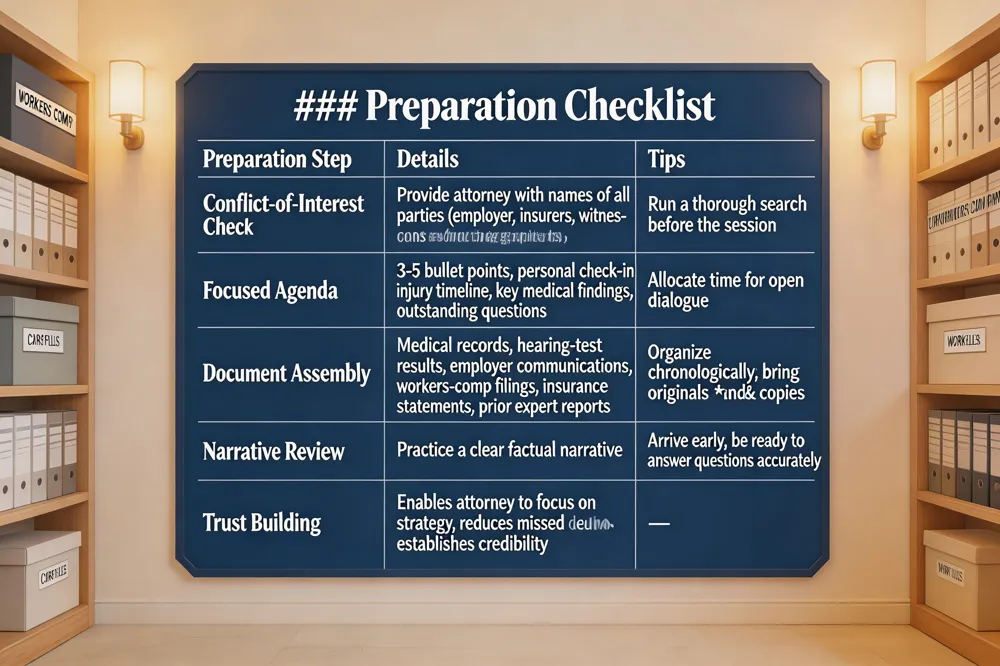 Preparing for a legal‑medical meeting begins with a conflict‑of‑interest check. Provide the attorney with the names of all parties—employer, insurers, witnesses, and any consulting experts—so a thorough search can be run before the session. Next, create a focused agenda that limits the discussion to the most critical items: a brief personal check‑in, a concise timeline of the injury, key medical findings (e.g., audiometric data, diagnostic reports), and a list of outstanding questions for the attorney. Keep the agenda to three‑to‑five bullet points and allocate time for open dialogue. Gathering essential documents is equally vital. Assemble all medical records, hearing‑test results, employer communications, workers‑comp filings, insurance statements, and any prior expert reports. Organize them chronologically and bring both originals and copies. Finally, review your notes, practice a clear factual narrative, and arrive early, ready to answer questions accurately. This preparation lets the attorney focus on strategy, reduces the risk of missed deadlines, and builds trust from the outset.
What Happens Inside the Meeting: Roles, Terminology, and Compensation
Meeting Roles & Compensation Overview
| Aspect | Description | Key Points |
|---|---|---|
| Medical‑Legal Consultant | Bridges health‑care and law; reviews records, identifies deviations, prepares expert witnesses | Assesses case strength for personal‑injury, workers‑comp, malpractice, product‑liability |
| Health‑Law Attorney | Specializes in health‑care law (medical‑malpractice, health‑policy, occupational injury) | Provides legal strategy, ensures compliance |
| Compensation (Top‑Tier) | Salary $200k+ annually; senior specialists $200k‑$250k+ with bonuses/profit‑sharing | Reflects expertise in regulatory compliance, health‑tech integration, complex litigation |
| Daubert Preparation | Consultant translates medical jargon into legal insights, meets Daubert standards | Enhances credibility of expert testimony |
| Settlement/Trial Strategy | Consultant helps shape approach based on medical evidence | Aligns legal decisions with accurate medical facts |
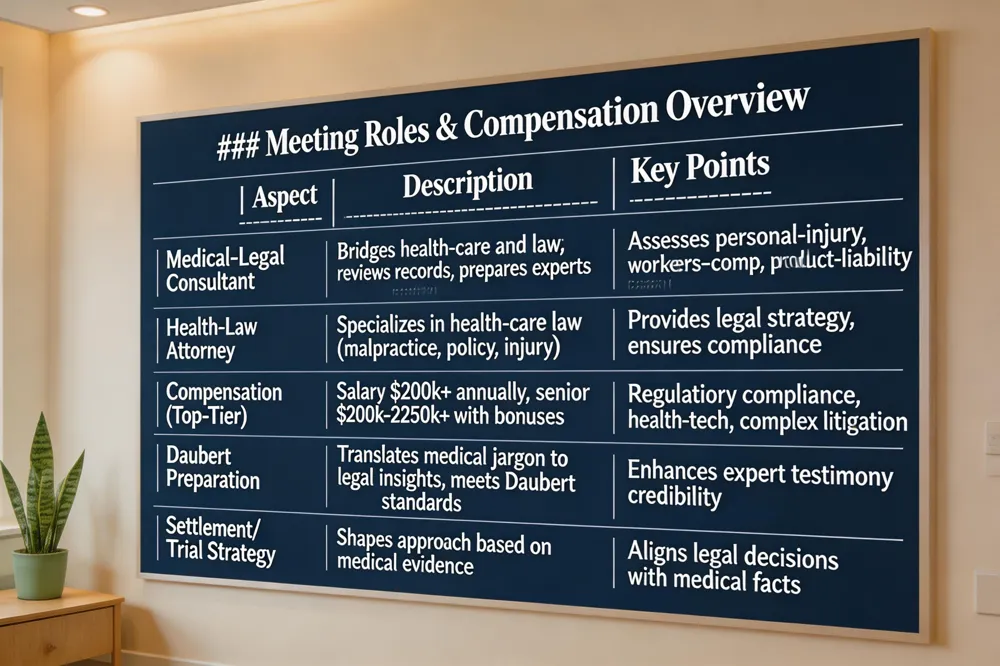 A medical‑legal consultant bridges health‑care and law. By reviewing medical records and pinpointing deviations from the standard of care, the consultant assesses case strength for personal‑injury, workers‑compensation, malpractice, or product‑liability claims. They prepare expert witnesses to meet Daubert standards, translate medical jargon into clear legal insights, and help shape settlement or trial strategy, ensuring that legal decisions are grounded in accurate medical evidence.
Attorneys who specialize in health‑care matters are generally called health‑law attorneys. Sub‑titles include medical‑malpractice attorney, health‑policy lawyer, or health‑care attorney, depending on the focus—whether patient‑rights, regulatory compliance, or occupational injury claims.
Compensation for top‑tier health‑care consultants often exceeds $200,000 annually, with senior specialists in regulatory compliance, health‑technology integration, or complex litigation support earning $200,000–$250,000 or more, plus bonuses and profit‑sharing incentives.
Avoiding Pitfalls in Settlement Discussions
Common Pitfalls & Recommended Language
| Pitfall | What to Avoid | Recommended Approach |
|---|---|---|
| Admitting Fault | Stating liability or shared responsibility | Stick to factual observations; let attorney handle liability |
| Exaggerating Severity | Claiming undocumented auditory‑loss severity | Reference documented medical findings only |
| Offering Legal Opinions | Speculating on policy limits or settlement figures | Defer to attorney; provide evidence‑based estimates only |
| Discussing Future Costs Without Evidence | Mentioning lost wages, future medical expenses | Provide solid, documented projections if required |
| Off‑hand Remarks | Uncontrolled comments that can be seized by opposing side | Keep statements concise, documented, and evidence‑backed |
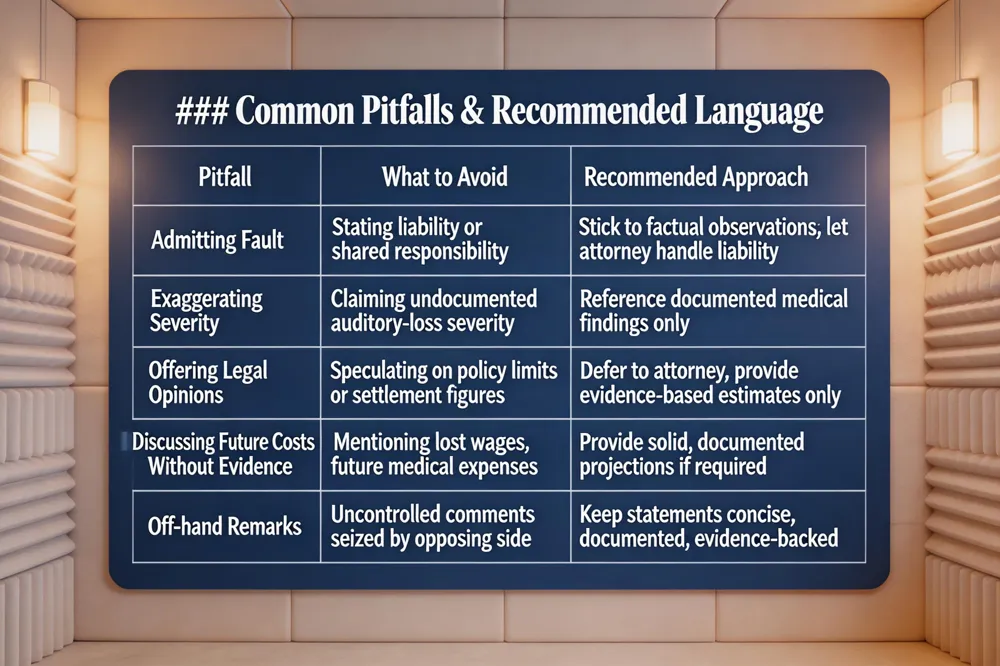 Effective settlement talks hinge on precise language, consistent credibility, and disciplined communication.
What language to steer clear of – Do not admit fault or liability, even if you suspect shared responsibility. Avoid exaggerating auditory‑loss severity or claiming undocumented symptoms. Refrain from offering legal opinions, speculation about policy limits, or guesses about the other party’s stance; those assessments belong to your attorney. Also, do not discuss future medical costs, lost wages, or settlement figures unless you have solid, documented evidence.
Maintaining credibility with insurers and attorneys – Stick to factual statements supported by medical records and expert reports. Acknowledge only what you know and can prove; vague or off‑hand remarks can erode trust and weaken your position.
Impact of off‑hand remarks on negotiations – Uncontrolled comments can be seized by the opposing side, used to diminish your claim’s value, or even trigger a denial. Careful, documented communication protects your case and preserves negotiating leverage.
Legal Foundations: Malpractice Elements and Compliance Considerations
Core Malpractice Elements & Compliance Factors
| Element / Consideration | Description | Relevance |
|---|---|---|
| Duty of Care | Provider’s legal obligation to patient | Basis for liability claim |
| Breach of Duty | Failure to meet standard of care | Must be proven with expert testimony |
| Causation | Direct link between breach and injury | Critical for establishing damages |
| Actual Damages | Tangible harm suffered by patient | Quantifies claim value |
| Weingarten Doctrine | Right to representation during investigatory interviews | Applies to unionized health‑care workplaces |
| Regulatory Agency Guidance (FDA, CMS, CDC, NIH, ASPR, BARDA) | Federal expectations on product safety, reimbursement, public‑health emergencies | Aligning evidence with guidance reduces penalties and strengthens case |
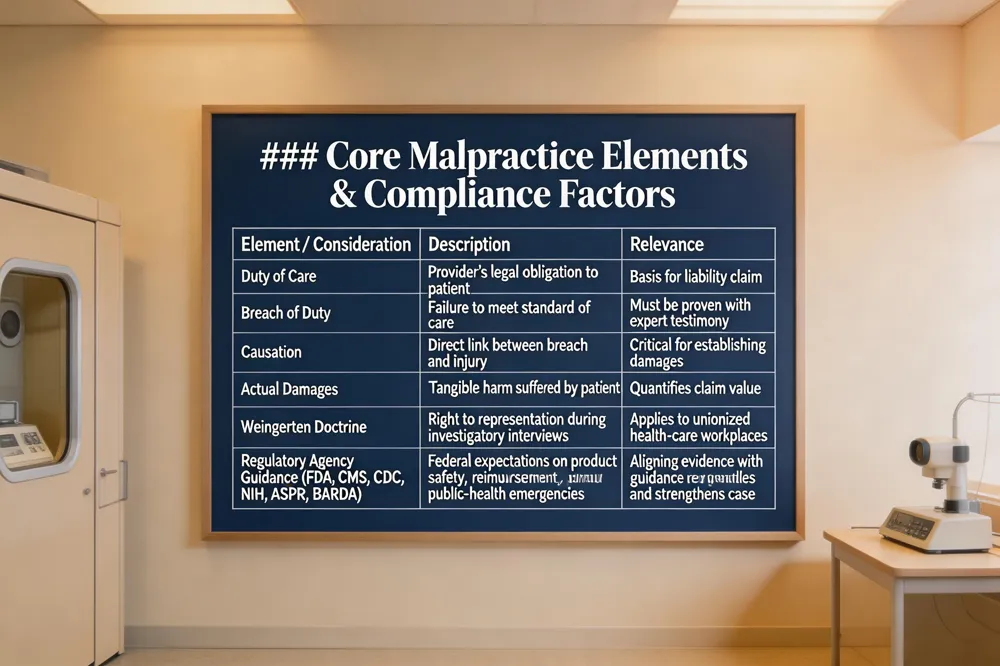 One‑on‑one legal‑medical strategy meetings are most effective when they begin with a clear legal framework. In a medical‑malpractice claim, four essential elements must be proven: (1) a duty of care owed by the provider, (2) a breach of that duty, (3) causation linking the breach to the patient’s injury, and (4) actual damages suffered. Establishing these pillars early guides the expert’s record review and the attorney’s narrative.
For unionized health‑care workplaces, supervisors must respect the Weingarten doctrine, which requires that employees be allowed representation during investigatory interviews that could lead to discipline. One‑on‑one meetings that touch on performance or disciplinary issues should therefore be coordinated with union counsel to avoid violations.
Regulatory agencies such as the FDA, CMS, CDC, NIH, ASPR, and BARDA shape the context of legal‑medical discussions, especially when claims involve product safety, reimbursement, or public‑health emergencies. Understanding each agency’s guidance helps ensure that medical evidence and compliance documents are aligned with federal expectations, reducing the risk of regulatory penalties and strengthening the legal strategy.
Ongoing 1:1 Dialogue: Follow‑Up, Documentation, and Roadblocks
Ongoing Dialogue Framework
| Activity | Frequency | Best Practices |
|---|---|---|
| Check‑In Meeting | Weekly / Bi‑weekly / Monthly (based on tenure & needs) | Keep to ≤30 min; flexible agenda; varied location |
| Note‑Taking | During meeting | Supervisor gives undivided attention; brief, clear notes |
| Follow‑Up Email | Immediately after meeting | Summarize key points, action items, owners; create written trail |
| Roadblock Identification | Ongoing | Highlight workflow inefficiencies, skill gaps, external constraints |
| Solution Proposal | Post‑identification | Supervisor proposes concrete actions to remove obstacles |
| Documentation for Compliance | Continuous | Maintain records of meetings, decisions, and follow‑ups |
 A consistent cadence—weekly, bi‑weekly, or monthly depending on tenure, experience, and training needs—keeps momentum while preventing issues from festering. Meetings should be concise, ideally 30 minutes or less, to preserve focus and respect busy schedules. A flexible agenda that highlights a few priority items, leaves room for open discussion, and varies location (office, coffee shop, walk) helps maintain engagement and fresh perspectives. During the session, supervisors must give undivided attention, take brief notes, and encourage the employee to voice challenges. Immediately after, a follow‑up email summarizing key points, action items, owners, ensures clarity, accountability and a written trail. This documentation is essential for compliance and can protect both parties if disputes arise. Identifying roadblocks—whether workflow inefficiencies, skill gaps, or external constraints—allows the supervisor to propose concrete solutions, remove obstacles, and demonstrate that the employee’s success is a priority.
Putting It All Together: A Blueprint for Successful One‑On‑One Legal‑Medical Strategy Meetings
Effective one‑on‑one legal‑medical strategy meetings begin with thorough preparation: gather all relevant medical records, create a chronological timeline, identify witnesses, and clarify the statute of limitations. Both parties should co‑create a concise agenda that includes a personal check‑in, review of medical findings, discussion of legal implications, and a clear list of action items. Throughout the meeting, maintain undivided attention, avoid multitasking, and document decisions in real time. Follow the discussion with a written summary that outlines responsibilities, deadlines, and next‑step priorities. Employers, attorneys, and medical experts should schedule regular follow‑up sessions, update documentation as new evidence emerges, and ensure confidentiality under HIPAA and attorney‑client privilege to sustain trust and drive case success.