Why DBA Matters for Overseas Contractors
The Defense Base Act (DBA) is a 1941 federal amendment to the Longshore and Harbor Workers’ Compensation Act that obligates U.S. government contractors and subcontractors to carry workers’ compensation insurance for any civilian employee performing work abroad on a U.S. government‑funded project. Coverage extends to U.S. citizens, host‑country nationals, and third‑country nationals engaged in construction, security, logistics, medical support, or any other services on military bases, public‑works sites, or foreign‑aid contracts, regardless of injury. Prompt reporting—within 30 days to the employer and within one year to the Office of Workers’ Compensation Programs—is essential; missed deadlines usually trigger denial of benefits. Detailed documentation, including medical records, incident reports, and expert evaluations (e.g., audiometric testing for hearing loss), strengthens the claim, facilitates accurate injury assessment, and improves the likelihood of full compensation through the DBA’s administrative‑law process.
Eligibility and Insurance Requirements
Eligibility & Insurance Requirements Summary
| Requirement | Who Must Comply | Key Points |
|---|---|---|
| Workers’ Compensation Coverage | All U.S. government prime contractors, subcontractors, and their employees (including on bases, public‑works, foreign‑aid projects) | Must carry a DBA endorsement to extend medical, wage‑replacement, and disability benefits abroad. |
| Independent Contractors & Service Providers | Contractors and service providers funded by the government | Covered under DBA if relationship meets local legal definitions and does not create a taxable permanent‑establishment. |
| Classification & Compliance | Companies engaging foreign workers | Use Contractor‑of‑Record or Employer‑of‑Record to ensure proper classification, tax compliance, and risk mitigation. |
| Penalties for Non‑Compliance | Any obligated contractor | Fines, loss of contract, and exposure to unrestricted federal lawsuits. |
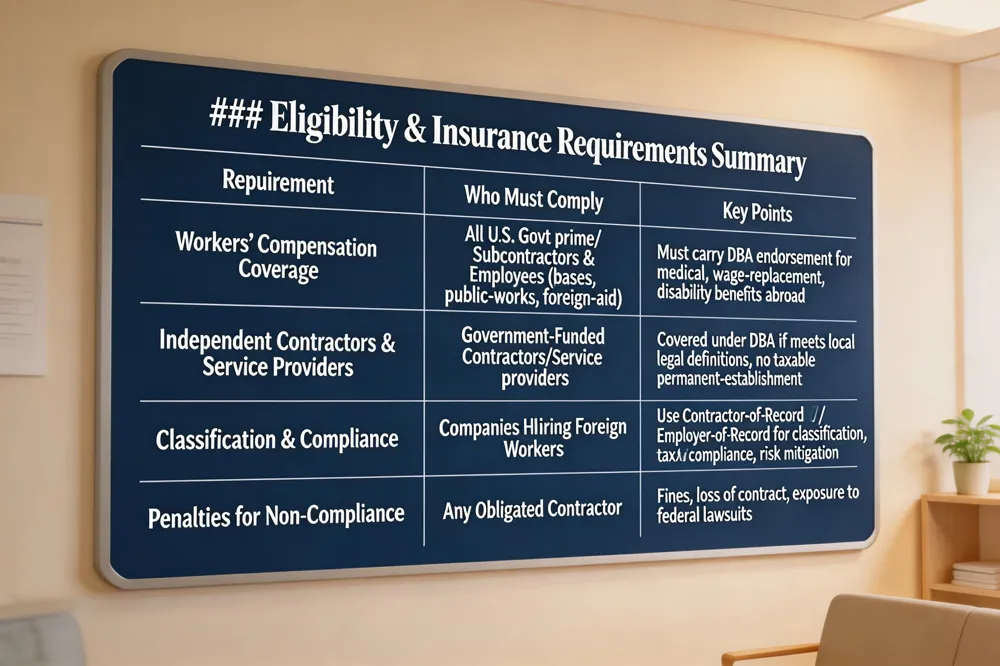 The Defense Base Act (DBA) obligates every U.S. government contractor—and its subcontractors—to carry workers’ compensation insurance for anyone performing work abroad. This includes prime contractors, subcontractors, and employees on military bases, U.S.‑funded public‑works projects, or foreign‑aid contracts deemed essential to U.S. national security. Independent contractors and service providers funded by the government are also covered. Failure to secure DBA coverage can result in fines, loss of the contract, and exposure to unrestricted federal lawsuits.
A workers’ compensation foreign‑coverage endorsement is an add‑on to a standard policy that extends the same statutory benefits—medical care, wage replacement, and disability payments—to employees working outside the United States. The endorsement protects U.S. citizens, third‑country nationals, and local hires, ensuring they receive the same protections as domestic workers.
U.S. companies may engage independent contractors abroad, provided the relationship meets local legal definitions and does not create a taxable permanent‑establishment. Proper classification—maintaining control over how, when, and where work is performed, and ensuring financial independence—is essential. Many firms use a Contractor‑of‑Record or Employer‑of‑Record to handle compliance, taxes, and payments, thereby minimizing mis‑classification risk while allowing legitimate international service delivery.
Filing a DBA Claim: Timelines and Procedures
Filing a DBA Claim: Timelines & Procedures
| Step | Deadline | Action |
|---|---|---|
| Injury Notice to Employer | 30 days from injury or from first knowledge it is work‑related | Submit written notice (Form LS‑201). |
| Formal Claim to OWCP | 1 year from injury date or last compensation payment | File Form LS‑203 with Office of Workers’ Compensation Programs. |
| Tolling for Gradual Illnesses | Starts when condition should reasonably be known; can extend 1‑year deadline | Document medical evaluations and employer payments. |
| Travel While Receiving Benefits | No fixed deadline, but must coordinate with insurer & physician | Keep medical documentation current and avoid contradictory activities. |
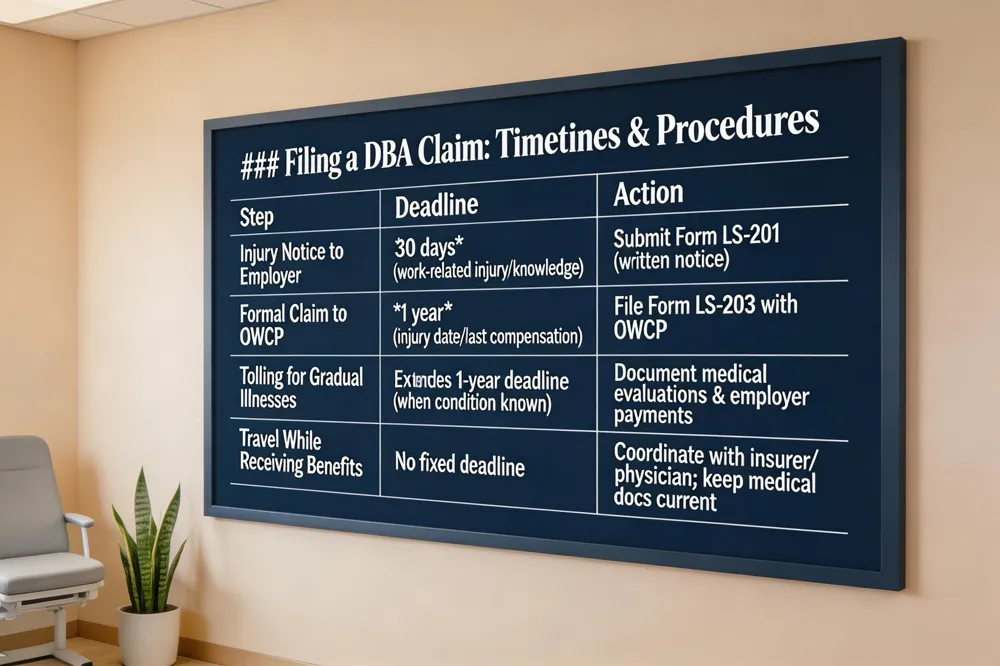 The Defense Base Act imposes strict deadlines to protect both workers and insurers. 30‑day injury notice to employer – You must give written notice (Form LS‑201) within 30 days of the injury, or within 30 days of first learning the injury is work‑related. One‑year filing deadline with OWCP – A formal claim (Form LS‑203) must be submitted to the Office of Workers’ Compensation Programs within one year of the injury date or the last compensation payment. Tolling provisions for gradual illnesses such as hearing loss – If an occupational disease develops slowly, the clock starts when you should reasonably have known the condition was work‑related; continued employer payments can extend the deadline. Impact of travel on claim processing – Travel is not prohibited, but you should inform your claims adjuster and treating physician, keep medical documentation current, and avoid activities that could contradict the injury’s severity.
Q: How long do I have to file a DBA claim?
You have 30 days for the employer notice and one year to file with OWCP, with possible tolling for gradual or delayed‑diagnosis conditions.
Q: Can I travel abroad while receiving workers’ compensation?
Yes, but you must coordinate with your insurer and medical provider, maintain treatment continuity, and document any travel‑related expenses to avoid jeopardizing benefits.
Common Reasons for Claim Denial and How to Avoid Them
Common Denial Reasons & Prevention
| Reason for Denial | Why It Occurs | How to Avoid |
|---|---|---|
| Work‑Relatedness | Event not linked to job duties, off‑site injury, or pre‑existing condition claim Maintain contemporaneous incident logs; obtain expert medical causation opinions. | |
| Employer/Insurer Dispute | Disagreement on severity or necessity of treatment | Prompt expert evaluation (e.g., NorCal Medical Consulting) and clear narrative. |
| Documentation Gaps | Missing reports, incomplete records, no baseline health data | Gather comprehensive physician reports, baseline assessments before deployment. |
| 59‑Minute Early Release Rule Misapplication | Contractor assumes rule applies without contractual provision | Verify contract language; only apply if expressly incorporated. |
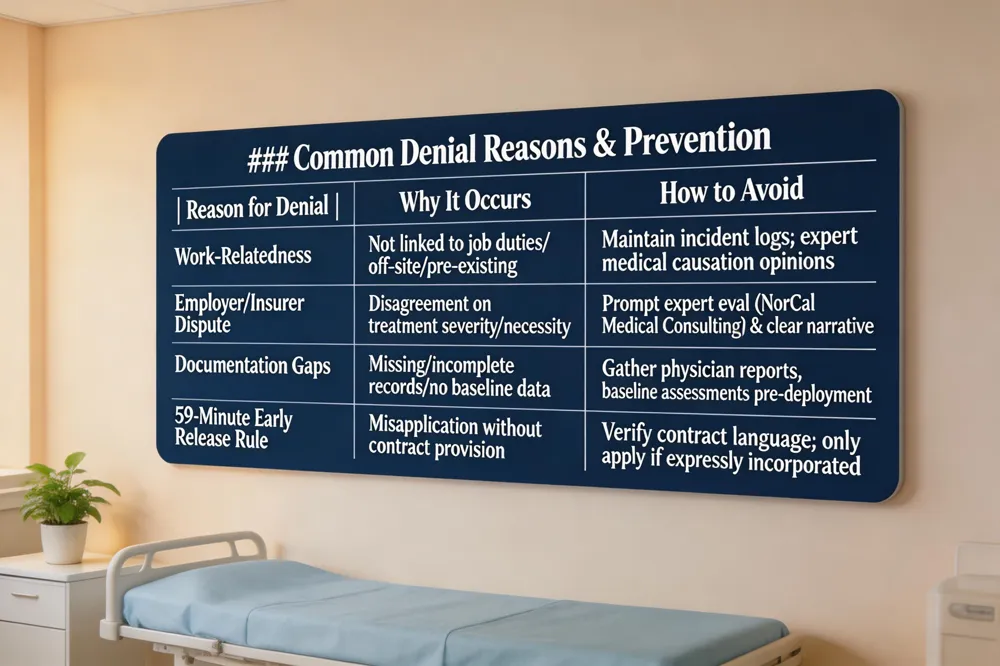 Work‑relatedness determination – The OWCP reviews whether the injury arose out of employment on a U.S. government contract. Claims are denied when the alleged event cannot be linked to job duties, when the injury occurred off‑site, or when the employer argues that the condition predates the assignment. Employer or insurer disputes – Contractors and insurers often contest the severity of the injury, the need for specific treatment, or the causation nexus. Prompt medical evaluation by an expert (e.g., NorCal Medical Consulting for auditory loss) and a clear causal narrative can defeat such challenges. Documentation gaps and pre‑existing condition allegations – Missing incident reports, incomplete medical records, or the comment that a condition was pre‑existing are frequent denial triggers. Maintain contemporaneous logs, obtain comprehensive physician reports, and secure baseline health assessments before deployment. Special rule: 59‑minute early release provision – This rule applies only when a contract expressly incorporates it; otherwise contractors are bound by the contract schedule. If the provision is absent, the contractor must follow the agreed work hours.
Can a DBA claim be denied? Yes. Denials arise from questions of work‑relatedness, employee status, or inconsistent evidence. The claimant may request an informal OWCP conference, appeal to an Administrative Law Judge, and ultimately to federal court; experienced DBA counsel and expert testimony are essential for overturning a denial.
Does the 59‑minute rule apply to contractors? No. The rule is limited to government employees covered by specific labor policies. Contractors only benefit from it if their contract expressly includes a similar early‑release clause; otherwise, the contract’s schedule governs.
Negotiating Settlements and the Role of Expert Medical Evidence
Settlement Timelines & Expert Evidence Role
| Factor | Typical Timeline | Role of Expert Medical Evidence |
|---|---|---|
| Straightforward Injuries | 3‑6 months after filing | Provides clear medical records that support liability and benefit amounts. |
| Chronic/Gradual Conditions (e.g., hearing loss, PTSD) | 12 months or longer | Audiometric testing, noise‑exposure analysis, and expert opinions establish nexus and disability severity. |
| Disputed Liability or Disability Extent | May extend to multiple years, involve hearings | Expert testimony clarifies causation, quantifies loss of earning capacity, and strengthens negotiation position. |
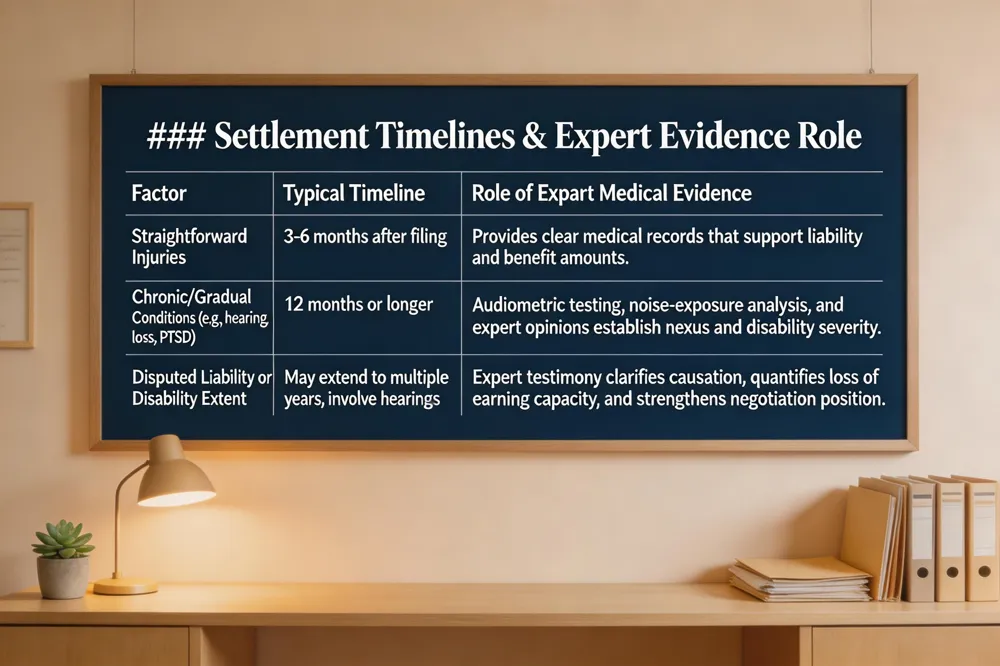 Typical settlement timelines for DBA claims vary with injury complexity. Straightforward cases with clear medical records often resolve in three to six months after filing, while chronic or gradual conditions—such as hearing loss—can extend negotiations to a year or more. The impact of gradual injuries is significant because disability compensation must be linked to a documented loss of earning capacity, which requires robust medical proof. Audiometric testing and noise‑exposure analysis are essential tools; they objectively measure hearing thresholds and quantify on‑the‑job noise levels, establishing a causal nexus for DBA benefits. NorCal Medical Consulting specializes in these assessments, providing detailed audiograms, exposure histories, and expert opinions that strengthen claimants’ positions. Their evaluations help insurers and administrative judges understand the severity and work‑relatedness of auditory injuries, facilitating fair compensation.
How long does it take to settle a DBA negotiation? Settlement negotiations under the Defense Base Act can differ dramatically from case to case. For straightforward injuries with clear medical documentation, a settlement is often reached in three to six months after the claim is filed. More complex or chronic conditions—such as gradual‑onset hearing loss or PTSD—can extend the negotiation period to a year or longer, especially if additional medical opinions or benefit reviews are required. If the employer or insurer disputes liability or the extent of disability, the process may stretch into multiple years, often involving formal hearings or appeals. Ultimately, the timeline hinges on the injury’s complexity, the completeness of the evidence, and the willingness of both parties to compromise.
Legal Decision‑Making and Appeal Pathways
Decision‑Making & Appeal Pathways
| Body | Decision Role | Appeal Path |
|---|---|---|
| Contracting Officer (CO) | Issues written determination (approval/denial) under FAR 33.211(a)(4) | Request formal reconsideration from CO; if upheld, appeal to ASBCA. |
| Armed Services Board of Contract Appeals (ASBCA) | Reviews administrative record, holds hearings, issues final agency decision | Appeal to U.S. Court of Federal Claims (or federal courts) for legal review. |
| U.S. Court of Federal Claims / Federal Courts | Judicial review of agency decision for legal adequacy | Final avenue for overturning adverse determinations. |
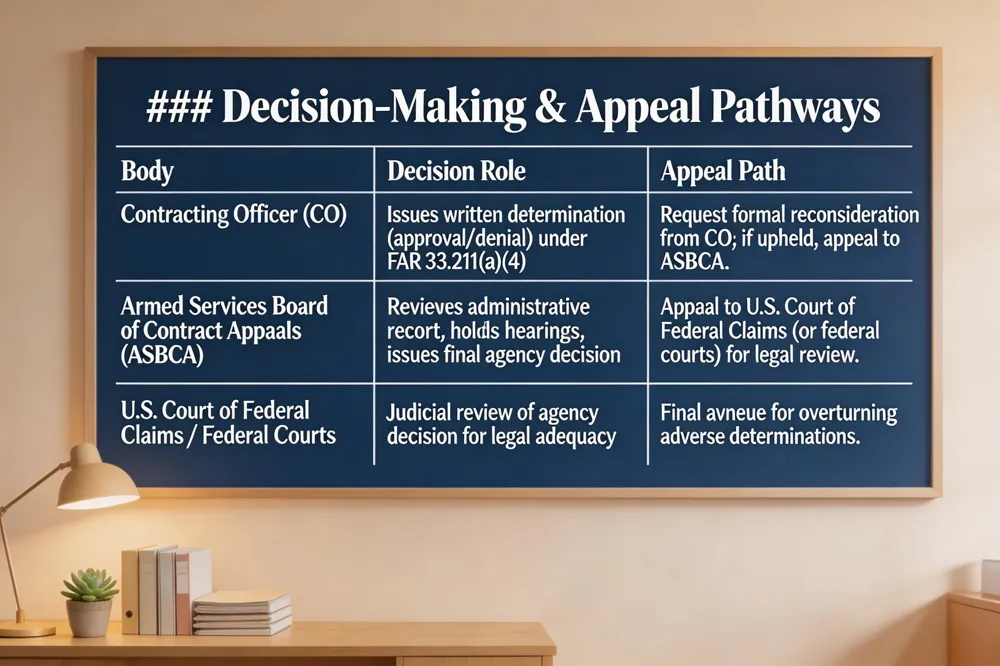 The contracting officer (CO) is the ultimate decision‑maker on a DBA claim. Under FAR 33.211(a)(4) the CO must issue a written determination that identifies the claim, cites the legal and contractual authority, and explains the basis for approval or denial. The CO’s decision must be supported by the factual record, which often includes expert medical evaluations—such as audiometric testing for hearing loss—provided by firms like NorCal Medical Consulting. If the contractor disagrees, the first step is to request a formal reconsideration from the CO, supplying any additional evidence or expert opinions. Should the CO uphold the denial, the contractor may appeal to the Armed Services Board of Contract Appeals (ASBCA). The ASBCA reviews the administrative record, may hold hearings, and issues a final agency decision. Unresolved issues can be taken to the U.S. Court of Federal Claims, and ultimately to the federal courts, where the original CO determination is reviewed for legal adequacy. This layered appeal process ensures that contractual, medical, and legal aspects of DBA claims receive thorough scrutiny.
IRS Rules and Paying Foreign Contractors
IRS Rules for Paying Foreign Contractors
| Requirement | Form(s) Required | Withholding |
|---|---|---|
| Non‑U.S. persons performing services outside U.S. | Completed Form W‑8BEN (or appropriate W‑8 series) | No 24 % backup‑ U statutory24% valid form provided; otherwise 24 % backup‑withholding applies. |
| U.S. citizens / resident aliens or services performed in U.S. | Form 1099‑MISC (or 1099‑NEC) | Standard U.S. income‑tax withholding applies. |
| Record‑Keeping | Retain W‑8 documentation for ≥3 years after last payment | Ensures compliance and avoids penalties. |
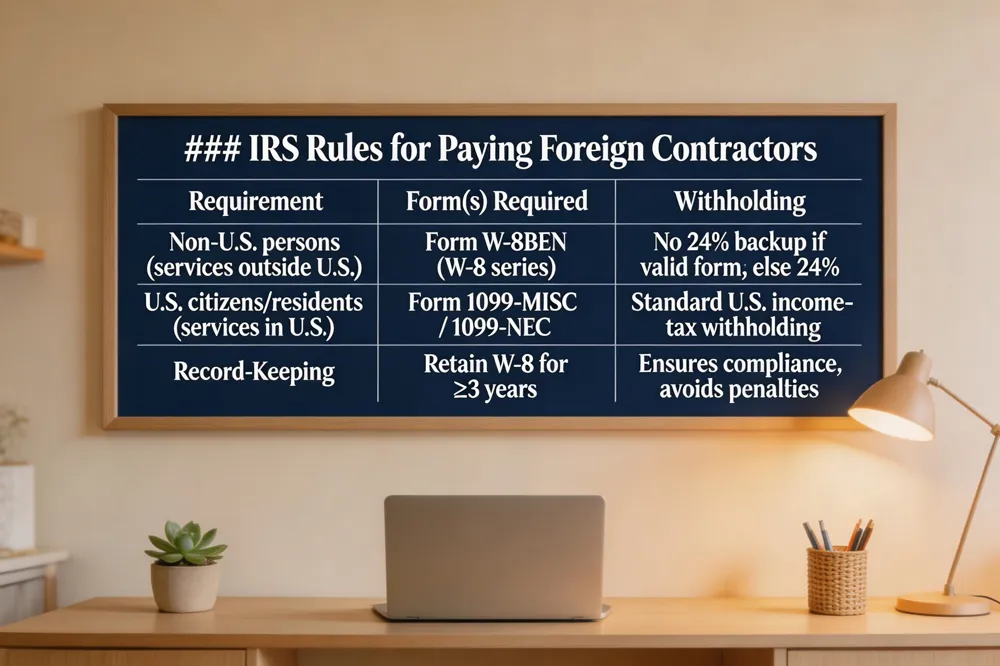 U.S. companies are not required to issue Form 1099‑MISC for foreign independent contractors who are non‑U.S. persons and perform all services outside the United States. Instead, the payer must collect a completed Form W‑8BEN (or the appropriate W‑8 series) to certify the contractor’s foreign status and to claim any treaty‑based exemption from withholding. No U.S. income‑tax withholding is needed unless the contractor is a U.S. citizen, resident alien, or the work is performed within the United States. If a valid W‑8 form is not provided, the payer must apply a 24 % backup‑withholding rate on the payment. The payer must retain the W‑8 documentation for at least three years after the last payment to satisfy IRS record‑keeping obligations. Proper handling of these forms and withholding rules helps avoid penalties and ensures compliance with IRS regulations for foreign contractor payments.
Key Takeaways and Next Steps
Promptly report any injury to your employer within the 30‑day window and keep detailed records of incident reports, medical treatment, and communications—these documents are the foundation of a successful DBA claim. Ensure your contractor carries valid DBA insurance and, where necessary, foreign‑coverage endorsements to protect both U.S. citizens and host‑country nationals working abroad. Engage NorCal Medical Consulting early; their expert auditory and occupational assessments provide the objective medical nexus and severity analysis that insurers and administrative law judges require. Finally, retain an experienced DBA attorney to guide claim filing, meet the one‑year OWCP deadline, and navigate appeals or settlements, maximizing the likelihood of full medical, disability, and rehabilitation benefits.