Why Coordinated Evidence Matters
The Defense Base Act (DBA) extends workers’ compensation benefits to U.S. contractors and their employees performing duties overseas. To secure disability, medical, and wage‑replacement benefits, claimants must file the LS‑201 notice within 30 days and the LS‑203 claim within one year, attaching a complete medical record package. Thorough documentation—emergency‑room notes, imaging, physician evaluations, wage statements, and witness affidavits—creates an unassailable factual foundation; any missing or inconsistent piece can trigger denial or reduced compensation. Care coordination, as outlined by AHRQ, streamlines this process: multidisciplinary teams use standardized templates, electronic health‑record exports, and a clear chain‑of‑custody to ensure every clinical datum is dated, signed, and linked to the incident timeline. Coordinated evidence not only satisfies OWCP filing requirements but also strengthens the legal narrative, enabling expert witnesses to deliver concise, evidence‑based opinions that meet Daubert standards and dramatically improve settlement odds.
Essential Timeline and Filing Requirements
Essential Timeline and Filing Requirements
| Step | Action | Deadline / Notes |
|---|---|---|
| 1 | Report the incident promptly – notify employer and complete LS‑201 | Within 30 days of injury (employee) and 10 days (employer) for LS‑202 |
| 2 | Obtain and preserve all medical records – ED notes, imaging, specialist reports | Collect as soon as possible; keep originals and digital copies |
| 3 | Secure witness statements – written accounts with contact info | Obtain within 7 days while memories are fresh |
| 4 | Keep copies of all correspondence – letters, emails, portal messages | Maintain a chronological folder (paper & electronic) |
| 5 | Upload the complete packet to the OWCP e‑Claim portal | Do immediately after gathering docs; monitor status regularly |
| 6 | Monitor claim status – portal dashboard or regional examiner | Check weekly; follow up on any requests promptly |
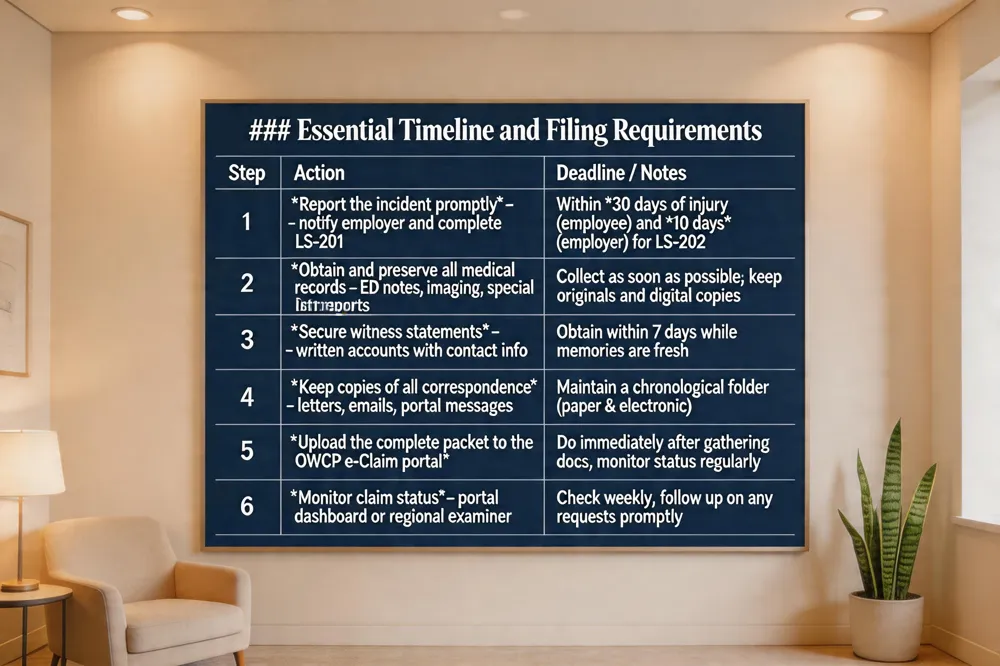 Steps to protect claim status – Report the incident promptly, obtain and preserve all medical records, secure witness statements, keep copies of all correspondence, and upload the complete packet to the OWCP e‑Claim portal. Claimants can monitor status through the portal or by contacting their regional examiner.
Foundations of Care Coordination
Foundations of Care Coordination
| Domain | Description | Example Activities |
|---|---|---|
| Comprehensive Assessment | Evaluate clinical, functional, social needs | Full intake interview, functional assessment, social work screening |
| Person‑Centered Care Plan | Develop individualized plan with goals | Write SMART goals, assign care manager, schedule follow‑ups |
| Synchronized Implementation | Align services across providers | Shared EHR updates, medication reconciliation, coordinated therapy sessions |
| Continuous Monitoring & Adjustment | Track progress and modify plan | Weekly case conferences, outcome metrics, plan revisions as needed |
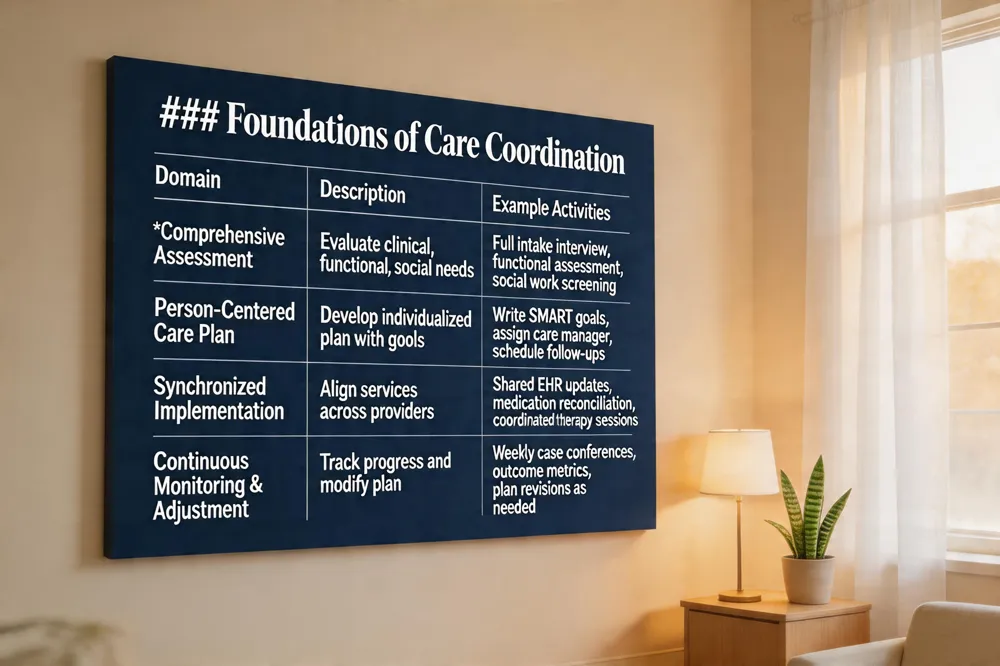 Care coordination in healthcare is the deliberate organization and management of a patient’s care activities across multiple providers, ensuring timely, accurate sharing of diagnoses, treatment plans, and records. Examples include regular interdisciplinary team meetings, shared electronic health‑record systems, patient‑navigation services, medication reconciliation at transitions, and proactive follow‑up communications. The process follows four sequential domains: (1) comprehensive assessment of clinical, functional, and social needs; (2) development of a person‑centered care plan; (3) synchronized implementation of services; and (4) continuous monitoring and adjustment of the plan. In mental health, coordination links psychiatrists, therapists, primary‑care physicians, and community resources to maintain consistent treatment and address broader determinants of health. Nursing coordination emphasizes nurses as facilitators of individualized plans, medication reconciliation, and discharge management. The four primary types of coordination are clinical, administrative, informational, and transitional. Coordinated care manifests as multidisciplinary teams, care managers, shared EHRs, and medical‑home models. Scholarly articles evaluate implementation strategies, barriers, and outcomes such as safety and cost‑effectiveness. Care‑coordination apps provide secure, HIPAA‑compliant platforms for real‑time messaging, record exchange, and appointment tracking.
Expert Medical Support for DBA Claims
Expert Medical Support for DBA Claims
| Professional Type | Role in DBA Claim | Typical Fee Range (USD) |
|---|---|---|
| Audiologist | Conduct hearing tests, provide opinion on auditory loss | $350‑$500 per hour (record review) |
| Orthopedist | Assess musculoskeletal injuries, develop treatment plan | $350‑$500 per hour; $2,500‑$4,000 per day for testimony |
| Neurologist | Evaluate nerve/brain injuries, interpret imaging | $350‑$500 per hour; $2,500‑$4,000 per day for testimony |
| Occupational‑Medicine Specialist | Determine work‑relatedness, calculate disability | $350‑$500 per hour; $2,500‑$4,000 per day for testimony |
| Qualified Medical Examiner (QME) | Neutral state‑approved evaluator (CA) | $350‑$500 per hour; $2,500‑$4,000 per day for testimony |
| Independent Medical Examiner (IME) | Insurer‑selected evaluator | Same as above; often billed at higher rates |
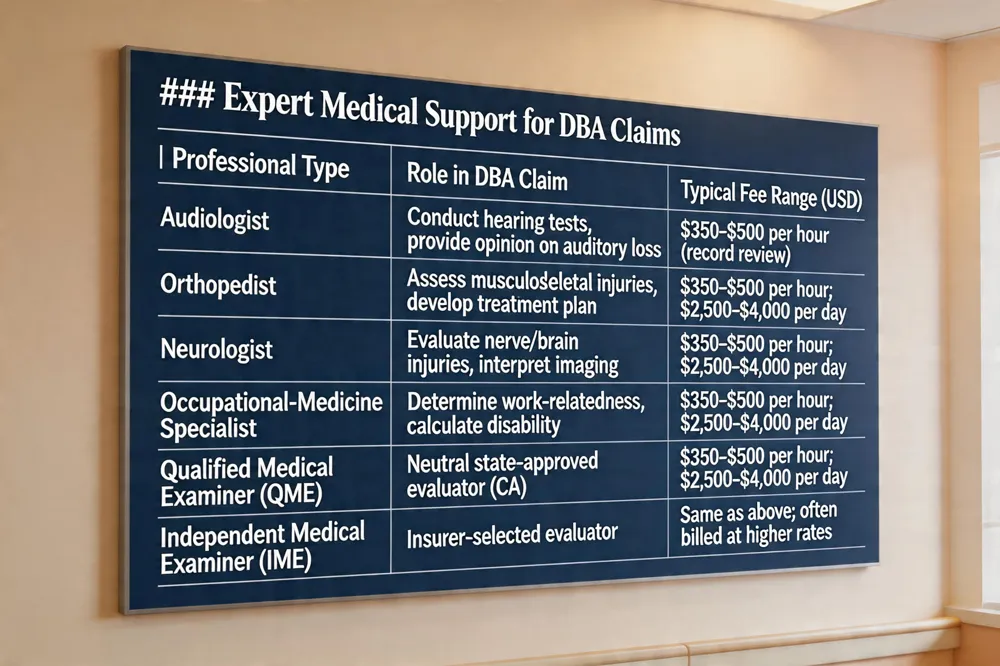 Board‑certified physicians—such as audiologists, orthopedists, neurologists, and occupational‑medicine specialists—provide the credible, case‑specific opinions lawyers need. An Independent Medical Examination (IME) is an insurer‑selected review, while a Qualified Medical Examiner (QME) is a state‑approved, neutral evaluator used in California workers’ compensation disputes. Expert‑witness firms and curated directories (e.g., JurisPro’s Expert Witness Directory) match attorneys with vetted professionals, and online expert locators streamline this process. Fee schedules typically run $350‑$500 per hour for record review and report preparation, with trial testimony billed at $2,500‑$4,000 per day. During an Independent Medical Examination (IME), the examiner will probe medical history, injury mechanism, symptom evolution, and any pre‑existing conditions; to counter a skeptical IME, bring complete records, answer honestly, and maintain composure.
Settlement Calculations and Benefit Structures
Settlement Calculations and Benefit Structures
| Settlement Type | Calculation Factors | Typical Range (USD) |
|---|---|---|
| Defense Base Act PTSD | AWW × severity multiplier + future earnings loss + medical costs | $250‑$500 k (varies by jurisdiction) |
| DBA Wage Benefits | 2/3 of Average Weekly Wage (AWW) × duration | Dependent on injury severity and duration |
| DBA Medical Expenses | Actual cost of treatment, rehab, medications | Fully reimbursed when documented |
| Recent 2024 Minor Injuries | Minor strain, simple sprain | $30‑$50 k |
| Recent 2024 Herniated‑Disc | Back disc injury with surgery/therapy | > $850 k |
| Recent 2024 Permanent Spinal/Brain | Permanent disability, catastrophic injury | > $1 M |
| Psychological Injury Max | Statutory cap on total workers’‑comp benefits | $250‑$500 k |
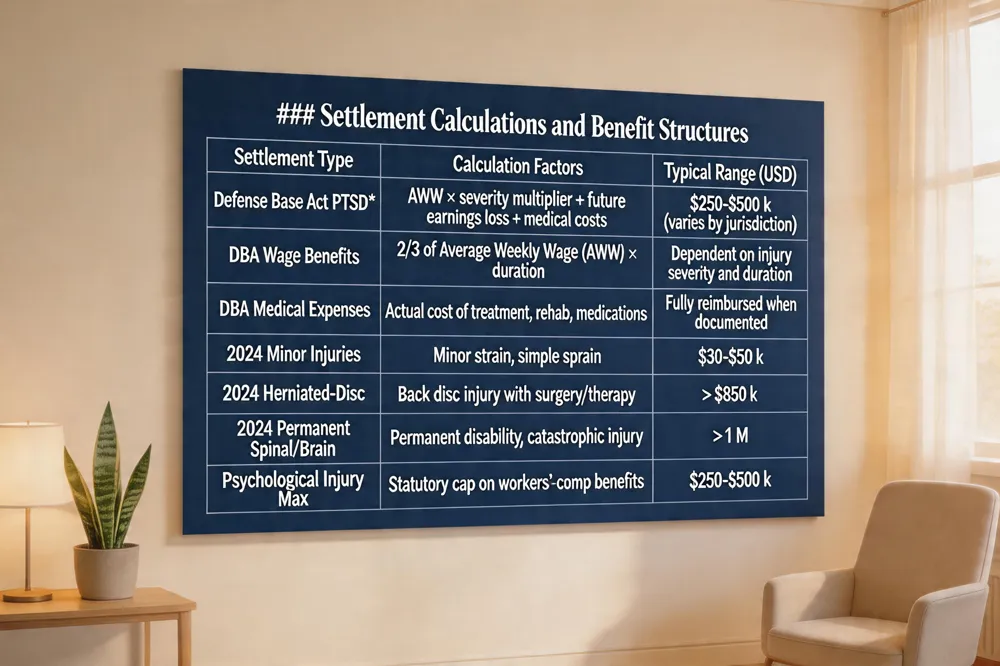 Defense Base Act PTSD settlements – Calculated on AWW, disorder severity, future earnings loss and medical costs; claimant must prove a work‑related traumatic incident and file LS‑201 with supporting records.
DBA claim settlements – Combine wage benefits (two‑thirds AWW), medical expenses and disability compensation, varying by disability classification.
Recent DBA settlements – 2024 data: minor injuries $30‑$50 k; herniated‑disc back injuries >$850 k; permanent spinal/brain injuries >$1 M.
Good settlement offer for a back injury – Typically $10‑$50 k for minor strain; $30‑$100 k for bulging disc with therapy.
Maximum payout for psychological injury – Limited by statutory caps, generally $250‑$500 k depending on jurisdiction.
Red flags for doctors – Out‑of‑state residence, specific drug requests, missing prior records, cash‑only payment, early‑refill patterns.
Is bursitis covered? – Yes, when caused or aggravated by work duties and supported by medical documentation.
Forms, Reporting, and Documentation Best Practices
Forms, Reporting, and Documentation Best Practices
| Form / Document | Purpose | Key Elements | Filing Deadline |
|---|---|---|---|
| OSHA Form 301 | Incident reporting for workplace injuries | Date, location, description, witnesses, narrative | Immediate (within 24 hrs) |
| Employee Accident Report (PDF) | Internal employer record | Same as OSHA + employee signature | Immediate |
| LS‑201 (Employee First Report) | DBA claim initiation | Incident details, site, medical provider | Within 30 days of injury |
| LS‑202 (Employer Report) | DBA claim employer filing | Incident details, employer info, initial medical care | Within 10 days of injury |
| Medical Records Log | Chronological organization of all health documents | Dates, provider names, document type, custody notes | Ongoing, as records received |
| Chain‑of‑Custody Log | Protect authenticity of evidence | Who handled, when, what action taken | Ongoing |
| HIPAA Release Forms | Authorize disclosure of medical info | Patient signature, scope of release | Before sharing records |
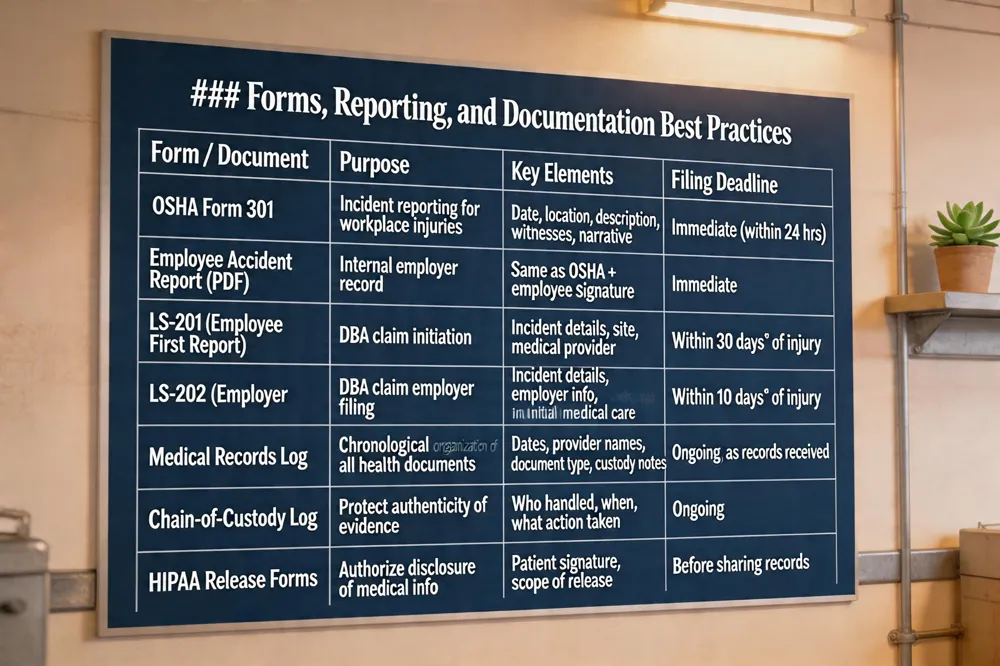 Incident reporting must be immediate, written, and time‑stamped; employers should complete OSHA Form 301 (the Incident Report Form) and an internal Employee Accident Report PDF that capture date, location, witnesses, and a narrative of the event. For DBA claims, the employee’s first report of injury (LS‑201) and the employer’s (LS‑202) must be filed within 30 days and 10 days respectively, detailing the incident, exact site, and medical provider information. Medical records should be gathered promptly, organized chronologically by type (ED notes, imaging, audiograms, prescriptions), and labeled with dates and provider names. A strict chain‑of‑custody log and HIPAA‑compliant releases protect authenticity and privacy. Separate medical and billing files avoid confusion and expedite benefit payments. Care‑coordination scholarly articles and secure coordination apps illustrate best practices for multidisciplinary communication.
Insurance Requirements and Contractor Obligations
Insurance Requirements and Contractor Obligations
| Requirement | Who Must Comply | Key Points |
|---|---|---|
| DBA Workers’‑Comp Coverage | All U.S. government contractors/sub‑contractors with workers abroad | Coverage must be in place before work starts |
| Approved Carriers / Self‑Insurance | Contractors | Use Department of Labor‑approved carriers (ACE‑USA, AIG, CNA) or obtain self‑insurance approval |
| Separate Medical & Billing Records | Contractors & insurers | Keeps privacy, demonstrates causation, eases benefit processing |
| Psychological Injury Treatment | Contractors (via insurance) | Treated like physical injury; subject to statutory caps $250‑$500 k |
| Documentation for Causation | Contractors & claimants | Detailed incident reports, medical logs, witness statements required |
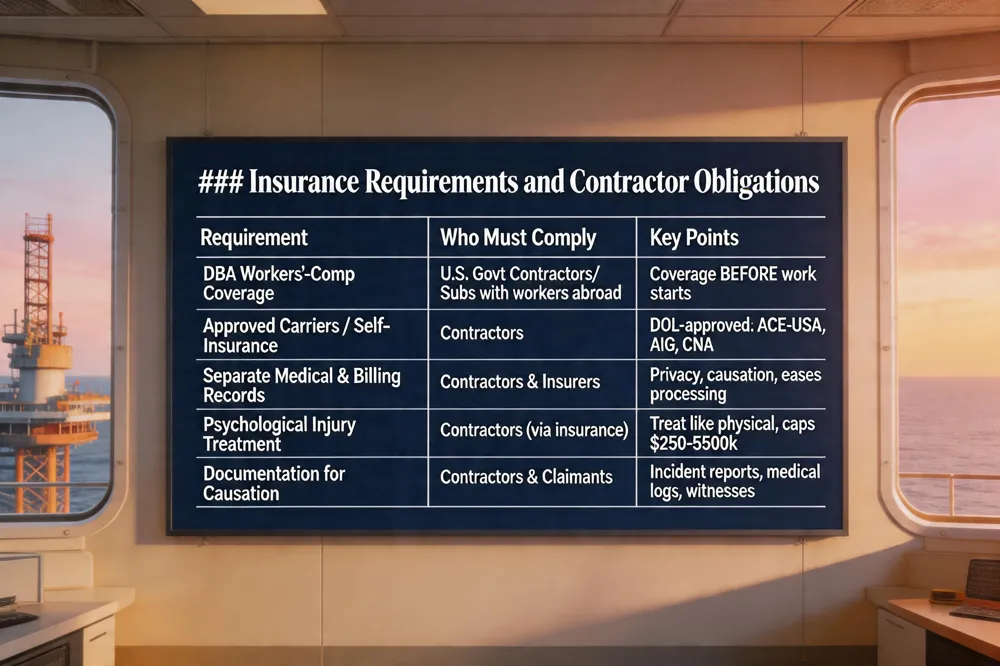 Under the Defense Base Act, DBA insurance is mandatory whenever a U.S. government contractor or subcontractor employs workers outside the United States on a covered contract—military bases, foreign public‑work projects, or Foreign Assistance Act‑funded work. Contractors must secure DBA workers’‑compensation coverage before any work begins; the Department of Labor authorizes a limited panel of carriers (e.g., ACE‑USA, AIG, CNA) or permits self‑insurance after approval. This requirement links directly to workers’ compensation statutes, ensuring that injured employees receive medical treatment, wage replacement, and disability benefits. Maintaining separate medical and billing records is essential to preserve privacy, demonstrate causation, and provide insurers with clear, admissible evidence. Psychological injuries are treated like physical injuries, so their maximum payout is subject to the state’s statutory cap on total workers’‑compensation benefits, generally $250,000‑$500,000.
Key Takeaways for Claimants and Counsel
Effective DBA claim success hinges on three coordinated actions. First, implement a disciplined care‑coordination workflow: collect every medical record (ED notes, imaging, specialist reports, audiograms), secure HIPAA‑compliant releases, and log each receipt with timestamps and chain‑of‑custody notes. Use a chronological timeline that links each treatment to the incident report and LS‑201/LS‑203 filings. Second, honor statutory deadlines—notify the employer and file the LS‑201 within 30 days, submit the LS‑203 within one year (or two years for occupational disease), and upload all documentation to the OWCP SEAPortal promptly. Missed dates can extinguish benefits. Third, engage qualified medical experts early. Independent medical examinations, nexus letters, and functional capacity evaluations from board‑certified physicians (e.g., audiologists for hearing loss) translate clinical findings into legally persuasive opinions, reinforce causation, and protect against insurer disputes. Together, these steps create a robust evidentiary package that maximizes compensation and mitigates claim denial.