Why a Unified Approach Matters
Sprains, strains and fractures fractures the most common musculoskeletal injuries in the workplace, accounting for millions of worker‑compensation claims each year. When clinicians use disparate measurement tools, timing, and endpoints, treatment plans can diverge, leading to delayed healing, unnecessary surgery, or prolonged disability. In the legal arena, inconsistent documentation makes it difficult for attorneys, insurers, and courts to establish causation, quantify impairment, and calculate fair compensation, often resulting in disputed claims and higher costs for all parties. A standardized, systematic evaluation protocol—integrating performance measures (range of motion, grip strength), validated patient‑reported outcome instruments (e.g., DASH), pain scales, complication tracking, and radiographic analysis—provides objective, comparable data across cases. Consistent follow‑up intervals (baseline, 6 weeks, 3 months, 6 months, 12 months) further enable reliable outcome tracking, support evidence‑based treatment decisions, and produce clear, defensible medical reports that streamline workers‑compensation and personal‑injury litigation.
Unified Clinical Workflow from Initial Triage to Final Diagnosis
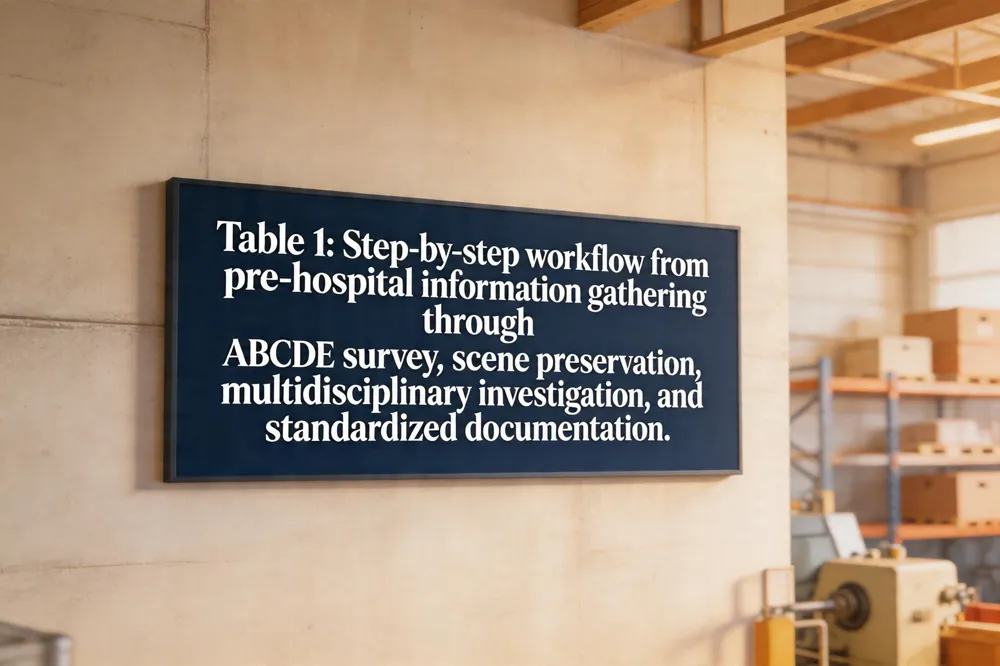 Effective injury management begins with pre‑hospital information gathering and team preparation, ensuring that vital data (mechanism, vitals, initial interventions) are relayed to the receiving unit. Upon arrival, the primary ABCDE survey quickly identifies life‑threatening conditions—airway obstruction, breathing compromise, circulatory loss, neurological disability, and exposure hazards—allowing rapid stabilization. The incident scene must be secured and evidence preserved; photographs, equipment logs, and witness statements are collected before the area is altered. A multidisciplinary investigation team—comprising the treating physician, occupational health specialist, safety officer, and legal counsel—then conducts a systematic workplace accident investigation. OSHA’s investigation steps start with scene preservation, followed by assembling the team, establishing a timeline, and gathering documentation. The workplace accident investigation procedure mirrors this: secure the scene, interview witnesses, analyze root causes, and develop corrective actions. A standardized investigation form captures employee details, narrative, contributing factors, and recommendations, providing a reliable record for workers’ compensation, legal, and insurance claims.
Standardized Injury Assessment: From Sprains to Fractures
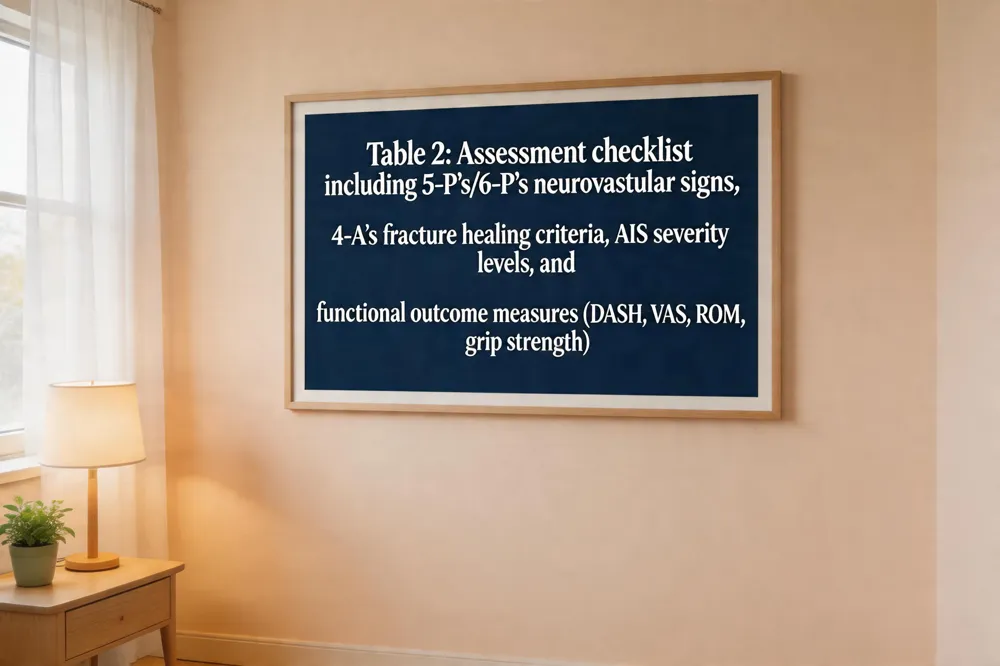
The 5 P’s of injury assessment (pain, pallor, pulse, paresthesia, paralysis) and the expanded six P’s (adding poikilothermia) guide rapid neurovascular evaluation, essential for workplace injury documentation. The 4 A’s of fracture healing—Alignment, Apposition, Apparatus, Activity—provide a structured framework for monitoring bony repair. Finally, the three AIS severity levels (AIS 1 – Minor, AIS 2 – Moderate, AIS 3 – Serious) help triage sprains, fractures, and associated auditory losses for workers’ compensation and personal injury claims.](https://www.pcec247.com/blog/2025/january/what-to-expect-from-a-workers-compensation-injur/)
Legal and Compensation Perspectives
 Workers’ compensation documentation must capture the injury chronology, mechanism, imaging, functional tests, and any work‑related limitations. Occupational health clinicians and medical experts—such as those at NorCal Medical Consulting—collaborate to produce objective reports that link clinical findings to job duties, include auditory‑loss testing when noise exposure is a factor, and ensure compliance with OSHA and state regulations. Expert testimony is built on standardized outcome measures (e.g., DASH, VAS), radiographic data, and impairment ratings, and the report must be unbiased, evidence‑based, and legally defensible.
What should you not say to a Workers' Compensation doctor during an evaluation? Never lie or downplay your history, exaggerate or minimize symptoms, claim the injury is unrelated to work, or state you will stop treatment early. Stick to factual, honest descriptions of pain and limitations.
Is bursitis covered under Workers' Compensation? Yes, if it results from a work‑related activity or incident; a physician’s linkage of the inflammation to the job is essential for benefits.
Workplace accident examples Slips, trips, falls, being struck by moving objects, electrocution, repetitive‑stress injuries, and hazardous‑environment exposures (including auditory loss) all qualify as workplace accidents.
Investigation Techniques and Reporting Tools
 A systematic injury‑investigation program relies on proven root‑cause analysis methods. The most widely used techniques are (1) 5 Whys, which repeatedly asks “why” until the fundamental source of failure is uncovered; (2) Fishbone (Ishikawa) diagram, a visual cause‑and‑effect chart that groups factors into People, Equipment, Procedures, Environment, etc.; (3) Fault‑Tree Analysis (FTA), a top‑down logical model that maps every possible failure path leading to the incident; (4) Root‑Cause Analysis (RCA), a comprehensive process that blends evidence gathering, data analysis, and causal‑factor identification; and (5) Chronological reconstruction, a step‑by‑step timeline that documents actions, conditions, and decisions before, during, and after the event.
A Workplace accident investigation report PDF is a structured record that captures employee details, injury description, sequence of events, cost and injury estimates, and corrective actions. The PDF format ensures easy sharing, printing, and archival for OSHA compliance and legal review.
The AMPLE mnemonic (Allergies, Medications, Past medical history, Last meal, Events) provides a rapid, standardized method for gathering a trauma patient’s essential history, supporting both clinical care and accurate documentation for workers’ compensation or personal‑injury claims.
Integrating Clinical Findings with Legal Evidence
 A unified injury evaluation begins with a detailed history and physical exam, followed by imaging (X‑ray, MRI) to capture radiographic parameters such as radial height, tilt, and alignment for fractures, and functional outcome measures like range‑of‑motion and grip strength. Patient‑reported tools—DASH for upper‑extremity disability and VAS for pain intensity—provide quantifiable, patient‑centered data that complement objective findings. Functional capacity testing (e.g., job‑specific simulations, strength dynamometry) informs return‑to‑work plans and helps establish permissible work restrictions. Thorough documentation—chronology of events, imaging reports, DASH/VAS scores, complication tracking, and radiographic analysis—creates a robust record for workers’ compensation and litigation, linking clinical severity to economic loss.
How to assess a work‑related injury: Document the incident’s date, task, location, and symptom pattern; conduct a comprehensive exam (strength, ROM, neurovascular, auditory if indicated); obtain appropriate imaging or audiometry; apply standardized functional surveys and DASH/VAS; synthesize quantitative and qualitative data into an objective report for legal and claim decisions.
OSHA accident reports by company: OSHA accident reports by company: OSHA’s public databases (Establishment Search and Accident Search) allow users to retrieve an employer’s recorded inspections, citations, and injury reports by entering the company name, address, or NAICS code. Results include incident dates, brief descriptions, and corrective actions; redacted privacy details may exist, but core data are free. For older or more detailed records, submit a Freedom‑of‑Information Act request to OSHA.
A Consistent Path Forward
A unified injury‑evaluation system brings measurable benefits: it standardizes history‑taking, physical examination, imaging, and functional testing, which reduces diagnostic variance, speeds treatment decisions, and creates comparable data for research and legal review. By integrating performance measures (range of motion, grip strength), patient‑reported outcomes (DASH, VAS), complication tracking, and radiographic parameters, clinicians can document injury severity and recovery trajectories with objective, reproducible metrics. NorCal Medical Consulting plays a pivotal role in translating this clinical rigor into legally defensible reports. Its multidisciplinary team links orthopedic assessment, audiometric testing, and functional capacity evaluations to workers’ compensation and personal‑injury claims, producing clear causation narratives and impairment ratings that satisfy insurers, attorneys, and courts. Looking ahead, injury‑assessment standards are moving toward electronic data capture, tele‑rehabilitation monitoring, and consensus‑driven outcome sets that align trauma, orthopedic, and occupational‑health guidelines. Wider adoption of unified protocols will enhance patient outcomes, streamline claim processing, and support evidence‑based policy making.