
Start With the Evaluation
A cervical spine evaluation in a workplace claim is a medical assessment of the reported injury or exposure, symptoms, examination findings, records, and effects on function. No single symptom, examination finding, or imaging result establishes the cause or full extent of a neck injury.
For injured workers, adjusters, and attorneys, the task is to understand how the evidence fits together. Neck pain, restricted movement, or an imaging abnormality may matter, but each needs context from the injury history, clinical examination, and medical record.
A useful report distinguishes what the worker reports from what the examiner measures, then explains how those findings support each opinion. At NorCal Medical Consulting, our physicians review records and examination findings to provide written, evidence-based opinions on workplace injury claims.
Evaluation principles do not replace claim-specific rules. California Qualified Medical Evaluator procedures and impairment references should not automatically be applied to federal claims under the Longshore and Harbor Workers’ Compensation Act or the Defense Base Act; the governing standards must be identified for the claim.
Symptoms and Clinical Findings
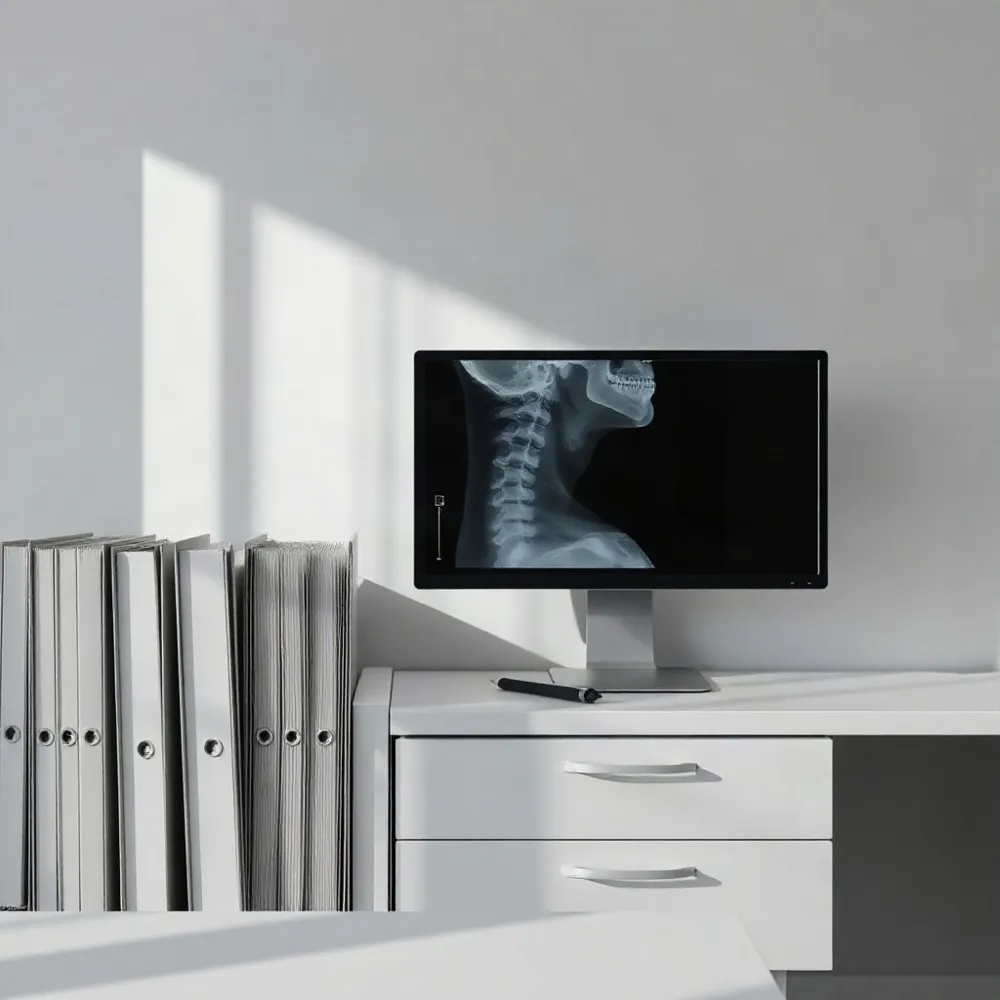 Relevant symptoms in a cervical spine claim can include pain or tenderness at the back of the neck, painful or restricted movement, headaches, dizziness, and pain that travels into a shoulder or arm. Tingling, numbness, or weakness in an arm may follow a nerve-root pattern, but those symptoms alone do not establish a diagnosis or show that work caused the condition.
The examination may document cervical range of motion, tenderness, muscle strength, sensation, reflexes, and other neurologic findings. If arm or shoulder symptoms are reported, comparing both sides and recording where symptoms occur can help clarify the clinical pattern. These findings should be considered with the worker’s history and job duties, not treated as proof of causation by themselves.
Serious spinal cord injury can produce flaccid weakness or absent reflexes, and bowel or bladder changes warrant prompt medical attention. In a severe injury, unusually low blood pressure together with a slow heart rate may indicate neurogenic shock, which requires urgent care. These warning signs call for immediate clinical assessment rather than routine claims review.
No single symptom, examination measure, or imaging finding settles the diagnosis or work relationship. NorCal Medical Consulting’s workplace injury assessments review records and imaging alongside a physical examination, allowing reported symptoms and clinical findings to be assessed in context. For readers reviewing related nerve symptoms, see our discussion of peripheral nerve injury symptoms.
Reviewing the Evidence and Work History
 An evaluator assesses a work-related cervical spine injury by connecting the reported event or work exposure and symptom timeline with job duties, medical history, examination findings, treatment records, and diagnostic studies. NorCal Medical Consulting reviews these sources together so the report can distinguish documented evidence from reported symptoms and explain how each supports an opinion.
Falls, vehicle collisions, abrupt head movement, direct trauma, and repetitive strain may all provide relevant context, but no mechanism alone proves that work caused an injury. The evaluator compares the account of how symptoms began with employment and accident records, prior treatment, and the physical demands of the job. This evidence-based approach is also described in our workplace injury assessments.
The examination may document cervical range of motion, tenderness, strength, sensation, reflexes, and signs of nerve-root involvement. X-rays, MRI, or CT scans can add information about alignment, discs, nerves, or bone, but their significance depends on whether the findings fit the worker’s symptoms and examination. NorCal Medical Consulting’s physicians consider imaging as part of the clinical record, not as a stand-alone answer to causation.
Delayed symptom onset or reporting, gaps in treatment, and inconsistent histories can make the timeline harder to assess. They do not automatically prove or disprove a work relationship; the evaluator should identify the limitation and weigh it against the full record, including prior medical documentation and the course of symptoms.
Degenerative disc disease, arthritis, age-related changes, or prior injuries may have existed before the reported event. The medical question is whether work caused a new condition, aggravated a pre-existing one, or is not supported as a contributor. That reasoning should account for the timing of symptoms and whether examination findings correspond with the diagnostic evidence.
Pain reports and imaging do not always align. An evaluator should neither dismiss reported pain because a scan shows limited changes nor assume that an imaging abnormality explains current symptoms. A clear report states what is documented, what remains uncertain, and how those limits affect conclusions about diagnosis, work relationship, function, and any supported need for further care.
Work Relationship and Functional Effects
Yes. Cervical radiculopathy can be work-related when a specific incident or job duties cause or aggravate nerve-root compression in the neck. Lifting, sustained positions, or repeated movements may be relevant, but the diagnosis alone does not establish that work caused the condition.
Radicular symptoms can include pain in the neck or arm, tingling, numbness, and weakness. To assess work relationship, our physicians consider when symptoms began and how they developed, the worker’s specific duties, examination findings, imaging, and medical history, including non-work causes such as degenerative changes.
The analysis connects the reported exposure with the clinical evidence rather than treating symptoms or scan findings as proof on their own. A workplace event may also aggravate a condition that existed before the claim. The report should explain how the timeline, work activities, and medical findings support or do not support that connection. See our review of musculoskeletal and neurological injuries for related work-relationship considerations.
A diagnosis and work causation are separate from functional capacity. The evaluator considers what the worker can do in practical terms, such as lifting, reaching overhead, or repeating neck and upper-body movements, and whether documented findings support limits in those activities.
Recommendations for work restrictions, further care, or impairment should follow from the examination and record, with the applicable claim-specific standards applied. NorCal Medical Consulting reviews workplace injury claims and documents how clinical findings relate to function; federal claims under the Longshore and Harbor Workers’ Compensation Act or Defense Base Act require attention to the standards governing that claim.
The Cervical Spine IME
An independent medical examination (IME) for a cervical spine claim is an evaluation, not a treatment visit. Its scope depends on the referral questions, so the examiner’s role is to assess the issues presented and document medical opinions, not to decide the claim.
The physician may review relevant medical records and imaging, then ask about the work incident, when symptoms began, and how they have changed. Expect questions about prior neck conditions, treatment, pain that travels into an arm, numbness or weakness, and effects on daily activities and work.
A focused examination may assess neck movement, strength, sensation, reflexes, and other findings relevant to the reported symptoms. The specific maneuvers depend on the referral and presentation. If a movement causes pain or cannot be performed safely, say so clearly rather than forcing it.
The resulting opinion may address diagnosis, whether work caused or aggravated the condition, treatment needs, work capacity, or maximum medical improvement. These are distinct medical questions, and the examiner should explain how the history, examination, and available records support each opinion. Our physicians conduct workplace injury assessments that include medical-record review, imaging review, and a physical examination when appropriate.
Answer questions accurately and distinguish what you experienced from what appears in the records. If an instruction or question is unclear, ask the examiner to clarify it. An IME may inform claim decisions, but it does not replace the claims process or determine the outcome by itself. For more on the evaluation’s scope, see what an independent examination covers.
Preparing for the Examination
 How should an injured worker prepare for an independent medical examination? Review the appointment instructions and confirm the time, location, and any requirements for forms or records. For additional guidance on appointment details and record preparation, see how to prepare for an independent medical evaluation.
Prepare a brief, factual timeline of the injury, symptom changes, treatment, medications, work duties, and current restrictions. Include dates where possible, and note which movements or activities affect your neck or arm symptoms. NorCal Medical Consulting’s workplace injury assessments include review of medical records and imaging alongside a physical examination, so requested records can help put the examination in context.
Bring the documents requested for the appointment and a current medication list. Wear clothing that allows the examiner to assess the neck and other affected areas without unnecessary difficulty.
Answer questions truthfully and consistently, describing your usual symptoms and functional limits rather than trying to predict what the examiner expects. Do not guess, rehearse, exaggerate, or minimize. Ask for clarification if a question is unclear, and tell the examiner when a movement hurts or cannot be done safely.
Rules about observers, recording, travel, and how often an examination may be requested vary by claim system. Do not assume procedures described for one state apply to a federal Longshore and Harbor Workers’ Compensation Act or Defense Base Act claim; confirm applicable instructions with the appropriate claim representative or attorney.
Weighing Different Medical Opinions
If an independent medical examiner’s opinion differs from the treating physician’s, neither opinion automatically controls. The decision-maker weighs both against the full record and the issue that must be resolved.
That review may include the history, examination findings, imaging and other diagnostic tests, treatment records, and each physician’s medical reasoning. The question may concern work-related causation, whether further treatment is supported, appropriate work restrictions, or permanent impairment. A physician’s view should be assessed in relation to the evidence bearing on that specific issue.
A disagreement can point to a gap that needs attention. The parties may seek clarification from a physician, submit additional medical evidence, or use the procedures available under the applicable claim system. For LHWCA and Defense Base Act claims, the full evidentiary record and applicable federal process govern how medical opinions are weighed. California QME procedures or rules from another jurisdiction should not be assumed to apply.
A useful report identifies the records and findings supporting each opinion, addresses evidence that points in another direction, and explains how the physician reached a conclusion. NorCal Medical Consulting’s workplace injury assessments include review of medical records and imaging alongside a physical examination, helping connect the opinion to the evidence under review.
For a closer look at how disagreements can be assessed without treating either physician’s view as controlling, see weighing conflicting medical opinions.
After the IME Report
After an independent medical examination (IME), the physician reviews the examination findings and available records, then prepares a written report addressing the questions in the referral. A clear report connects each opinion to relevant clinical findings and record evidence.
Depending on the referral, the report may address diagnosis, work relationship, work capacity, treatment, impairment, or other claim issues. The requesting party, and other parties as allowed by the applicable process, may review it to assess the claim or identify a need for additional evidence or testimony.
When an opinion conflicts with treating-provider findings, the parties may seek clarification, submit rebuttal evidence, or pursue further proceedings. A report should make its reasoning traceable, including how the physician considered relevant records and any limits in the available evidence. For a cervical-spine claim, that may mean explaining how examination findings relate to reported symptoms and imaging.
NorCal Medical Consulting prepares medical-legal evaluations and written reports for workplace claims, including federal Longshore and Defense Base Act matters, where the applicable claim-specific standards must guide the analysis. An IME report is evidence for consideration, not a decision on the claim or a guarantee of settlement. For more on the usual report sequence, see understanding the IME report.
Make the Reasoning Traceable
A useful cervical spine evaluation connects the worker’s account and symptom timeline with examination findings, imaging, and the demands of the job. The report should then explain how that evidence supports conclusions about work relationship, functional limits, and any recommended care.
For adjusters, attorneys, and injured workers, clarity depends on distinguishing reported symptoms from documented findings and addressing gaps or inconsistencies rather than overlooking them. The reasoning should also identify the standards that apply to the specific claim; California QME procedures, for example, should not be assumed to govern federal LHWCA or Defense Base Act claims. NorCal Medical Consulting prepares workplace injury evaluations and chart reviews with findings tied to the records and claim context.