Introduction: Why Harbor Authority Communication Matters
The Longshore and Harbor Workers’ Compensation Act (LHWCA) gives maritime employees federal coverage for injuries on navigable waters or adjacent sites. Workers must give written notice of an injury within 30 days (Form LS‑201) and file a formal claim within one year (Form LS‑203). Harbor authorities—port commissions, district offices, and safety officers—serve as the first point of contact, providing claim forms, authorizing medical treatment, and guiding claimants through the Secure Electronic Access Portal. Prompt, documented communication with these authorities ensures that deadlines are met, earnings and medical records are accurately reported, and disputes are resolved quickly. Clear, factual exchanges dramatically improve the likelihood of timely benefit approval and reduce the risk of claim denial.
Reporting Injuries and Initial Documentation
| Resource | Description | Link |
|---|---|---|
| Longshore and Harbor Workers' Compensation Act (pdf) | Full text of the Act | https://www.govinfo.gov/content/pkg/COMPS-1522/pdf/COMPS-1522.pdf |
| Longshore Act | Provides medical care, wage replacement, vocational rehab for maritime workers | |
| LHWCA portal (ECOMP login) | Access benefits, file claims | |
| Statute of limitations | 1‑year for injuries, 2‑year for occupational disease after discovery | https://www.dol.gov/agencies/owcp/dlhwc/FAQ/lsfaqs |
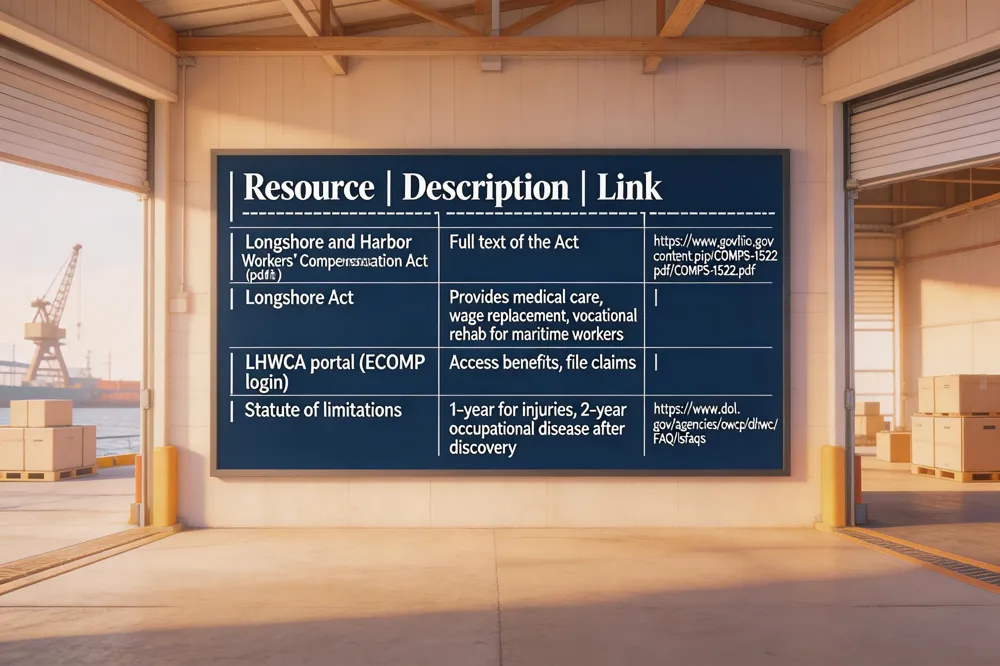 Longshore and Harbor Workers' Compensation Act pdf – The Act’s full text is downloadable from the U.S. Government Publishing Office at https://www.govinfo.gov/content/pkg/COMPS-1522/pdf/COMPS-1522.pdf.
Longshore Act – The federal Longshore Act provides medical care, wage replacement, and vocational rehabilitation for maritime workers injured on navigable waters, including occupational diseases such as hearing loss.
LHWCA login – Access benefits through the Department of Labor’s LHWCA portal by signing in with an ECOMP account; register if you lack credentials.
Statute of limitations – A one‑year filing deadline applies to injury claims, starting when the employee knows (or should know) the injury is work‑related; occupational disease claims have a two‑year window after discovery.
Medical Authorization, Treatment Coordination, and Auditory Injuries
| Item | Detail |
|---|---|
| Form LS‑1 | Employer‑issued authorization for non‑emergency medical care |
| Physician choice | Worker may select any non‑barred physician |
| Auditory injury docs | Audiograms, exposure assessments, causal narrative |
| Advanced Hearing Providers (AHP) | Nationwide audiology network, claim admin, 10‑day hearing‑aid processing |
| AHP contact | 9000 Southside Blvd., Bldg 100, Suite 11000, Jacksonville, FL 32256; 1‑800‑598‑5300; info@hearingprovider.com |
| Coverage scope | LHWCA & Defense Base Act – medical care, 2/3 wage replacement, survivor benefits; excludes seamen, federal employees, non‑maritime staff |
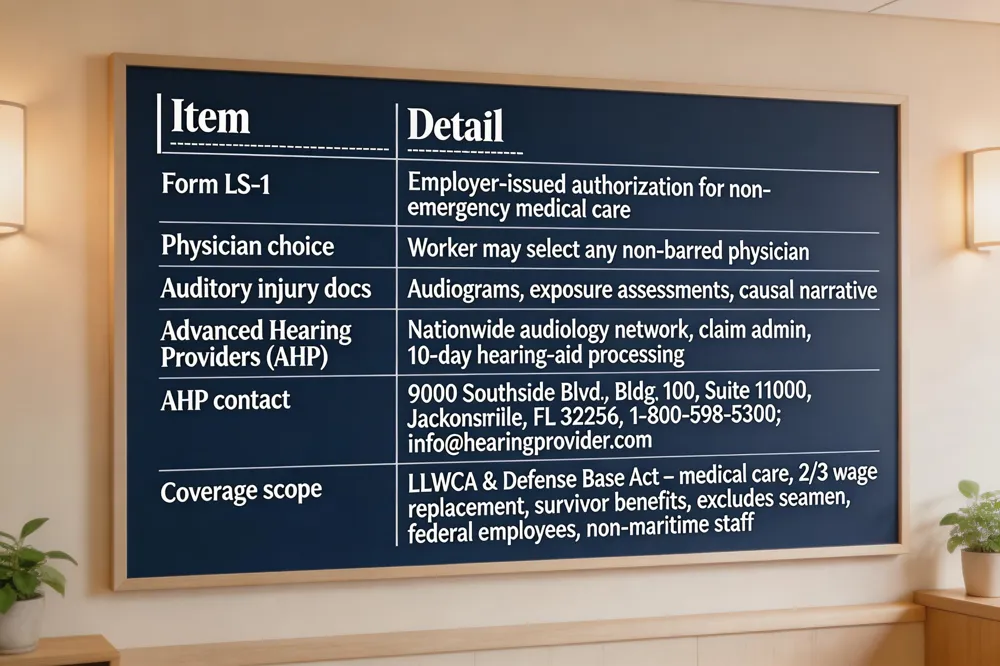 Under the Longshore and Harbor Workers’ Compensation Act (LHWCA), the employer must issue Form LS‑1 to authorize any non‑emergency medical care. The employee retains the statutory right to select a treating physician of choice, provided the doctor is not barred from the LHWCA program. For occupational hearing loss, the claimant must submit contemporaneous audiograms, exposure assessments, and a clear causal narrative linking noise levels on the dock or vessel to the impairment. Advanced Hearing Providers (AHP) serve as a full‑service hearing‑health partner; AHP’s nationwide network of credentialed audiologists delivers prompt evaluations, handles claim administration, and ensures OSHA‑compliant hearing‑conservation programs. AHP processes hearing‑aid claims within ten days, conducts free clinical reviews, and eliminates unnecessary high‑end product requests, saving employers time and money while protecting worker health. AHP’s headquarters are located at 9000 Southside Blvd., Building 100, Suite 11000, Jacksonville, FL 32256; toll‑free assistance is available at 1‑800‑598‑5300 and via email at info@hearingprovider.com. Maritime workers’ compensation, governed by LHWCA and extensions such as Defense Base Act, provides medical care, two‑thirds wage replacement, and survivor benefits for non‑seaman marine employees, including those with hearing loss. The program covers shipbuilders, ship‑repairers, longshoremen, and harbor‑construction workers, but excludes seamen, federal employees, and non‑maritime staff.
Benefit Calculations, Compensation Rates, and Survivor Entitlements
| Benefit | Formula / Rate |
|---|---|
| Average Weekly Wage (AWW) | Based on pre‑injury earnings; benchmarked against NAWW |
| Weekly disability | 2/3 AWW, minimum 50 % and maximum 200 % NAWW; FY 2026 max $2,082.70/week |
| Survivor spouse | ½ AWW for life (or lump‑sum of 2 years if remarried) |
| Dependent child | 1/6 AWW each, capped at 2/3 AWW; ends at age 18 (23 for full‑time students) |
| Occupational disease (e.g., hearing loss) | Same AWW formula; may adjust for permanent impairment |
| Death benefits | $3,000 funeral allowance; claim on Form LS‑265 within 1 year of death |
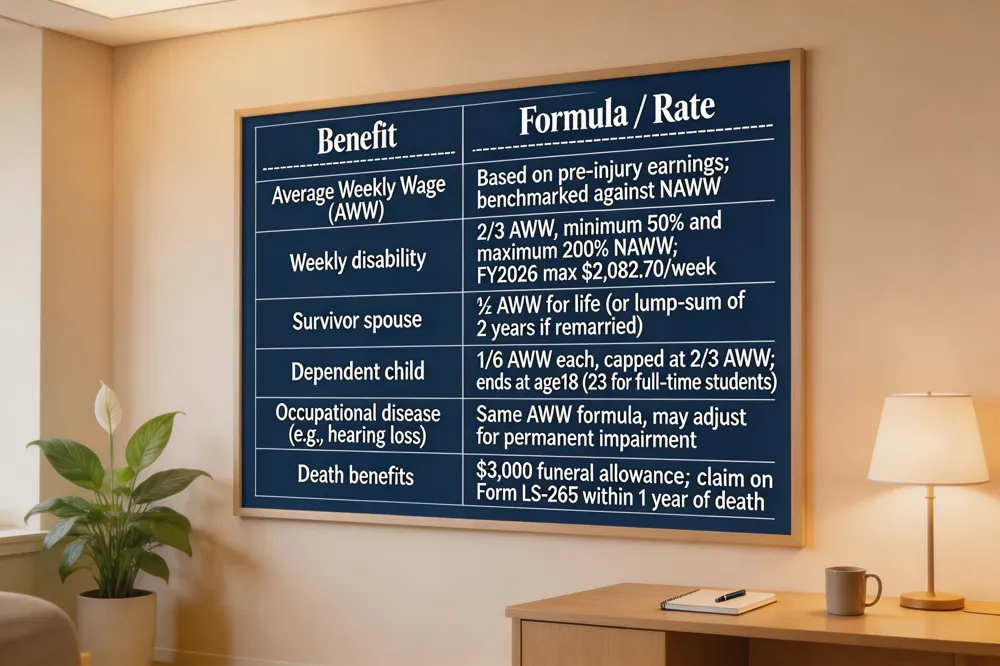 Under the LHWCA the Average Weekly Wage (AWW) is calculated from the employee’s pre‑injury earnings, using the most recent wage statements and the National Average Weekly Wage (NAWW) as a benchmark. Weekly disability benefits are paid at two‑thirds of the AWW, but no less than 50 % and no more than 200 % of the NAWW; the FY 2026 maximum is $2,082.70 per week (twice the NAWW of $1,041.35). Survivor benefits are based on two‑thirds of the deceased worker’s AWW: a surviving spouse receives one‑half of the AWW for life (or a lump‑sum of two years’ benefits if remarried), and each dependent child receives one‑sixth, capped at two‑thirds of the AWW, with payments ending at age 18 (or 23 for full‑time students). Occupational diseases such as hearing loss are treated as compensable injuries; the same AWW formula applies, and the benefit amount may be adjusted for the degree of permanent impairment. Death benefits include a $3,000 funeral allowance and must be filed on Form LS‑265 within one year of death.
Dispute Resolution, Hearings, and Appeals
| Entity | Role |
|---|---|
| LHWCP (Office of Workers’ Compensation Programs) | Administers LHWCA benefits |
| Workers’ Compensation Appeals Board | California quasi‑judicial agency for appeals |
| Division of Workers’ Compensation (Dept. of Industrial Relations) | State‑level administration of workers‑comp laws |
| Settlement components | Medical expenses, 2/3 wage replacement (AWW), vocational rehab |
| Winning odds | High when backed by solid medical and wage documentation |
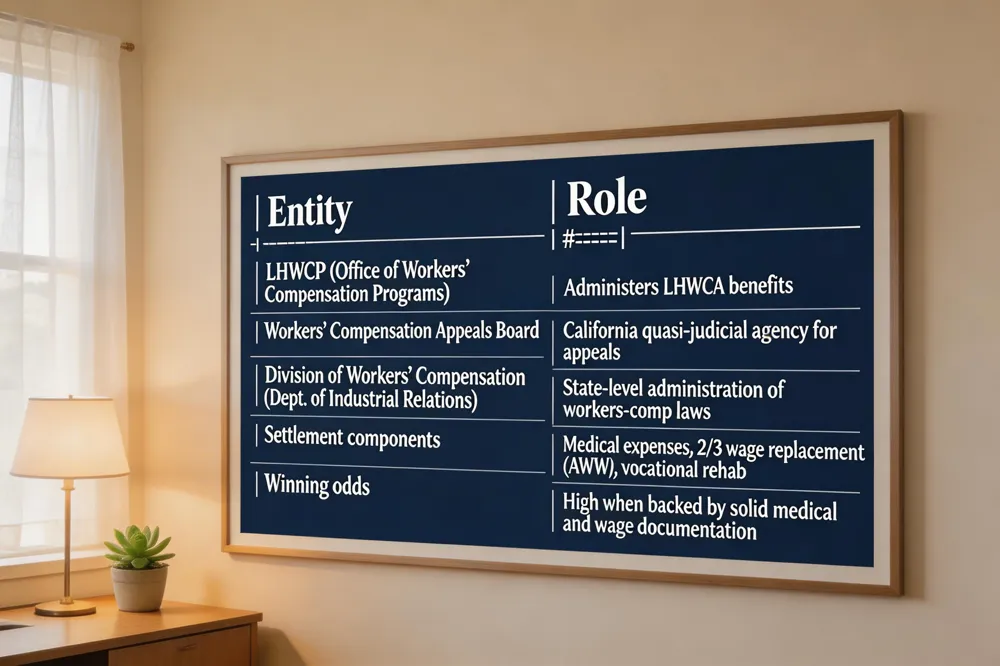 The LHWCP is run by the U.S. Department of Labor’s Office of Workers’ Compensation Programs, administering benefits. The Workers’ Compensation Appeals Board is a legitimate California quasi‑judicial agency. A Longshore workers‑comp settlement includes medical expenses, two‑thirds wage replacement based on AWW, and vocational rehabilitation. Workers‑compensation laws are administered by the Division of Workers’ Compensation within Department of Industrial Relations. Winning odds are high when claims are backed by medical and wage documentation.
Coverage Endorsements, Legal Framework, and Practical Guidance
| Topic | Key Points |
|---|---|
| Red‑flag indicators | No witnesses, illogical injury description, multiple suspicious claims, late reporting, refusal of diagnostics, questionable providers |
| What not to say to adjust adjuster | Recorded statement without counsel, speculation, admission of fault, down‑playing injuries, discussing settlement, unrelated medical history |
| USL&H insurance requirement | Mandatory; lack leads to lawsuits, fines, personal liability |
| Substance‑abuse‑related claims | 45‑50 % of all workers’ comp claims involve substance abuse |
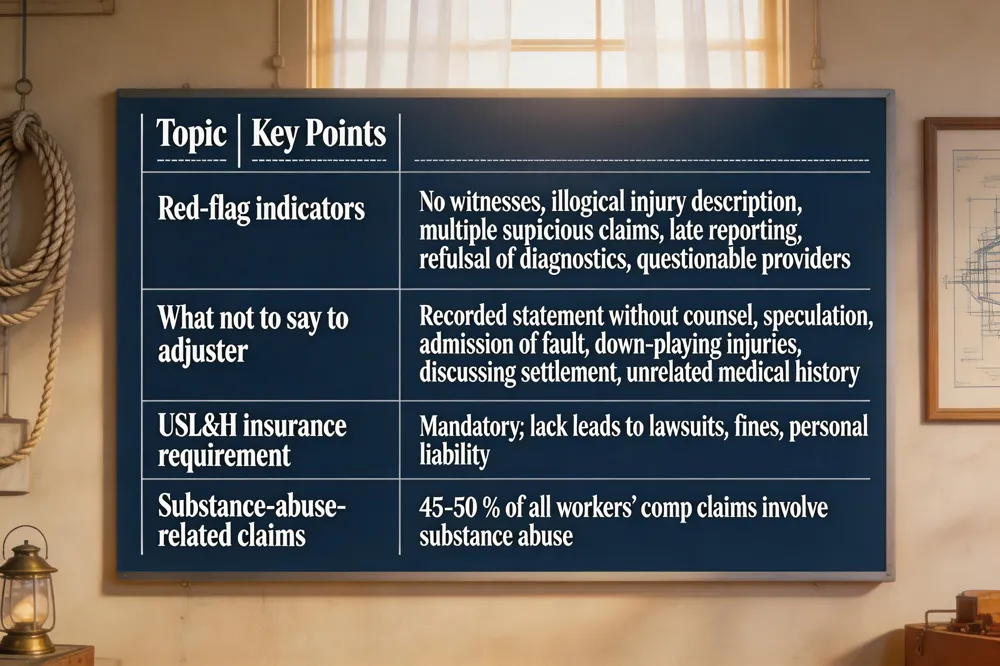 Red flag in workers' compensation claims – Absence of witnesses, illogical injury descriptions, multiple suspicious past claims, late reporting, refusal of diagnostic testing, and use of questionable medical/legal providers signal potential fraud and merit closer scrutiny.
What not to say to a Workmans Comp adjuster – Do not give a recorded statement without counsel, speculate, admit fault, downplay injuries, discuss settlement expectations, or volunteer unrelated medical history. Stick to facts and say “I don’t know” when unsure.
Is USL&H required? – Yes. Without USL&H insurance, businesses risk lawsuits, hefty fines, and personal liability, especially when maritime exposure exists.
Substance‑abuse‑related claims – Approximately 45‑50 % of all workers’ compensation claims involve substance abuse, underscoring the need for drug‑free workplace programs.
Practical Tips for Effective Communication with Harbor Authorities
| Question | Answer |
|---|---|
| What is LHWCA? | Federal law offering medical care, wage replacement, vocational rehab, survivor benefits for maritime workers on navigable waters |
| Red flag example? | Lack of witnesses, inconsistent injury story, late reporting, etc. |
| What not to say to adjuster? | No recorded statement without lawyer; avoid speculation, fault admission, down‑playing, settlement talk |
| Odds of winning a claim? | Varies 50 %‑94 % depending on state, injury type, documentation, counsel |
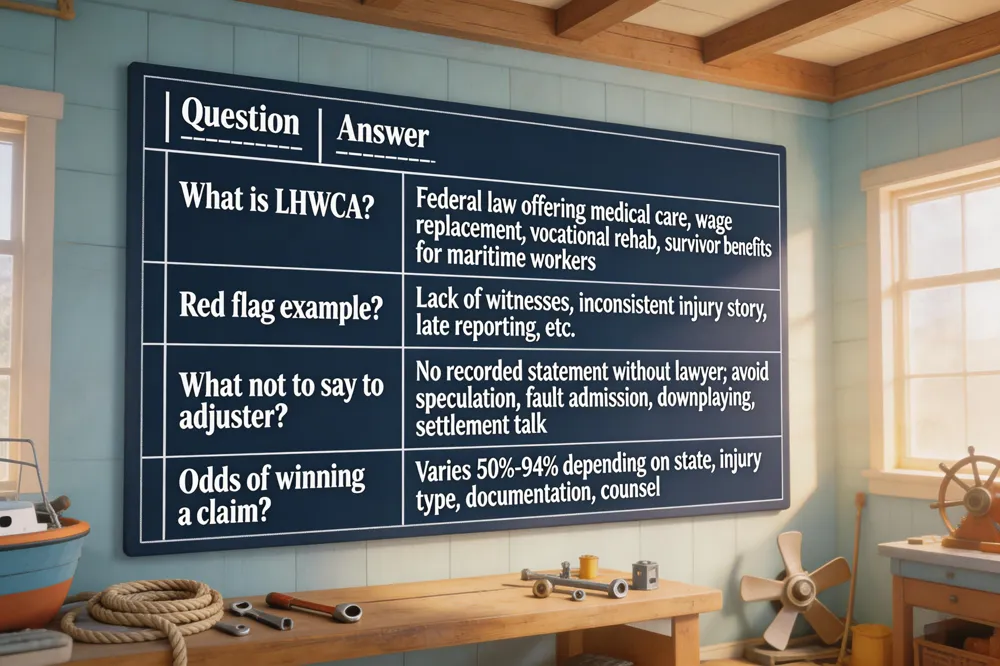 What is the Longshoreman and Harbor Workers Compensation Act?
The Longshore and Harbor Workers’ Compensation Act (LHWCA) is a federal law that provides medical care, wage replacement, vocational rehabilitation, and survivor benefits to workers injured on navigable U.S. waters or adjoining harbor areas. It covers maritime occupations—longshoremen, shipbuilders, repairers, and harbor construction workers—and occupational diseases such as hearing loss.
Which of the following is a red flag in workers' compensation claims?
Red flags include lack of witnesses, inconsistent injury descriptions, late reporting, a pattern of multiple suspicious claims, refusal to undergo diagnostic testing, and use of questionable medical or legal providers. When two or more appear, the claim warrants closer scrutiny.
What not to say to a Workman's Comp adjuster?
Do not give a recorded statement before consulting counsel. Avoid speculation, admit fault, downplay severity, discuss settlement amounts, or provide unrelated medical history. Stick to factual statements and say “I don’t know” when unsure.
What are the odds of winning a workers' comp case?
Approval rates vary by state and injury type but generally range from 50% to 94%. Factors such as state medical review processes, employer insurance practices, and injury severity affect outcomes; experienced counsel can improve success odds.
Conclusion: Maintaining Open, Accurate, and Timely Dialogue
Effective communication with harbor authorities begins with a written injury notice within thirty days, followed by prompt submission of Form LS‑201 and LS‑203 through SEAPortal or mail. Workers should keep a chronological log of every email, call, and meeting, noting dates, participants, and summaries. Detailed documentation—photos, witness statements, wage records, and medical reports—protects both employee and employer from disputes and speeds benefit calculations. Engaging a qualified medical consultant early, especially for conditions such as occupational hearing loss, ensures that causation and severity are clearly linked to workplace exposure. Finally, adhering to statutory deadlines—thirty‑day notice, one‑year claim filing, and timely earnings reports—preserves eligibility and prevents costly delays. By maintaining this disciplined communication routine, claimants and harbor officials alike can achieve faster resolutions and mutual trust.