Why Digital Portals Matter
Workplace‑injury claims have grown in complexity, involving medical evaluations, legal analysis, and insurance adjustments that must be coordinated across multiple stakeholders. Cloud‑based, HIPAA‑compliant portals provide a secure, real‑time conduit for sharing medical records, accident reports, and expert opinions, eliminating the delays of fax, email, and physical mail. By centralizing data, these systems streamline eligibility checks, automate workflow routing, and create an audit‑trail that supports both compliance and litigation readiness. The result is faster claim resolution, reduced administrative overhead, and improved cash‑flow for providers and claimants alike. In short, digital portals turn fragmented, paper‑heavy processes into an efficient, transparent ecosystem that accelerates fair outcomes for workplace‑injury cases.
Understanding Digital Claim Portals
 A claim portal is a secure, cloud‑based platform that lets claimants, providers, insurers, and legal representatives exchange all relevant claim information electronically. Users can upload medical records, accident reports, and legal documents, track claim status in real time, and communicate within a protected environment that meets HIPAA, SOC 2, and ISO 27001 standards. Real‑time collaboration is enabled by secure messaging, timestamped chat, and shared document repositories, allowing attorneys, adjusters, and clinicians to view the same data simultaneously and reduce email back‑and‑forth. Benefits include faster claim resolution, lower administrative costs, reduced duplicate testing, and improved coordination of care. Adjusters gain instant access to medical evidence, attorneys receive timely expert reports, and providers see payment updates without manual follow‑up. In short, a claim portal streamlines workflow, enhances security, and creates a single source of truth for all stakeholders, accelerating settlements and improving overall claim efficiency.
Leading Platforms and Their Offerings
 Attorney and Employer Portals (PrognoCIS) – PrognoCIS provides HIPAA‑compliant, cloud‑based portals that integrate directly with EHR and practice‑management systems. Attorneys, employers, and adjusters can securely share medical records, case documents, and appointment schedules, reducing duplicate testing and administrative overhead.
Claim.MD Electronic Clearinghouse – Claim MD is a cloud‑based electronic clearinghouse that streamlines the entire medical‑claim workflow for providers and attorneys. It lets users create, edit, and submit 837P/837I claims, track real‑time status updates, and receive electronic remittance advice (ERA) and eligibility responses directly through its web portal. Integrated “GetHelp” tickets provide rapid support, and the platform’s interactive claim forms highlight errors for quick correction, making it ideal for workplace‑injury and auditory‑loss cases.
ClaimWizard Pricing and Features – ClaimWizard offers three primary tiers: the Single‑User Package at $99 /mo for solo adjusters; the Business Package at $250 /mo (up to three licenses, $50 /mo per additional license); and an Enterprise Package with unlimited licenses and custom services quoted per client. Features include customizable templates, automated reminders, batch processing, and audit‑trail compliance tools.
Free Digital Claim Portals – Free portals give 24/7 access to submit, track, and manage claims without service fees. Users can upload forms, view payment history, and receive instant notifications. Examples include the Claim.MD clearinghouse’s free entry option and ShelterPoint’s disability portal, both offering secure, real‑time status updates.
Mobile Claim Filing with Streamline Claims – Streamline Claims (iOS/Android) lets policyholders capture inventory photos, scan receipts via OCR, and generate instant PDF/CSV claim packages. Encrypted cloud backup and guided claim‑filing workflows streamline documentation for homeowners, renters, and small businesses.
The Healthcare Claim Processing Workflow
 Eligibility verification and coding standards
Effective claim processing begins with real‑time eligibility checks through portals such as Claim.MD, Availity, or MyInsurancePortal, ensuring that patient coverage is active and benefits are accurate. Accurate ICD‑10, CPT, and HCPCS coding, supported by tools like MedCare MSO’ 3‑million‑rule engine, translates clinical services into standardized billing data, reducing errors that trigger denials.
Adjudication, ERA, and payment cycles
Once submitted, claims are adjudicated by payers who apply contractual rates and coverage rules, generating an Electronic Remittance Advice (ERA) in 835 format. Platforms like Claim.MD and ClaimConnect deliver ERAs instantly, allowing providers to reconcile payments, address rejections, and accelerate cash flow.
Common denial codes and how to avoid them
Top denial reasons include missing patient info (CO 16), eligibility errors (CO 109), duplicate submissions (CO 18), lack of prior authorization (CO 197), and invalid codes (CO 167/181). Prevent these by using claim‑scrubbing tools, validating patient demographics, confirming authorizations, and employing real‑time eligibility checks.
Training for staff and best‑practice tools
Comprehensive training—covering HIPAA compliance, coding standards, denial‑code analysis, and appeal workflows—empowers staff to submit clean claims. Solutions such as MedCare MSO’ automated scrubbing, Claim.MD’s batch uploads, and AI‑driven analytics in platforms like Streamline Results further streamline the cycle, improving reimbursement rates and supporting legal documentation for workplace injury cases.
Attorney‑Adjuster Communication Best Practices
 Effective collaboration between attorneys and insurance adjusters hinges on preserving attorney‑client privilege and maintaining crystal‑clear role boundaries. Courts apply a "dominant purpose" test (e.g., Menapace v. Alaska Nat’l Ins. Co.) to decide whether communications are privileged; therefore, every email or portal message should be labeled explicitly as "legal advice" when counsel is providing analysis, and all fact‑finding or medical‑record review should be handled by the adjuster.
What not to say to a claim adjuster – Do not admit fault, speculate about injury cause, or offer unverified medical details. Avoid discussing settlement amounts, policy limits, or your own valuation of the claim. Stick to factual observations and defer substantive analysis to your attorney and medical experts.
EOB vs. 835 – An Explanation of Benefits (EOB) is a human‑readable summary of claim processing, while the 835 transaction is the HIPAA‑mandated electronic remittance advice (ERA) that conveys the same data in a machine‑readable X12 format. The EOB appears as a PDF or paper statement; the 835 contains claim control numbers, line‑item payments, and adjustments used for posting and accounting.
Avoiding common filing mistakes – The biggest pitfall is delaying the claim and neglecting policy notice requirements. Promptly file, preserve comprehensive documentation (photos, medical records, timestamps, witness statements), and ensure eligibility the insurer receives accurate, complete data. Using cloud‑based, HIPAA‑compliant portals—such as those offered by PrognoCIS, Claimant Portal, or ClaimDeck—provides real‑time document sharing, reduces duplicate entry, and creates an audit trail that protects both legal privilege and claim integrity.
By adhering to these practices, attorneys and adjusters can streamline communication, protect privileged information, and accelerate fair resolution of workplace injury claims.
Medical Consulting, Compensation, and Claim Stages
 Medical consulting claims compensation
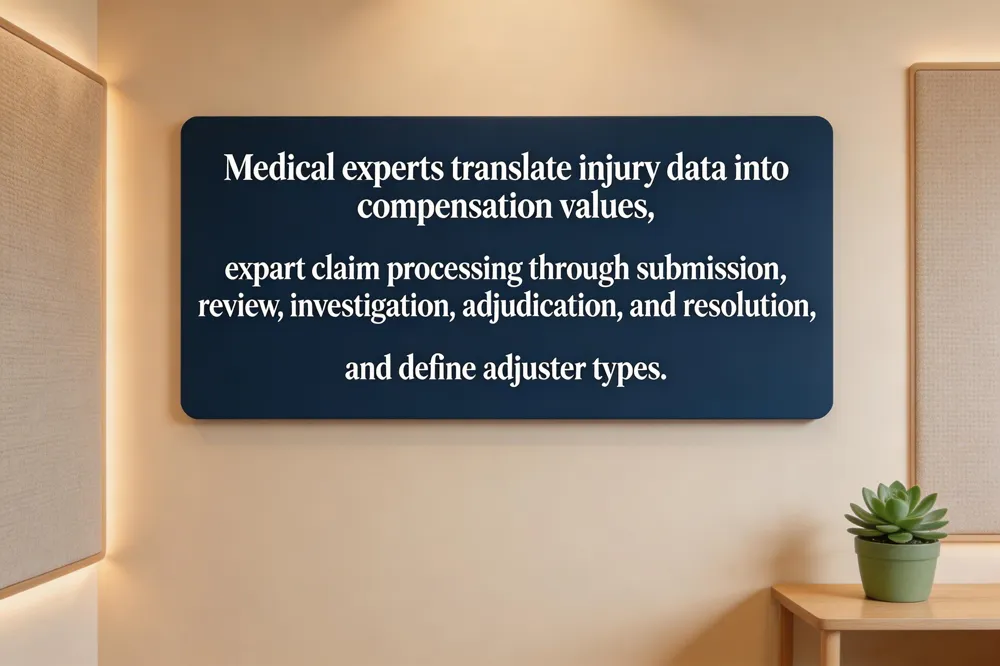
Medical consulting provides the clinical expertise needed to translate injury data into credible compensation values. Board‑certified physicians conduct evidence‑based reviews—impairment‑rating assessments, diagnostic re‑reads, and baseline clinical evaluations—to determine loss severity, causation, and future medical costs. Their analyses produce defensible, citation‑rich reports that clearly articulate the medical rationale for claim adjusters, insurers, and attorneys, ensuring accurate earnings‑capacity loss and expense estimates in hearings or litigation.
Medical consulting claims compensation
Medical consulting provides the clinical expertise needed to translate injury data into credible compensation values. Board‑certified physicians conduct evidence‑based reviews—impairment‑rating assessments, diagnostic re‑reads, and baseline clinical evaluations—to determine loss severity, causation, and future medical costs. Their analyses produce defensible, citation‑rich reports that clearly articulate the medical rationale for claim adjusters, insurers, and attorneys, ensuring accurate earnings‑capacity loss and expense estimates in hearings or litigation.
What are the stages of claim processing?
- Submission – Claimant provides medical reports and injury details.
- Initial review – Completeness and eligibility are verified.
- Investigation/assessment – Medical experts evaluate the injury (e.g., auditory loss) for causation and severity.
- Adjudication – Insurer or legal team decides appropriate compensation based on findings.
- Resolution – Payment or settlement is issued and the case is closed for future reference.
Four types of claims adjusters
- Staff/in‑house adjusters (carrier employees).
- Independent contractor adjusters (case‑by‑case hires).
- Public adjusters (represent policyholders).
- Specialist adjusters (focus on property, liability, workers’ compensation, or medical loss).
Medical claim example A worker suffers a workplace hearing injury and sees an ENT specialist. The provider orders audiometry, codes the service CPT 92557, and diagnoses ICD‑10 H90.3. The CMS‑1500 claim is submitted electronically via a HIPAA‑compliant portal, allowing real‑time eligibility checks and secure document exchange. The insurer validates coverage, applies the fee schedule, and issues payment. The documented claim supports any subsequent legal review or settlement negotiations.
Key Takeaways for NorCal Medical Consulting
Digital claim portals centralize medical records, accident reports, and correspondence while employing HIPAA‑compliant encryption and role‑based access, safeguarding patient privacy. Selecting a cloud‑based platform that integrates with EHRs and practice management systems—such as PrognoCIS, Claim.MD, or ClaimDeck—streamlines adjuster‑attorney coordination, delivering real‑time status updates and secure messaging. Comprehensive training on portal workflows, clear communication protocols, and meticulous documentation (including electronic signatures and audit trails) markedly reduce claim denials and accelerate reimbursement. Finally, medical consulting translates clinical findings into legally defensible expert reports, bridging the gap between healthcare evidence and compensation outcomes for workplace injury cases.