Setting the Stage: Noise, Hearing, and the Need for Better Tools
Approximately 25 % of U.S. workers are exposed to hazardous noise levels of 85 dBA or higher, and many lack adequate hearing protection, placing them at risk for occupational hearing loss. Pure‑tone audiometry, the traditional gold‑standard, is limited in industrial settings: test‑retest variability is higher than in clinical environments, it often stops at 4–6 kHz, and it relies on active patient responses that can be compromised by language barriers, fatigue, or malingering. These shortcomings can lead to missed early high‑frequency damage and spurious Standard Threshold Shifts. Auditory Steady‑State Response (ASSR) offers an objective, electrophysiologic alternative. By delivering rapid, amplitude‑ or frequency‑modulated tones and using spectral‑domain statistical detection (e.g., F‑test, mutual‑information classifiers), ASSR simultaneously estimates thresholds at 0.5, 1, 2, and 4 kHz (and higher) in both ears within 20‑25 minutes, independent of patient cooperation. This makes ASSR especially valuable for documenting noise‑induced hearing loss in workers‑ compensation and insurance claims, and for augmenting OSHA‑mandated hearing‑conservation programs.
ASSR in Action: From Auditory Neuropathy to Clinical Benchmarks
 How is ASSR used to evaluate auditory neuropathy?
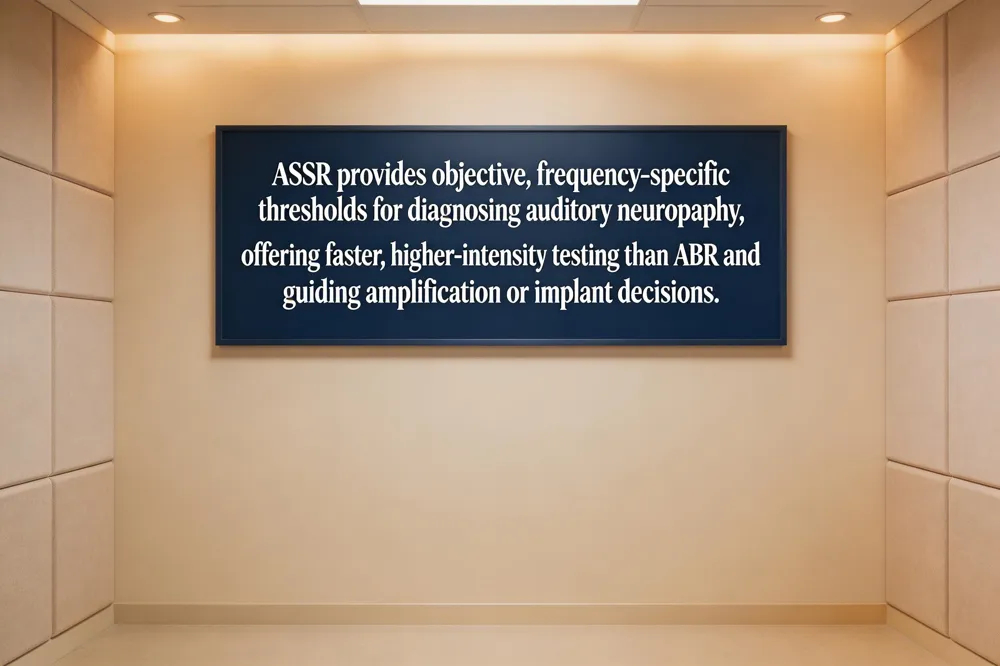
ASSR estimates hearing thresholds by recording steady‑state brain responses to rapid, amplitude‑ or frequency‑modulated tones. When outer‑hair‑cell function is intact (normal OAEs) but ABR is absent or severely delayed, a measurable ASSR threshold indicates neural dysfunction—characteristic of auditory neuropathy spectrum disorder (ANSD). The frequency‑specific ASSR data guide amplification or cochlear‑implant decisions, complementing ABR and OAE findings.
How is ASSR used to evaluate auditory neuropathy?
ASSR estimates hearing thresholds by recording steady‑state brain responses to rapid, amplitude‑ or frequency‑modulated tones. When outer‑hair‑cell function is intact (normal OAEs) but ABR is absent or severely delayed, a measurable ASSR threshold indicates neural dysfunction—characteristic of auditory neuropathy spectrum disorder (ANSD). The frequency‑specific ASSR data guide amplification or cochlear‑implant decisions, complementing ABR and OAE findings.
What are the normal range for ASSR thresholds? Normative data show mean ASSR thresholds of roughly 35‑37 dB nHL (±10 dB) across 500‑4000 Hz, with more recent studies reporting 40‑50 dB HL as typical upper limits, depending on frequency and stimulus parameters.
What are the advantages of ASSR over ABR? ASSR provides simultaneous, frequency‑specific thresholds, can test higher intensities (up to 120 dB HL), and yields results faster (≈20‑25 min). It is especially valuable when behavioral audiometry is impractical, such as in infants, uncooperative workers, or legal evaluations.
What are the limitations of ASSR? Results are state‑dependent; movement or wakefulness can degrade recordings. High‑frequency thresholds may be less precise, and the test requires specialized equipment, trained personnel, and careful calibration.
What is the difference between ASSR and ABR? ASSR estimates thresholds using steady‑state responses across multiple frequencies, while ABR assesses neural timing in the auditory nerve and brainstem, offering detailed neural integrity information but typically delivering a single threshold per ear.
Building a Robust Hearing Conservation Program
 What should a Hearing Conservation Program template include?
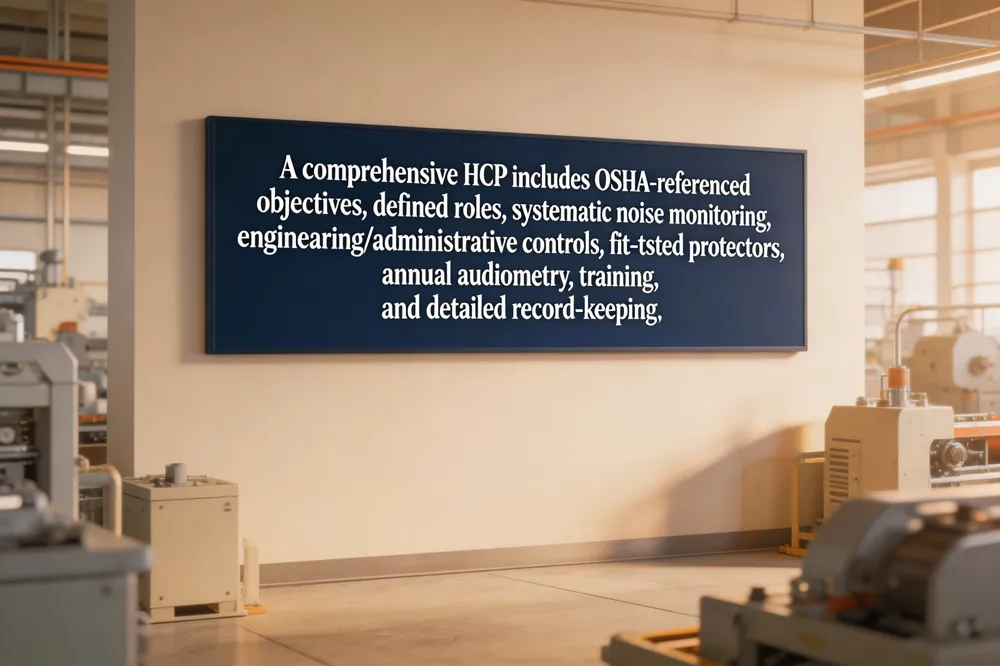
A template must open with a clear objective referencing OSHA 29 CFR 1910.95, then list roles—management, program administrator, supervisors, workers—and their duties. Core procedures cover (1) systematic noise monitoring, (2) engineering and administrative controls, (3) selection, distribution, and fit‑testing of hearing protectors, and (4) free annual audiometric testing with prompt retesting of any standard threshold shift (STS). A training component describing hazard education, proper protector use, and program benefits follows. Finally, record‑keeping and program‑evaluation sections specify how exposure logs, audiograms, training records, and protector inventories are maintained, reviewed, and used to adjust the program.
What is the 1‑3‑6 rule for hearing‑loss management?
The rule mandates that a worker identified at risk receive a hearing screening within 1 month, a full diagnostic audiologic evaluation by 3 months, and enrollment in early‑intervention or rehabilitation services by 6 months. Meeting these timelines optimizes outcomes and strengthens legal/insurance documentation.
What are common noise hazards and control measures in the workplace?
Typical hazards include heavy machinery, compressors, pneumatic tools, impact equipment, and construction activities that generate continuous or impulse noise. Engineering controls reduce source levels via low‑noise equipment, maintenance, and enclosures. Administrative controls limit exposure by rotating staff, scheduling noisy tasks when fewer workers are present, increasing distance, and providing quiet break areas. When these measures cannot achieve ≤85 dBA, properly fitted hearing protectors (earplugs or earmuffs) must be used. A comprehensive HCP integrating these controls, monitoring, and training prevents occupational hearing loss and supports claim substantiation.
OSHA Compliance: Audiometric Testing and ASSR Integration
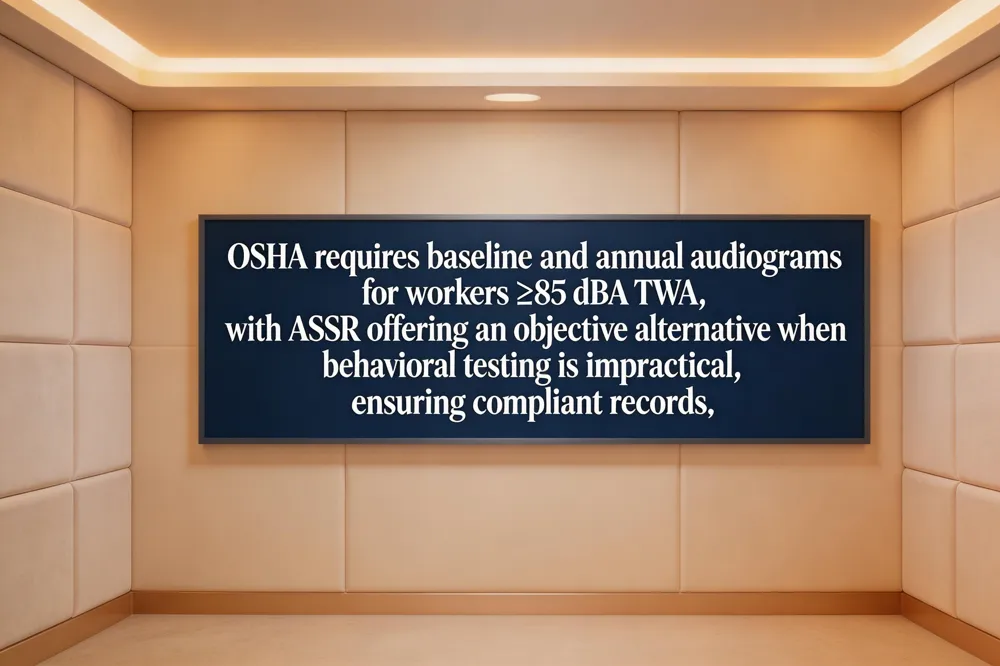 OSHA mandates that any worker exposed to ≥85 dB(A) TWA be enrolled in a hearing‑conservation program, receive a baseline audiogram within six months of exposure (after ≥14 h of quiet), and obtain annual follow‑up audiograms at no cost. Records must be kept for at least two years and made available to the employee. A standard threshold shift (≥10 dB change at 2, 3, 4 kHz) triggers employer notification, retesting, and possible fit‑testing of hearing protectors.
Screening guidelines require free baseline and yearly testing for all exposed employees, with immediate retest of any suspected shift to eliminate false positives. Documentation of thresholds, shifts, and corrective actions is essential for OSHA compliance and workers’‑ compensation claims.
The ASSR procedure is an objective electrophysiologic test that delivers simultaneously amplitude‑modulated tones at 0.5, 1, 2, 4 kHz via insert earphones. Electrodes on mastoids, vertex, and ground record brain responses; statistical algorithms (F‑test or mutual‑information) determine thresholds, which are then converted to estimated hearing levels.
Typical ASSR stimulus parameters: four carrier frequencies (500 Hz–4 kHz), 100 % AM depth, modulation rates >80 Hz (often 80‑100 Hz), intensity stepped in 5‑dB increments, binaural delivery, and testing performed in a quiet environment with skin impedance ≤3 kΩ.
Legal and Financial Implications of Occupational Hearing Loss
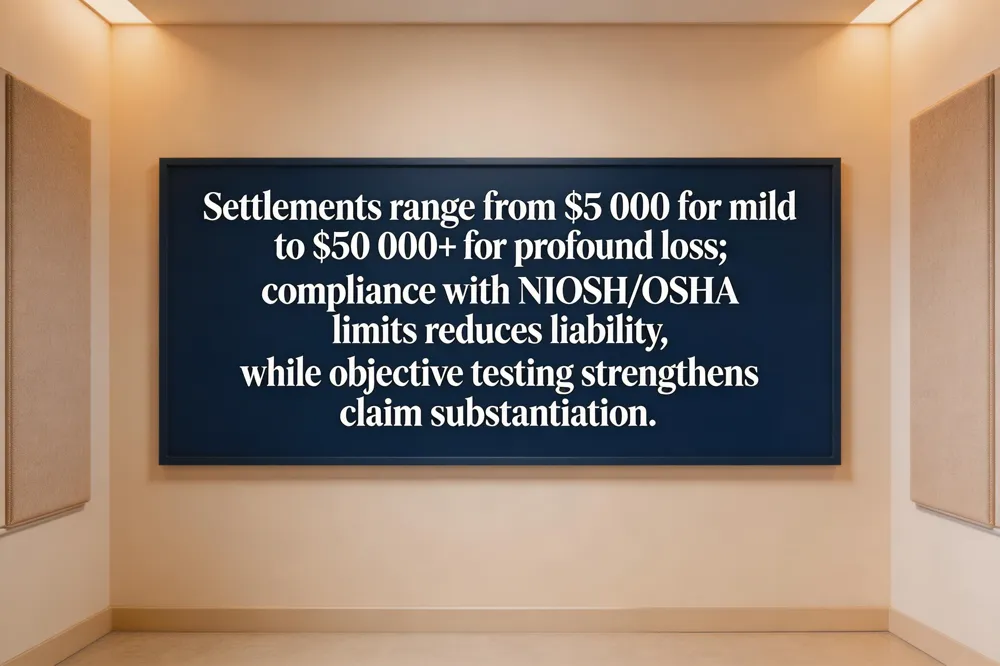 Industrial hearing‑loss settlements in the United States typically range from a few thousand dollars for the mildest cases to several tens of thousands for severe injuries. Slight or mild loss awards often fall between $5,000 and $12,000; moderate loss claims settle between $12,000 and $30,000; and profound loss can command $30,000‑$50,000 or more, especially when earning capacity is markedly reduced.
NIOSH recommends that occupational noise exposure not exceed an 8‑hour time‑weighted average (TWA) of 85 dBA, based on a 3‑dB exchange rate. Exceeding this level triggers the need for a hearing‑conservation program and engineering or administrative controls.
OSHA’s noise standards set a permissible exposure limit of 90 dBA TWA for an 8‑hour shift, with an action level of 85 dBA TWA. When the action level is met, employers must implement a hearing‑conservation program, conduct baseline and annual audiograms, provide fit‑tested hearing protectors, and train workers. Impulsive noise may not exceed 140 dB peak SPL.
Objective Electrophysiology: BAER/ABR, ASSR Eclipse, and Their Role in Claims
 What is a brainstem auditory evoked response (BAER/ABR)?
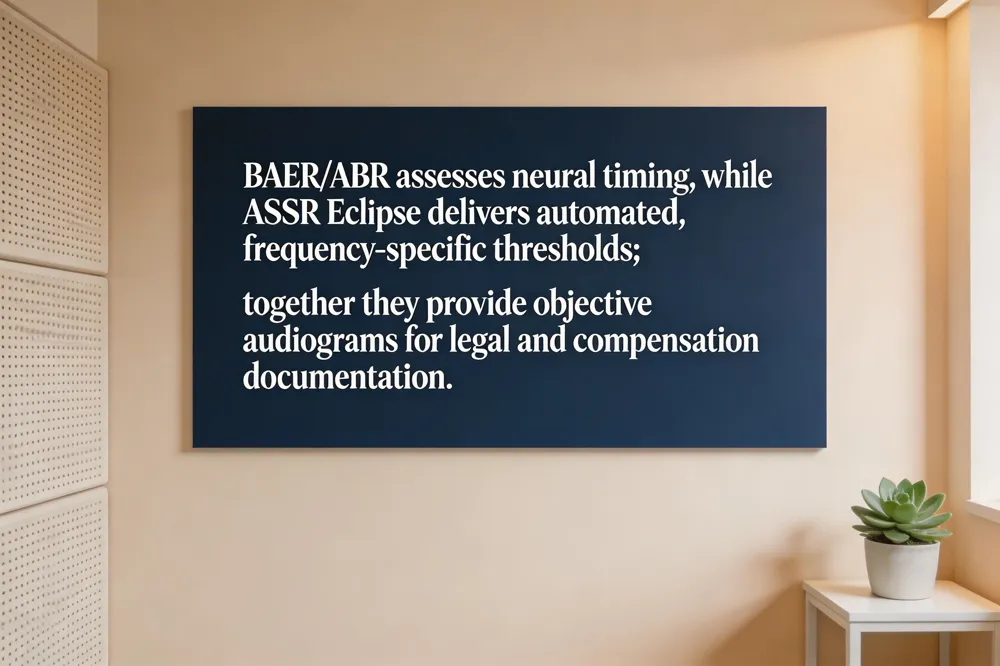
A BAER (also called ABR) records the electrical activity of the auditory nerve and brainstem in response to brief clicks or tone bursts. Surface electrodes capture a series of waveform peaks that reflect sequential neural relays from the cochlea through the auditory nerve, cochlear nucleus, superior olivary complex, and lateral lemniscus. By analyzing wave latencies and amplitudes, clinicians assess pathway integrity, estimate thresholds, and detect lesions, making the test essential for patients who cannot cooperate with behavioral audiometry.
What do abnormal ABR test results indicate in adults?
Delayed or absent waves, reduced amplitudes, or prolonged inter‑peak intervals suggest disruptions such as acoustic neuroma, brainstem lesions, demyelination, or severe sensorineural loss that impairs neural synchrony. These findings help localize the lesion and guide further evaluation.
What is ASSR Eclipse and how is it used?
ASSR Eclipse (Interacoustics) is an integrated hardware‑software platform that delivers amplitude‑/frequency‑modulated stimuli, records neural responses, and automatically estimates frequency‑specific hearing thresholds for both ears simultaneously. It is employed in workplace injury assessments when behavioral audiometry is impractical, providing objective audiograms for legal and insurance documentation.
Why is Pure‑tone audiometry important in occupational health?
Pure‑tone audiometry remains the gold‑standard for quantifying hearing sensitivity across standard frequencies, enabling detection of noise‑induced shifts, longitudinal monitoring, and precise documentation for OSHA‑compliant hearing‑conservation programs and workers‑compensation claims.
The Core Problem: Noise‑Induced Hearing Loss and Its Hazards
 What is the most common workplace problem related to hearing loss?
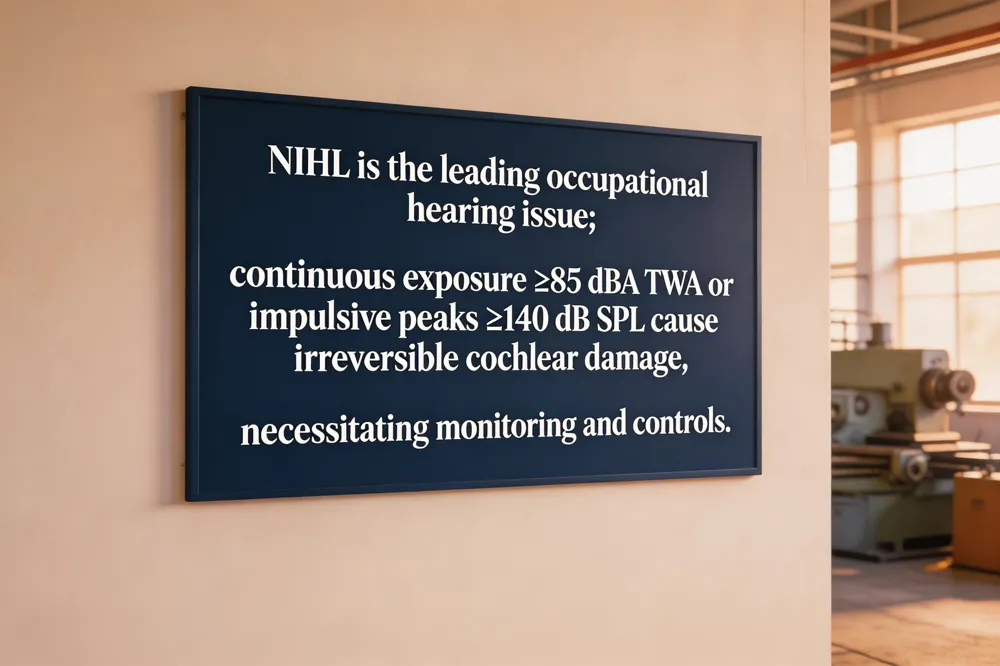
Noise‑induced hearing loss (NIHL) is the most prevalent occupational hearing issue. Prolonged exposure to high‑decibel environments—construction sites, manufacturing plants, mines, and transportation hubs—damages cochlear hair cells, producing gradual, often irreversible, impairment. In 2018, 25 % of U.S. workers reported occupational noise exposure, and the resulting legal and insurance claims make NIHL a critical focus for expert medical evaluation. Robust hearing‑conservation programs, baseline audiograms, and regular monitoring are essential to mitigate this hazard.
What impulse or impact noise level is considered hazardous for hearing?
Impulse or impact noise that peaks at ≈140 dB SPL is deemed hazardous. OSHA’s noise standard (29 CFR 1910.95) specifies that exposure to impulsive noise should not exceed 140 dB peak, as such levels can cause immediate acoustic trauma and quickly surpass permissible exposure limits. Continuous noise becomes hazardous at 85 dBA TWA (NIOSH REL). Therefore, any impulse‑noise event ≥140 dB SPL must trigger engineering controls, fit‑tested hearing protection, and prompt audiometric surveillance.
Putting It All Together: A Future‑Ready Hearing Conservation Strategy
Auditory Steady‑State Response (ASSR) complements pure‑tone audiometry by providing objective, frequency‑specific thresholds even when workers cannot cooperate, such as during language barriers, fatigue, or legal disputes. ASSR’s statistical detection (F‑test, FFT) yields reproducible results within 10‑15 dB of behavioral thresholds, enhancing early detection of high‑frequency and hidden hearing loss that pure‑tone testing may miss. Legally, ASSR data are less vulnerable to malingering and thus strengthen workers’ compensation, insurance, and litigation claims. Clinically, rapid 20‑25‑minute assessments can be performed on‑site with insert earphones, supporting prompt retesting of suspected standard threshold shifts. Integrating ASSR into a comprehensive Hearing Conservation Program ensures compliance with OSHA/NIOSH standards, improves surveillance sensitivity, and provides robust, defensible evidence for both employer and employee protection.