Why Effective Communication Matters
Effective communication between insurance adjusters and attorneys is a cornerstone of efficient claim resolution. When parties exchange factual, concise updates promptly, claim timelines shrink dramatically—studies show a 15‑20 % reduction in overall duration and up to a 30 % decrease in litigation escalation. Regulatory frameworks reinforce this urgency: California law mandates claim acknowledgement within 15 days and investigation completion within 40 days, while the NAIC and OSHA require written documentation within 24 hours to meet compliance. Meeting these expectations not only avoids penalties but also safeguards the claimant’s right to a timely, fair settlement. Collaboration amplifies these advantages. Shared portals, standardized forms, and joint status meetings create a unified record, reduce duplicate requests, and ensure that medical evidence—such as audiograms or expert reports—is accurately reflected in valuation. Ultimately, a coordinated approach minimizes disputes, preserves attorney‑client privilege, maximizes the likelihood of a satisfactory, evidence‑based resolution for all stakeholders involved and reinforces trust throughout the process.
Foundations of Adjuster‑Attorney Interaction
Foundations of Adjuster‑Attorney Interaction
| Topic | Key Points |
|---|---|
| Roles | Adjuster: insurer’s investigator, minimizes payouts, gathers facts. <br>Attorney: protects claimant rights, evaluates damages, negotiates or litigates. |
| Legal & Ethical Boundaries | Adjuster must respect right to counsel; many states (e.g., FL, NY) prohibit direct contact with represented parties without consent. <br>Attorney must keep privilege intact, avoid unnecessary factual disclosures, label legal advice clearly. |
| Initial Contact Protocols | Verify adjuster identity, limit early statements to basic contact details, refrain from recorded statements until counsel is present. Document every interaction (date, time, name, summary) and follow up with an email recap. |
| Communication Tips | 1. Prepare concise incident summary and supporting documents. <br>2. Stick to factual information only. <br>3. Share only what is asked; do not volunteer extra details. <br>4. Keep a written log of each conversation and confirm in writing. <br>5. Consult an experienced workplace‑injury attorney early. |
| What Not to Say to Claim Adjuster | Admit fault, apologize, downplay injuries, speculate, agree to recorded statements, sign documents, post claim details on social media. |
| What Not to Say to Workmans Comp Adjuster | Give a recorded statement without counsel, guess/speculate about accident or medical history, admit fault, downplay severity, discuss unrelated health issues, provide unsolicited extra details. |
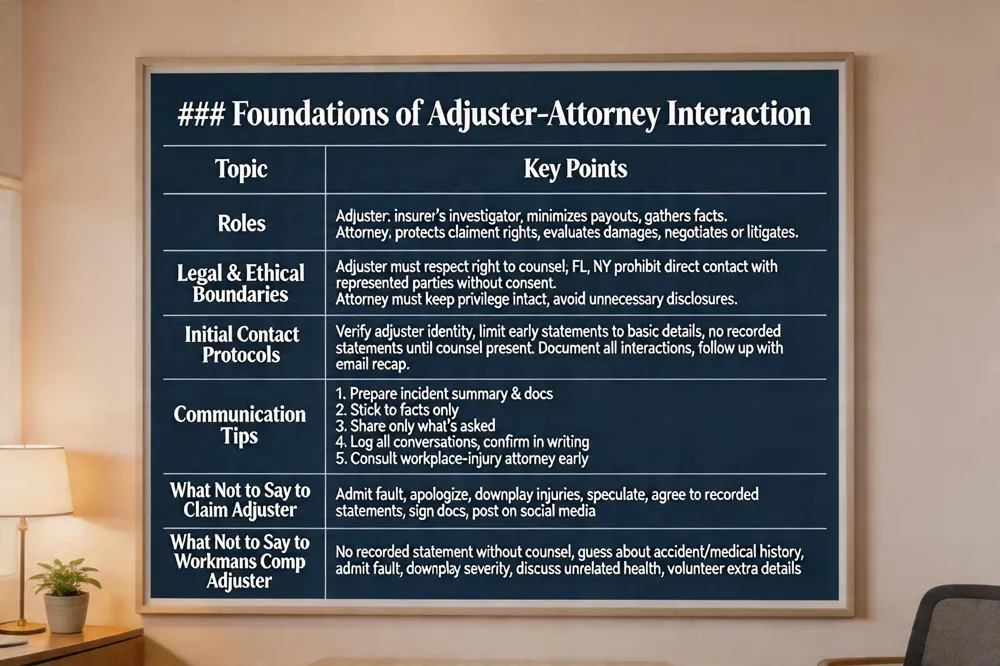 Roles of adjuster and attorney – Adjusters act as the insurer’s investigators, tasked with minimizing payouts while gathering facts. Attorneys protect the claimant’s rights, evaluate damages, and negotiate or litigate on the client’s behalf.Legal and ethical boundaries – Adjusters must respect the claimant’s right to counsel; many states (e.g., Florida, New York) prohibit direct communication with a represented party without consent. Attorneys must keep privilege intact by avoiding unnecessary factual disclosures and by labeling legal advice clearly.Initial contact protocols – Verify the adjuster’s identity, limit early statements to basic contact details, and refrain from recorded statements until counsel is present. Document every interaction (date, time, name, summary) and follow up with an email recap.
How to communicate with insurance adjusters? 1. Prepare a concise summary of the incident, diagnoses, and supporting documents before any call. 2. Stick to factual information only—no speculation or admissions of fault. 3. Share only what is asked; do not volunteer extra details or give recorded statements without an attorney. 4. Keep a written log of each conversation and confirm it in writing. 5. Consult an experienced workplace‑injury attorney early to guide responses and negotiate offers.
What not to say to claim adjuster? Do not admit fault, apologize, downplay injuries, speculate, agree to recorded statements, sign documents, or post claim details on social media.
What not to say to a Workmans Comp adjuster? Do not give a recorded statement without counsel, guess or speculate about the accident or medical history, admit fault, downplay severity, discuss unrelated health issues, or provide unsolicited “extra” details.
Navigating Workers’ Compensation in Texas
Navigating Workers’ Compensation in Texas
| Step | Action | Details |
|---|---|---|
| Report Injury | Submit written notice to employer within 30 days. | Must be in writing; keep a copy. |
| File Claim | Complete Texas DWC Form‑041 (Employee’s Claim for Compensation). | Submit to Division of Workers’ Compensation within 1 year of injury or when injury is realized. |
| Claim Number | Division assigns claim number and notifies employer/insurer. | Use this number for all subsequent communications. |
| Benefits | Medically necessary treatment, wage‑replacement (based on average weekly wage), survivor benefits if death occurs. | |
| Dispute / Appeal | If denied, appeal through state dispute‑resolution process; protected from employer retaliation. | Follow statutory timelines for filing appeals. |
| Expert Consultation | Use specialized consultants (e.g., NorCal Medical Consulting) for auditory‑loss assessments. | Strengthens claim and ensures proper compensation under Texas law. |
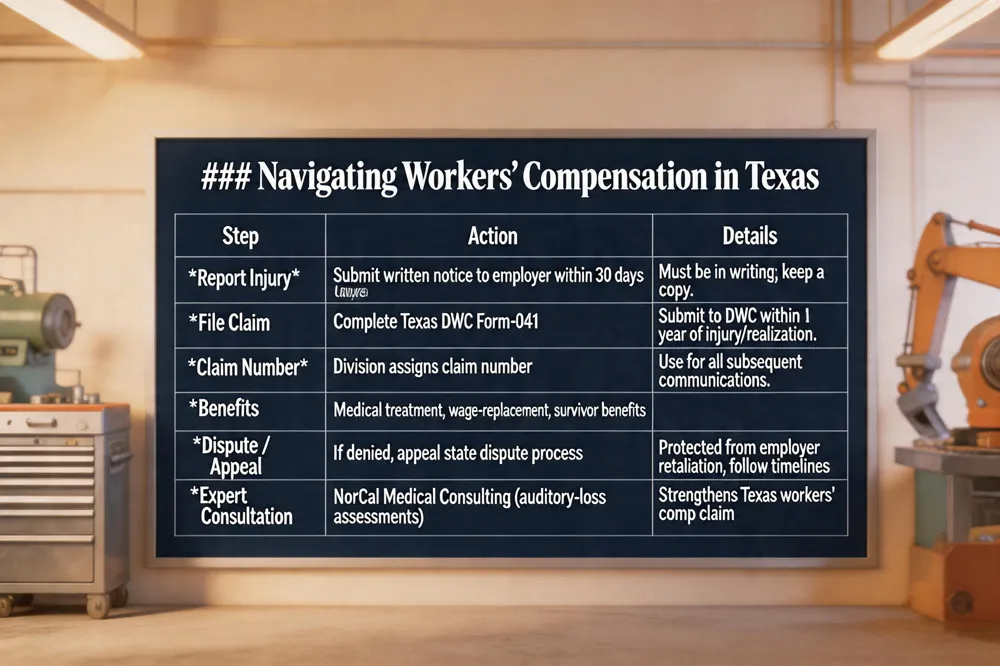 Texas workers’ compensation is overseen by the Texas Department of Insurance and is optional for most private‑sector employers, though required for public entities. To protect your rights, report any work‑related injury to your employer in writing within 30 days. Then complete the Texas DWC Form‑041 (Employee’s Claim for Compensation) and submit it to the Division of Workers’ Compensation within one year of the injury (or when you first realized it was work‑related). Keep copies of the form and all medical records. Once filed, the Division assigns a claim number, notifies the employer and insurer, and begins benefit evaluation. Covered employees receive medically necessary treatment, wage‑replacement benefits calculated from the average weekly wage, and, in case of death, survivor benefits. If you encounter a denial or dispute, you may appeal through the state’s dispute‑resolution process and are protected from employer retaliation. For specialized injuries such as auditory loss, NorCal Medical Consulting can provide expert assessments to strengthen your claim and ensure proper compensation under Texas law.
Medical Consultancy and Its Role in Claims
Medical Consultancy and Its Role in Claims
| Function | Description |
|---|---|
| Evaluation & Interpretation | Qualified healthcare experts review clinical records, audiograms, treatment plans to determine causation, severity, and compliance with occupational health standards. |
| Expert Report | Concise, evidence‑based report outlining injury extent, projected medical costs, functional impact; serves as factual backbone for valuation and litigation. |
| Business Model | Firms aggregate licensed physicians/allied health professionals; services offered on contingency or fee‑based models; include document review, expert testimony, strategic guidance. |
| Compliance & Deadlines | Ensure HIPAA compliance, meet statutory deadlines (e.g., California’s 40‑day investigation rule) to enhance claim valuation and reduce dispute risk. |
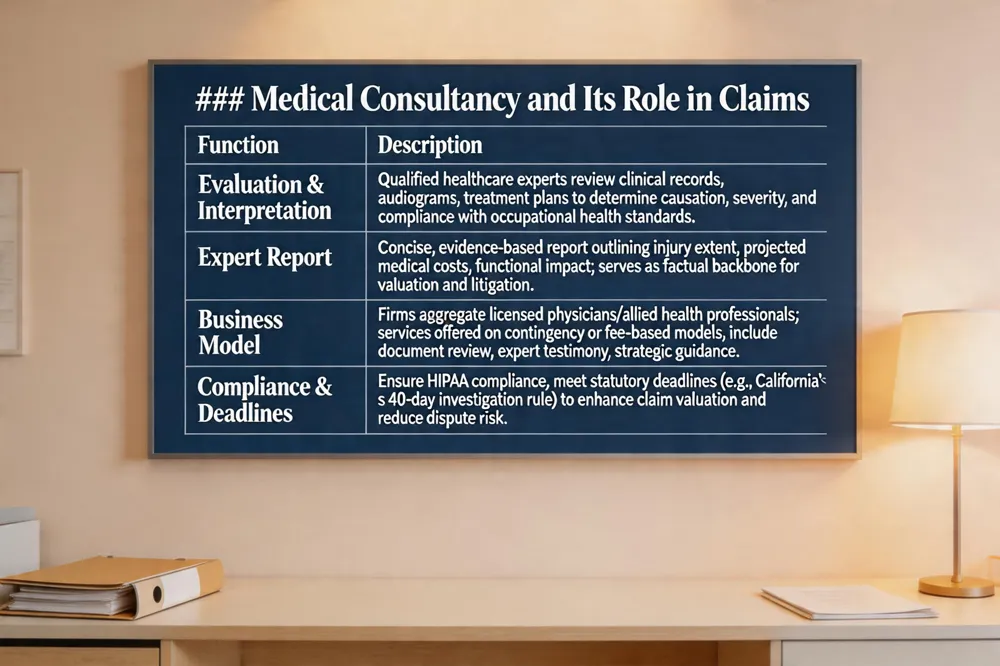 Medical consultancy is a specialized professional service in which qualified healthcare experts evaluate, interpret, and advise on medical matters for individuals, organizations, or legal entities. In workplace‑injury contexts—especially auditory‑loss claims—consultants analyze clinical records, audiograms, and treatment plans to determine causation, severity, and compliance with occupational health standards. Their expert reports become the factual backbone of claim valuation and litigation strategy.
A medical consultant reviews a claimant’s medical history, assesses whether diagnoses and treatments meet the accepted standard of practice, and identifies any gaps, negligence, or over‑treatment. The consultant then prepares a concise, evidence‑based report that outlines the extent of injury, projected medical costs, and functional impact on the worker’s ability to perform job duties. This report is used by attorneys and insurers to negotiate fair settlements or to support a bad‑faith claim when necessary.
A medical consulting business is a firm that aggregates licensed physicians and allied health professionals to deliver these services on a contingency or fee‑based model. It offers document review, expert testimony, and strategic guidance to ensure that medical evidence is presented clearly, complies with HIPAA, and aligns with statutory deadlines—such as California’s 40‑day investigation rule—thereby enhancing claim valuation and reducing the risk of costly disputes.
Handling Denials and Appeals
Handling Denials and Appeals
| Common Denial Reason | Action |
|---|---|
| Missing/Incomplete Documentation (photos, records, receipts) | Gather required docs, attach to appeal. |
| Missed Filing Deadline | Verify timeline, seek possible waiver, submit as promptly as possible. |
| Policy Exclusion | Review policy language, provide evidence the injury is covered. |
| Incorrect Patient/Provider Data | Verify demographics, correct errors, resubmit. |
| Non‑necessary/Experimental Services | Provide medical necessity justification, expert opinion. |
| Coding Errors | Review CPT/ICD codes, correct and re‑submit. |
| Lack of Prior Authorization | Obtain retroactive authorization if possible, attach proof. |
| Out‑of‑Network Services | Demonstrate necessity, request reimbursement per policy terms. |
| Coordination‑of‑Benefits Mismatch | Align claim with other insurers, provide coordination statements. |
Denial Management Steps 1️⃣ Review denial notice; identify specific code (e.g., CO 16, CO 109). 2️⃣ Verify patient demographics, injury dates, diagnosis codes. 3️⃣ Correct any errors; attach supporting evidence (accident reports, expert opinions). 4️⃣ Resubmit with proper denial claim number. 5️⃣ Use dedicated denial‑management team and automated claim‑scrubbing tools. 6️⃣ Track appeals in a secure portal to meet 48‑hour response windows. 7️⃣ Maintain documented communication with adjuster and attorney to preserve audit trail. |
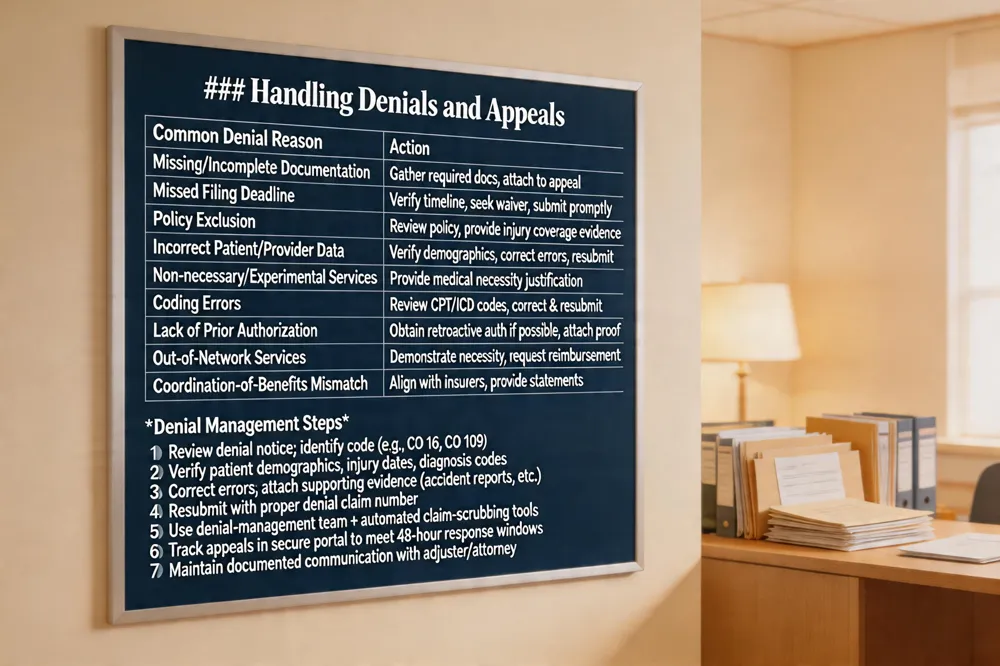 Common denial reasons – Insurers deny claims when required documentation is missing or incomplete (photos, medical records, receipts), when filing deadlines are missed, when the policy excludes the incident, when claim forms contain incorrect patient or provider data, and when services are deemed non‑necessary or experimental. Coding errors, lack of prior authorization, out‑of‑network services, and coordination‑of‑benefits mismatches also trigger denials.
Denial management steps – First, review the denial notice and identify the specific code (e.g., CO 16, CO 109). Verify all patient demographics, dates of injury, and diagnosis codes. Correct any errors, attach supporting evidence such as accident reports and expert medical opinions, and resubmit with the proper denial claim number. Establish a dedicated denial‑management team, use automated claim‑scrubbing tools, and track appeals in a secure portal to meet 48‑hour response windows. Prompt, documented communication with the adjuster and attorney preserves an audit trail and demonstrates good‑faith efforts.
Medical billing denials – A "Denial Management in Medical Billing" guide outlines root‑cause analysis, checklists for eligibility verification, and step‑by‑step appeal procedures, helping providers recover lost revenue and ensure timely reimbursement for occupational injury services such as auditory loss assessments.
Settlement Strategies and What to Avoid
Settlement Strategies and What to Avoid
| Do (Effective Practice) | Don’t (Pitfall) |
|---|---|
| Stick to verified injury facts and medical evidence. | Admit liability, speculate, or discuss personal finances. |
| Provide clear, factual summaries to adjuster. | Downplay injuries, guess about cause, or discuss future costs without expert input. |
| Consult an experienced injury attorney before any recorded statement or signing documents. | Give a recorded statement or sign any document without attorney counsel. |
| Document every interaction (date, time, participants, summary) in writing. | Discuss claim details on social media or with unrelated parties. |
Maintain disciplined communication to reduce lowball offers and preserve claim strength. |
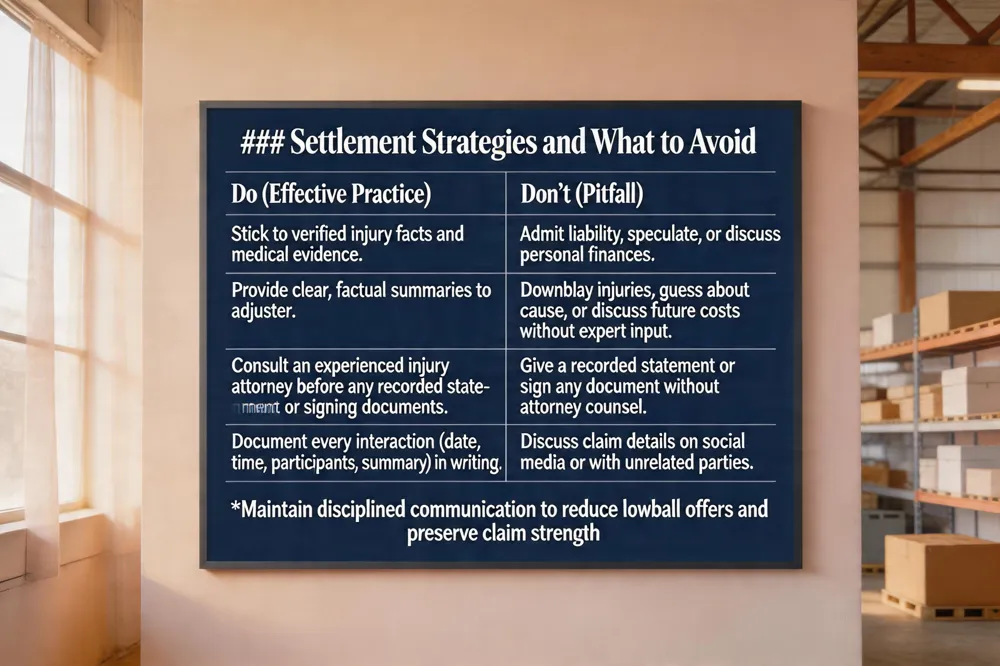 Effective settlement negotiations hinge on facts, discipline, and early attorney involvement. When you speak with an adjuster, stick strictly to verified injury facts and medical evidence; do not admit liability, speculate, or discuss personal finances, future costs, or prior settlements. Never give a recorded statement or sign any document without first consulting an experienced injury attorney, who can evaluate damages, preserve evidence, and negotiate on your behalf. In workers' compensation contexts, the same rules apply: avoid guessing, downplaying injuries, or linking pre‑existing conditions unless a qualified medical expert has done so. Document every interaction—date, time, participants, and summary—to create an audit trail that protects your rights and demonstrates good‑faith cooperation. By following these disciplined communication practices, you reduce the risk of lowball offers and preserve the strongest possible claim for fair compensation.
Best Practices for Claim Lifecycle Management
Best Practices for Claim Lifecycle Management
| Stage | Best Practice |
|---|---|
| Initial Contact | Promptly acknowledge claim, collect basic incident details, assign claim handler. |
| Evidence Gathering | Compile medical records, accident reports, witness statements, photos, wage‑loss docs; organize digitally. |
| Independent Medical Examination | Engage qualified medical expert to assess injury extent and impact. |
| Presentation & Negotiation | Use factual evidence and expert reports to negotiate; involve attorney early. |
| Litigation | Prepare for trial with comprehensive documentation; retain expert testimony. |
| 5 Ws | Who – injured employee, employer, others; What – specific injury; When – date/time of incident; Where – workplace location; Why – cause and legal significance. |
| Communication Protocols | Provide regular updates, maintain written logs, confirm verbal conversations in writing. |
| Triage & Assignment | Fast‑track simple claims; assign complex cases to specialists. |
| Digital Tools & Fraud Detection | Use secure collaboration platforms, automated claim‑scrubbing, and fraud analytics. |
| Resolution Best Practices (2022+) | Proactive communication, regular carrier reviews, reserve alerts, return‑to‑work programs, post‑accident investigations, annual compliance audits. |
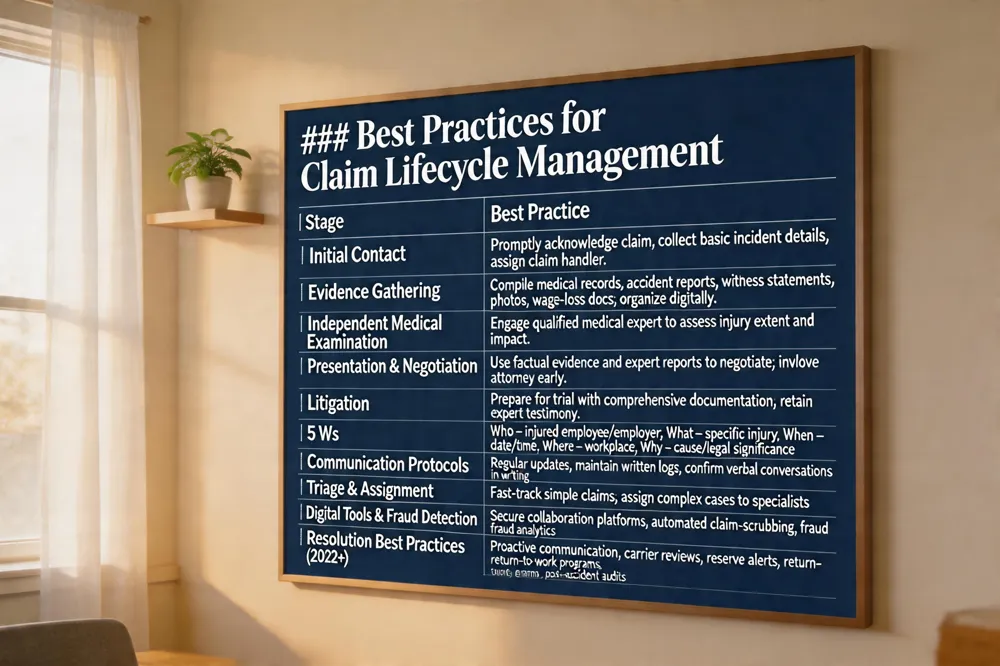 What are the stages of an injury claim? The process begins with an initial contact and assessment to determine claim viability. Next, all evidence—medical records, accident reports, witness statements, photographs, and wage loss documentation—is gathered. An independent medical examination then establishes injury extent and impact. With this factual base, the claim is presented and settlement negotiations commence. If negotiations fail, the case proceeds to litigation where a judge or jury decides liability and compensation.
What are the 5 W’s when submitting a claim?
- Who – injured employee, employer, and any other parties.
- What – specific injury (e.g., auditory loss) and supporting medical evidence.
- When – date and time of the incident and symptom onset.
- Where – workplace location of the injury.
- Why – underlying cause and the claim’s legal/insurance significance.
Claim handling best practices – Promptly acknowledge each claim and provide regular updates. Collect comprehensive, organized documentation, including expert audiometric reports. Use triage to fast‑track simple claims and assign complex cases to specialists. Conduct evidence‑based evaluations aligned with policy language, and employ secure digital tools for collaboration and fraud detection.
Claim resolution best practices 2022 – Implement proactive communication protocols with clear reporting channels and acknowledgment timelines. Schedule regular reviews with carriers and trigger alerts for large reserves. Integrate return‑to‑work programs and conduct post‑accident investigations to prevent repeat injuries. Perform annual audits to ensure compliance and continuous improvement.
Putting It All Together
Key takeaways: Effective adjuster‑attorney collaboration hinges on timely, documented, and factual exchanges. Both parties must respect statutory deadlines, protect privileged communications, and prioritize HIPAA‑compliant sharing of medical evidence. Actionable steps: 1) Establish a single point of contact on each side and agree on response‑time expectations (e.g., acknowledgment within 24 hours, substantive update within 48 hours). 2) Use a secure, cloud‑based portal for all records, tagging documents with concise, bullet‑point summaries. 3) Log every interaction—date, participants, and summary—in a centralized claim file. 4) Involve expert medical consultants early to translate technical findings into lay language for legal review. 5) Conduct weekly status calls to align on medical milestones, reserve levels, and settlement strategy. Future of adjuster‑Attorney collaboration: AI‑driven analytics and standardized claim‑management software will further streamline data exchange, reduce manual errors, and enable real‑time risk scoring. As technology matures, the partnership will shift from reactive troubleshooting to proactive case planning, shortening resolution timelines and preserving claimants’ rights.