Why Objective Audiometry Matters in Legal Contexts
Objective audiometric testing—most notably Auditory Steady‑State Response (ASSR)—has become indispensable in workers’ compensation and other legal matters because it yields examiner‑independent, reproducible threshold data that can be presented as court‑admissible evidence. Unlike pure‑tone audiometry, which relies on a patient’s behavioral responses, ASSR records the brain’s electrical activity to modulated tones, allowing accurate frequency‑specific thresholds even when the claimant is uncooperative, sedated, or has cognitive impairments. This eliminates the risk of malingering or effort‑related bias, a frequent concern for insurers and defense counsel. Behavioral audiometry also suffers from practical limitations: it is capped at 8 kHz, may miss high‑frequency noise‑induced loss, and can be compromised by language barriers, fatigue, or fear of testing. Objective measures can detect non‑notch high‑frequency patterns, differentiate sensorineural from conductive components, and provide statistical confidence intervals (e.g., F‑test or q‑sample analysis) that strengthen causation arguments linking occupational noise exposure to documented hearing loss. Consequently, integrating ASSR into a claimant’s evaluation package enhances the evidentiary foundation for establishing injury severity, causation, and appropriate monetary awards.
ASSR Overview and Clinical Utility
 What is ASSR?
The auditory steady‑state response (ASSR) is an objective electrophysiological test that estimates hearing thresholds by measuring the brain’s synchronized response to rapid, amplitude‑ and frequency‑modulated tones. Scalp electrodes record neural activity, and statistical algorithms analyze both amplitude and phase across multiple frequencies (commonly 500 Hz, 1 kHz, 2 kHz, and 4 kHz) simultaneously. Because it does not require patient cooperation, ASSR is valuable for infants, young children, sedated patients, or individuals unable to perform reliable behavioral audiometry. Results are presented as an estimated audiogram (eHL) after applying manufacturer‑specific correction factors, providing quantitative data for diagnosis, hearing‑aid fitting, and legal documentation.
Auditory steady‑state response (ASSR)
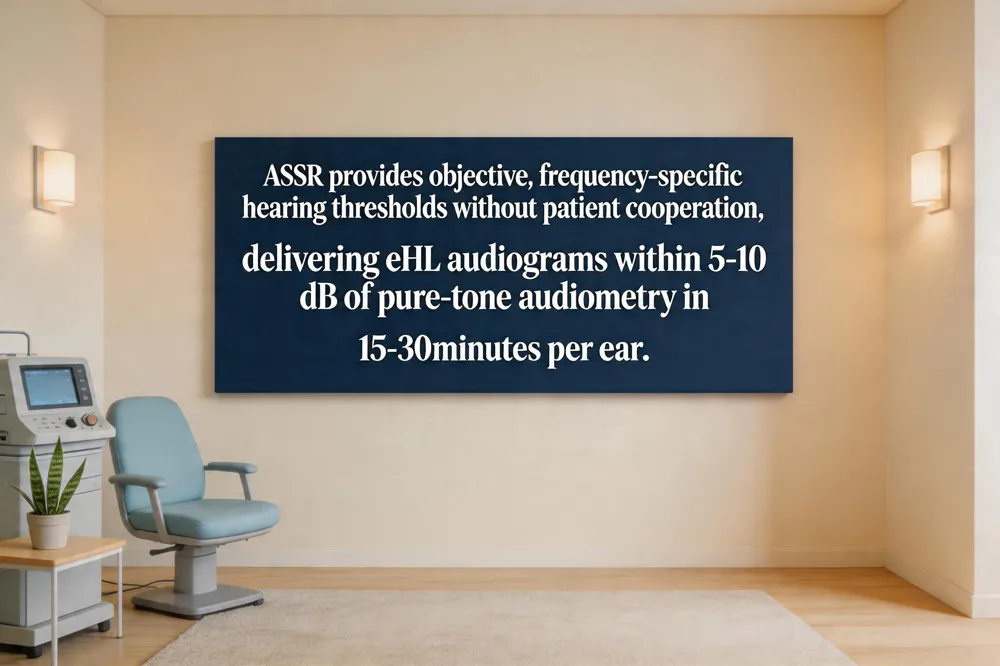
Unlike the auditory brainstem response (ABR), which relies on examiner interpretation of latency waveforms, ASSR uses statistical detection (F‑test, q‑sample) to determine response presence, yielding reproducible thresholds within 5‑10 dB of pure‑tone audiometry for moderate‑to‑severe loss. The test can assess air‑ and bone‑conduction pathways, differentiate conductive from sensorineural loss, and detect high‑frequency deficits (up to 8 kHz) often missed by conventional audiometry. Typical stimulus parameters include modulation rates of 80‑110 Hz, insert earphones delivering up to 100 dB HL, and electrode montage mirroring ABR (vertex active, ipsilateral mastoid reference, forehead ground). The automated algorithm stops recording once a statistically significant response is detected, reducing test time to 15‑30 minutes per ear and minimizing examiner bias—features that make ASSR a preferred objective tool in occupational injury assessments and workers’ compensation claims.
Practical Integration of ASSR into Compensation Cases
 Auditory Steady‑State Response (ASSR) testing provides an objective, examiner‑independent audiometric profile that is especially valuable when behavioral audiometry is unreliable. By delivering frequency‑specific thresholds (0.5, 1, 2, and 4 kHz) in both ears within 15‑30 minutes, ASSR creates a reproducible audiogram that can be directly compared to occupational exposure standards (NIOSH, OSHA) and legal threshold criteria (SSA, state compensation rules). Research consistently shows ASSR thresholds correlate within 5‑10 dB of pure‑tone audiometry, allowing the test to serve as a valid surrogate for establishing the degree of mild ( mild, moderate, severe, profound) in compensation claims.
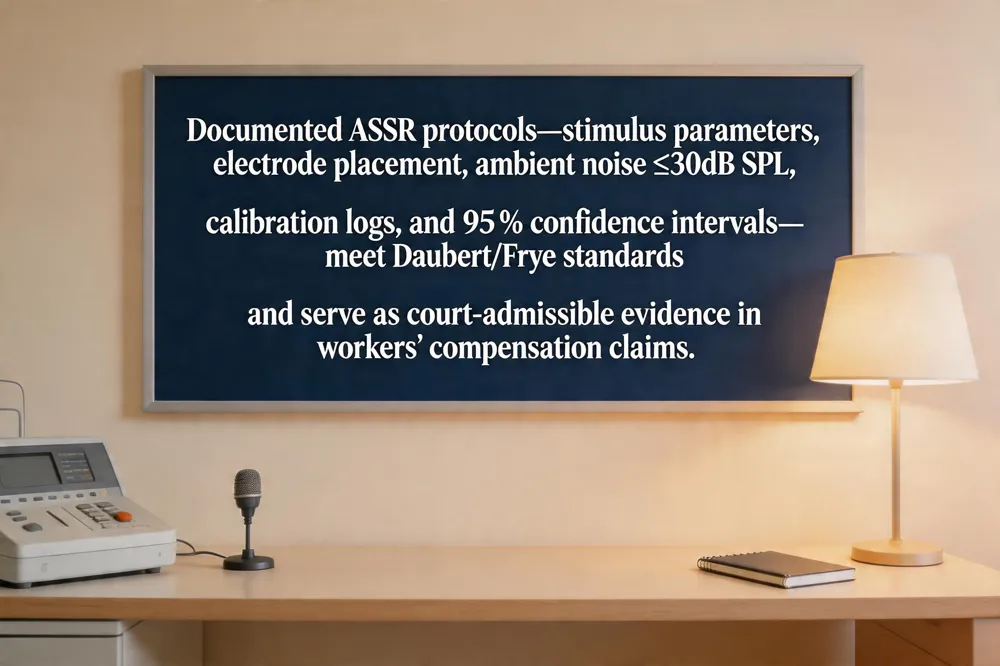
For admissibility, the report must document stimulus parameters, electrode placement, ambient‑noise limits (≤30 dB SPL), calibration logs, signal‑to‑noise ratios, and statistical confidence intervals (e.g., 95 %). The audiogram should be presented in standard format, accompanied by a narrative that references professional guidelines (AAO‑HNS, OD104/115) and the appropriate CPT code (92652) for threshold‑search ASSR. Such detailed documentation meets Daubert/Frye standards and minimizes challenges to bias or malingering.
ASSR test results – ASSR provides an objective estimate of hearing thresholds across multiple frequencies, reported in estimated hearing level (eHL) after correction factors. The resulting audiogram quantifies loss severity and is court‑admissible evidence for workplace injury claims.
ASSR vs ABR – ABR records transient neural activity and is useful for neural integrity but may underestimate severe loss and requires longer testing. ASSR uses continuous, frequency‑specific stimuli, tests several frequencies simultaneously, yields more accurate high‑frequency thresholds, and is faster, making it preferable for legal and insurance evaluations.
ASSR correction factors – Raw nHL values are adjusted (0‑10 dB depending on frequency) to produce eHL thresholds that reflect real‑world audiometry. Applying these factors frequency‑by‑frequency ensures the final audiogram is defensible and aligns with legal impairment calculations.
Financial and Procedural Considerations for Claimants
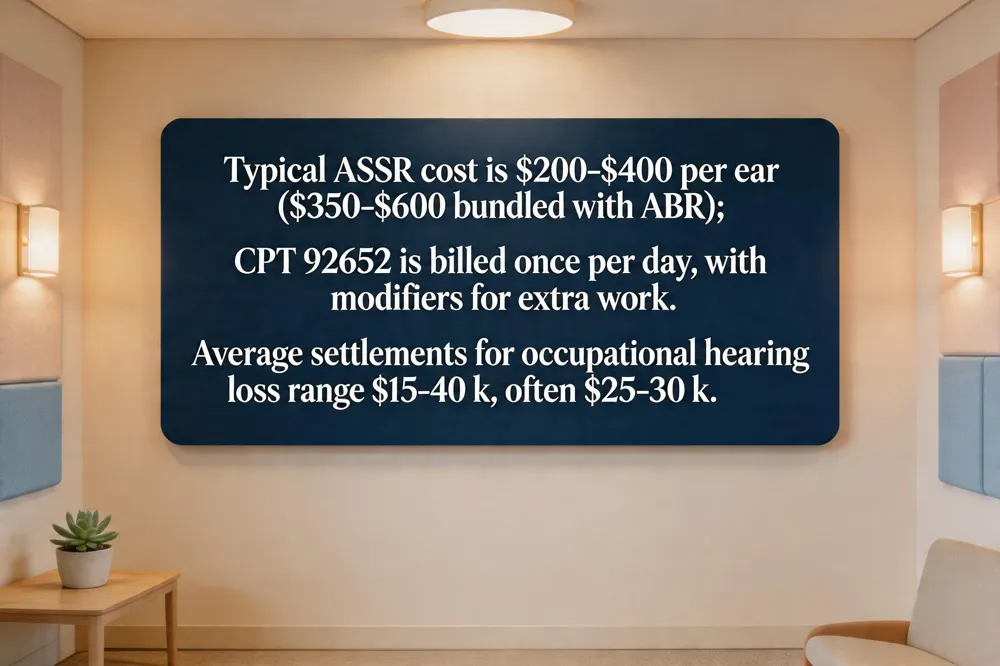 The Auditory Steady‑State Response (ASSR) test is an objective electrophysiological procedure that quantifies frequency‑specific hearing thresholds without requiring patient cooperation. Cost of ASSR testing and insurance coverage – In most U.S. clinics the test runs between $200 and $400 per ear; when bundled with an ABR the combined fee is typically $350‑$600. Prices rise in high‑cost markets such as California. Insurance, including Medicare and Medi‑Cal, will cover the test when it is deemed medically necessary for a workplace‑injury claim, but out‑of‑pocket fees are common, so claimants should request a detailed estimate and verify reimbursement beforehand. Billing codes (CPT 92652 and Medicare/Medicaid guidance – CPT 92652 is the appropriate code for threshold‑search ASSR testing (and for threshold‑search ABR). Only one 92652 may be billed per day; modifiers such as ‑22 can be added for additional work. Medicare and Medicaid follow the AMA’s 2021 CPT updates and require documentation of stimulus parameters, calibration logs, and response confidence levels to support payment. Typical settlement ranges for occupational hearing loss – A workers’ compensation settlement generally reimburses medical expenses, hearing‑aid fittings, and wage loss. Average awards for noise‑induced hearing loss fall between $15,000 and $40,000, with many cases settling around $25,000‑$30,000. The Judicial College Guidelines and state‑specific statutes guide these amounts; higher awards occur when the loss is severe, permanent, or linked to a high‑risk occupation. Key factual points – The ASSR test duration is 10‑30 minutes per ear, allowing rapid data collection. The objective, statistically‑validated thresholds (within 5‑10 dB of pure‑tone audiometry) provide credible, court‑admissible evidence that strengthens the claimant’s causal link to occupational noise exposure and supports a fair compensation outcome.
Occupational Noise Exposure and Preventive Strategies
 Occupational noise exposure
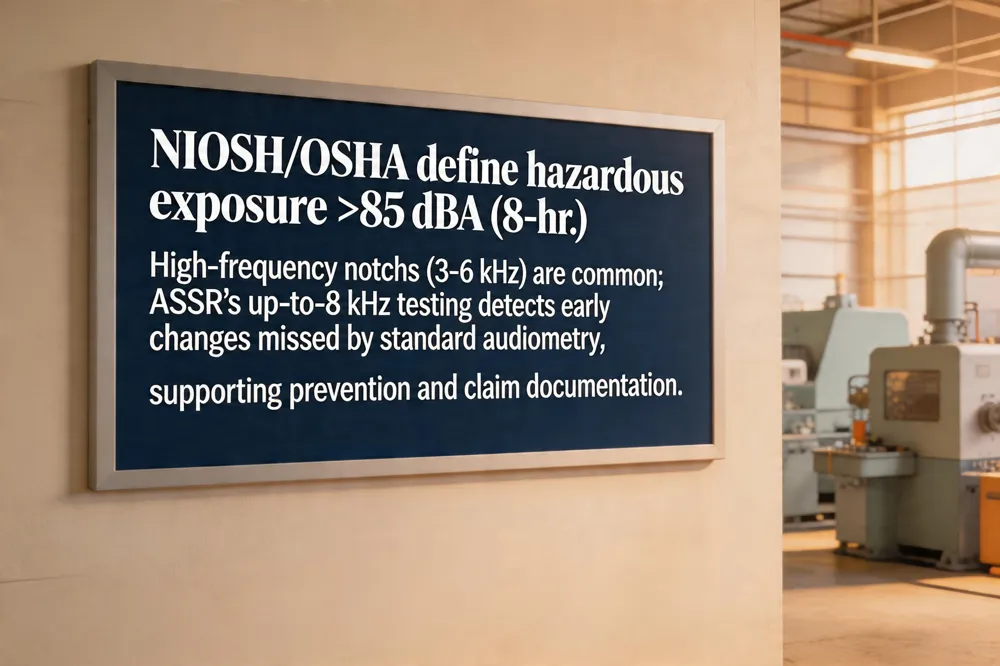
Workers exposed to sound levels above 85 dBA (NIOSH recommended limit) for an eight‑hour shift are at risk for permanent noise‑induced hearing loss. OSHA mandates a hearing‑conservation program once exposures reach the 85 dBA action level or 90 dBA exceedance level, including engineering controls, regular audiometric monitoring, and provision of hearing‑protective devices. Objective testing such as Auditory Steady‑State Response (ASSR) offers examiner‑independent threshold data, especially for high‑frequency loss that may be missed by conventional audiometry. NorCal Medical Consulting integrates ASSR results with exposure histories to produce expert reports for legal and insurance claim.
Occupational hearing loss statistics
Approximately 27 million U.S. workers are exposed to hazardous noise each year, and 22 million encounter ototoxic chemicals. Among noise‑exposed employees, 20 % demonstrate a material hearing impairment and 13 % have bilateral loss, yet over half do not use protection. The prevalence of noise‑induced hearing loss has declined only marginally over three decades, underscoring the need for robust monitoring and objective documentation, such as ASSR threshold estimates to substantiate causation in compensation cases.
Most occupational hearing loss occurs at high frequency levels
The prevailing pattern of occupational hearing loss is a high‑frequency notch at 3–6 kHz, not low‑frequency loss. High‑frequency damage compromises speech understanding and is the focus of OSHA and NIOSH hearing‑conservation programs. ASSR’s ability to assess frequencies up to 8 kHz (and beyond) makes it indispensable for detecting these early high‑frequency changes, strengthening the evidentiary basis for workers’ compensation and litigation.
Emerging Therapies and Future Directions
 The landscape of hearing‑loss treatment is evolving rapidly, yet current options remain limited for workers who have sustained occupational auditory injury. The most advanced therapeutic breakthrough to date is a single‑injection gene‑therapy that delivers a functional copy of the OTOF gene to the inner ear via an adeno‑associated virus. Early clinical data show restoration of hearing within weeks in all ten patients treated for congenital deafness, and researchers are adapting the platform for noise‑induced sensorineural loss. Parallel efforts focus on hair‑cell regeneration; inhibition of the Notch pathway with a gamma‑secretase inhibitor prompts supporting cells in the adult cochlea to transdifferentiate into new sensory hair cells, partially reversing hearing loss in animal models. Nanoparticle‑based delivery systems further enhance the stability and distribution of growth‑factor therapies inside the cochlea.
Most work‑related hearing loss can be reversed with treatment
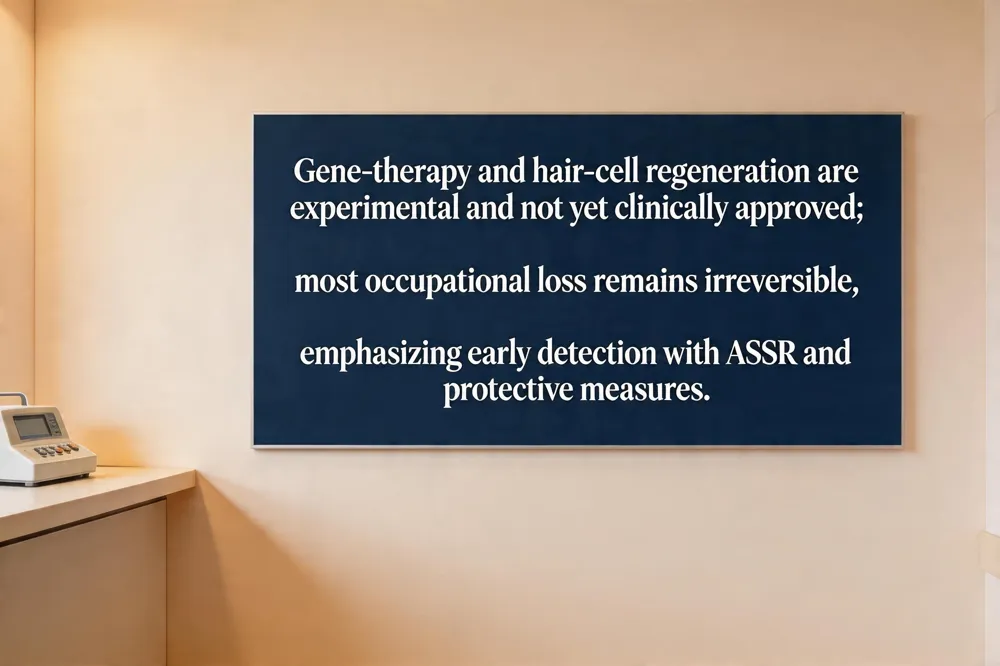
No. The majority of occupational hearing loss is sensorineural, resulting from irreversible damage to hair cells or the auditory nerve. Presently, only devices such as hearing aids and cochlear implants can amplify or bypass the deficit; they do not restore native auditory function. Gene‑therapy and hair‑cell regeneration remain experimental and are not yet approved for widespread human use. Consequently, most work‑related hearing loss cannot be reversed with existing treatments, underscoring the importance of early detection, preventive hearing protection, and accurate objective assessment—such as Auditory Steady‑State Response (ASSR) testing—to support compensation claims.
Potential impact on compensation assessments
As these emerging therapies progress toward clinical availability, expert witnesses will need to integrate objective ASSR data with emerging therapeutic outcomes to quantify residual impairment, guide causation analysis, and adjust monetary awards accordingly.
Practical Resources for Claimants and Professionals
 Free online hearing screenings and their limitations
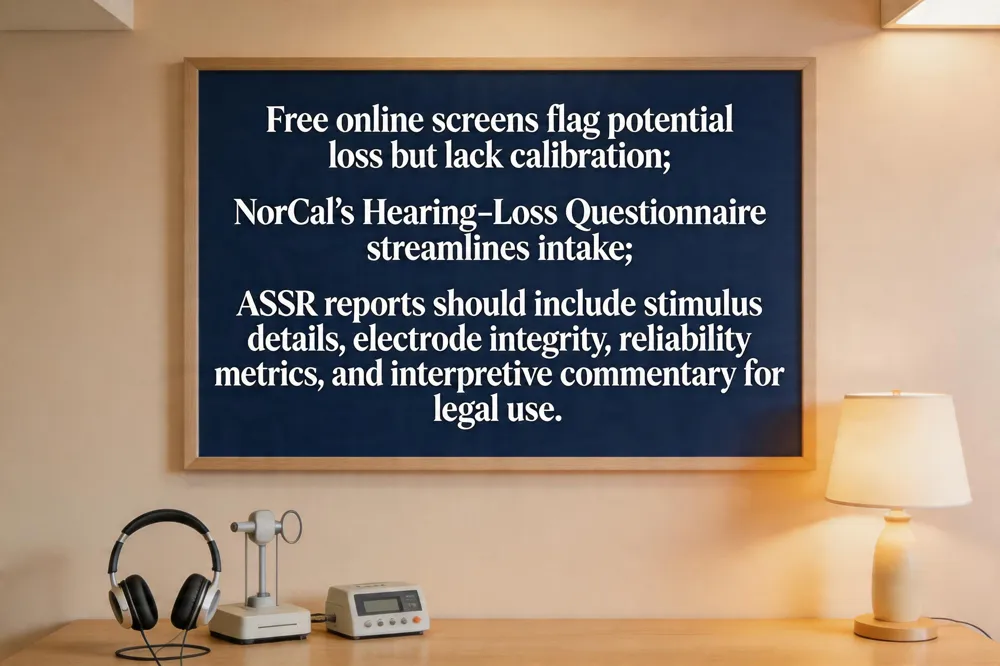
Free online hearing tests, such as those offered by major manufacturers and public health sites, allow a quick three‑to‑five‑minute screen in a quiet room using headphones or earbuds. They are useful for flagging potential loss but cannot replace a full audiologic evaluation by a licensed audiologist. Results are limited to broad frequency bands, lack calibrated stimulus levels, and are vulnerable to ambient noise and user error. If a screen suggests a problem, an in‑person examination—including pure‑tone audiometry, speech testing, and, when needed, objective measures like ASSR—is required to determine exact thresholds, type of loss, and appropriate treatment or compensation strategies.
Free online hearing screenings and their limitations
Free online hearing tests, such as those offered by major manufacturers and public health sites, allow a quick three‑to‑five‑minute screen in a quiet room using headphones or earbuds. They are useful for flagging potential loss but cannot replace a full audiologic evaluation by a licensed audiologist. Results are limited to broad frequency bands, lack calibrated stimulus levels, and are vulnerable to ambient noise and user error. If a screen suggests a problem, an in‑person examination—including pure‑tone audiometry, speech testing, and, when needed, objective measures like ASSR—is required to determine exact thresholds, type of loss, and appropriate treatment or compensation strategies.
Hearing‑loss questionnaire PDF from NorCal Medical Consulting NorCal Medical Consulting provides a downloadable "Hearing Loss Questionnaire" PDF that patients complete before their appointment. The form captures the onset and progression of hearing difficulty, occupational noise exposure, use of hearing aids, tinnitus, ear pain, and a functional‑impact scale measuring social and emotional effects. The questionnaire streamlines the intake process, ensures that relevant exposure history is documented, and allows the consulting team to tailor the objective testing protocol (e.g., ASSR, ABR, OAE) to the claimant’s specific circumstances. The PDF is available on the NorCal Medical Consulting website under the Resources section or can be requested via email or phone.
Guidance on interpreting ASSR reports for legal use An Auditory Steady‑State Response (ASSR) report presents statistically derived hearing thresholds across multiple frequencies (typically 0.5‑4 kHz, extending to 8 kHz when needed). Key elements for legal admissibility include:
- Stimulus parameters – modulation rates, carrier frequencies, and intensity levels used during testing.
- Electrode integrity – impedance values and placement diagram to confirm reliable recording conditions.
- Reliability metrics – signal‑to‑noise ratios, confidence intervals, or F‑test values that indicate the statistical significance of each threshold estimate.
- Comparison to behavioral data – when available, a side‑by‑side audiogram showing ASSR versus pure‑tone or ABR results, typically within 5‑10 dB, reinforcing validity.
- Interpretive commentary – a professional opinion linking the objective thresholds to occupational exposure (e.g., a high‑frequency notch consistent with noise‑induced loss) and recommendations for further evaluation or rehabilitation.
In workers’ compensation or personal‑injury claims, the ASSR report serves as objective, examiner‑independent evidence of hearing loss. Courts and insurers favor such data because it reduces the risk of malingering, is reproducible across testing sites, and aligns with recognized professional guidelines (American Academy of Audiology, ASHA, ISO). Proper documentation of test environment (ambient noise ≤30 dB SPL), equipment calibration logs, and patient state (awake, sedated, or sleeping) further strengthens the evidentiary weight of the ASSR findings.
How to interpret ASSR confidence intervals Confidence intervals in an ASSR report quantify the statistical certainty of each threshold estimate. A narrow interval (e.g., ±5 dB) indicates high reliability, whereas a wide interval (e.g., ±15 dB) suggests greater uncertainty, often due to low signal‑to‑noise ratio or patient movement. Legal experts should focus on thresholds with tight intervals when establishing the degree of loss, and they may request repeat testing or supplemental objective measures for frequencies with wide intervals to ensure a robust evidentiary record.
Putting It All Together: ASSR as a Cornerstone of Compensation Cases
Auditory Steady‑State Response (ASSR) testing combines strong clinical validity with high legal credibility, making it indispensable in occupational hearing‑loss claims. Clinically, ASSR objectively estimates frequency‑specific thresholds from 0.5 kHz up to 8 kHz (or higher), correlates within 5–10 dB of pure‑tone audiometry, detects high‑frequency notch patterns typical of noise exposure, and can be performed on patients who cannot cooperate. Legally, ASSR provides examiner‑independent, reproducible data that withstands Daubert and Frye scrutiny, is endorsed by the American Academy of Audiology, ASA, and OSHA guidelines, and is reimbursable under CPT 92652 and Medi‑Cal HCPCS X4522. Courts and insurers routinely give greater weight to ASSR because it eliminates patient effort bias and can be documented with waveform analyses, signal‑to‑noise ratios, and confidence intervals. Claimants who suspect work‑related hearing loss should promptly consult a qualified audiologist to obtain an ASSR study, integrating the results with exposure histories to strengthen their compensation claim and pursue the benefits you deserve.