Why Collaboration Matters
Early joint involvement of attorneys and insurance adjusters sets the tone for a claim’s trajectory. When medical experts such as NorCal Medical Consulting are consulted within the first 48‑72 hours, injury severity and causation are documented before insurers can deploy low‑ball offers or delay tactics. This proactive stance forces the insurer to base its evaluation on complete, expert‑verified data, reducing the risk of bad‑faith denials.
Typical friction arises from mismatched expectations about documentation, response times, and the role of legal advice versus adjuster functions. Adjusters may request redundant records, while attorneys worry that recorded statements could waive privilege. Misaligned communication schedules and unclear point‑of‑contact designations further exacerbate delays.
Shared, secure digital platforms—cloud‑based case portals with version‑controlled file sharing—eliminate silos. Real‑time access to medical reports, claim forms, and settlement notes lets both sides verify facts, track deadlines, and coordinate strategy, cutting processing time by up to 30 percent and improving settlement outcomes for claimants.
Establish Clear Communication Protocols
Response‑Time Expectations
| Interaction | Expected Acknowledgment | Expected Turn‑around |
|---|---|---|
| New request (e.g., medical record) | within 24 hours | within 48 hours |
| Follow‑up inquiry | within 24 hours | within 48 hours |
| Settlement draft review | within 24 hours | within 72 hours |
| Urgent safety issue | immediate (≤ 4 hours) | immediate (≤ 24 hours) |
All communications must flow through a secure, HIPAA‑compliant digital hub that logs timestamps and user IDs.
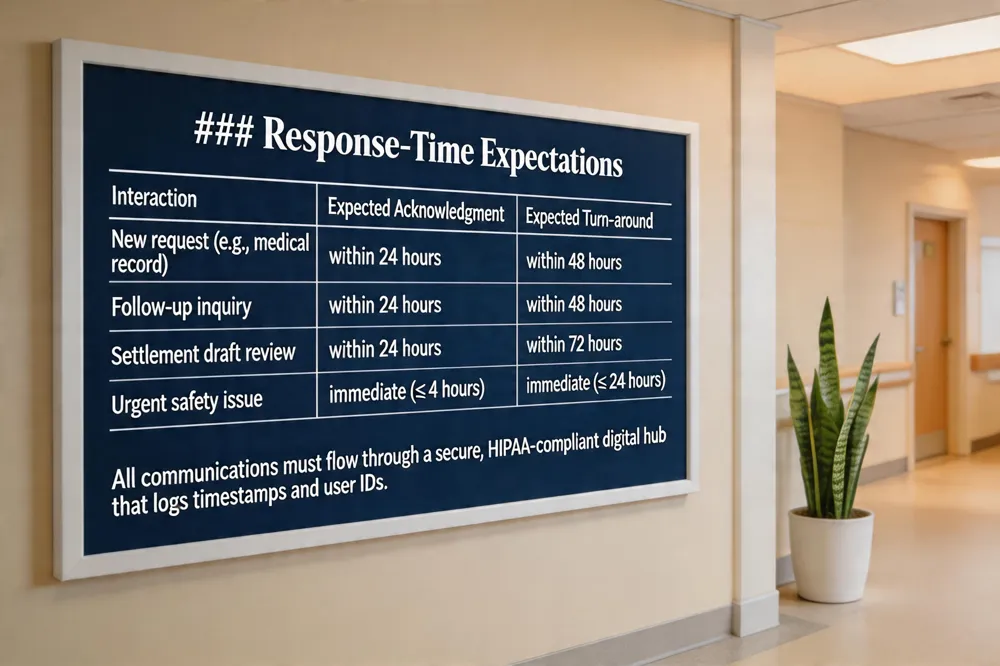 Effective communication between insurance adjusters and attorneys begins with a written definition of each party’s role and responsibility. A simple RACI chart or checklist prevents overlap and makes clear who is the point‑of‑contact for medical records, legal strategy, and policy interpretation. Once roles are set, both sides agree on response‑time expectations—typically a 24‑hour acknowledgment of requests and a 48‑hour turnaround for substantive documents—so that delays (the “3 D’s” of delay, deny, defend) are minimized. All information should flow through a secure, shared digital hub—such as a cloud‑based case‑management portal with HIPAA‑compliant encryption—allowing real‑time access to medical reports, expert opinions from firms like NorCal Medical Consulting, and settlement drafts while preserving an audit trail.
What not to say to a claims adjuster? Do not admit fault, apologize, or downplay injuries (e.g., “I’m fine”). Avoid speculation about the accident, agreeing to recorded statements, or discussing prior conditions without medical corroboration. Never sign settlement paperwork or disclose details on social media before consulting an attorney.
What not to say to a Workmans Comp adjuster? Never give a recorded statement without legal counsel, guess the cause of the injury, or mention unrelated medical history. Do not concede you can return to work or that pain is minor, and do not accept or sign any settlement offer without attorney review. These safeguards protect claim value and ensure the‑faith requirements.
By instituting clear protocols, parties reduce friction, meet statutory deadlines, and keep the claim on a fast, transparent track toward a fair resolution.
Leverage Expert Medical Insight Early
Compensation Ranges for Auditory Loss (Workers’ Comp)
| Severity | Typical Award Range | Key Medical Inputs |
|---|---|---|
| Minor (temporary loss) | $5 k – $10 k | Audiogram baseline, short‑term therapy cost |
| Moderate (partial permanent loss) | $10 k – $30 k | Audiometric decline, projected hearing aid expense |
| Severe (full permanent loss) | $50 k – $150 k+ | Expert report, long‑term rehabilitation, loss of earning capacity |
Early expert reports from NorCal Medical Consulting provide the objective data needed to justify these amounts.
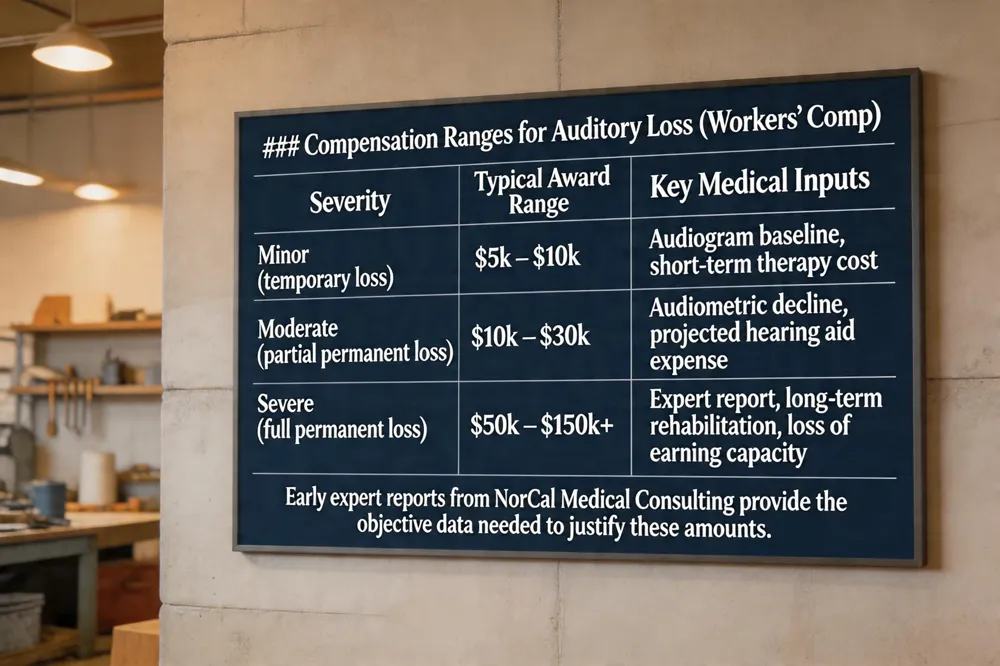 Early involvement of a specialist such as NorCal Medical Consulting is essential for workers’ compensation claims involving auditory loss. NorCal’s audiometric testing—conducted within 30 days of injury per AAO‑HNS guidelines—creates an objective baseline and quantifies the degree of hearing impairment. Their peer‑reviewed expert reports translate these audiograms into clear medical findings, projected treatment needs, and economic loss calculations. When attorneys incorporate these reports into their legal strategy, they can counter insurer tactics that downplay severity, substantiate the causation link, and justify higher compensation.
Workers' compensation benefits – The program covers all medically necessary treatment, wage replacement for temporary or permanent disability, vocational rehabilitation, and death benefits.
How much compensation can you get for an injury at work? – Awards vary by injury severity and projected costs; minor injuries may yield a few thousand dollars, moderate injuries $10‑30 k, and severe permanent loss, as in permanent hearing loss, $50‑150 k or more, plus special damages for medical expenses and lost earnings. Early expert input helps secure the full, fair value.
Standardize Documentation and Timelines
Unified Claim Checklist
| Item | Description | Owner |
|---|---|---|
| Injury description | Detailed account of incident & injury | Attorney |
| Medical records | Full set of treatment notes, audiograms, imaging | Adjuster |
| Witness statements | Signed statements from coworkers or bystanders | Attorney |
| Wage‑loss calculation | Average weekly wage × disability weeks | Adjuster |
| Expert report | Diagnosis, prognosis, economic loss | Medical Consultant |
| Claim filing | Completed claim form (CA‑1/CA‑2) submitted | Attorney |
| Settlement negotiation | Offer/ counter‑offer documentation | Joint |
All items are stored in a version‑controlled case‑management platform with automated deadline alerts.
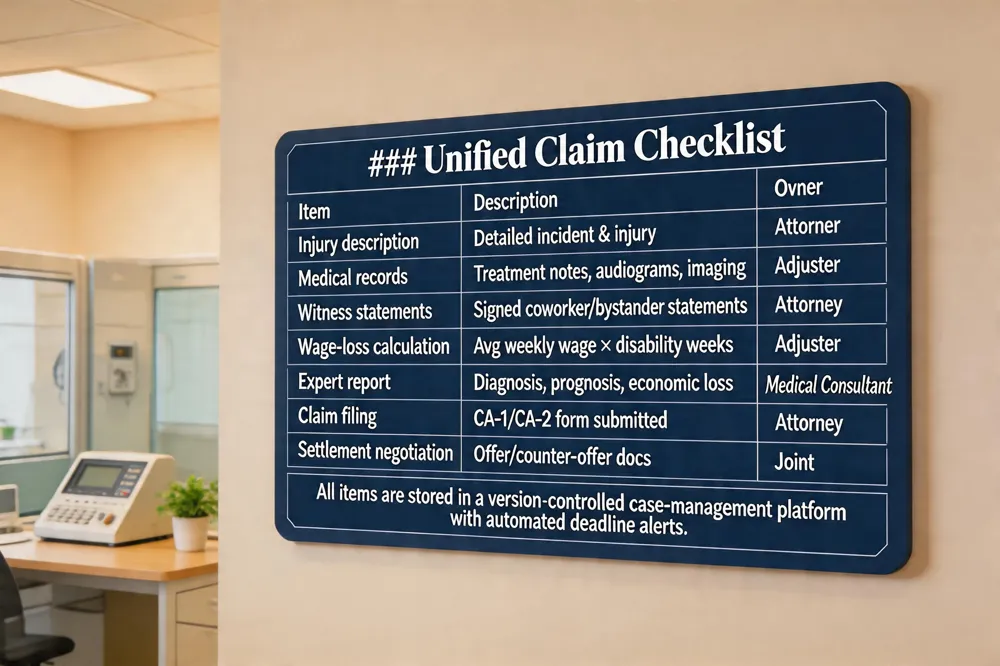 Effective claim handling begins with a shared checklist and standardized claim forms that capture every required data point—injury description, medical records, witness statements, and wage‑loss calculations. By using a single, vetted template, both adjusters and attorneys eliminate duplicate requests and reduce the risk of missing critical evidence.
A centralized case‑management platform (e.g., CARET Legal, CLAIMSmanager) serves as a secure, real‑time repository for all documents, notes, and communications. Version‑controlled file sharing ensures that every party reviews the same latest medical reports, expert opinions from firms like NorCal Medical Consulting, and settlement offers.
Setting milestone deadlines—initial injury report, medical evaluation, expert report, claim filing, and settlement negotiation—creates a transparent timeline. A shared project calendar with automatic alerts keeps the claim on schedule and prevents the “delay tactics” insurers often employ.
Workers' comp settlement chart Georgia
The Georgia Workers’ Comp Settlement Chart assigns fixed weeks of Permanent Partial Disability (PPD) to each body part. In 2026 the weekly benefit caps at two‑thirds of the employee’s average weekly wage (up to $800). Example caps: 225 weeks for an arm/leg, 60 weeks for a thumb, 75 weeks for loss of hearing in one ear. Temporary Total Disability (TTD) pays up to $800/week for up to 400 weeks; Temporary Partial Disability (TPD) pays up to $533/week for up to 350 weeks. Total settlement = weekly rate × assigned weeks, often ranging from a few thousand to over $100,000. An attorney can interpret the chart and negotiate a fair payout.
How long do you have to file a workers' comp claim in Georgia?
Georgia provides a one‑year filing window from the injury date. Claimants must give written notice to the employer within 30 days; otherwise, benefits may be forfeited. If benefits cease, a two‑year period is available to seek additional compensation. Death benefits must be filed within one year of death.
Utilize Technology for Real‑Time Collaboration
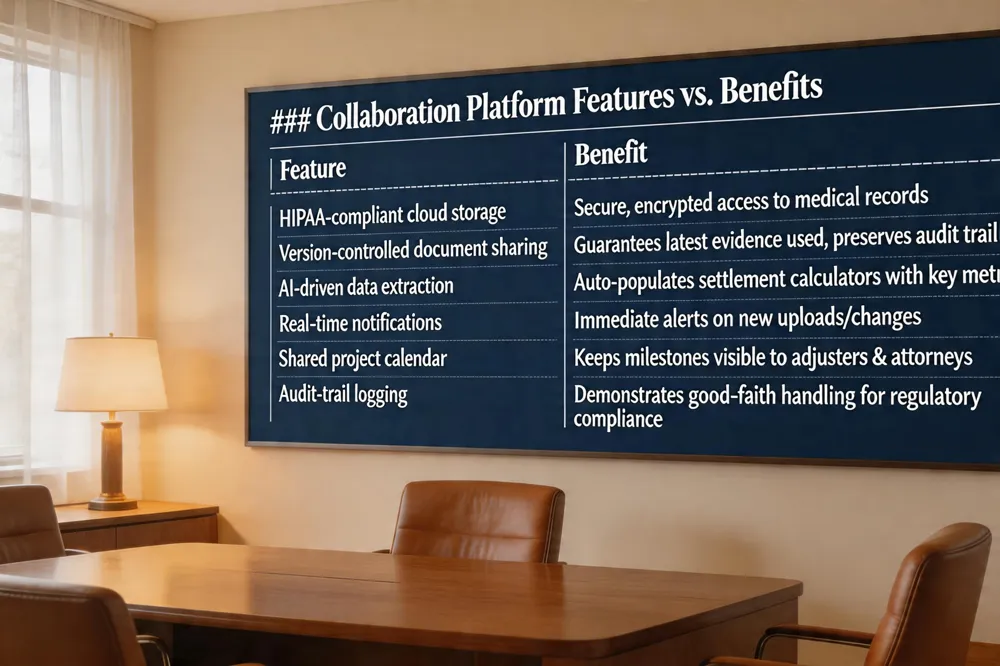
Collaboration Platform Features vs. Benefits
| Feature | Benefit |
|---|---|
| HIPAA‑compliant cloud storage | Secure, encrypted access to medical records |
| Version‑controlled document sharing | Guarantees the latest evidence is used, preserves audit trail |
| AI‑driven data extraction | Auto‑populates settlement calculators with key metrics |
| Real‑time notifications | Immediate alerts on new uploads or changes |
| Shared project calendar | Keeps all milestones visible to adjusters & attorneys |
| Audit‑trail logging | Demonstrates good‑faith handling for regulatory compliance |
 Secure Cloud Portals
Modern claim teams rely on platforms such as CARET Legal and CLAIMSmanager to host all case files in a HIPAA‑compliant cloud environment. These portals give adjusters and attorneys instant access to medical reports, claim forms, and settlement offers, eliminating the delays caused by email attachments or faxed documents.
Secure Cloud Portals
Modern claim teams rely on platforms such as CARET Legal and CLAIMSmanager to host all case files in a HIPAA‑compliant cloud environment. These portals give adjusters and attorneys instant access to medical reports, claim forms, and settlement offers, eliminating the delays caused by email attachments or faxed documents.
Version‑Controlled Document Sharing Version control ensures that every participant works from the latest medical assessment or legal brief. When a new audiogram from NorCal Medical Consulting is uploaded, the system flags the change, preserves the prior version for audit, and notifies both parties, preventing disputes over outdated evidence.
AI‑Powered Data Extraction Artificial‑intelligence tools can automatically parse dense medical records, extracting key metrics such as loss of hearing thresholds, treatment dates, and projected future care costs. This structured data feeds directly into settlement calculators, allowing attorneys to quantify economic and non‑economic damages with greater precision.
Federal Workers' Compensation website The official site is hosted by the U.S. Department of Labor’s Office of Workers’ Compensation Programs (OWCP) at https://www.dol.gov/agencies/owcp. Claims are filed through the ECOMP portal (https://owcp.dol.gov/), which also provides claim‑status tracking and a Medical Bill Processing Portal.
Is $900 an hour a lot for a lawyer? A $900 hourly rate sits at the high end of the market, typical for senior partners in major metros or for specialized litigation such as complex workplace‑injury claims. While junior attorneys bill $100‑$200 per hour, senior counsel with niche expertise can command $400‑$1,000+ per hour, making $900 reasonable for highly experienced representation.
Align Strategic Goals and Settlement Timelines
Joint Review & Settlement Timeline
| Milestone | Deadline (Days from Injury) | Responsible |
|---|---|---|
| Initial injury report | 5 | Attorney |
| First medical evaluation | 15 | Adjuster |
| Expert report (NorCal) | 30 | Medical Consultant |
| Claim filing with state agency | 45 | Attorney |
| Settlement negotiation kickoff | 60 | Joint Team |
| Final settlement agreement | 90 | Joint Team |
| Payment disbursement | 100 | Adjuster |
All dates are tracked in the shared calendar with automated reminders.
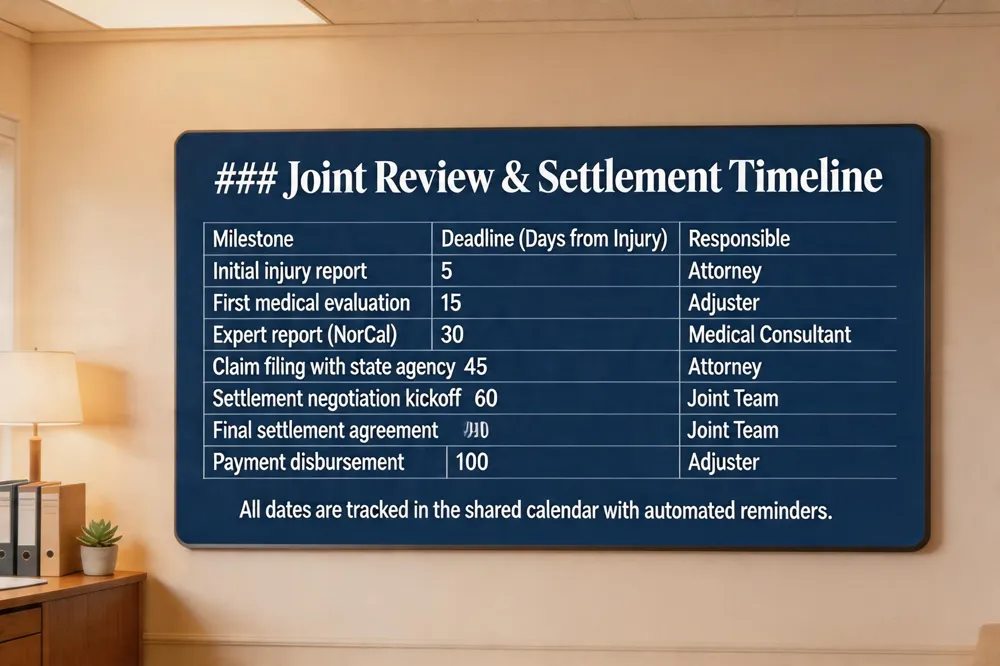 Joint case review meetings are the cornerstone of an effective attorney‑adjuster partnership. By gathering adjusters, counsel, and medical consultants such as NorCal Medical Consulting in a single virtual or in‑person session, the team can verify injury severity, confirm causation (e.g., auditory loss), and pinpoint any missing documentation before deadlines loom. A shared settlement negotiation framework follows these meetings, outlining when to present low‑ball offers, when to invoke expert testimony, and how to balance legal risk with policy limits. Establishing clear metrics—average claim‑processing speed, number of days from injury report to medical evaluation, and settlement‑to‑payment turnaround—provides objective performance targets and highlights bottlenecks.
What is the highest paid insurance adjuster? The highest‑paid insurance adjusters are typically those who specialize in complex, high‑stakes claims such as catastrophe or forensic adjustments. A senior catastrophe adjuster, who handles large‑scale natural‑disaster losses, can earn between $100,000 and $150,000 annually, often with substantial bonuses tied to the volume and severity of claims. Damage‑inside adjusters, who assess and negotiate property losses on‑site, also rank near the top, reporting salaries in the $96,000‑$100,000 range. Forensic adjusters—who investigate disputed or fraudulent claims—often command similar compensation, with total earnings (base salary plus incentives) reaching $120,000 or more.
Workers' compensation California California workers’ compensation provides medical treatment, temporary disability, permanent disability, and death benefits to employees who suffer work‑related injuries or illnesses. Claims must be filed with the employer within one year of the injury, after which the Division of Workers’ Compensation (DWC) oversees the administrative and judicial process. The DWC’s Medical Unit and Qualified Medical Evaluators (QMEs) ensure that injuries—such as auditory loss—are properly evaluated and that treatment follows the Official Medical Fee Schedule. Benefits are calculated based on the injured worker’s average weekly wage, and the system also includes a future‑injury trust fund and an uninsured‑employer fund. NorCal Medical Consulting assists claimants and attorneys by delivering expert medical assessments and documentation to support timely and accurate workers’‑comp claims.
Maintain Confidentiality and Legal Compliance
HIPAA & Privilege Safeguards
| Requirement | Implementation |
|---|---|
| Encrypted transfer | Use TLS‑1.3 portals and encryptedAt for all file uploads |
| Access logging | Timestamped user‑ID logs for every document view/download |
| Privilege labeling | Tag all strategy communications as “Attorney‑Client Privilege” and route through secure email/portal |
| Segregated channels | Separate legal advice from fact‑finding requests |
| Retention policy | Store audit trail for minimum 7 years per Department of Labor guidance |
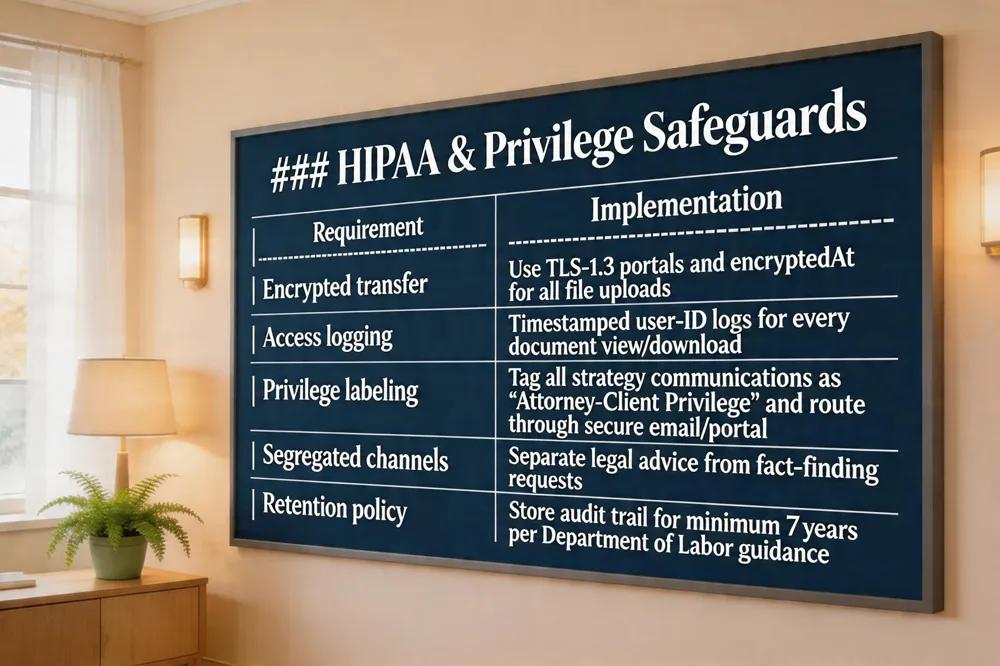 HIPAA‑compliant sharing is the foundation of any joint claim effort. All medical records, audiograms, and treatment notes must be transferred through encrypted portals or secure cloud‑based case‑management systems that log access timestamps and user IDs. This protects the claimant’s privacy while allowing adjusters and attorneys to view the same up‑to‑date information.
Attorney‑client privilege considerations require careful segregation of legal advice from adjuster‑type functions. Communications that focus on case strategy, settlement offers, or legal risk should be labeled as privileged and routed through the attorney’s secure email or client portal. When an attorney performs fact‑finding or medical‑record requests, the privilege may be waived; therefore, keep legal counsel distinct from claim‑investigation duties and document the purpose of each exchange.
Record‑keeping audit trails are essential for regulatory compliance and bad‑faith defenses. Every document uploaded, every email sent, and each meeting note should be time‑stamped and stored in a shared repository that tracks version history. This audit trail demonstrates good‑faith handling, satisfies U.S. Department of Labor requirements, and provides a defensible record if a dispute reaches litigation.
What is workers' compensation and how does it work? Workers’ compensation is a state‑mandated insurance system funded by employer payroll premiums that provides medical care and wage replacement for job‑related injuries or illnesses. Injured employees must promptly notify their supervisor, file the appropriate claim form (e.g., CA‑1 or CA‑2), and receive benefits after a short waiting period. The insurer evaluates coverage, authorizes treatment, and pays a portion of lost wages, protecting both employee and employer from costly lawsuits.
What not to say to a claims adjuster? Never admit fault, apologize, or downplay injuries; avoid speculation about the accident, and do not agree to recorded statements or sign settlements without counsel. Refrain from discussing prior conditions or posting details on social media, as these can be used to diminish the claim.
Continuous Improvement Through Training and Metrics
Sample Performance Dashboard
| KPI | Target | Current | Trend |
|---|---|---|---|
| Avg. claim‑processing time | ≤ 30 days | 38 days | ↘️ (down 5 %) |
| Documentation turnaround (request → receipt) | ≤ 48 hours | 55 hours | ↗️ (up 2 %) |
| Settlement‑to‑payment speed | ≤ 15 days | 12 days | ✅ |
| Training attendance (monthly) | 100 % | 92 % | ↘️ |
| Bad‑faith complaint rate | 0 % | 0 % | ✅ |
Metrics are reviewed quarterly and feed into targeted training sessions.
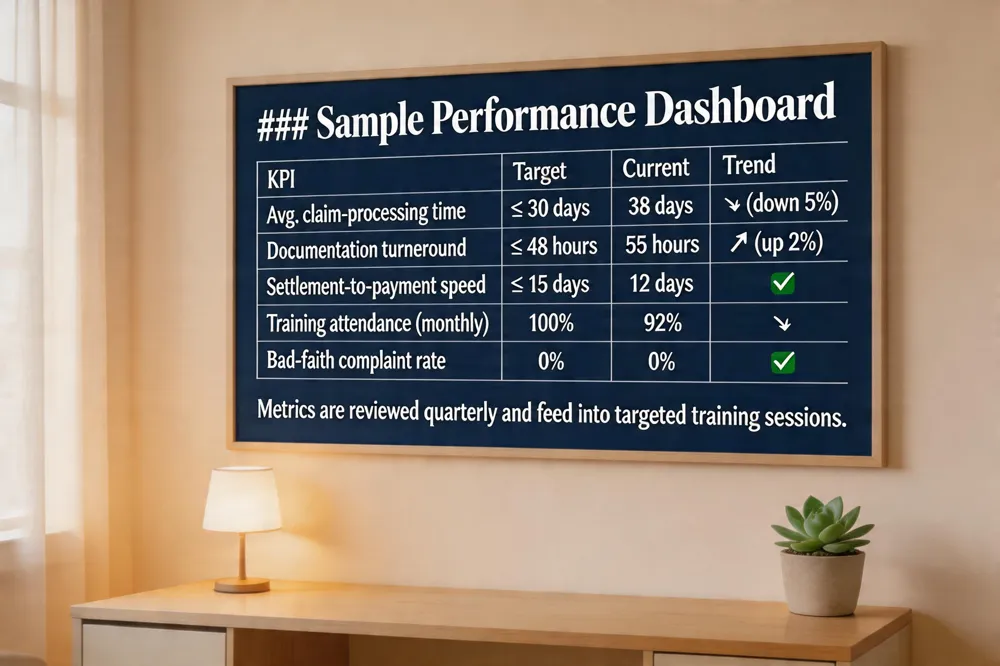 Joint education sessions that blend legal updates with medical advancements keep adjusters and attorneys aligned on evolving workers’ compensation standards. Regular workshops—featuring experts from NorCal Medical Consulting, OSHA, and the U.S. Department of Labor—allow participants to discuss new diagnostic protocols (e.g., audiometric testing for occupational hearing loss) and recent case law on bad‑faith claims. Performance dashboards that track claim‑resolution timelines, documentation turnaround, and settlement‑value trends provide real‑time visibility into bottlenecks, enabling managers to set measurable goals such as a 30 % reduction in processing time. After each claim, a structured feedback loop captures lessons learned, documents any missed deadlines, and records best‑practice adjustments; these debriefs are archived in a secure, shared repository for future reference.
Is bursitis covered under workers' compensation? Yes, bursitis is generally covered when it arises from or is aggravated by job duties, provided the employee can link repetitive motions, pressure, or awkward postures to the inflammation. Approved claims reimburse medical expenses, replace lost wages up to 95 % of pre‑injury earnings, and may include permanent‑impairment benefits if functional loss persists.
Georgia Workers' Compensation case Search: To locate a case, visit the Georgia State Board of Workers’ Compensation website and use the “Case Search” feature. Enter the case number, employer name, or injured worker’s name to retrieve records. For assistance, call (404) 656‑3818 or toll‑free (800) 533‑0682. The portal offers 24/7 access to case status, documents, and fee schedules.
Putting It All Together
The nine collaborative strategies—clear, actionable communication, a shared digital hub, regular status meetings, defined roles, psychological safety, cross‑functional teamwork, mentorship, measurable goals, and inclusive participation—form a robust framework that aligns insurers and attorneys around a common objective: fair, timely claim resolution. Expert medical consultants, such as NorCal Medical Consulting, are the linchpin of this process; their unbiased, peer‑reviewed assessments translate complex injury data into compelling legal narratives, strengthen settlement offers, and pre‑empt insurer tactics that downplay severity. By engaging adjusters, attorneys, and medical experts at the outset—ideally within the first 48‑72 hours after an injury—parties can establish a shared timeline, secure essential documentation, and set realistic expectations before low‑ball offers or delay tactics emerge. Early joint engagement not only protects claimants’ rights but also accelerates resolution, reduces litigation costs, and fosters good‑faith compliance with U.S. workers’ compensation and personal injury law.