Why Understanding the LHWCA Matters
The Longshore and Harbor Workers’ Compensation Act (LHWCA) is a federal, no‑fault statute enacted in 1927 to protect maritime employees who work on navigable waters, docks, shipyards and related facilities. Unlike state workers’ compensation schemes, the LHWCA applies uniformly across the United States and covers workers not classified as seamen, such as longshoremen, ship‑repairers and harbor construction crews. Benefits include reasonable medical care, wage‑loss compensation calculated at two‑thirds of the average weekly wage, permanent‑disability awards, vocational rehabilitation and survivor benefits. For employers, the Act imposes a duty to secure coverage, report injuries promptly and refrain from retaliation, while also allowing recovery from third‑party tortfeasors. Understanding these distinctions helps employees preserve rights, ensures employers comply with federal obligations, and facilitates accurate, timely claim filing and reduce the risk of costly disputes.
Rule 1 – Prompt Reporting and Notice
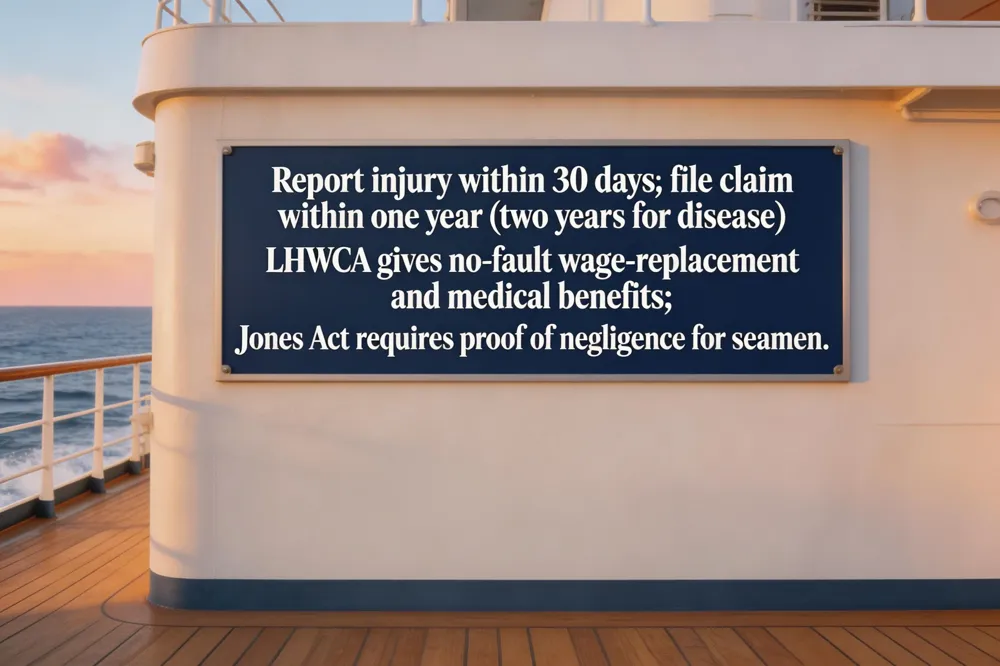 Longshore vs. Jones Act: LHWCA provides no‑fault wage‑replacement and medical benefits to non‑seamen; the Jones Act requires proof of negligence for seamen and allows broader damages.
Statute of limitations: Claims must be filed within one year (or two years for disease) or benefits are barred.
Rule 2 – Medical Treatment, Documentation and Occupational Injuries
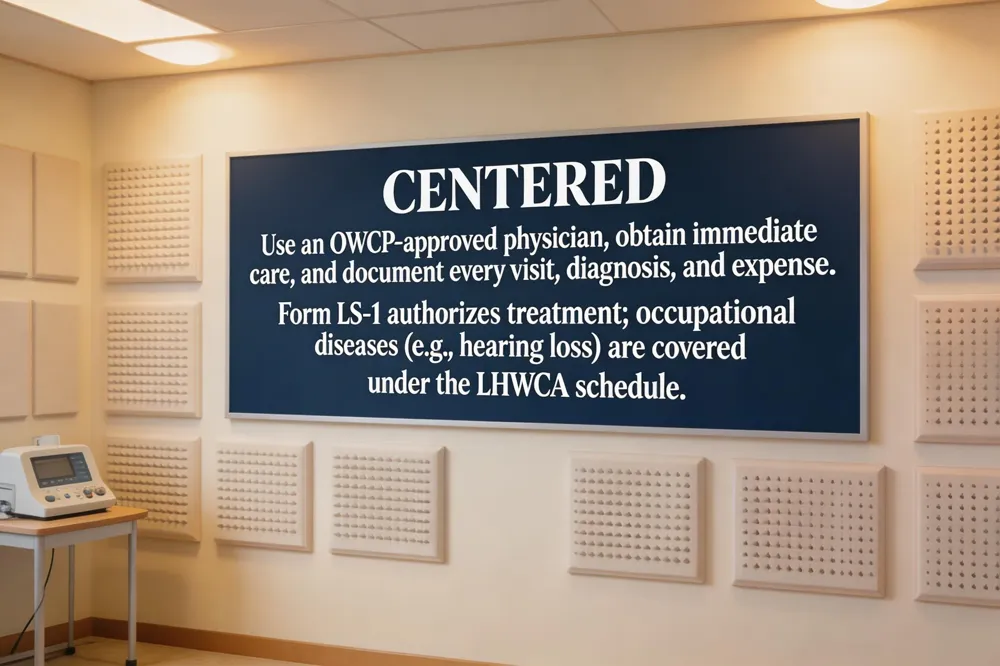 A worker must select a qualified, OWCP‑approved physician and obtain immediate care; treatment authorization is requested on Form LS‑1 to ensure timely coverage. All medical visits, diagnoses, and expenses must be documented in detail, and the same diligence applies to occupational diseases such as hearing loss, which are covered under the LHWCA schedule of benefits. The Act’s full statutory text is available as a PDF at https://www.govinfo.gov/content/pkg/COMPS-1522/pdf/COMPS-1522.pdf for reference.
What injuries are covered by the 1923 Act? The 1923 Employees’ Compensation Act compensates any work‑related injury or illness—accidental bodily harm, occupational disease, temporary or permanent disability, and death benefits for workers not covered by state ESI schemes.
Longshore and Harbor Workers' compensation Act pdf The consolidated LHWCA PDF can be downloaded from the U.S. Government Publishing Office link above or via the Department of Labor’s LHWCA page.
Coverage endorsement The LHWCA endorsement adds federal maritime coverage to a standard workers‑comp policy, extending benefits (including for hearing loss) while excluding DBA, OCSLA, and NAFIA claims.
Death benefits Survivor benefits receive up to two‑thirds of the deceased’s average weekly wage—half for a spouse, one‑sixth per child—plus a $3,000 funeral allowance, claimable with Form LS‑265 within one year of death.
Rule 3 – Filing the Formal Claim and State‑Specific Procedures
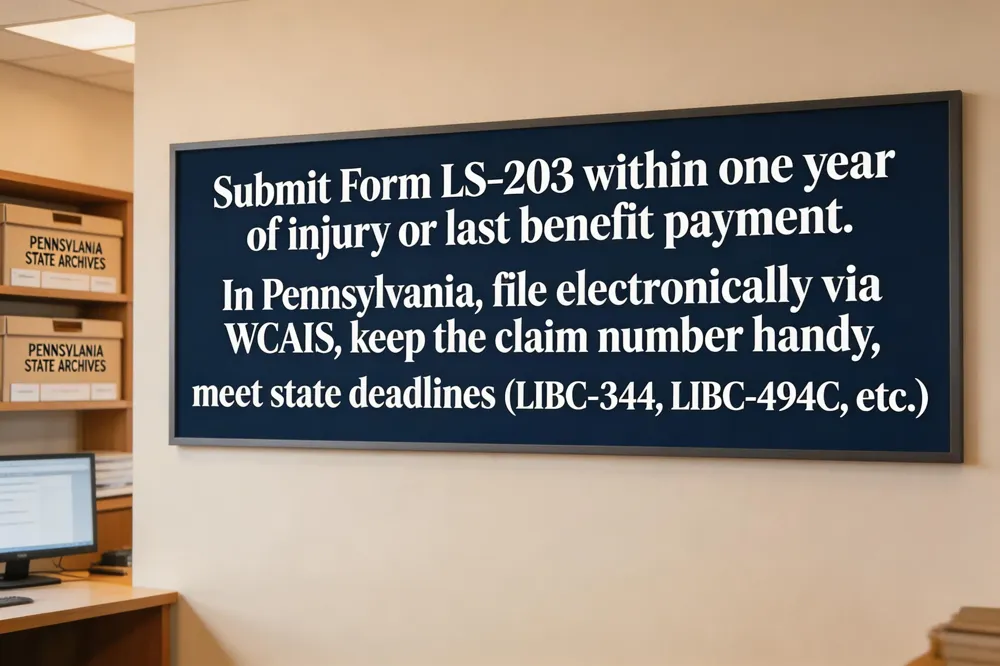 Submitting Form LS‑203 to OWCP
After the 30‑day injury notice, file a formal claim (Form LS‑203) with the Office of Workers’ Compensation Programs within one year of the injury or the last benefit payment.
Electronic filing via WCAIS in Pennsylvania
Pennsylvania uses the Workers’ Compensation Automation and Integration System (WCAIS). Register as an injured worker, enter your unique claim number, and upload LS‑203 and supporting documents 24/7.
Obtaining and using claim numbers
The employer or insurer assigns a claim ID on the first notice. Keep this number handy; it is required for all WCAIS logins, status checks, and correspondence with the OWCP.
Key PA forms and deadlines
File the First Report of Injury (LIBC‑344) within 10 days, a Wage Statement (LIBC‑494C) within 5 days, and any disability agreements (LIBC‑336/337) promptly. Missed deadlines can delay benefits.
Online portal access and troubleshooting
Visit www.wcais.pa.gov, register, then log in with your claim number and MFA token. For help, call the BWC helpline (800) 482‑2383 or email RA‑LI‑BWC‑Helpline@pa.gov.
Check my workers' comp claim online PA
Log into WCAIS using your claim number to view documents, hearing notices, and payment history. If you lack a claim number, contact your employer’s carrier or the BWC.
PA Workers' compensation forms
Start with LIBC‑344 and LIBC‑494C; submit electronically or via duplex paper. Accurate, ink‑black forms are required. (See the PA Workers' compensation Act resources for details.)
Pa workers compensation login
Register on the DLI site, create credentials, and use MFA for secure access. Helpline assistance is available.
Workers' Comp claim number Lookup
Check any employer or insurer paperwork; if absent, request it from HR, the carrier, or the state BWC.
How to file for workers' comp in PA
Report injury promptly, seek medical care, complete WC‑1, submit to the insurer, and retain copies. Follow up via WCAIS.
WCAIS Claim number
This unique ID tracks your case in the system; it appears on all official notices and is needed for online queries.
Rule 4 – Calculating Benefits and Negotiating Settlements
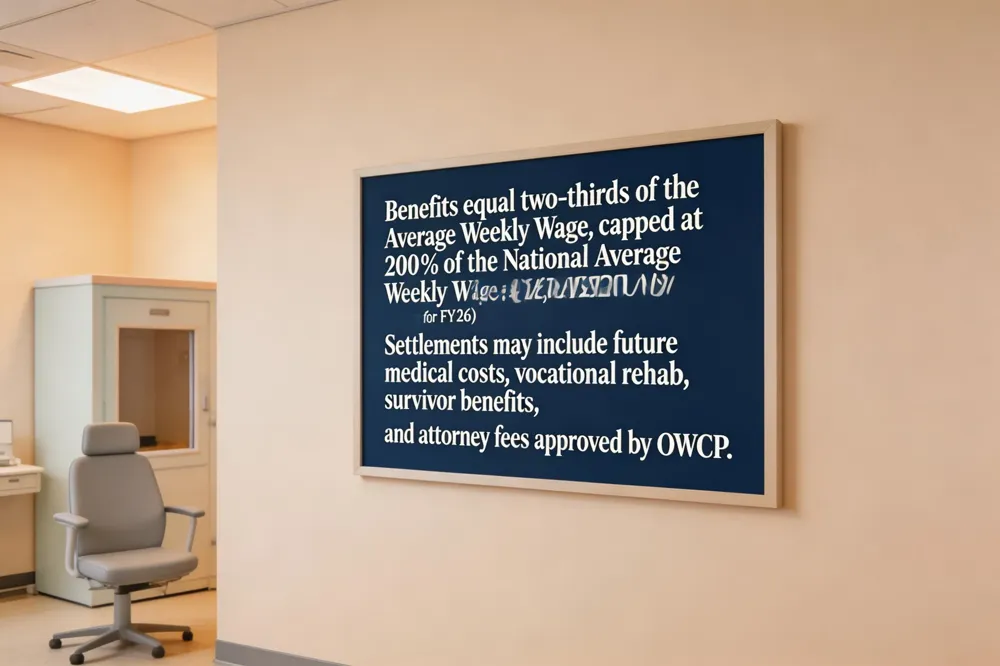 Under the LHWCA, benefits are anchored to the employee’s Average Weekly Wage (AWW); disability payments are generally two‑thirds of the AWW, subject to the annual maximum of 200 % of the National Average Weekly Wage (NAWW). For FY 26 the NAWW is $1,041.35, yielding a maximum weekly rate of $2,082.70. Temporary total disability, temporary partial, permanent total and permanent partial awards follow the same 2/3 formula, while permanent partial awards may be scheduled by body part or calculated on loss of earning capacity. Settlement negotiations often culminate in a lump‑sum that incorporates future medical expenses, vocational rehabilitation, and, when applicable, survivor benefits. Attorney fees must be approved by the OWCP or a court and are taken from the settlement after the employee’s compensation is secured. Vocational rehabilitation services are provided to help permanently disabled workers re‑enter the workforce. The OWCP, administered by the U.S. Department of Labor oversees claim filing, benefit determination, and dispute resolution, while Pennsylvania’s BWC offers a parallel state system with its own electronic filing and helpline support.
Rule 5 – Managing the Claim and Protecting Rights
 Effective claim management begins with immediate reporting of the injury to the employer and the workers’ compensation carrier, followed by prompt medical treatment and thorough documentation of symptoms, dates, and circumstances (including hearing‑loss assessments when applicable). Maintain open lines of communication with the employer, carrier, and treating physicians; share updates, request needed information, and verify that all medical expenses and disability payments are processed correctly. Preserve detailed records of earnings, wage statements, and any other income, as the OWCP may adjust benefits based on reported earnings. Coordinate vocational‑rehabilitation services and,‑to‑work programs to facilitate a safe return to duty while protecting the employee’s earnings. The LHWCA prohibits retaliation—employers who retaliate may face civil penalties and must restore the employee’s position and back‑pay. Attorney fees are payable only after OWCP or a court approves a reasonable amount, and legal counsel can ensure compliance with filing deadlines, evidence preservation, and appeals, safeguarding both the worker’s and the employer’s interests.
Putting It All Together – A Successful LHWCA Claim
Recap of the nine essential rules: 1) Notify your employer in writing within 30 days using Form LS‑201. 2) Seek medical care and keep all records. 3) File Form LS‑203 with OWCP within one year of injury or last payment. 4) Accurately report earnings while receiving benefits. 5) Preserve evidence—photos, logs, witness statements—to support causation. 6) Choose an authorized physician but retain the right to change if needed. 7) Keep a file of all correspondence and medical documents. 8) If denied, request an informal conference and, if necessary, a formal hearing with Form LS‑18. 9) Avoid retaliation and report employer misconduct.
Expert assistance—consultants, vocational specialists, and maritime attorneys—provides evaluations, strengthens causation arguments, and ensures procedural compliance.
Next steps: finalize documentation, submit the claim, engage experts, and monitor deadlines to secure LHWCA benefits.