Why a Mistake‑Free DBA Claim Matters
The Defense Base Act (DBA) extends workers’ compensation benefits to civilian contractors and employees performing duties overseas for U.S. government projects. Benefits—medical care, wage replacement (typically two‑thirds of the average weekly wage) and death compensation—are calculated from accurate earnings data and depend on strict filing deadlines. Procedural missteps such as missing the 30‑day injury notice, filing the LS‑203 claim after the one‑year limitation, or submitting incomplete wage documentation can trigger claim denial, reduced benefits, or costly appeals. Moreover, over‑disclosing unrelated medical history or providing an unsanctioned recorded statement may give insurers leverage to limit compensation. Engaging expert medical consultants, such as board‑certified audiologists or occupational physicians, ensures that injury assessments directly link the condition to work‑related exposure, producing objective reports that withstand insurer scrutiny. Expert testimony not only validates the severity of the injury but also supports accurate wage‑loss calculations, dramatically increasing the likelihood of a full, fair DBA award.
Critical Timing and Procedural Mistakes
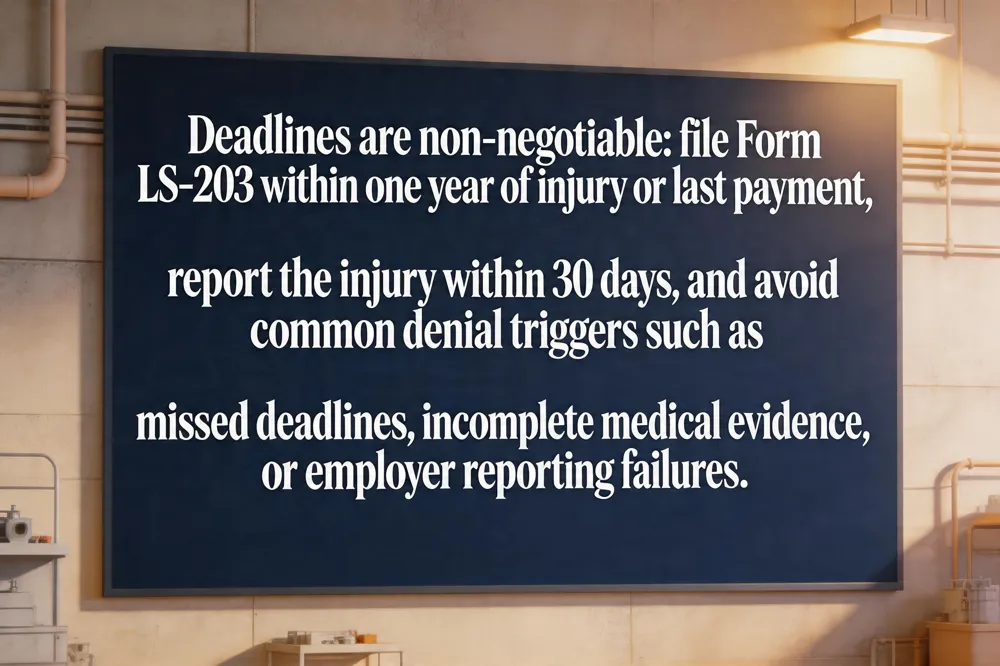 A Defense Base Act (DBA) claim hinges on strict statutory filing deadlines. The claimant must submit Form LS‑203 within one year of the injury or of the last compensation payment, whichever is later; extensions are rare and require extraordinary circumstances.
Four‑step claim process
- Notification – Report the injury to the employer within 30 days and obtain a Form LS‑201.
- Investigation – Gather medical records, witness statements, pay stubs, and any accident reports.
- Evaluation – Obtain a qualified medical assessment (e.g., audiometric testing for hearing loss) to link the injury to work duties and calculate the average weekly wage (AWW).
- Settlement/Decision – Submit the completed claim to the OWCP and negotiate a settlement; if denied, prepare for an appeal.
Common denial reasons include missed filing deadlines, insufficient medical documentation tying the injury to job duties, lack of employer‑filed injury reports, inaccurate wage data, or failure to cooperate with required medical exams. Insurers may also reject claims for services rendered without prior authorization.
How long a DBA claim can take? Simple cases may be resolved in a few weeks, while complex claims or appeals can extend to a year or more. Prompt, complete filing and early legal counsel dramatically reduce delays.
Key Q&A
- How to file a DBA claim? Report the injury within 30 days, seek immediate medical care, complete Form CA‑1 (trauma) or CA‑2 (occupational disease), attach all evidence, and submit to the OWCP within one year.
- What are the four steps to filing a claim? Notification, investigation, evaluation, and settlement/decision (as outlined above).
- How long does a DBA claim take? From a few weeks to several years, depending on complexity and appeals.
- Can a DBA be denied? Yes—common reasons are missed deadlines, inadequate medical proof, or lack of employer reporting.
- What is a typical denial example? Receiving treatment without the insurer’s prior authorization, leading to a rejected bill.
- What are common mistakes in injury claims? Delayed medical care, poor documentation, giving recorded statements without counsel, and accepting settlements without attorney review.
- How can insurance claim errors be avoided? Keep meticulous records, verify all information before submission, and work with an experienced DBA attorney or medical‑consulting firm.
Accurate Wage Calculation and Income Reporting
 The Defense Base Act (DBA) bases wage‑replacement benefits on the claimant’s Average Weekly Wage (AWW), as defined in Section 10 of the Longshore and Harbor Workers’ Compensation Act. The statute provides three methods for calculating AWW: (a) using the employee’s actual earnings for the year preceding the injury, (b) using the earnings of a similarly situated worker when the employee’s record is insufficient, and (c) a "fair and reasonable" estimate when neither of the first two methods applies. All sources of income that affect the employee’s regular earnings—base salary, overtime, per‑diem, housing and medical allowances, bonuses, stipends, and reimbursed expenses—must be reported accurately on Form LS‑203. The Department of Labor and insurers verify these figures with payroll records, contracts, and tax documents; any omission or mis‑statement can lower the AWW and consequently reduce the two‑thirds benefit rate.
Under 33 U.S.C. § 908, permanent total disability is paid at two‑thirds of the claimant’s AWW for the duration of the disability, while temporary total disability receives the same rate for the period it lasts. For permanent partial injuries, the statute assigns fixed weeks of compensation (e.g., 52 weeks for loss of hearing in one ear, 200 weeks for loss of hearing in both ears) and requires an audiogram as presumptive evidence of hearing loss.
Impact of misreporting: Failure to include all wage components or to disclose unrelated medical records can lead insurers to calculate a lower AWW, resulting in reduced weekly payments and a smaller lump‑sum present‑value settlement. Accurate AWW calculations also affect the Defense Base Act settlement calculator, which projects weekly benefits, cost‑of‑living adjustments, and future medical expenses. Because each case is unique, claimants should engage a DBA‑experienced attorney and, when appropriate, a qualified medical‑consulting firm to ensure that all earnings are documented and that the AWW reflects the true earning capacity. Proper reporting protects the claimant’s right to the full statutory compensation and prevents costly under‑settlements.
Medical Evidence, Expert Assessments, and Auditory Injuries
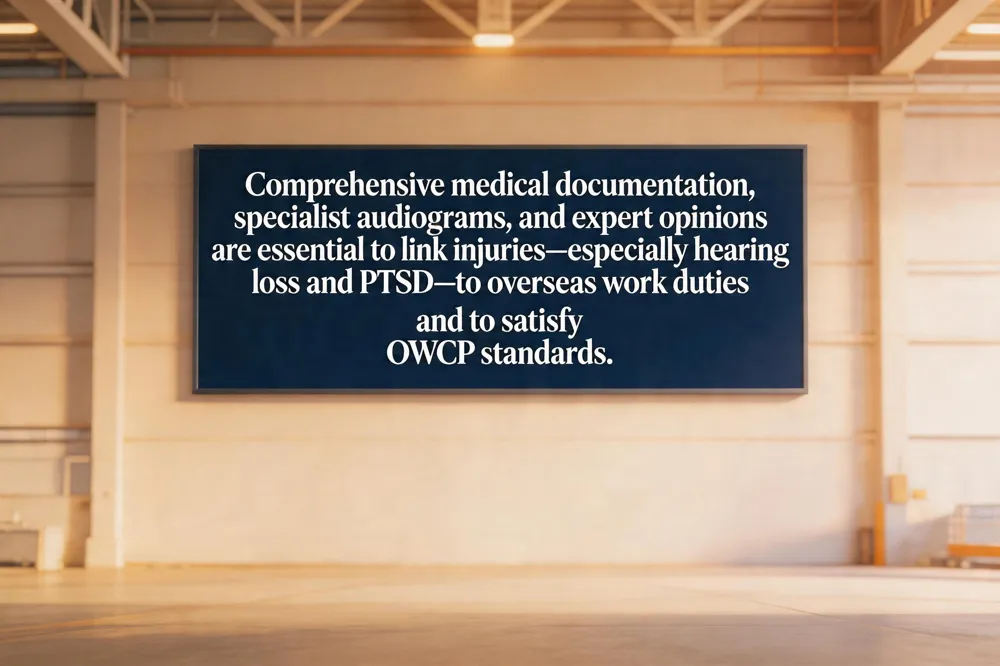 When filing a Defense Base Act (DBA) claim, injury‑specific medical records are the foundation of any successful request. Physicians must document the exact date, mechanism, and body part affected, and link the condition directly to the overseas work duty. For auditory injuries, an audiometric test performed by a qualified audiologist is essential; the report should include pure‑tone thresholds, speech‑in‑noise scores, and an opinion that the loss is occupational rather than age‑related. PTSD settlements under the DBA require a comprehensive mental‑health record: a DSM‑5 diagnosis, treatment history, functional‑capacity assessments, and a clear causal connection to the hostile work environment. Expert medical consultants, such as those at NorCal Medical Consulting, prepare these detailed evaluations, draft authoritative medical opinions, and testify at hearings to substantiate the severity of hearing loss, PTSD, or other occupational illnesses.
Defense Base Act PTSD settlements – Compensation covers medical care, ongoing therapy, medication, a lump‑sum disability award, lost wages, and future earning loss. An experienced DBA attorney can prove the work‑related cause and maximize the settlement.
DBA insurance claim – The claim must be reported to the employer, filed with the OWCP within one year, and supported by complete medical documentation, including any auditory‑loss assessments. Expert consultants ensure the claim meets all regulatory standards.
33 U.S.C. § 901 – This provision titles the Longshore and Harbor Workers’ Compensation Act, the statutory basis for DBA coverage.
Longshore Act – The LHWCA provides medical, wage‑replacement, and vocational benefits for maritime and harbor workers, including compensation for occupational hearing loss.
Legal Representation, Communication, and Red Flags
 Hiring an experienced DBA attorney is critical because the claim process involves filing deadlines, detailed wage calculations, and complex negotiations with insurers. An attorney can protect your rights, ensure proper medical documentation, and prevent costly procedural errors.
Red‑flag indicators that insurers watch for include a lack of witnesses, late reporting of the injury, inconsistent statements, a history of multiple litigated claims, or filing the claim immediately after a workplace change such as a layoff. These signals may prompt the insurer to scrutinize the claim for fraud.
When speaking with a workers’ compensation adjuster, do not give a recorded statement without counsel, speculate about the accident, discuss unrelated health issues, or admit fault. Answer only the specific question asked; if you are unsure, simply state that you do not know.
Common defenses used by insurers and employers are comparative negligence, assumption of risk, the statute of limitations, contributory negligence, sudden emergency, failure to mitigate damages, and acts of God.
The Jones Act and the U.S. Longshore and Harbor Workers’ Compensation Act (USL&H) differ markedly: the Jones Act permits seamen to sue for negligence and recover full damages, including pain and suffering, while USL&H provides a no‑fault, workers‑compensation‑style benefit limited to medical expenses and a portion of lost wages. Determining which regime applies requires a nuanced analysis of the worker’s duties and injury circumstances, underscoring the value of specialized legal counsel.
Administrative Requirements, Forms, and Department of Labor Oversight
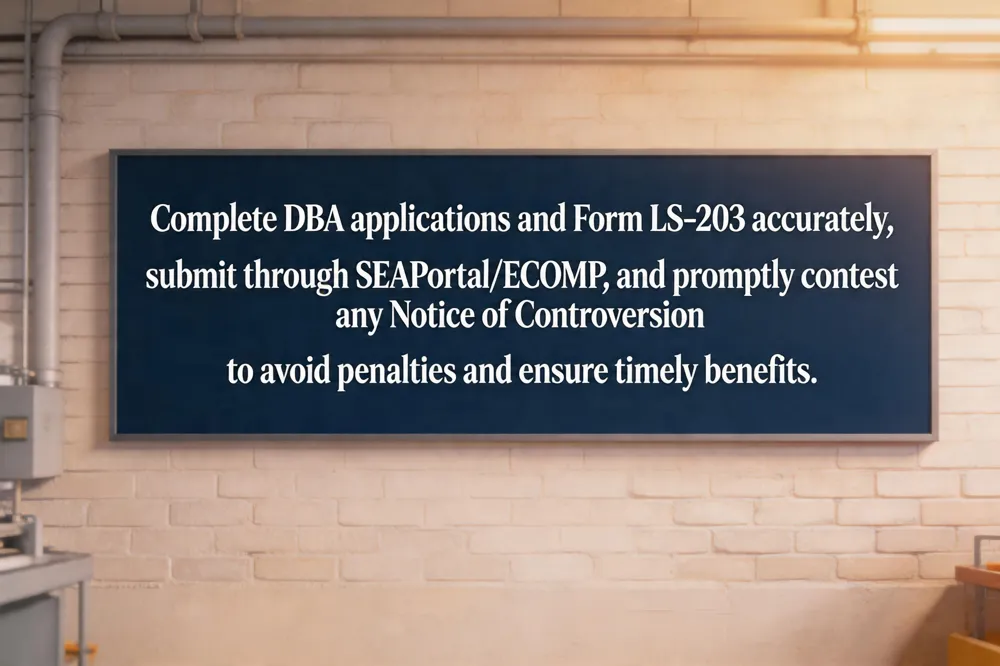 The Defense Base Act (DBA) application is the contractor’s formal request for mandatory workers‑compensation coverage for employees performing overseas U.S. government or military work. The application, filed with an authorized DBA insurer such as Chubb or Arch Insurance, must detail the company’s structure, contract terms, employee classifications, payroll, loss history, and any waivers for local or third‑country nationals. Accurate completion protects workers—including those with auditory injuries—by guaranteeing medical benefits and wage replacement if a claim arises. NorCal Medical Consulting can review the application for completeness and advise on required medical documentation.
The U.S. Department of Labor’s Longshore Program administers the Longshore and Harbor Workers’ Compensation Act and its extensions, including the DBA. Its mission is to ensure prompt, proper benefits, provide technical assistance, and oversee self‑insured employers and carriers. Claims are filed and managed electronically through the SEAPortal and ECOMP systems, allowing claimants, attorneys, and medical providers to access case files online.
A Notice of Controversion of Right to Compensation is a formal objection filed by an employer or insurer disputing an employee’s entitlement to benefits. Under 33 U.S.C. 914 and 20 C.F.R. §702.251, the notice must be delivered within 14 days of learning of the injury, citing legal reasons and providing a copy to the claimant. Failure to file or pay the disputed installments can trigger a 10 % penalty per unpaid amount. Claimants should promptly review the notice, gather supporting medical evidence—especially for auditory loss claims—and either negotiate or appeal the district director. Consulting a workers‑compensation specialist ensures the notice is contested correctly and that rights to timely benefits are protected.
Common mistakes in injury claims include: delaying medical care, which can be used to argue the injury was not serious; failing to document the accident promptly (photos, witness statements, medical records); providing recorded statements to insurers without counsel; returning to work before medical clearance; and accepting settlements without experienced legal counsel, which often results in undervaluing the claim and forfeiting future benefits.
Settlement Strategies, Recent Outcomes, and Odds of Success
 Recent DBA Settlement Trends – 2025 settlements have ranged from $150,000 to over $1 million. High‑profile cases include a herniated‑disc back injury at $850,000 and a linguist PTSD claim at $575,000. Severe permanent disabilities often exceed $1 million when future medical care and wage replacement are factored. Insurers typically start with offers under $30,000, underscoring the need for seasoned DBA counsel.
Calculating Settlement Value – Benefits are based on two‑thirds of the claimant’s average weekly wage (AWW) plus projected medical expenses, vocational rehabilitation, and any permanent disability rating. Accurate reporting of all earnings—salary, overtime, per‑diem, bonuses, and allowances—maximizes the AWW. Expert medical assessments (e.g., audiometric testing for hearing loss) substantiate disability severity and future treatment costs, directly boosting the settlement figure.
Winning Odds for Workers’ Compensation Cases – In California, claim‑approval rates now hover around 94 percent; neighboring states such as Oregon range from 86‑89 percent. When a qualified medical expert links the injury to workplace exposure, odds rise above 80 percent for eligible claimants. Professional representation further improves outcomes by countering insurer tactics.
Strategic Use of Expert Testimony – Expert witnesses provide objective, evidence‑based evaluations that clarify causal relationships, quantify loss of earning capacity, and project long‑term medical needs. Their testimony is often pivotal in negotiations and at Administrative Law Judge hearings, turning a modest offer into a fair, comprehensive settlement.
Final Checklist for a Successful DBA Claim
- Review deadlines and forms – Notify your employer in writing within 30 days (Form LS‑201) and file the formal claim (Form LS‑203) with the OWCP within one year of injury (or two years for occupational disease). Use the correct forms and submit them to the Central Case‑Create office or SEAPortal to avoid processing delays.
- Secure expert medical assessments – Obtain prompt, injury‑related medical care from a qualified physician of your choice. For specialized injuries such as auditory loss, request audiometric testing and vocational evaluations to create a robust medical record that directly links the condition to work duties.
- Engage a DBA‑experienced attorney early – An attorney familiar with DBA law can navigate filing requirements, negotiate with insurers, and protect your rights during recorded‑statement requests and settlement discussions.
- Maintain thorough documentation – Preserve all wage records (including overtime, per‑diems, stipends), incident reports, witness statements, photographs, and every medical invoice. Accurate, complete documentation is essential for calculating average weekly wage benefits and for defending the claim against denial.