Why Workplace Safety Matters
Workplace injuries impose a staggering economic burden—non‑fatal incidents cost U.S. employers an average of $42,000 each, while slip, trip, and fall accidents alone account for billions in lost productivity and medical expenses. Legal and regulatory drivers reinforce the need for rigorous safety programs: OSHA’s General Duty Clause and NIOSH standards require employers to control hazards, provide hearing protection when noise exceeds 85 dB, and maintain accurate injury records, while the National Safety Council highlights that timely expert medical assessments can accelerate legal and insurance claim resolution by up to 40 %. Health consulting firms play a pivotal role in this ecosystem. They conduct ergonomic assessments that can cut musculoskeletal disorders by up to 50 %, implement engineering controls that reduce occupational hearing loss by 50 %, and offer expert testimony that validates injury causation for courts and insurers. By integrating medical expertise, data‑driven risk analysis, and regulatory compliance, health consultants help organizations lower injury rates, control costs, and swiftly navigate claim processes.
Implement a Comprehensive Safety Management System
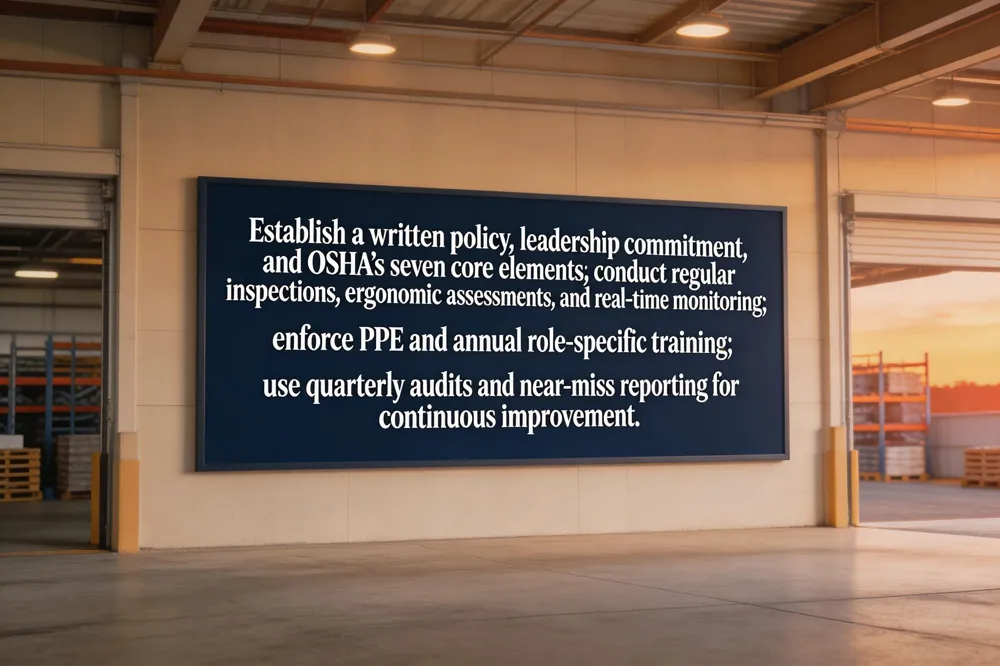 A robust safety program starts with clear foundations: a written policy, leadership commitment, and the seven core OSHA elements (management, worker participation, hazard identification, prevention, training, evaluation, continuous improvement). Risk identification and assessment use regular inspections, ergonomic evaluations, and real‑time monitoring (e.g., noise sensors) to locate hazards before they cause harm. Training, education, and PPE enforcement must be role‑specific, conducted at least annually, and reinforced through drills and competency checks; proper hearing protection for noise ≥ 85 dB and ergonomic tools lower injury rates by up to 50‑60%. Policy enforcement is backed by quarterly audits, near‑miss reporting, and a disciplined corrective‑action loop that sustains compliance and improves safety‑culture scores. Performance metrics—incident rates, near‑miss counts, PPE compliance (>90%), and audit scores—provide leading indicators for continuous improvement.
Best way to prevent injuries? Embed a comprehensive safety and wellness program, match jobs to worker capabilities, enforce PPE, maintain staffing levels, and conduct routine hazard inspections.
5 occupational health and safety guidelines? 1. Hazard identification & risk assessment 2. Training & education 3. PPE & engineering controls 4. Emergency response & reporting 5. Continuous‑improvement monitoring.
5 safety tips? Know hazards, reduce stress, move regularly, use ergonomic workstations, practice safe lifting, wear proper PPE, and speak up about risks.
Cultivate a Strong Safety Culture
 Ideas for improving safety culture in the workplace
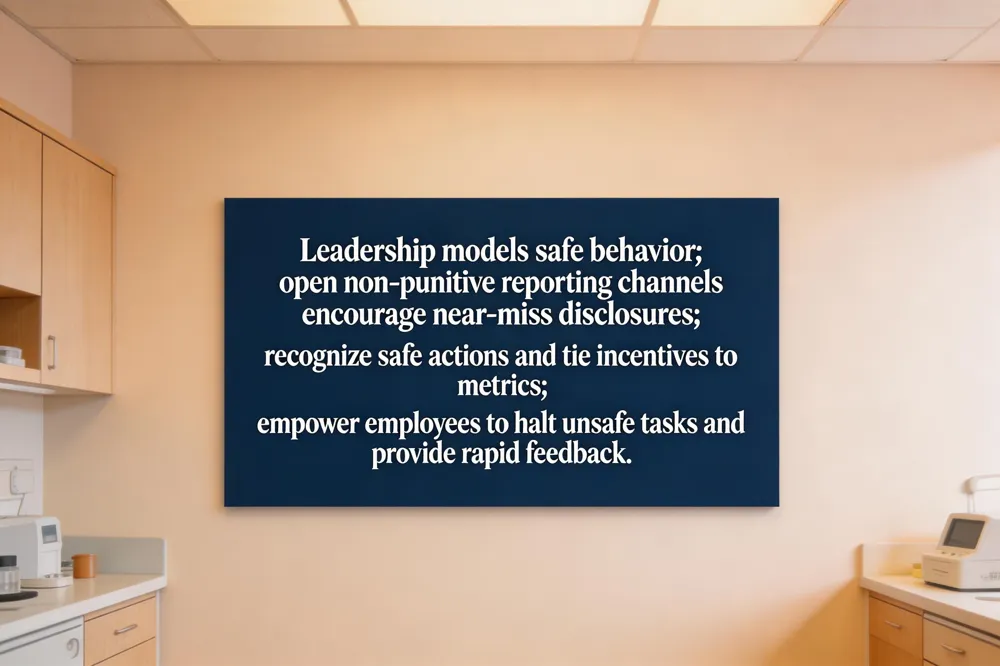
Leadership must model safe behavior—wear required PPE, stop work when hazards appear, and attend safety briefings. Open, non‑punitive reporting channels (including anonymous options) encourage near‑miss disclosures, which OSHA and the American Society of Safety Professionals link to a 25% reduction in actual injuries. Recognize safe actions publicly and tie incentives to measurable safety metrics to sustain engagement.
How to improve safety awareness in the workplace
Regular, job‑specific training—covering noise‑induced hearing loss (NIOSH reports 22 million workers affected) and ergonomic best practices—lowers injury rates by 30‑40% (OSHA, CDC). Use real‑time noise monitors to alert workers when levels exceed 85 dB, and conduct quarterly audits to keep hazards visible. Empower employees to halt unsafe tasks and provide quick feedback on reported concerns.
Safety tip of the day
Protect your hearing: wear approved earplugs or earmuffs whenever noise reaches 85 dB, take quiet‑breaks, and schedule annual audiometric testing. Promptly report noisy equipment to prevent permanent loss and simplify future workers’ compensation claims.
Daily workplace safety tips
Start each shift with a visual inspection for tripping hazards, secure tools, and verify PPE availability. Apply proper lifting techniques and use mechanical aids to reduce musculoskeletal disorders (up to 50% reduction with ergonomic assessments). Stay hydrated, take scheduled micro‑breaks, and report unsafe conditions immediately to maintain a proactive safety culture.
Target Specific Hazard Controls
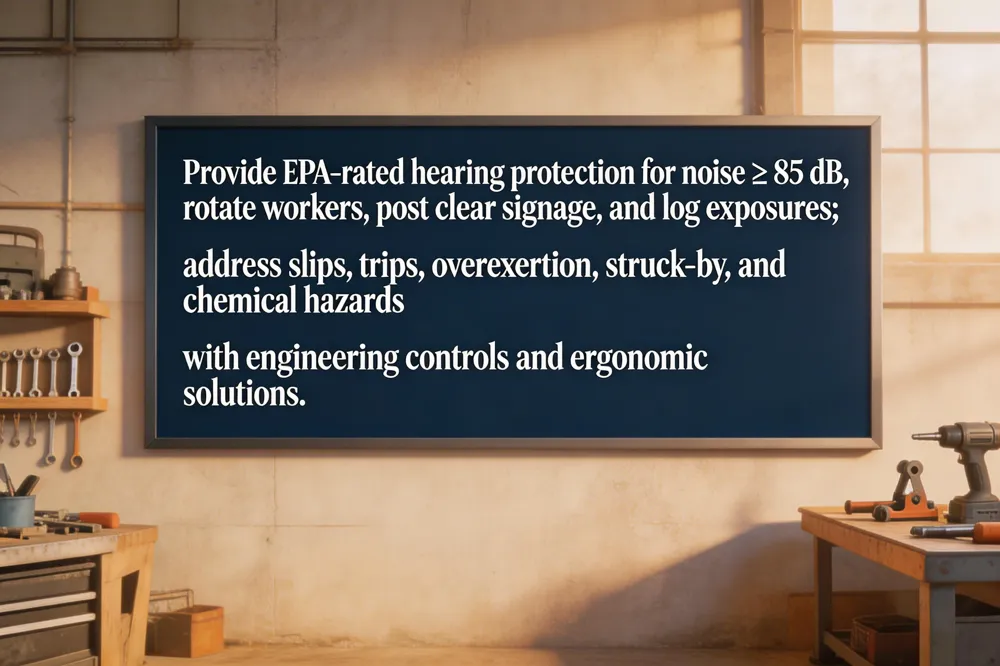 Examples of safety suggestions – Provide EPA‑rated hearing‑protection (earmuffs or earplugs) and enforce use where noise exceeds 85 dB(A); conduct monthly sound‑level surveys and post clear signage; rotate workers to limit time in high‑noise zones; train staff on proper fit and maintenance of protectors; keep exposure logs and audiometric records to support future claims.
Examples of workplace injuries – Slips, trips and falls that cause bruises, fractures or head trauma; overexertion and repetitive motions leading to back strains, shoulder sprains or carpal tunnel syndrome; struck‑by or caught‑in equipment injuries such as lacerations, crush injuries or broken bones; auditory loss, respiratory irritation or chemical burns from hazardous substances; electrocution, burns and vehicle collisions.
New ideas for safety improvement – Implement continuous noise‑monitoring devices with real‑time alerts; launch a confidential near‑miss reporting platform and involve staff in hazard‑control brainstorming; schedule short stretch breaks and ergonomic workstation adjustments; reward compliance and model safe behavior at leadership levels; partner with occupational‑health clinicians for expert injury assessments and streamlined return‑to‑work plans.
Most common OSHA‑recorded injuries – Falls (including same‑level and ladder falls), struck‑by or caught‑in incidents involving machinery, and musculoskeletal strains from manual handling dominate the recordable case count; lockout/tagout and hazard‑communication violations also contribute significantly to injury rates.
Why occupational health and safety matter – Protecting workers is a moral and legal duty; safe environments reduce absenteeism, boost productivity and lower insurance costs; compliance avoids fines and reputational damage; a strong safety culture attracts talent and investors; ultimately, safeguarding health sustains business continuity and community goodwill.
Engage Employees Through Training and Participation
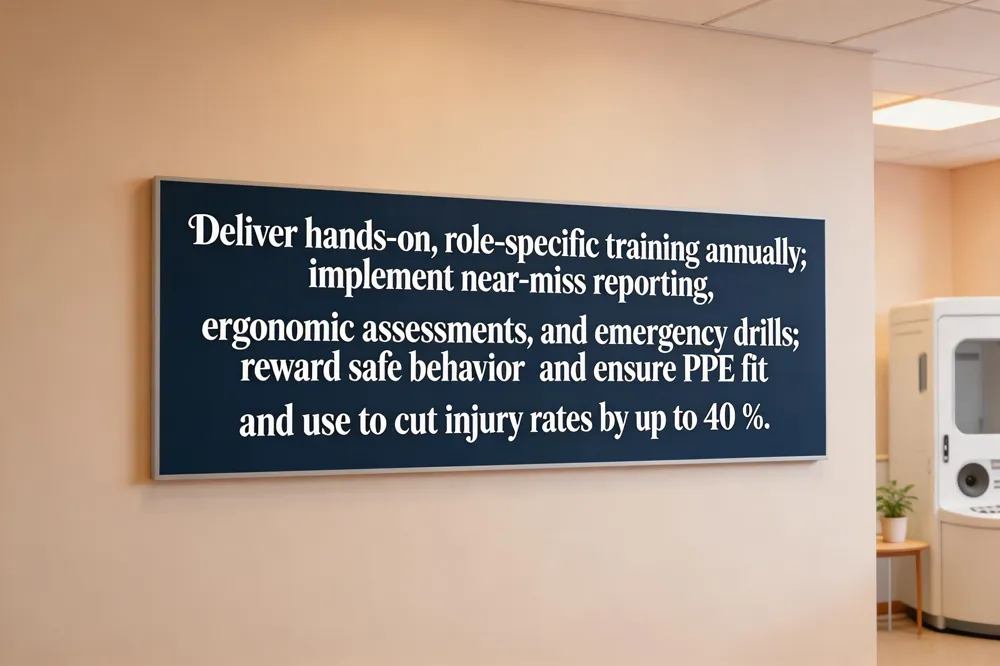 Employee involvement is the cornerstone of an effective injury‑prevention strategy. Hands‑on safety training—delivered annually or more often—improves hazard recognition and proper use of PPE, cutting injury rates by 30‑40 % (OSHA, NIOSH). Near‑miss reporting systems encourage early hazard identification, which research shows reduces actual injuries by 25 %. Ergonomic assessments that adjust workstation layout, tool design, and lifting techniques can lower musculoskeletal disorders by up to 50 % (Journal of Occupational Rehabilitation). Regular emergency‑preparedness drills sharpen response times and reduce severity of incidents.
Three ways to prevent injuries: (1) Provide and enforce correctly fitted PPE (helmets, ear‑plugs, safety shoes). (2) Incorporate warm‑up, stretch, and strength‑training routines before demanding tasks. (3) Ensure hydration, scheduled rest breaks, and attentiveness to early pain signals.
Ten ways to prevent workplace injuries: develop a comprehensive safety‑wellness program, conduct pre‑placement exams, supply and train on PPE, maintain staffing levels, enforce housekeeping, schedule stretch breaks, run safety drills, implement near‑miss reporting, apply engineering controls (noise barriers, real‑time monitors), and reward safe behavior.
Ten rules for workplace safety: shared responsibility, proper PPE wear, tidy work areas, emergency protocol knowledge, correct lifting, sobriety, regular breaks, mechanical aids, vigilance, and reporting hazards promptly.
Office‑worker tips: ergonomic workstation setup, frequent micro‑breaks, clear walkways, headset use for calls, and regular emergency‑procedure drills.
Ensuring safety at NorCal Medical Consulting: we embed a proactive safety culture, deliver role‑specific training on hearing‑conservation, conduct on‑site ergonomic reviews, use clear signage for noise zones, partner with occupational‑health clinicians, incentivize safe practices, maintain PPE, and continuously monitor metrics to stay OSHA‑compliant and protect our workforce.
Leverage Data, Technology and Continuous Improvement
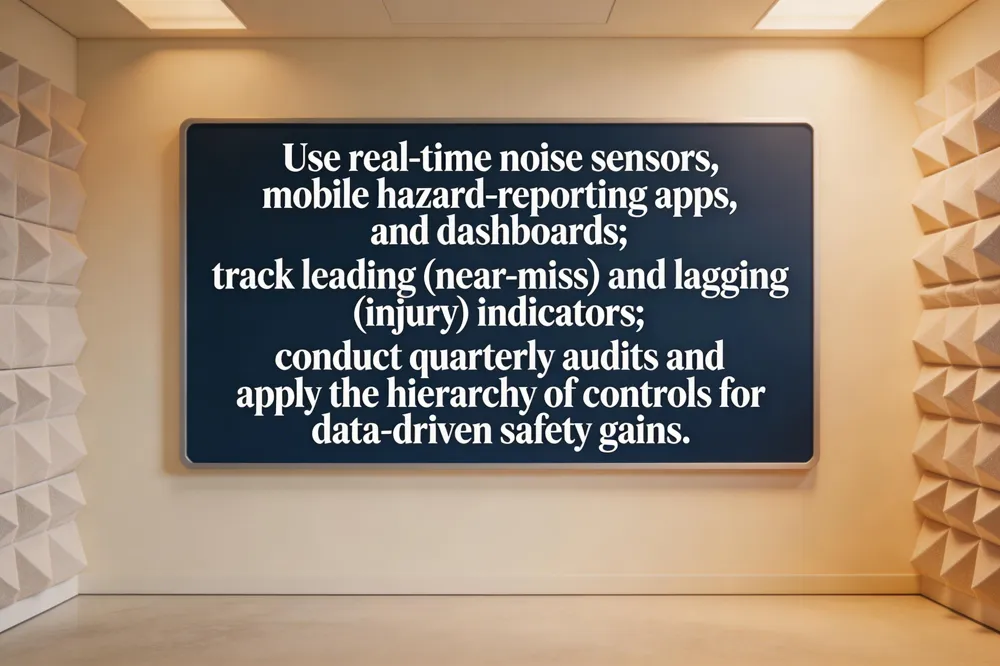 Real‑time monitoring, such as continuous noise‑level sensors that alert workers when sound exceeds 85 dB, enables early identification of auditory hazards and supports OSHA‑mandated hearing‑conservation programs. Quarterly safety audits and inspections systematically uncover slip, trip, fall, and ergonomic risks, driving a 15%‑40% improvement in safety‑culture scores and a 25% reduction in injury rates when combined with near‑miss reporting. Metrics and performance tracking—using leading indicators like near‑miss reports and lagging indicators such as recordable injury rates—provide the data backbone for continuous improvement and compliance with OSHA’s seven core elements. Technology tools, including mobile hazard‑reporting apps, real‑time dashboards, and wearable ergonomics monitors, streamline hazard communication and reinforce the hierarchy of controls.
Most common workplace injuries (OSHA data): OSHA reports that falls, struck‑by or caught‑in‑between incidents, and musculoskeletal strains from manual handling dominate injury statistics, accounting for the bulk of the 2.6 recordable cases per 100 workers annually.
New ideas for safety improvement: Deploy regular audiometric testing and noise monitoring, cultivate a safety‑first culture with leadership modeling and reward systems, equip ergonomic workstations with clear signage and stretch breaks, establish confidential reporting and staff‑driven hazard‑control brainstorming, and partner with occupational health clinicians for expert assessments and return‑to‑work planning.
10 principles of occupational health and safety: Prevention, Worker Rights, Accountability, Commitment, Collaboration, Evidence‑driven Risk Mitigation, Knowledge Provision, Learning and Improvement, Rehabilitation, and Ethical Values form the universal framework guiding effective safety programs.
Putting It All Together for a Safer Workplace
A comprehensive safety and health program integrates seven core elements—leadership, worker participation, hazard identification, hazard prevention, education and training, program evaluation, and continuous improvement—to create a systematic defense against injuries. By coupling engineering controls (e.g., noise‑reducing barriers and real‑time noise monitors) with administrative measures such as quarterly audits, near‑miss reporting, and ergonomic assessments, employers can cut injury rates by 30‑60% and lower workers’ compensation costs. NorCal Medical Consulting brings expert medical assessments to the process: its audiologists verify hearing‑loss claims, occupational physicians conduct functional‑capacity evaluations, and its consultants aid legal and insurance teams in documenting causation, accelerating claim resolution by up to 40%. Employers are urged to adopt a documented safety policy, schedule annual training, enforce PPE compliance above 90%, and partner with NorCal Medical Consulting to ensure clinical rigor and swift claim handling. The result is a healthier workforce, reduced liability, and a stronger bottom line.