Why Asking the Right Questions Matters
Comprehensive documentation is the backbone of any workers’ compensation or personal‑injury claim because it establishes the factual foundation that courts and insurers rely on. Gathering evidence early—accident reports, witness statements, photographs, medical records, and wage data—preserves details that might otherwise fade, dramatically improving the likelihood of a benefit award. Expert assessments, such as those provided by NorCal Medical Consulting, translate clinical findings into acceptable opinions, linking the injury to workplace exposures and quantifying impairment. This combined approach of documentation, evidence collection, and medical expertise helps claim success and protects the injured worker’s rights.
Foundations of a Workplace Injury Assessment
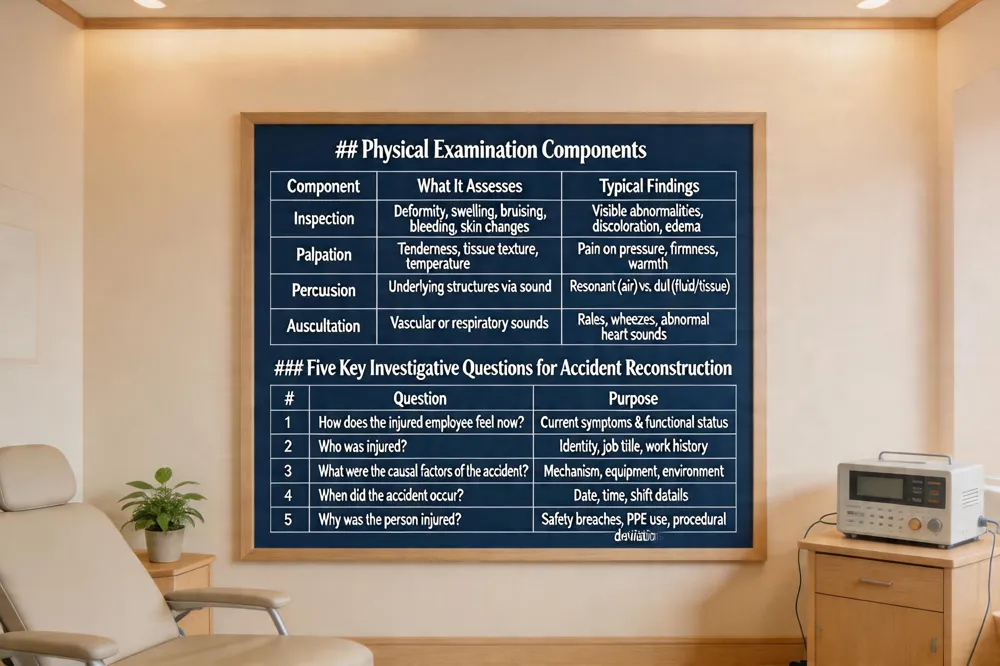
Physical Examination Components
| Component | What It Assesses | Typical Findings |
|---|---|---|
| Inspection | Deformity, swelling, bruising, bleeding, skin changes | Visible abnormalities, discoloration, edema |
| Palpation | Tenderness, tissue texture, temperature | Pain on pressure, firmness, warmth |
| Percussion | Underlying structures via sound | Resonant (air) vs. dull (fluid/tissue) |
| Auscultation | Vascular or respiratory sounds | Bruuses, wheezes, abnormal heart sounds |
Five Key Investigative Questions for Accident Reconstruction
| # | Question | Purpose |
|---|---|---|
| 1 | How does the injured employee feel now? | Current symptoms & functional status |
| 2 | Who was injured? | Identity, job title, work history |
| 3 | What were the causal factors of the accident? | Mechanism, equipment, environment |
| 4 | When did the accident occur? | Date, time, shift details |
| 5 | Why was the person injured? | Safety breaches, PPE use, procedural deviations |
 Four Physical Examination Components
A complete physical exam includes inspection, palpation, percussion, and auscultation. Inspection looks for deformity, swelling, bruising, bleeding or and skin changes. Palpation assesses tenderness, tissue texture, and temperature. Percussion helps evaluate underlying structures by detecting resonant or dull sounds, and auscultation listens for abnormal sounds that may indicate vascular or respiratory involvement.
Four Physical Examination Components
A complete physical exam includes inspection, palpation, percussion, and auscultation. Inspection looks for deformity, swelling, bruising, bleeding or and skin changes. Palpation assesses tenderness, tissue texture, and temperature. Percussion helps evaluate underlying structures by detecting resonant or dull sounds, and auscultation listens for abnormal sounds that may indicate vascular or respiratory involvement.
Five Key Investigative Questions for Accident Reconstruction
- How does the injured employee feel now? – current symptoms and functional status.
- Who was injured? – identity, job title, and work history.
- What were the causal factors of the accident? – mechanism, equipment, and environmental conditions.
- When did the accident occur? – date, time, and shift details.
- Why was the person injured? – breakdown of safety breaches, PPE use, and procedural deviations.
Determining Work‑Relatedness Work‑relatedness hinges on whether the activity that caused the harm was performed as part of the employee’s job duties and occurred in the work environment. If the injury arose from a task directly tied to employment, it qualifies for workers’ compensation; otherwise, it may be treated as a non‑work injury.
Common Workplace Injuries to Recognize The most frequent injuries include sprains/strains, fractures, contusions, cuts/lacerations, burns, concussions, dislocations, tendinitis, bursitis, plantar fasciitis, tennis elbow, and golfer’s elbow. Recognizing these patterns aids timely diagnosis, documentation, and claim preparation.
Bursitis and Workers’ Compensation Coverage
Bursitis Claim Eligibility & Benefits
| Criteria | Details |
|---|---|
| Work‑Related Cause | Repetitive motion, sustained pressure, awkward posturing performed during job duties |
| State Requirement (Ohio) | Injury must occur while employee is on the job in Ohio |
| Medical Documentation | Physician diagnosis, imaging, PT notes, description of work tasks |
| Supporting Records | Pay stubs, employer incident report |
Benefit Types
| Benefit | Description |
|---|---|
| Medical Treatment | Doctor visits, PT, injections, surgery |
| Partial Wage Replacement | % of pre‑injury earnings |
| Permanent Impairment | Lump‑sum award for lasting disability |
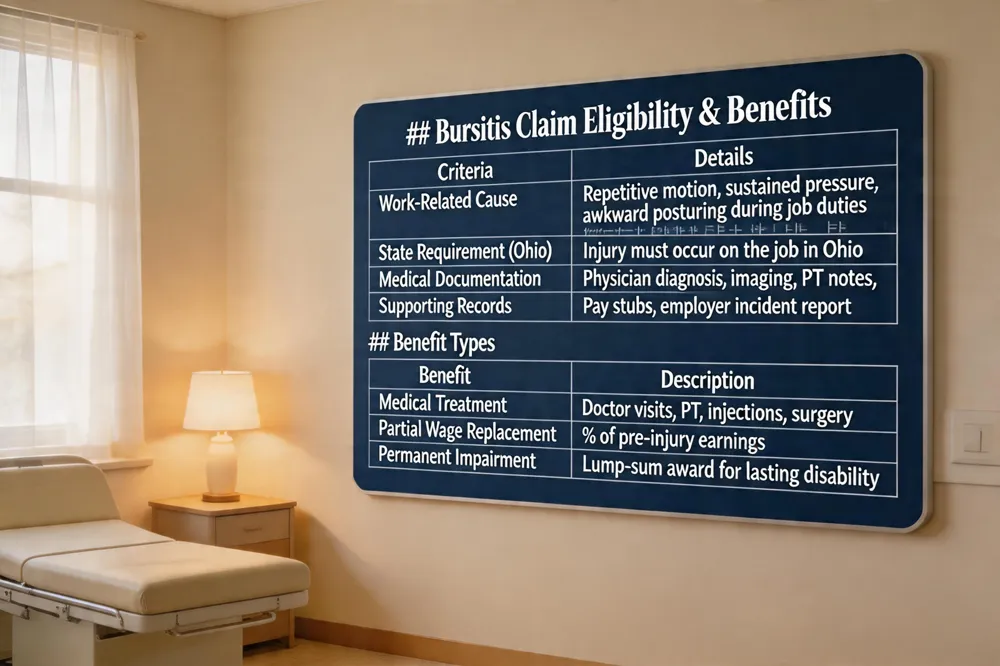 Eligibility for a bursitis claim hinges on showing that the inflammation of the bursa was caused or aggravated by work‑related activities. In Ohio, a claimant must demonstrate that repetitive motions, sustained pressure, or awkward posturing—common in many occupations—directly produced the condition, and that the injury occurred while the employee was engaged in job duties in the state. Medical documentation is critical: a thorough physician diagnosis, imaging reports, physical therapy notes, and a clear description of the work tasks that precipitated the bursitis must be gathered. Supporting records such as pay stubs and the employer’s incident report help calculate wage‑replacement benefits. Once the claim is approved, workers’ compensation can provide several benefit types: payment for medical treatment (doctor visits, physical therapy, injections, surgery), partial wage replacement based on a percentage of pre‑injury earnings, and, in cases of permanent impairment, a lump‑sum award. Early documentation of the work‑related nature of the injury and a comprehensive medical evaluation are essential to securing these benefits.
Navigating an Independent Medical Examination (IME)
Typical IME Question Categories
| Category | Focus Areas |
|---|---|
| Injury Mechanism | Date, time, task, equipment, environment |
| Symptom Description | Location, quality, radiation, onset, progression, associated signs |
| Functional Impact | Aggravating/relieving activities, work limitations, daily‑life restrictions |
| Treatment History | Prior care, meds, therapy, surgeries, compliance |
| Pre‑Existing Conditions | Prior injuries/illnesses that may affect current claim |
Tip: Keep a pain journal with numeric ratings (0‑10) and note tasks that trigger or relieve symptoms.
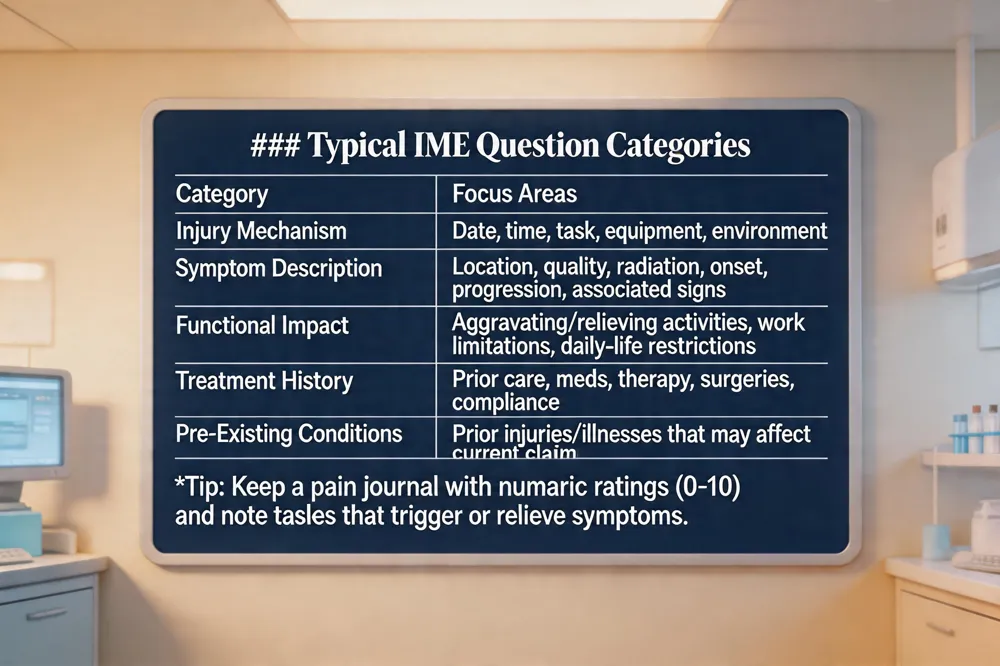 An Independent Medical Examination (IME) is a key step in many workers’ compensation and personal‑injury claims. The examiner will first confirm basic demographics and medical history, then focus on the injury in question. Typical question categories include: (1) injury mechanism – date, time, task, equipment, and environment; (2) symptom description – location, quality, radiation, onset, progression, and any associated signs such as tinnitus or numbness; (3) functional impact – activities that aggravate or relieve symptoms, limitations on work duties, and daily‑life restrictions; (4) treatment history – prior care, medications, therapy, surgeries, and compliance with recommended regimens; (5) pre‑existing conditions – prior injuries or illnesses that could influence the current complaint. To prepare for symptom‑rating scales, keep a pain journal, note numeric ratings (0‑10) for pain or hearing loss, and identify specific tasks that trigger or ease discomfort. IME findings can heavily influence claim resolution: a clear, documented link between work exposure and injury supports benefit awards, while contradictory answers or insufficient evidence may lead to claim denial or prolonged appeals. Accurate, honest responses and thorough documentation are essential for a fair outcome.
Understanding Settlement Net Proceeds
Settlement Deductions Overview
| Deduction Type | Typical Share of Settlement |
|---|---|
| Attorney Contingency Fee | 30 % – 35 % (often ~33 %) |
| Medical Provider Liens | Varies – based on unpaid bills for services, |
Example: $100,000 Settlement
| Step | Amount After Deduction |
|---|---|
| Gross Settlement | $100,000 |
| Attorney Fee (33 %) | $33,000 |
| Estimated Medical Liens | $5,000 – $15,000 |
| Net to Claimant | $52,000 – $75,000 (≈ 52 % – 75 % of gross) |
 When a workers’ compensation or personal injury claim is resolved with a monetary settlement, the headline figure rarely reflects the amount the injured worker will actually receive. The net proceeds are shaped by three primary categories of deductions:
Attorney contingency fees and typical percentages – Most workers’ compensation attorneys work on a contingency basis, receiving a fixed share of the settlement only if the case is successful. In Ohio and many other states the standard fee ranges from 30 % to 35 % of the total award. This fee is calculated before any other liens are paid and is taken directly from the settlement check.
Medical provider liens and other deductions – Health‑care providers who treated the injury often file liens to recoup the cost of services rendered. These liens may include hospital bills, physician fees, therapy expenses, prescription costs, and any outstanding balances with the employer‑selected workers’ compensation health‑care provider. In addition, there may be payroll‑tax withholdings, workers’ compensation insurance premiums, or third‑party claims (e.g., liability insurance) that must be satisfied.
Factors that influence the final amount received – The ultimate percentage of the settlement that reaches the claimant depends on the severity of the injury, the projected need for future medical care, the presence of pre‑existing conditions, and whether additional parties (such as a negligent third party) are involved. A clean case with minimal liens will leave the plaintiff closer to the higher end of the net range, whereas extensive medical treatment or multiple liens will reduce the final payout.
How much of a $100K settlement will I get? – In a typical $100,000 settlement, the first deductions are usually the attorney’s contingency fee—often one‑third of the total—plus any outstanding medical‑provider liens and unpaid medical bills. After those expenses are paid, most plaintiffs end up with roughly 60 % to 75 % of the original amount, which translates to $60,000–$75,000. The exact figure can vary depending on the severity of your injury, the amount of future medical care needed, and whether any third‑party claims (such as insurance or workers‑compensation liens) exist. If you have minimal liens and a relatively straightforward case, you may be closer to the higher end of that range. Always have a qualified consultant review the settlement details to confirm the final net amount you’ll receive.
Preparing for Your First Personal Injury Consultation
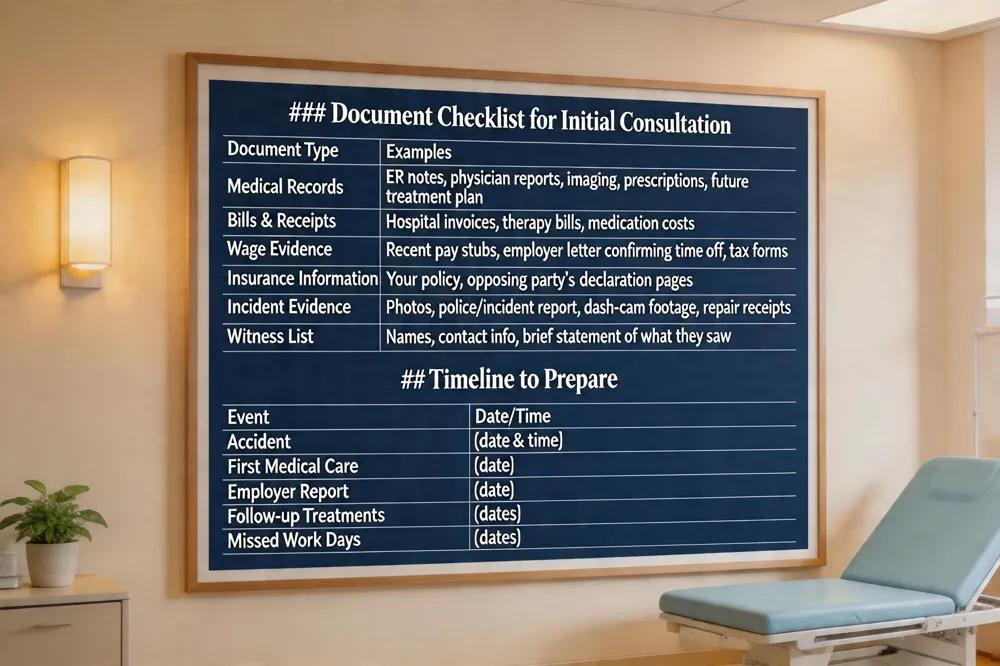
![### Document Checklist for Initial Consultation
| Document Type | Examples |
|---|---|
| Medical Records | ER notes, physician reports, imaging, prescriptions, future treatment plan |
| Bills & Receipts | Hospital invoices, therapy bills, medication costs |
| Wage Evidence | Recent pay stubs, employer letter confirming time off, tax forms |
| Insurance Information | Your policy, opposing party’s declaration pages |
| Incident Evidence | Photos, police/incident report, dash‑cam footage, repair receipts |
| Witness List | Names, contact info, brief statement of what they saw |
Timeline to Prepare
| Event | Date/Time |
|---|---|
| Accident | [date & time] |
| First Medical Care | [date] |
| Employer Report | [date] |
| Follow‑up Treatments | [dates] |
| Missed Work Days | [dates] |
| ](https://rank-ai-generated-images.s3-us-east-2.amazonaws.com/f597f704-72bd-4486-89f0-0818e0f7468d-banner-888a7cb2-c549-44d8-a2ab-fb8e907f77e7.webp) | |
| A successful initial meeting with a personal injury attorney begins with a well‑organized document checklist. Bring complete medical records—including emergency department notes, physician reports, imaging results, prescriptions, and any future treatment plans—and all related bills. Compile wage evidence such as recent pay stubs, employer letters confirming time off, and tax forms to substantiate lost earnings. Include copies of your own insurance policy, the opposing party’s policy declaration pages, and any correspondence with insurers. Photographs, police or incident reports, dash‑cam footage, and repair receipts serve as critical visual evidence, and a list of witnesses with contact information should be ready. |
Create a concise timeline that lists the date and time of the accident, when medical care was sought, when you reported the injury to your employer, and any subsequent treatments or missed work days. This chronology helps the attorney quickly grasp the sequence of events and identify any statutory deadlines.
Key questions to ask the attorney include: What is your experience handling cases similar to mine? How do you structure fees and what costs will I be responsible for up front? What is the projected timeline for my case, and how will you keep me informed of progress? These queries ensure clarity on strategy, expectations, and communication before you commit to representation.
Putting It All Together for a Strong Claim
A solid workers’ compensation claim hinges on answering ten key questions: injury date and time, task performed, mechanism, body part affected, symptoms, witness details, employer reporting, medical treatment, pre‑existing conditions, and wage documentation. Capture every detail immediately—accident reports, photos, pay stubs, and medical records—to preserve evidence before memories fade. Engage an expert medical consultant early; their objective assessment and audiometric data can substantiate causation and impairment. Finally, file the claim within the statutory deadline, submit the compiled documentation to a qualified attorney, and follow up on medical evaluations, return‑to‑work plans, and any necessary appeals.